




The Politics of Planned Development PDF is the official NCERT chapter on how India chose to grow its economy, from Politics in India Since Independence. This page lets students download the original Chapter 3 text and figures for the 2026-27 CBSE syllabus. Reading the source chapter is the best way to understand the two models of development, the Five Year Plans and the debates behind them.
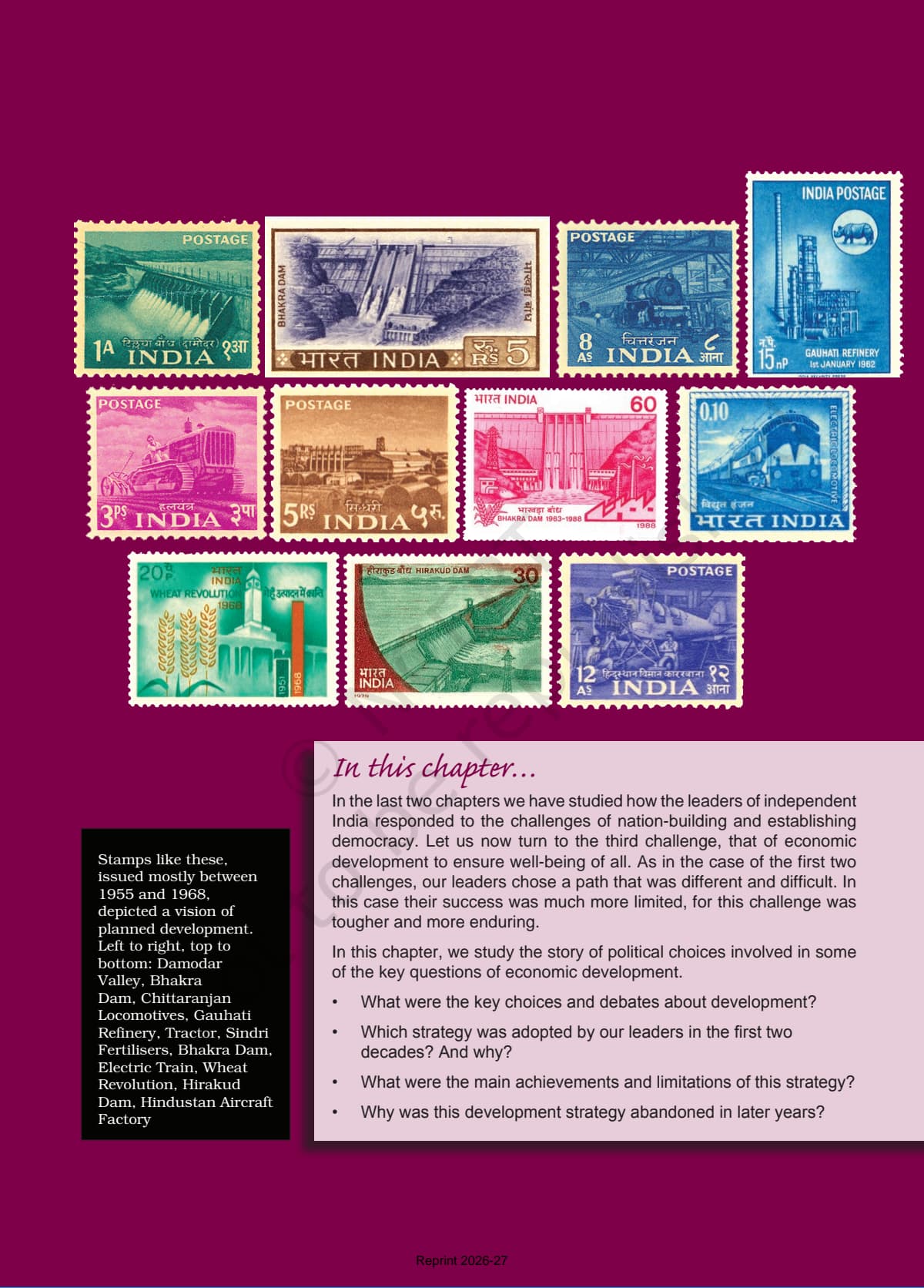
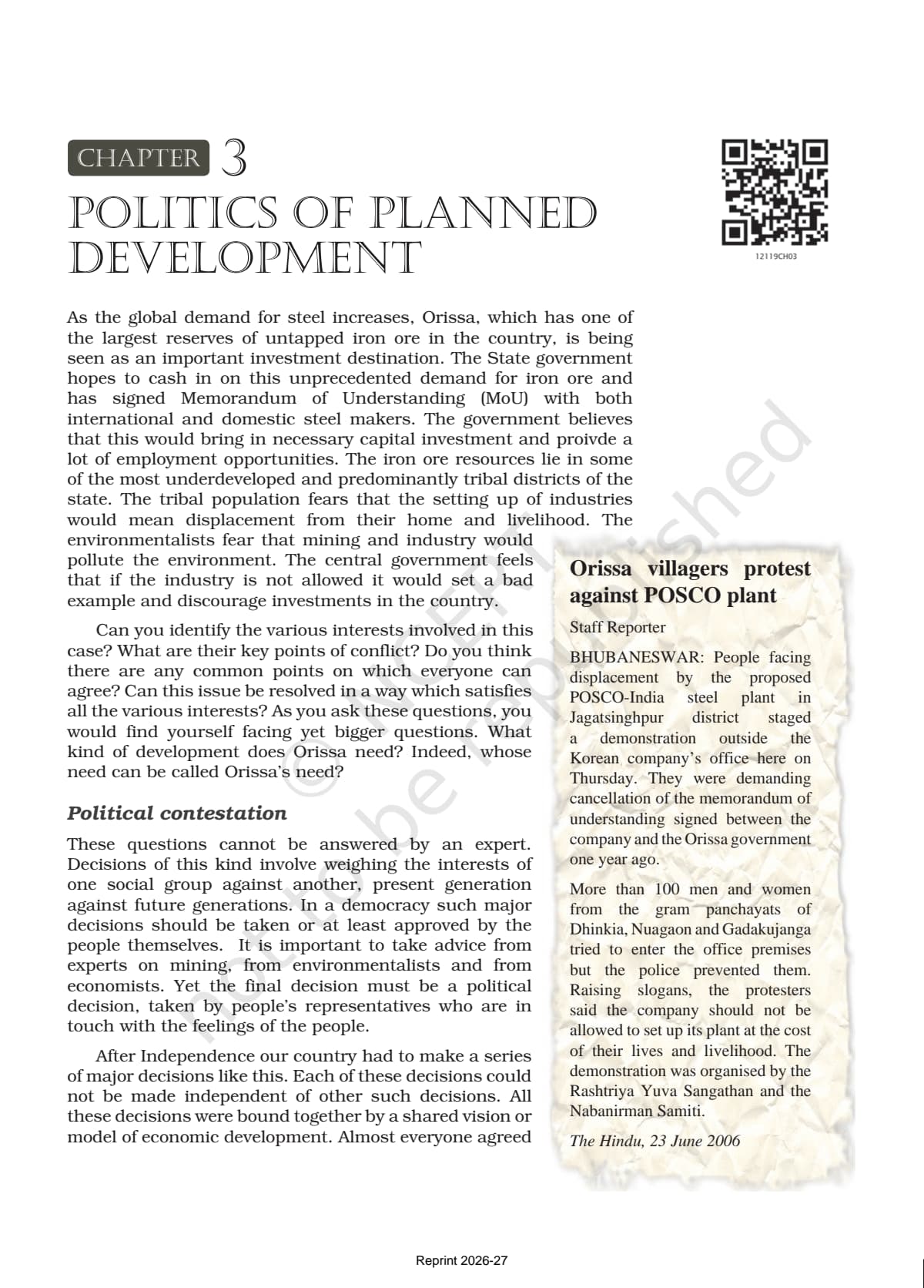
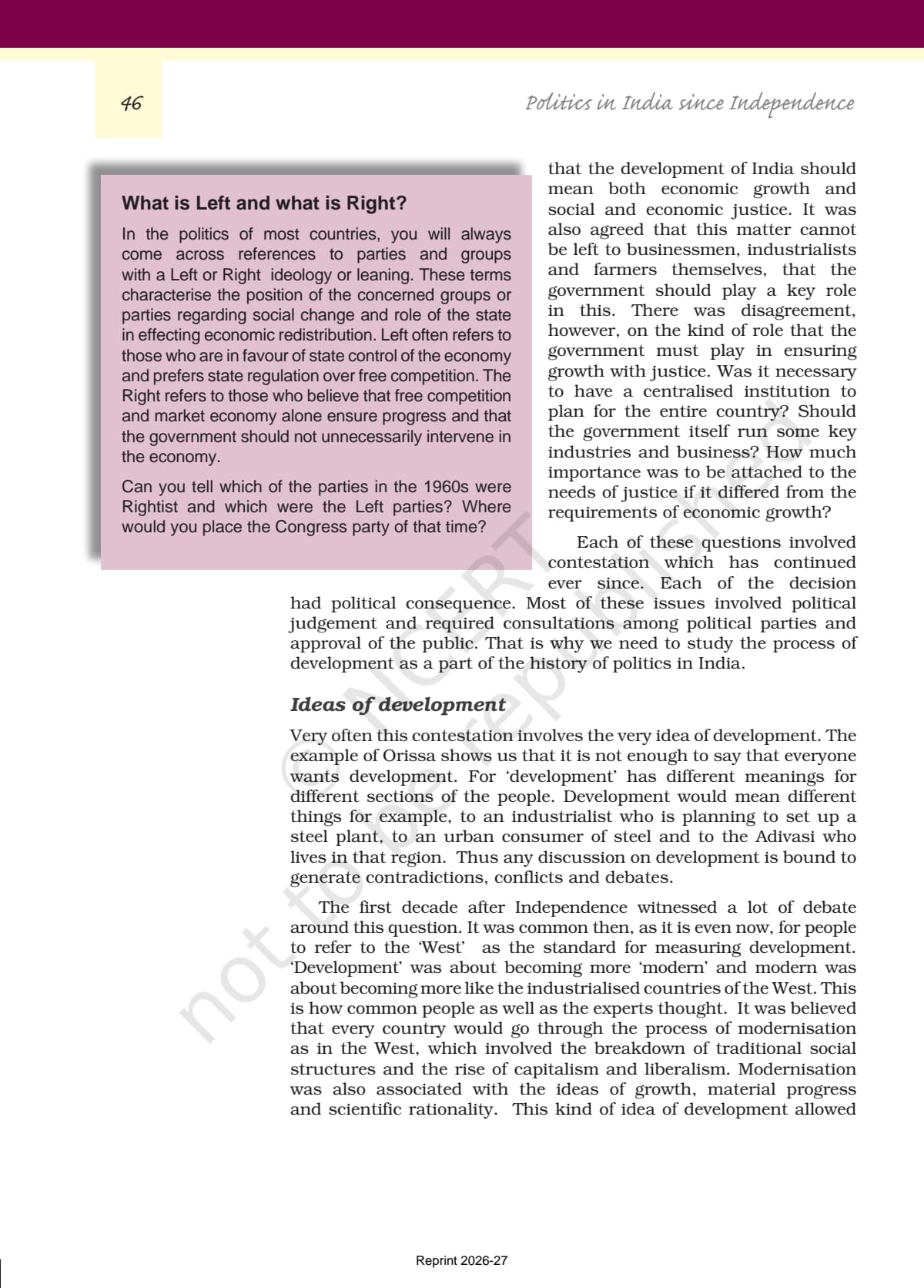
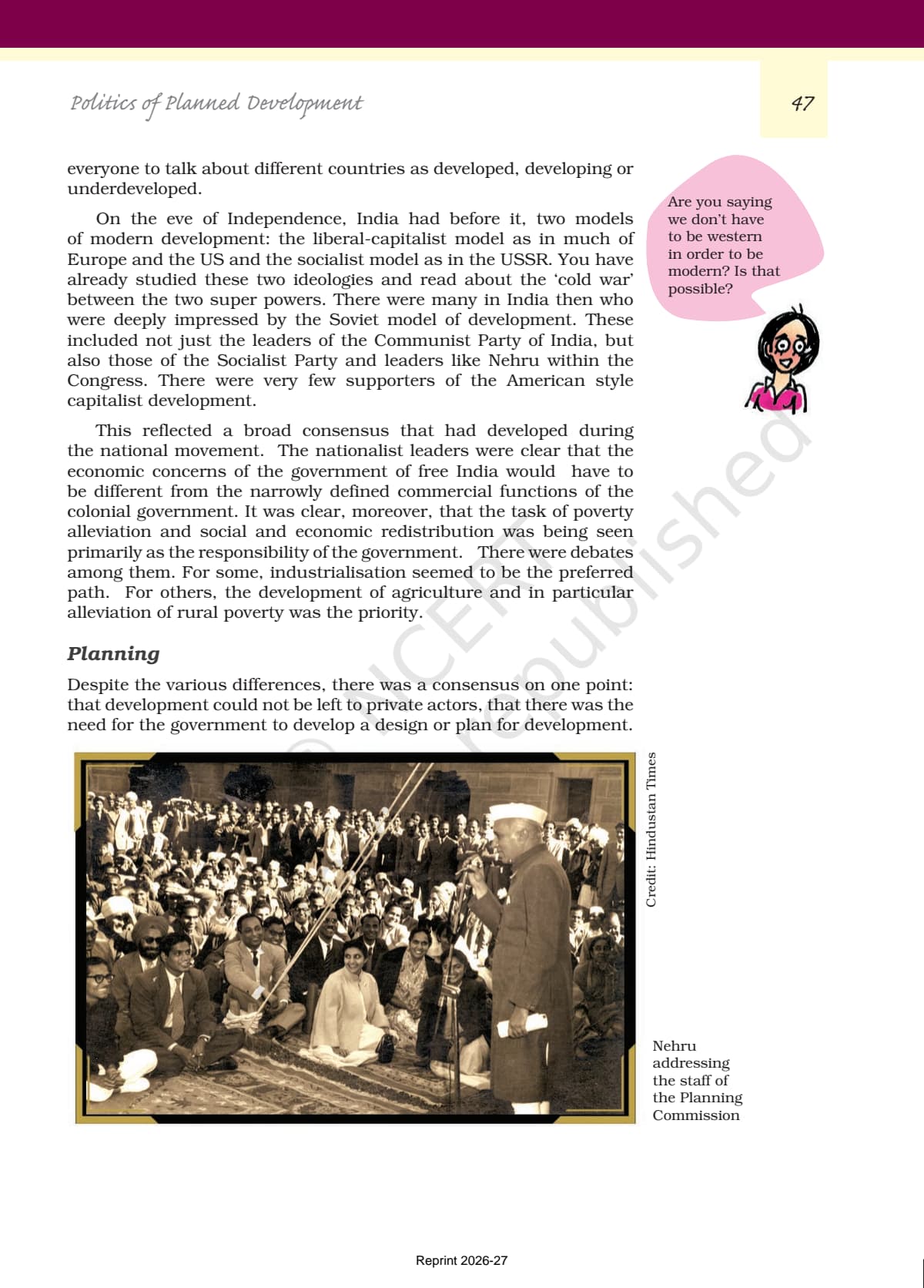
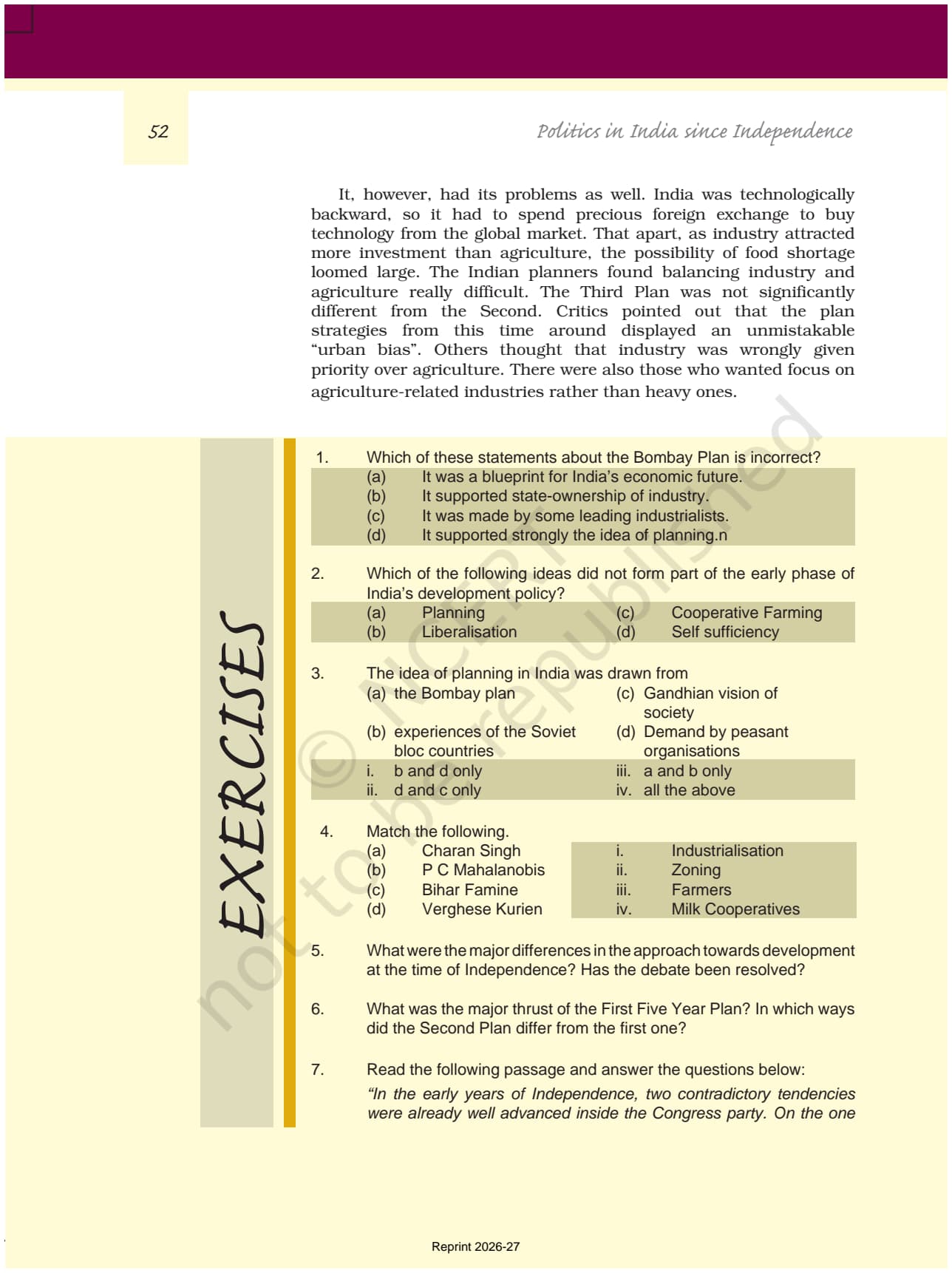
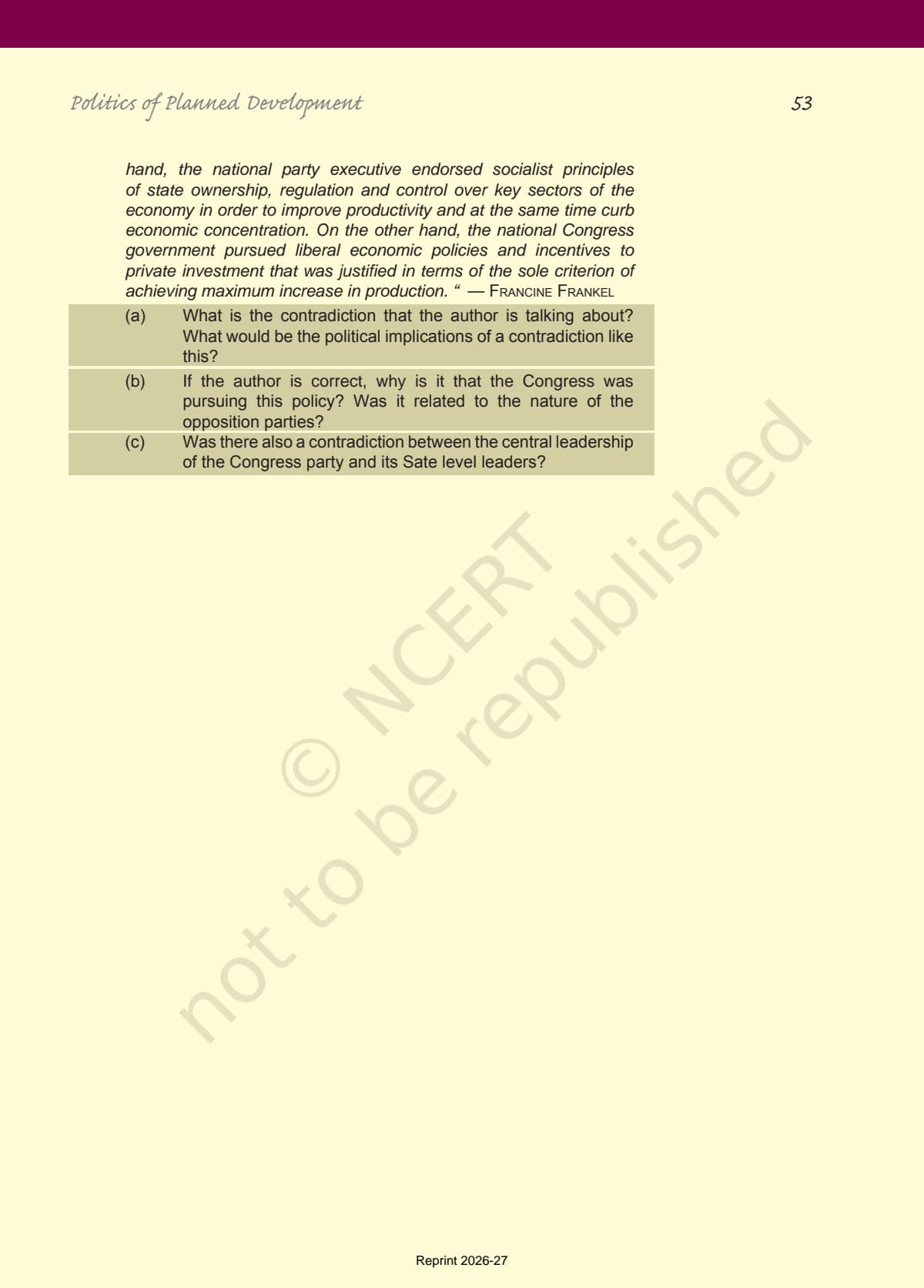
- Official NCERT chapter with the original photographs, source boxes and the Francine Frankel passage.
- This Class 12 Political Science chapter usually carries 5 to 6 marks in the board paper.
- Pairs with the NCERT Solutions, Notes and Handwritten Notes linked lower on this page.
This is the official NCERT Politics of Planned Development chapter from Politics in India Since Independence, offered for free download in the 2026-27 edition.
Student Feedback: In a Collegedunia poll of 7,030 Class 12 Political Science students before the 2026 boards, 66% of students said they kept the official NCERT chapter PDF open while solving the passage-based question, because the Francine Frankel extract and source boxes come straight from the chapter itself.
Source: 2026-27 Class 12 Political Science student poll. Sample of 7,030 students from CBSE schools across 12 states.
What the Politics of Planned Development NCERT Chapter Covers
Politics of Planned Development is the third chapter of Politics in India Since Independence. It studies how India chose to grow its economy after 1947. The central idea is that development is a political choice, not just a technical one, because every choice helps some groups and hurts others.
The chapter is built around three threads, which the NCERT covers in order:
- The models: the capitalist and socialist paths, and India's mixed economy.
- The planning: the Bombay Plan, the Planning Commission and the Five Year Plans.
- The debates: industry versus agriculture, and the public versus private sector.
Reading the original NCERT text matters because the source boxes and the Francine Frankel passage in the class 12 political science chapter 3 pdf are exactly what CBSE quotes in source-based questions. A student who knows the chapter's own examples, such as the Orissa-POSCO case, can answer those passages with confidence.
Chapter Highlights and Important Topics
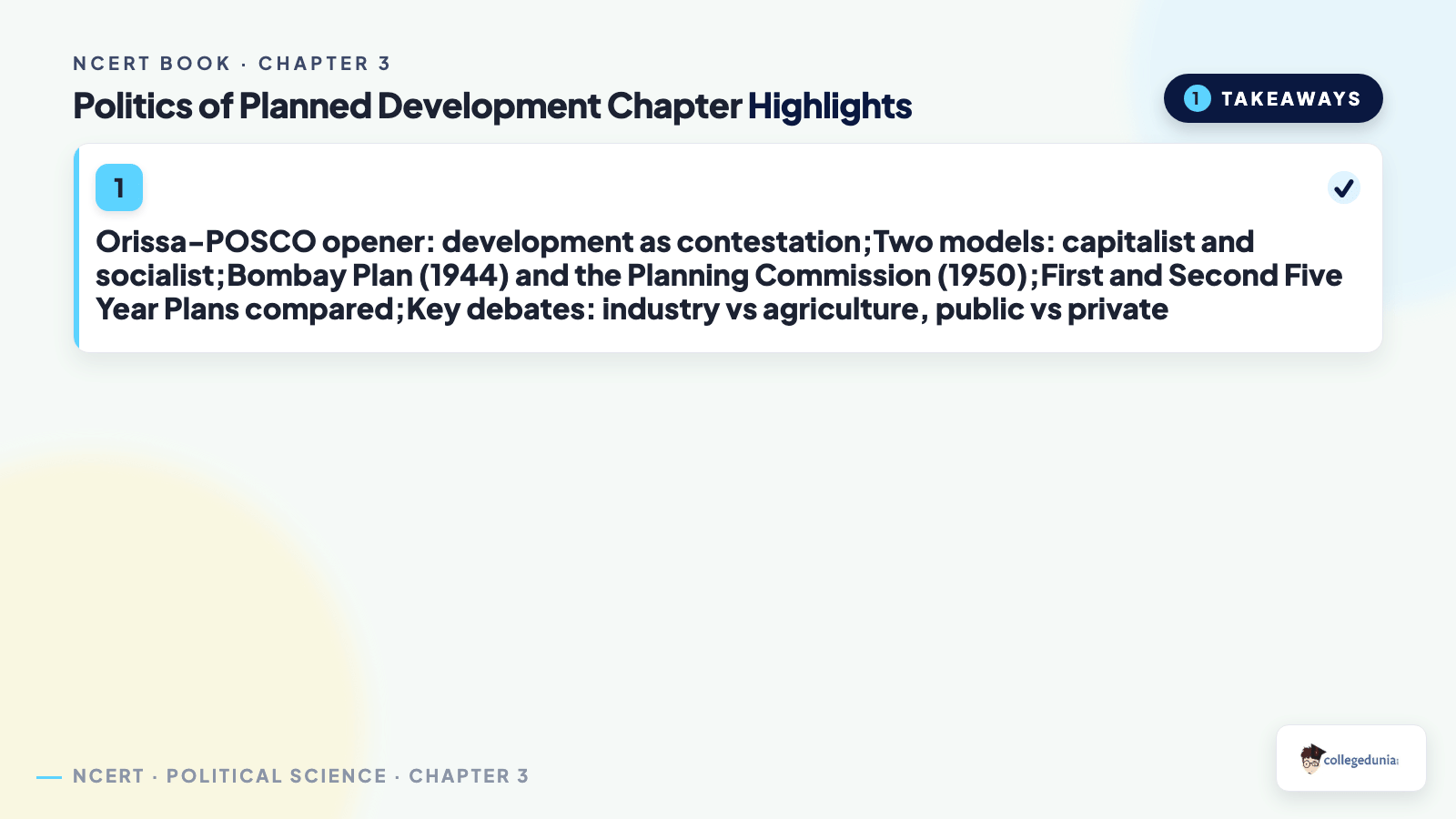
The NCERT chapter is rich with photographs, source boxes and a key passage that the exam often refers to. Knowing what each highlight covers helps students answer questions quickly. The table below lists the highlights students should study in the original chapter PDF.
| Highlight | Why it matters |
|---|---|
| Orissa-POSCO opener | Shows development as contestation, weighing jobs against tribal land and forests. |
| Two models of development | The capitalist (market-led) and socialist (State-led) paths, and India's mixed economy. |
| Bombay Plan and Planning Commission | The 1944 industrialists' plan and the 1950 body that ran the Five Year Plans. |
| First and Second Plans | Agriculture-first versus the Mahalanobis industry-first model. |
| Francine Frankel passage | Source extract on the contradiction inside the Congress party. |
The chapter also explains the later outcomes of planning, such as the Green Revolution and land reforms. One point students should mark while reading is that India settled on a mixed economy but never settled the development debate. That single idea from the chapter is the heart of the industry-versus-agriculture answer, and it appears almost every year.
The Two Models and Planning in the Chapter
The chapter devotes whole sections to the two models of development and how India set up planning. These sections feed the short and long answers, so reading them in the original NCERT helps students quote the right examples. The lists below show what the chapter covers under each theme.
- Capitalist model: market-led growth driven by private enterprise, as in Europe and the US.
- Socialist model: State-led growth with State ownership of key sectors, as in the USSR.
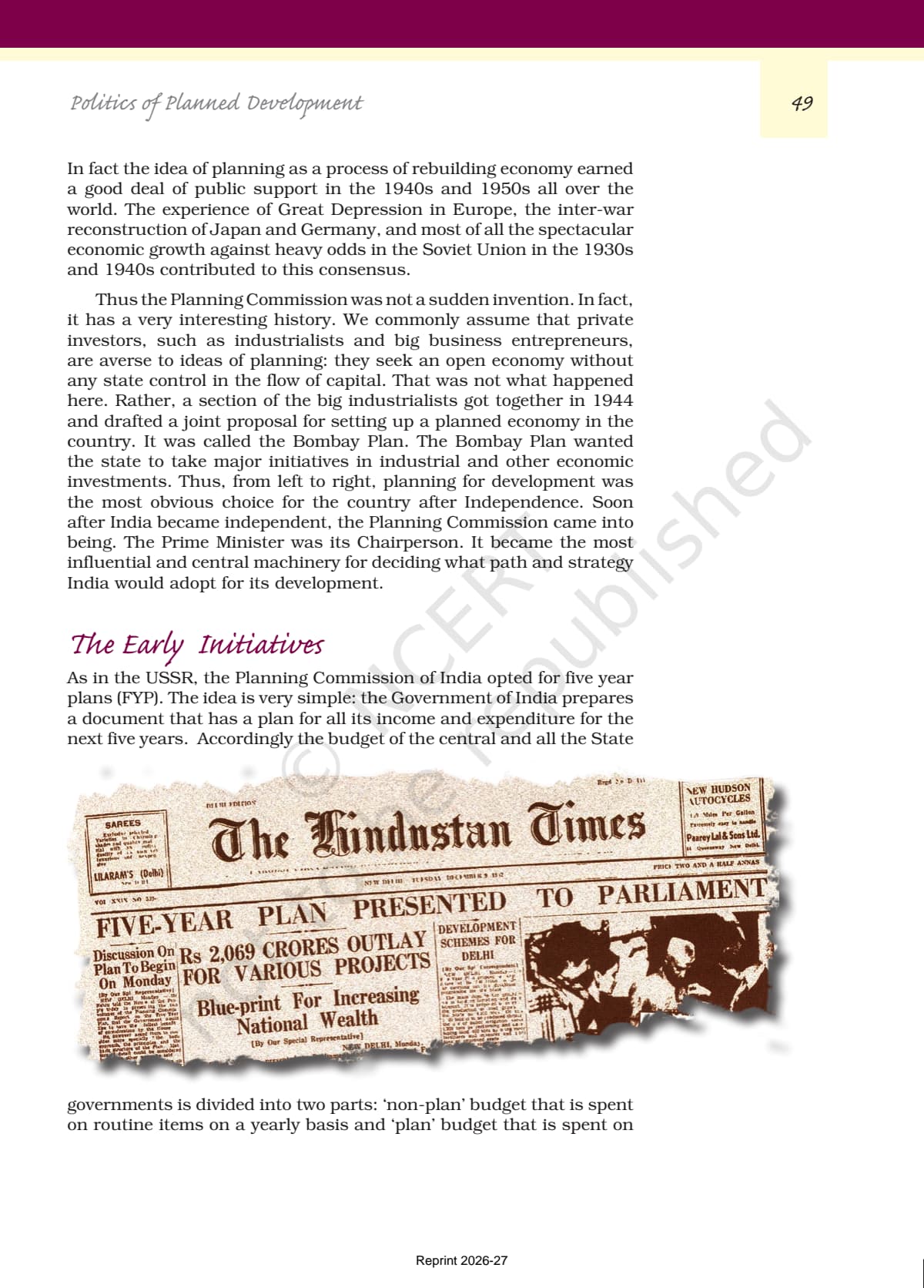
- Bombay Plan (1944): industrialists ask the State to lead industrial investment.
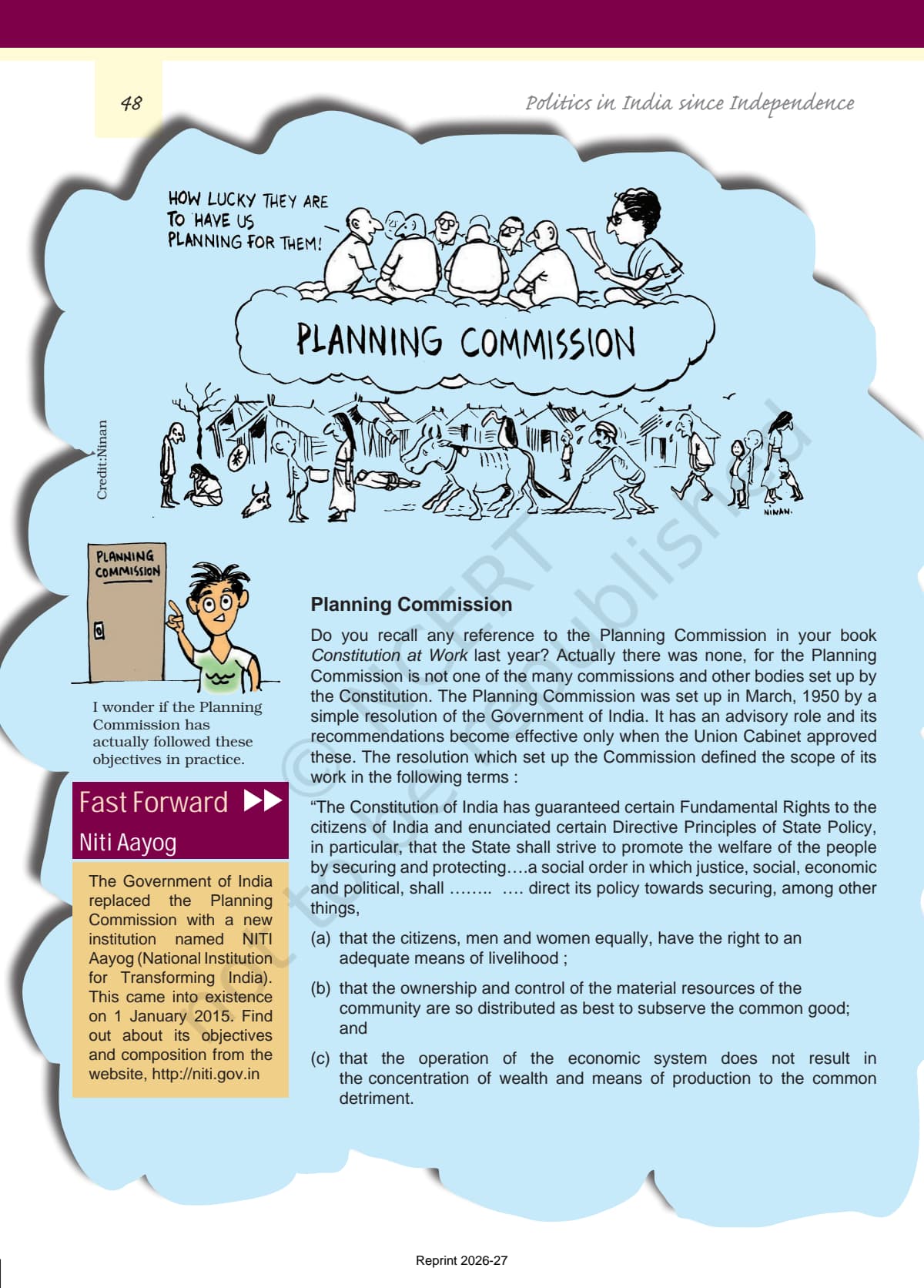
- Planning Commission (1950): set up in March, with the PM as Chairperson, to draw up the plans.
The chapter explains that India chose a middle path, a mixed economy, with the State leading big industry while the private sector ran much of agriculture and trade. It is clear that even big business, through the Bombay Plan, wanted a planning State, so support for planning ran "from left to right". Because these examples are drawn straight from the source chapter, the chapter 3 political science class 12 ncert book is the most reliable place to learn them.
The Five Year Plans and Debates in the Chapter
The closing sections of the chapter explain the First and Second Plans and the debates they left open. These pages are the most exam-relevant for the long answer, so reading them in the original chapter helps students write balanced answers.
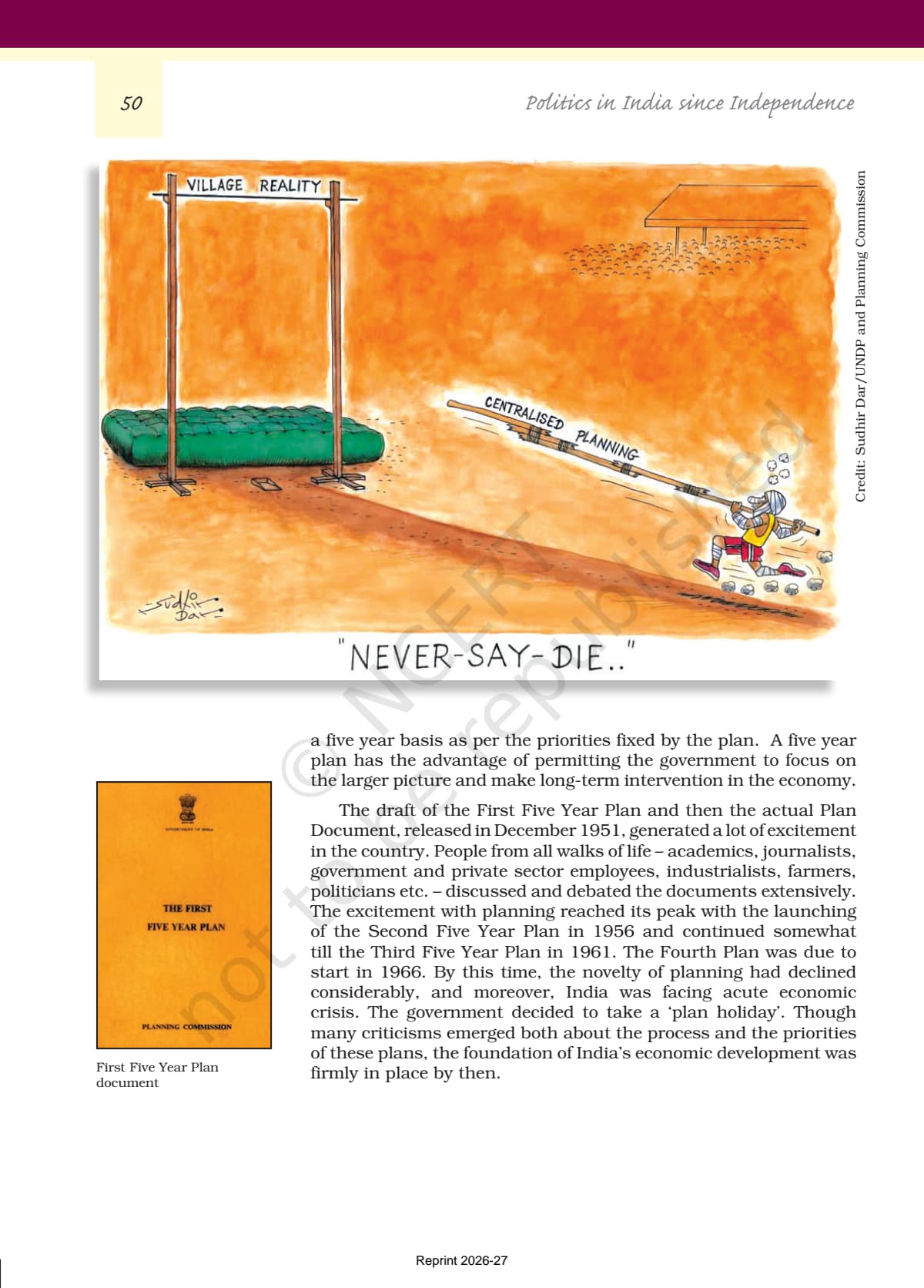
- First Plan (1951-56): agriculture, dams, irrigation, land reforms and a "hasten slowly" approach.
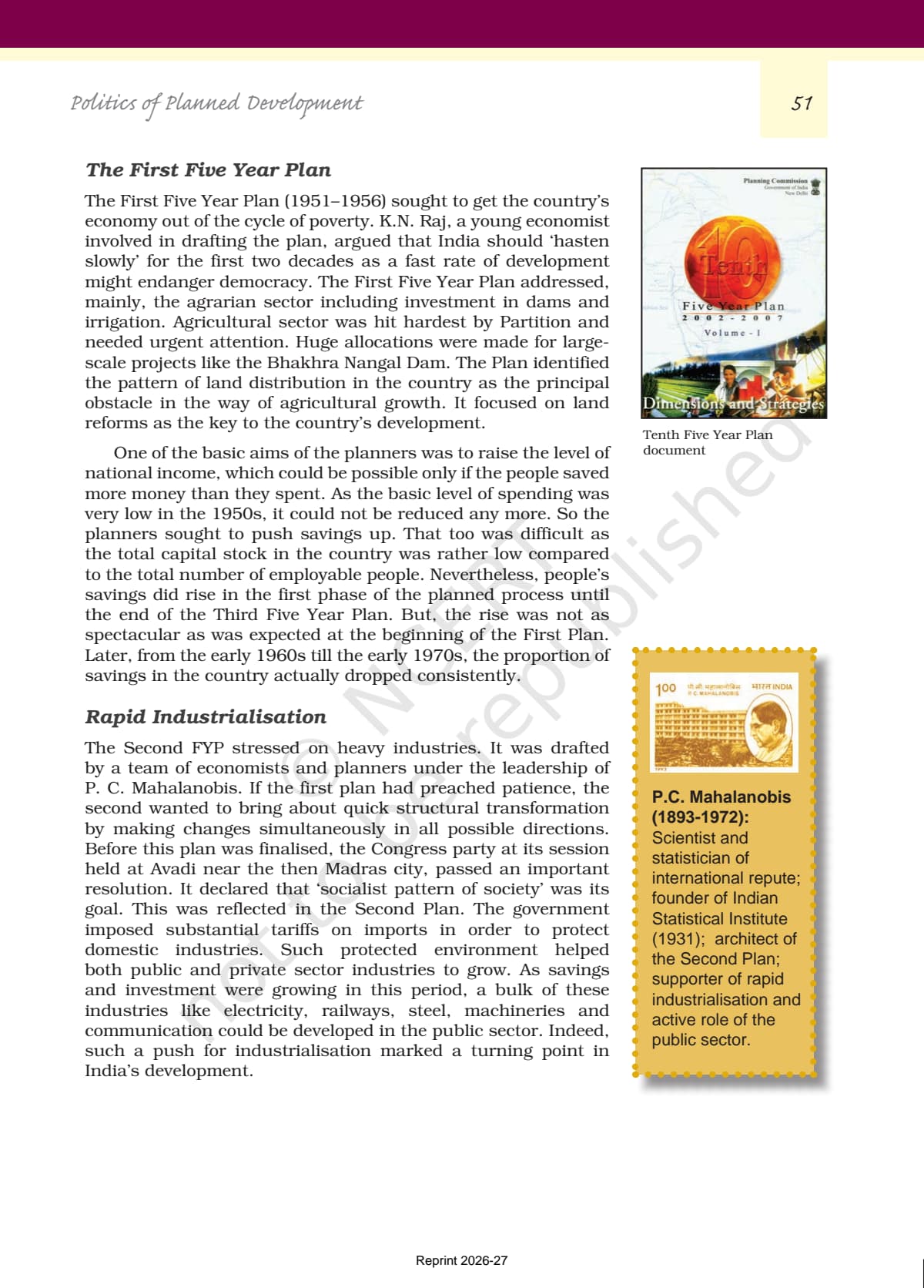
- Second Plan (1956-61): rapid heavy industry under P.C. Mahalanobis and a bigger public sector.
- Industry vs agriculture: critics charged the plans with an "urban bias".
- Later outcomes: the Green Revolution and land reforms grew out of these debates.
The chapter is clear that the mixed-economy compromise pleased neither the capitalists nor the social-justice camp fully. It ends with the idea that India settled on a model of planning but never settled the question of what development should mean. Reading these closing pages in the official PDF gives students the wording NCERT itself uses, which scores best in the board paper.
How to Download and Use the NCERT Chapter PDF
The chapter PDF is free and easy to use on any device. Students can save it for offline reading and pair it with the solutions and notes. The steps below show how to get the most out of the Politics of Planned Development PDF during revision.
- Download: tap the download card above to save the official Chapter 3 PDF to your device.
- First read: read the chapter once end to end, marking the source boxes and the Frankel passage.
- Source practice: keep the PDF open while attempting the passage-based question, since it comes from the chapter.
- Revision: use the chapter alongside the notes to fix dates, names and the two-plan contrast.
Many students search for the class 12 political science chapter 3 pdf the night before a test so they can revise offline. A saved copy means the source boxes and the key passage are always at hand. After reading the chapter, move to the solutions to check that your answers match the model points, then use the notes for a final quick recall.
How the Book PDF Pairs with the Solutions and Notes
The NCERT Book PDF is the source text. To prepare fully, students should use it with the other resources for the same chapter, all linked in the table below. Read the chapter, fix the ideas with the notes, then test yourself with the solutions.
| Resource | Best used for |
|---|---|
| Politics of Planned Development NCERT Solutions | Step-by-step answers to all 7 back-exercise questions |
| Politics of Planned Development Class 12 Notes | Quick chapter summary with all dates and key terms in one place |
| Politics of Planned Development Handwritten Notes | Last-minute, one-shot revision in a scanned notebook style |
Tip: read the chapter PDF first, then attempt the solutions on your own, and only then check the model answers. Reading the source text before the answers builds far stronger source-based skills.
All Class 12 Political Science NCERT Book PDFs by Chapter
The table links the NCERT chapter PDFs for every chapter in both Class 12 Political Science books, so students can move across the course in one click. Politics of Planned Development is highlighted.
| Chapter | NCERT Book PDF |
|---|---|
| Contemporary World Politics | |
| Chapter 1 | The End of Bipolarity |
| Chapter 2 | Contemporary Centres of Power |
| Chapter 3 | Contemporary South Asia |
| Chapter 4 | International Organisations |
| Chapter 5 | Security in the Contemporary World |
| Chapter 6 | Environment and Natural Resources |
| Chapter 7 | Globalisation |
| Politics in India Since Independence | |
| Chapter 1 | Challenges of Nation Building |
| Chapter 2 | Era of One-Party Dominance |
| Chapter 3 | Politics of Planned Development |
| Chapter 4 | India's External Relations |
| Chapter 5 | Challenges to and Restoration of the Congress System |
| Chapter 6 | The Crisis of Democratic Order |
| Chapter 7 | Regional Aspirations |
| Chapter 8 | Recent Developments in Indian Politics |
FAQs on Politics of Planned Development NCERT Book PDF
Politics of Planned Development Class 12 NCERT Book Common Questions
Ques. Where can I download the Politics of Planned Development NCERT Book PDF?
Ans. You can download the official Politics of Planned Development Class 12 Political Science chapter PDF directly from this page. It is free, follows the 2026-27 NCERT edition, and carries the original text, source boxes and the Francine Frankel passage of Chapter 3.
Ques. Which book is Politics of Planned Development from?
Ans. It is the third chapter of Politics in India Since Independence, one of the two Class 12 Political Science textbooks. The chapter studies how India chose to grow its economy through planning after Independence.
Ques. What does the Politics of Planned Development chapter cover?
Ans. It covers development as a political choice, the capitalist and socialist models, the Bombay Plan, the Planning Commission, the First and Second Five Year Plans, and the debates over industry versus agriculture and the public versus private sector.
Ques. Why should I read the original NCERT chapter PDF?
Ans. Because CBSE draws source-based questions straight from the chapter's own boxes and the Francine Frankel passage. Reading the official chapter 3 political science class 12 PDF gives you the exact wording and examples that score best in the board paper.
Ques. How should I use the chapter PDF with the other resources?
Ans. Read the chapter PDF first, fix the ideas with the notes, then test yourself with the solutions. Keeping the PDF open while practising the passage-based question helps, since the extract comes directly from it.



Comments