The NCERT Solutions for Political Science Class 12 Chapter 3 Politics of Planned Development answer every textbook question on how independent India chose to grow its economy, set to the latest 2026-27 CBSE syllabus. Each answer explains the two models of development, the Bombay Plan, the Planning Commission and the First and Second Five Year Plans. These solutions help students prepare for the Class 12 Political Science board paper in 2026-27.
Covers all 7 exercise questions from Politics in India Since Independence Chapter 3, with full point-wise answers.
This Class 12 Political Science chapter usually carries 5 to 6 marks per board paper.
Pairs with the Notes, Handwritten Notes and NCERT Book PDF linked lower on this page.
Every solution for Class 12 Political Science Chapter 3 in this Collegedunia compilation is written by subject experts from the official NCERT Politics in India Since Independence textbook, and checked against the last five years of CBSE board papers.
Student Feedback: In a Collegedunia poll of 8,950 Class 12 Political Science students taken before the 2026 boards, 68% of students rated the First Plan versus Second Plan question as the part they got wrong most often in Politics of Planned Development. Most students said a clear two-word tag for each plan, agriculture and industry, made the answer easy to recall.
Source: 2026-27 Class 12 Political Science student poll. Sample of 8,950 students from CBSE schools across 13 states.
What the Politics of Planned Development Class 12 Chapter Is About
Politics of Planned Development is the third chapter of Politics in India Since Independence. It tells the story of how India chose to grow its economy after 1947. The big idea is that development is a political choice, not just a technical one decided by experts. Every choice helps some groups and hurts others, so it has to be argued out in public.
The chapter answers three big questions that students must keep in mind:
Which model? The capitalist (market-led) model or the socialist (state-led) model.
How to plan? Through the Planning Commission (1950) and the Five Year Plans.
What to put first? Industry or agriculture, the public sector or the private sector.
So the chapter is really about the politics behind India's economic choices. A student who keeps these three threads in mind can connect almost any question in Politics of Planned Development class 12 back to one of them. Sort each fact under "model", "planning" or "debate" first, and revision gets much faster.
Development as a Political Choice
The chapter opens with the Orissa-POSCO case, where a steel plant promised jobs but threatened tribal land and forests. This example shows that development always weighs one group's needs against another's, so it cannot be left to experts alone. People's representatives must decide it through debate.
Who gains, who loses? A big project can bring jobs yet displace local people, so the choice is political.
More than money: development means social justice too, not just a higher national income.
Contestation: different groups push their own idea of development, so the State must balance them.
The point examiners look for is that development is about values and not just growth figures. Whenever a question asks "what does development mean", the safe answer links economic growth with justice, and shows that the choice has winners and losers. The Orissa example is the chapter's own proof of this, so quoting it scores well.
Two Models of Development: Capitalist and Socialist
At Independence, India had two models of development to choose from. The differences between them are a long-answer favourite, so students should learn them as a clear comparison rather than a story. The table below sorts the two models for fast revision.
Model
Key idea to recall
Capitalist (market-led)
Private enterprise and the market lead growth, as in Europe and the US; less direct State control.
Socialist (State-led)
The State owns and directs key sectors, as in the USSR; aims to curb inequality.
India's choice
A middle path, the "mixed economy", combining the State and the private sector.
A key insight for the exam is that India did not copy either model fully; it built a mixed economy. Many leaders, including Nehru, were impressed by the Soviet model, but very few wanted full American-style capitalism. So India let the State lead big industry while the private sector ran much of agriculture, trade and consumer goods. This compromise is the heart of the chapter.
The Bombay Plan and the Planning Commission
Two things set up planning in India: the Bombay Plan and the Planning Commission. Both are popular MCQ and short-answer points, so students should know what each one was and when it came. The list below keeps the key facts together.
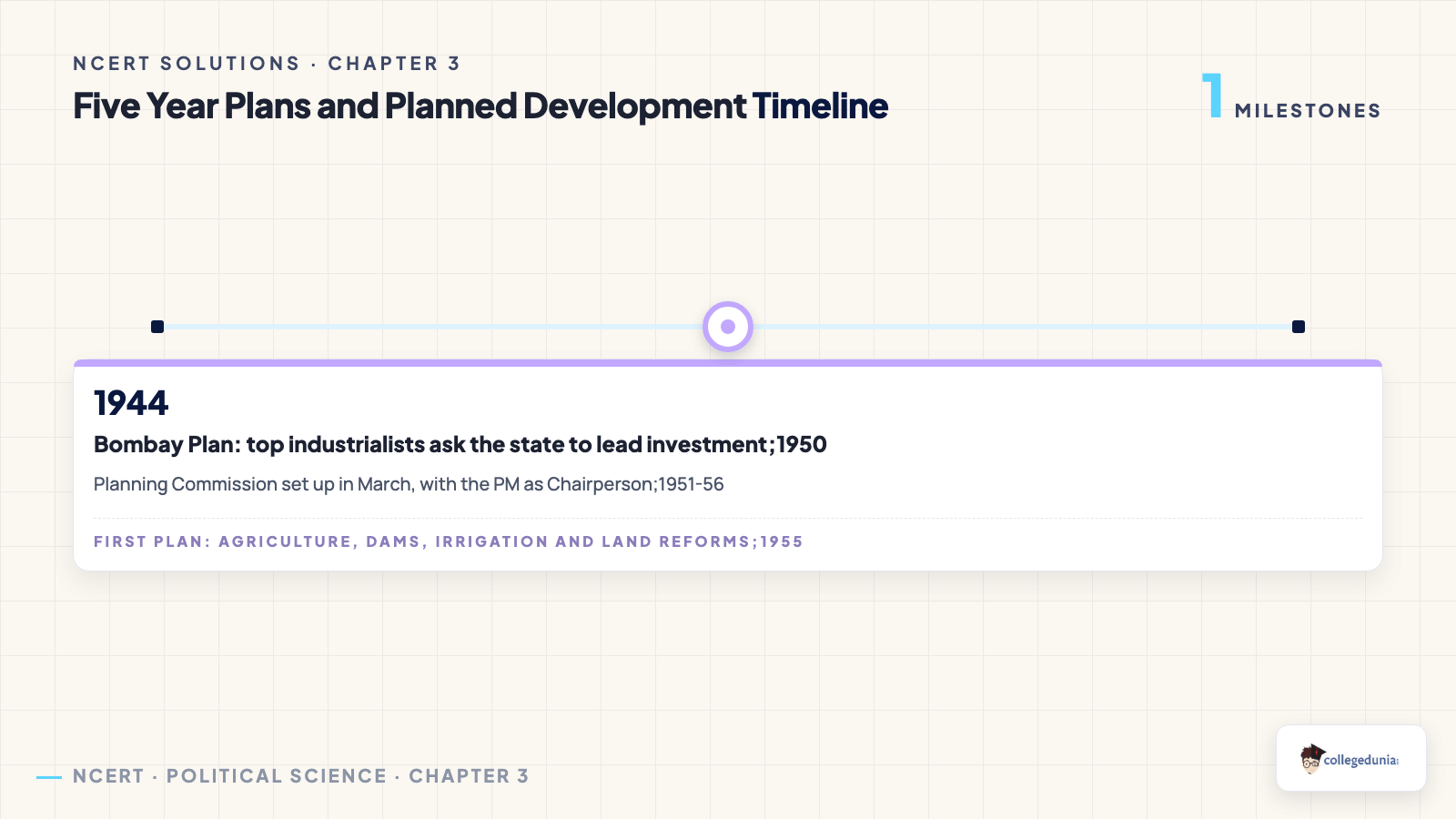
Bombay Plan (1944): a joint proposal by leading industrialists asking the State to lead investment in industry.
Why it mattered: it proved that even big business wanted a planning State, so support for planning ran "from left to right".
Planning Commission (1950): set up in March 1950, with the Prime Minister as Chairperson, as an advisory body.
Its tool: the Commission drew up the Five Year Plans to guide the whole economy.
The honest exam point is that the Bombay Plan was a private suggestion, not the official national blueprint. The MCQ in this chapter traps students by calling it "a blueprint for India's economic future", which overstates its role. Remember it as one influential input, made by industrialists, that backed both planning and a strong State.
The First and Second Five Year Plans
The First Plan (1951 to 1956) and the Second Plan (1956 to 1961) had very different priorities. This contrast is the most-asked long answer in the chapter, so the answer needs both plans lined up on the same points. The table keeps them side by side.
Point
First Plan (1951-56)
Second Plan (1956-61)
Main thrust
Agriculture, dams and irrigation
Rapid heavy industry
Pace
Patient, "hasten slowly" (K.N. Raj)
Fast, simultaneous change
Architect
K.N. Raj's caution
P.C. Mahalanobis's drive
State role
Land reforms, savings
Bigger public sector, "socialist pattern"
The simplest way to lock this in is with two anchor words: tag the First Plan with "agriculture" and the Second Plan with "industry". Every other difference, pace, architect and public-sector role, flows from these two. The Second Plan also rode on the 1955 Avadi resolution that declared a "socialist pattern of society", which is why it counts as a real turning point.
The Big Debates and Later Outcomes
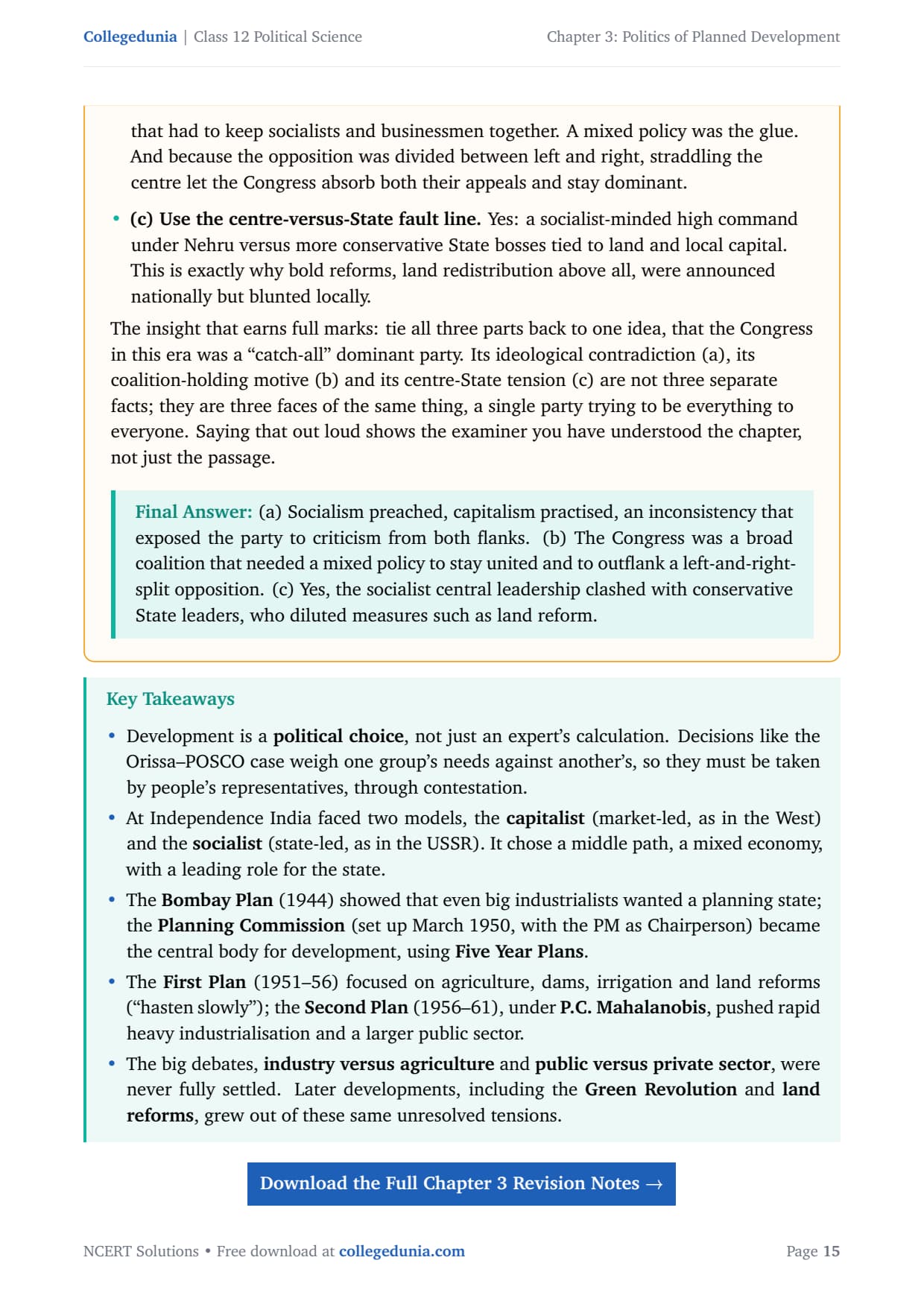
The chapter ends with the debates that India's planning never fully settled, and the outcomes they led to. These link the chapter to later events, so they appear in both short and long answers. The list below keeps the debates and outcomes together.
Industry versus agriculture: critics said the plans had an "urban bias" and neglected farmers.
Public versus private sector: capitalists felt the public sector got too much, the justice camp felt the State did too little.
Green Revolution: new seeds and inputs raised food output but widened gaps between rich and poor farmers.
Land reforms: announced strongly at the centre, but often diluted by State-level leaders close to landlords.
The point that scores marks is that India settled on a model but never settled the debate. The mixed economy was a compromise that pleased neither side fully, and the same tensions, growth versus justice and industry versus agriculture, still run through Indian politics today. The Orissa case at the start of the chapter is proof that this argument is still live.
Politics of Planned Development Class 12 Exercise-wise Coverage
The chapter exercise has 7 questions. The table maps each one to its topic so students can plan revision and find the right NCERT answer fast. The full point-wise solution for each sits in the question set lower on this page.
Question
Topic it tests
Q 1
Incorrect statement about the Bombay Plan (MCQ)
Q 2
Idea that did NOT form part of the early phase of development (MCQ)
Q 3
Sources from which India drew the idea of planning (MCQ)
Q 4
Match the following (Charan Singh, Mahalanobis, Bihar Famine, Kurien)
Q 5
Differences in the approach to development, and whether the debate is resolved
Q 6
Major thrust of the First Plan and how the Second Plan differed
Q 7
Passage-based question on the Congress contradiction (Francine Frankel)
Questions 5, 6 and 7 are the most-asked long answers, so students preparing Politics of Planned Development class 12 important questions should learn those three first. The MCQs and the match (Q1 to Q4) are quick marks, so revise the Bombay Plan and the two plans well to secure them.
Students who want the offline copy can save the class 12 political science chapter 3 pdf from the download card above and tick off each question as they finish it.
Politics of Planned Development Important Questions and Previous Year Trends
CBSE sets a steady mix of MCQ, short and long answers from this chapter. Knowing the pattern helps students decide how much to write. The chapter is a regular source of one 4-mark or 6-mark question, which is why a focused list of Politics of Planned Development important questions saves a lot of revision time.
Long answer (5 to 6 marks): the First Plan versus the Second Plan, or the two models of development.
Short answer (4 marks): the Bombay Plan, the Planning Commission, or what "development" means.
Source-based: a passage on the Congress contradiction or planning, with sub-parts (as in Q7).
Objective and MCQ: dates, the Avadi session, the Mahalanobis model, and the Green Revolution.
For quick recall before the exam, students often practise the class 12 political science chapter 3 mcq set and a list of Politics of Planned Development class 12 important questions. The most repeated items are the two-plan contrast and the capitalist-versus-socialist debate, so keep those answer points ready in your own words.
Working through the ncert solutions class 12 political science chapter 3 set twice, once open-book and once from memory, fixes the dates and names well before the board exam.
Common Mistakes Students Make in This Chapter
A few errors cost marks every year in this chapter. Most come from swapping the two plans or mixing up the names in the match question. Avoiding them is the fastest way to lift a score.
Swapping the plans - the First Plan stressed agriculture, the Second Plan stressed industry.
Confusing Charan Singh (farmers) with Mahalanobis (industrialisation) in the match question.
Calling the Bombay Plan the "official blueprint" - it was only a private 1944 industrialists' proposal.
Treating liberalisation as an early-phase idea - it belongs to the post-1991 reforms.
Saying the development debate was settled - India's mixed-economy compromise left it open.
Students who fix these five points usually move from average to high marks on the long answers. The exam rewards a balanced view, so always show both the agriculture and the industry side before you judge India's choices.
Politics of Planned Development PDF Download Formats and Languages
The solutions are free to download in more than one format, so students can pick what suits their device and revision style. The download card at the top of the page carries each option for this chapter.
Normal and HD PDF: the class 12 political science chapter 3 pdf comes in a normal size for quick downloads and an HD version for clear printing.
English medium: all 7 answers are written in simple English for the CBSE board paper.
Question-only set: a print-and-practise sheet of Politics of Planned Development extra questions for self-testing.
Whole-book pack: the solutions sit in one set that runs through every Politics in India Since Independence chapter, so you can revise in one place.
Many students search for class 12 political science chapter 3 answers on their phone the night before a test, so a saved PDF means you can revise even without internet. Keep both the question set and the solved version handy for a full self-check.
How These Solutions Pair with the Notes and Book PDF
These NCERT Solutions answer the back-exercise questions. To revise the full chapter, students should use them alongside the other resources for the same chapter, all linked in the table below.
Reading the original NCERT chapter text and figures
Tip: read the Notes first, then attempt these solutions on your own, and only then check the model answers here. That order builds memory faster than copying answers straight away.
All NCERT Solutions for Class 12 Political Science
The table links the NCERT Solutions for every chapter in both Class 12 Political Science books, so students can move across the course in one click. Politics of Planned Development is highlighted.
All NCERT Solutions for Politics of Planned Development with Step-by-Step Solutions
Below are all 7 NCERT exercise questions for this chapter, exactly as they appear in the textbook. Tap Check Solution for the model answer or Expert Solution for the topper-style approach.
Q 3.1
Which of these statements about the Bombay Plan is incorrect?
(a) It was a blueprint for India's economic future.
(b) It supported state-ownership of industry.
(c) It was made by some leading industrialists.
(d) It supported strongly the idea of planning.
Concept used. The Bombay Plan was a joint proposal
drafted in 1944 by a section of big industrialists for setting up a
planned economy in India. To find the incorrect statement, we test
each option against what the chapter actually says the Bombay Plan stood
for. The incorrect one is (a) It was a blueprint for India's
economic future.
Here is why (a) is the odd one out, and why the other three are correct:
(a) is incorrect. The Bombay Plan was a private proposal
by a group of industrialists, not an official government document
or an adopted national blueprint. It was one influential input
into the planning debate, but it was never the actual roadmap that
India's economic future was built on. So calling it ``a blueprint
for India's economic future'' overstates its role.
(b) is correct. The Bombay Plan wanted the state to take
major initiatives in industrial and other economic investments. It
clearly backed a strong role for the government in industry.
(c) is correct. The chapter states plainly that a section
of the big industrialists got together in 1944 and drafted the
joint proposal. Leading industrialists did make it.
(d) is correct. The whole point of the Bombay Plan was to
support the idea of planning. It is the chapter's striking example
that even private capitalists wanted a planned economy.
Read the question word
The question asks for the incorrect statement. Three options are
true of the Bombay Plan; only one is false. Underline ``incorrect'' so you
pick the odd one out, not a true fact.
Incorrect statement: (a) It was a blueprint for India's
economic future.
AM
Aarav Mehta
M.A Political Science, Jawaharlal Nehru University
Verified Expert
Strategic angle. In an ``which is incorrect'' MCQ, I do not hunt
for the right fact, I hunt for the wrong one. So I quickly confirm the
three statements I know the chapter supports, and the survivor is my
answer. For the Bombay Plan, three things are famous: industrialists made
it, it backed planning, and it wanted the state to lead industry.
Confirm the famous three. Made by industrialists (c),
supported planning (d), backed state-led industrial investment (b).
All three are textbook-true, so none can be the answer.
Isolate the survivor. That leaves (a), ``a blueprint for
India's economic future.'' The Bombay Plan was a private
suggestion, never the official national plan, so this overstated
claim is the incorrect one.
Sanity check the trap. The exam wants you to read ``state
ownership'' in (b) and assume a private industrialists' plan could
not back the state. But that surprise is exactly the chapter's main
point, so (b) is true, not the trap.
The deeper exam value here: the Bombay Plan is the chapter's proof that
support for planning ran ``from left to right'' in 1947. Even big business
asked for a strong, planning state. Remembering that one idea answers most
Bombay Plan questions, because every wrong option will try to make the
industrialists sound anti-state or anti-planning, and they were neither.
Incorrect statement: (a). The Bombay Plan was a private
1944 proposal by industrialists, not the official blueprint of India's
economic future.
Q 3.2
Which of the following ideas did not form part of the early phase
of India's development policy?
(a) Planning (c) Cooperative Farming
(b) Liberalisation (d) Self sufficiency
Concept used. The ``early phase'' here means the first two to
three decades after Independence, roughly the 1950s to the 1960s, the age
of the Five Year Plans. We check which of the four ideas belongs to a
much later period. The idea that did not form part of the early
phase is (b) Liberalisation.
(b) Liberalisation is the answer. Liberalisation means
reducing state controls and opening the economy to free
competition and private players. India moved decisively in this
direction only later, especially after the 1991 economic reforms.
It was not a feature of the planned, state-led early phase.
(a) Planning was central early on. The whole early phase
was built around planning, the Planning Commission and the Five
Year Plans. So planning very much formed part of it.
(c) Cooperative Farming was an early-phase idea. Pooling
land and farming it cooperatively was actively discussed and tried
in this period as a route to rural development.
(d) Self sufficiency was an early-phase goal. The
government protected domestic industry with high tariffs on
imports so India could stand on its own feet. Self sufficiency
was a clear aim of early policy.
Spot the odd era
Three of these (planning, cooperative farming, self sufficiency) are
state-led 1950s ideas. Liberalisation is a 1990s market-led idea. When
three options share an era and one jumps decades, the time-jumper is your
answer.
Idea that did not form part of the early phase:
(b) Liberalisation.
SI
Sneha Iyer
M.A History, University of Delhi
Verified Expert
Strategic angle. The clue is hidden in three words: ``early
phase.'' I treat this as a timeline question, not a definition question. I
group the options by their decade. Whichever option belongs to a different
decade from the rest is almost always the right pick in a ``did not form
part'' question.
Date each option. Planning, cooperative farming and self
sufficiency are all 1950s, state-led, plan-era ideas. They cluster
together.
Find the outlier. Liberalisation is the language of the
1991 reforms, a market-led turn. It sits in a completely different
decade and a completely opposite direction.
Confirm the logic, not just the date. The early phase
trusted the state to lead; liberalisation trusts the market. So it
is wrong both by date and by spirit, which makes it a safe answer.
The point worth carrying forward: this chapter's early phase and India's
1991 turn are opposites. Early India said ``the state must plan and
protect''; 1991 India said ``free the market.'' Any question that mixes
these two eras is testing whether you can tell state-led planning apart
from market-led liberalisation. Keep that fault line clear and these
questions become easy.
(b) Liberalisation. It belongs to the post-1991 reform
era, not the state-led planning phase of the 1950s and 1960s.
Q 3.3
The idea of planning in India was drawn from
(a) the Bombay plan (c) Gandhian vision of society
(b) experiences of the Soviet bloc countries (d) Demand by peasant
organisations [3pt]
i. b and d only iii. a and b only
ii. d and c only iv. all the above
Concept used. We look at the two sources the chapter names for
the idea of planning in India, then match them to the option that lists
exactly those two. The chapter draws planning from (a) the Bombay
Plan and (b) the experiences of the Soviet bloc countries, so
the answer is (iii) a and b only.
(a) the Bombay Plan supplied the home-grown root. A
section of Indian industrialists drafted the Bombay Plan in 1944,
asking the state to lead investment. This showed that support for
planning existed within India itself, even among capitalists.
(b) the Soviet experience supplied the global inspiration.
The chapter says the spectacular economic growth of the Soviet
Union in the 1930s and 1940s, against heavy odds, made planning
attractive worldwide. India was deeply impressed by this Soviet
model.
(c) and (d) are not named as sources. The chapter does not
say the idea of planning was drawn from a Gandhian vision of
society or from a demand by peasant organisations. So any option
containing (c) or (d) is ruled out.
Pick the matching option. Only option (iii), ``a and b
only,'' lists exactly the two sources the chapter mentions.
Two roots, not four
The chapter gives planning a home root (Bombay Plan) and a foreign root
(Soviet growth). It does not trace planning to Gandhi or to
peasant demands. So ``a and b only'' is the textbook answer; an answer key
marking ``all the above'' goes beyond what this chapter states.
(iii) a and b only: the Bombay Plan and the experiences
of the Soviet bloc countries.
RV
Rohan Verma
M.A Political Science, University of Hyderabad
Verified Expert
Strategic angle. This is an ``assertion-by-combination'' MCQ. The
fastest route is to test the two doubtful sources, (c) Gandhian vision and
(d) peasant demands, against the chapter. If the chapter never ties
planning to them, I can delete every option that includes (c) or (d) in
one stroke.
Delete the weak claims. The chapter does not source
planning from Gandhi or from peasant organisations. So options (i)
b and d, (ii) d and c, and (iv) all the above all fall, because
each one carries a (c) or a (d).
Keep the survivor. That leaves only (iii) a and b. It
matches the chapter's two stated roots exactly: the Bombay Plan at
home and Soviet growth abroad.
Note the live disagreement. Some keys mark (iv) all the
above. But going strictly by this chapter's text, only (a) and (b)
are named, so (iii) is the defensible, source-grounded answer.
The deeper takeaway: notice how India's planning was both indigenous and
borrowed. The Bombay Plan proves the idea had Indian backers from business
itself; the Soviet example proves the worldwide mood favoured planning
after the Great Depression. That ``home root plus foreign root'' pairing is
the chapter's actual claim, and it is why (a) and (b) together, and nothing
else, are the sourced answer.
(iii) a and b only. (Some keys list (iv); the chapter
text names only the Bombay Plan and the Soviet experience.)
Q 3.4
Match the following. [3pt]
(a) Charan Singh i. Industrialisation
(b) P C Mahalanobis ii. Zoning
(c) Bihar Famine iii. Farmers
(d) Verghese Kurien iv. Milk Cooperatives
Concept used. Matching questions reward you for linking each name
or event to the one idea the chapter associates with it. Here the correct
pairing is (a) Charan Singh : iii Farmers, (b) P C
Mahalanobis : i Industrialisation, (c) Bihar Famine : ii
Zoning, and (d) Verghese Kurien : iv Milk Cooperatives.
(a) Charan Singh : (iii) Farmers. Chaudhary Charan Singh
was the leader who forcefully argued for keeping agriculture and
the farmer at the centre of India's planning. His name stands for
the farmers' cause.
(b) P C Mahalanobis : (i) Industrialisation. Mahalanobis
was the architect of the Second Plan, which stressed heavy
industry. He stands for rapid industrialisation.
(c) Bihar Famine : (ii) Zoning. During the Bihar famine,
the policy of ``zoning,'' which banned the movement of food across
state borders, sharply cut the food available in Bihar. The famine
is linked to the zoning policy.
(d) Verghese Kurien : (iv) Milk Cooperatives. Verghese
Kurien led India's milk cooperative movement (the Amul model and
Operation Flood), so he stands for milk cooperatives.
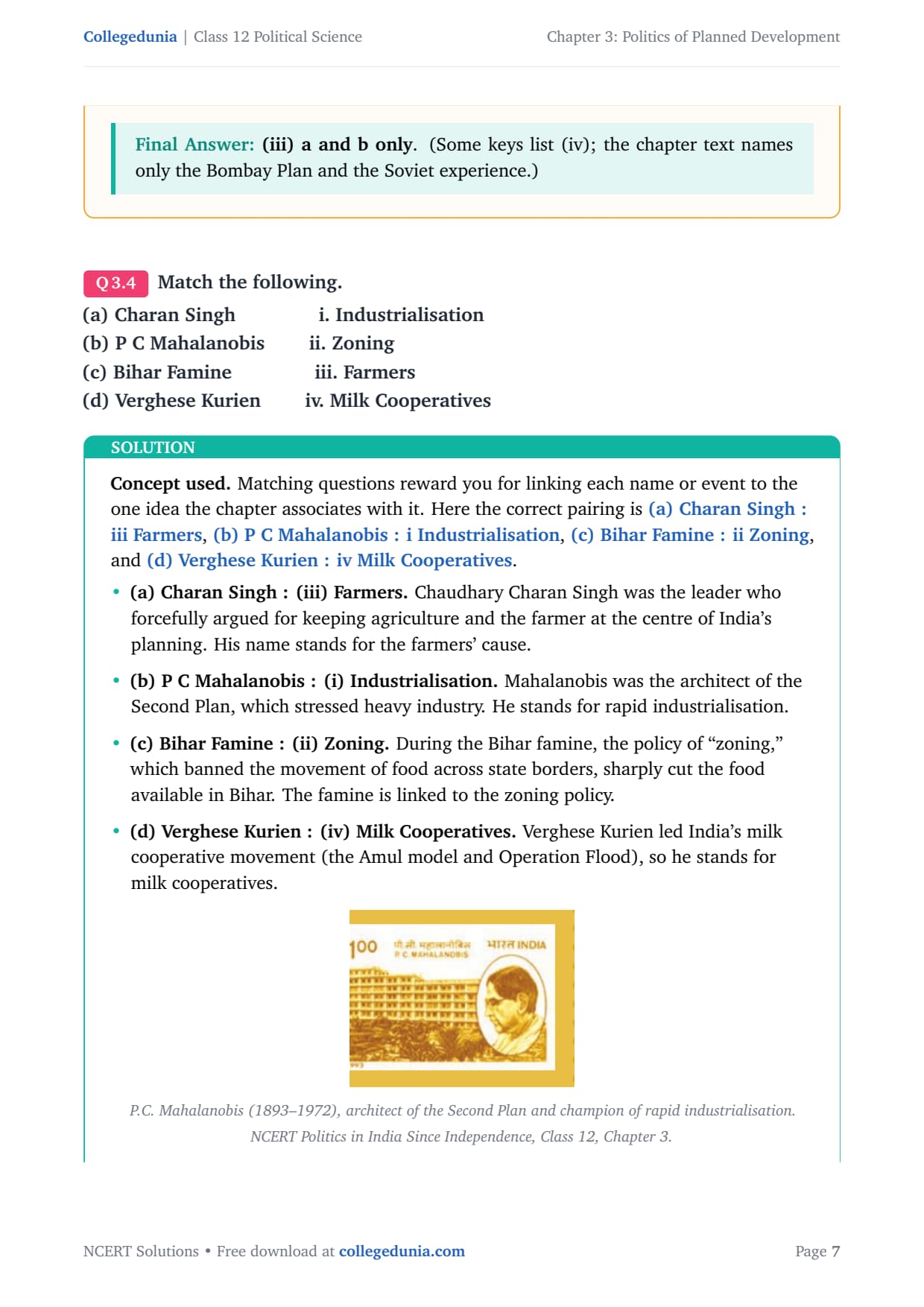
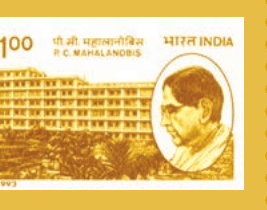
P.C. Mahalanobis (1893–1972),
architect of the Second Plan and champion of rapid industrialisation.
NCERT Politics in India Since Independence, Class 12, Chapter 3.
Students often swap Charan Singh and Mahalanobis. Remember the rule of
opposites: Charan Singh spoke for agriculture (farmers), while
Mahalanobis spoke for industry (industrialisation). They sit on
opposite sides of the chapter's big debate.
Strategic angle. In a matching question I lock the
``can't-be-wrong'' pairs first, because that shrinks the puzzle. Two pairs
here are almost unmissable: Kurien goes with milk cooperatives, and the
Bihar Famine goes with zoning. Once those are fixed, the remaining two
names sort themselves out.
Lock the easy two. Verghese Kurien is famous only for milk
cooperatives, so (d)–(iv). Bihar Famine pairs with the zoning
policy that worsened it, so (c)–(ii). Two down.
Use the debate to place the last two. The two leftover
ideas are farmers and industrialisation, the two poles of the
chapter's central argument. Charan Singh argued for farmers, so
(a)–(iii); Mahalanobis argued for industry, so (b)–(i).
Cross-check by elimination. Every name now has a unique
idea and no idea is used twice, which confirms the full match is
consistent.
The bigger picture this match captures: it is really the agriculture
versus industry debate in disguise. Charan Singh (farmers) and Mahalanobis
(industry) personify the two competing priorities of Indian planning,
while the Bihar Famine and Kurien's cooperatives are two real outcomes,
one a policy failure, one a policy success, of how India handled food and
agriculture. Reading the match this way makes it stick.
(a)–iii, (b)–i, (c)–ii, (d)–iv.
Q 3.5
What were the major differences in the approach towards
development at the time of Independence? Has the debate been resolved?
Concept used. At Independence, almost everyone agreed that India
needed planned development with a strong role for the government. The
differences were about how to do it: which model to follow,
and which sector to put first. The main fault lines were
capitalist versus socialist models and agriculture
versus industry as the first priority.
The major differences in approach were:
Two models of development. India had before it two models.
The liberal-capitalist model, as in Europe and the US,
trusted the market and private enterprise. The socialist
model, as in the USSR, trusted the state to own and direct key
sectors. Many leaders, including Nehru, were impressed by the
Soviet model, while very few backed full American-style capitalism.
Agriculture first, or industry first? Even among those who
wanted planning, there was disagreement. For some, rapid
industrialisation, especially heavy industry, was the
path to progress. For others, the development of
agriculture and the removal of rural poverty was the more
urgent priority.
What role for the state? There was further debate on
how much the government should do. Should there be a single
central body to plan for the whole country? Should the government
itself run key industries? How much weight should justice get if
it clashed with the goal of faster growth?
A shared base under the differences. Despite these splits,
there was a broad consensus that development meant both economic
growth and social and economic justice, and that this could
not be left to private actors alone. The state had to lead.
Why this still matters
The Orissa–POSCO example at the start of the chapter shows the same
clash continuing today: industry and jobs on one side, tribal livelihoods
and the environment on the other. The model that India chose did not end
these conflicts; it only set the stage for them.
Has the debate been resolved? No, the debate has not been fully
resolved. India chose a middle path (a ``mixed economy'') that tried to
combine the state and the market, and that compromise pleased neither side
completely. The capitalists felt the public sector was given too much
space and the private sector too little freedom. Those who wanted social
justice felt the state did too little to remove poverty and inequality.
The industry-versus-agriculture argument also continued, with critics
accusing the plans of an ``urban bias.'' So the question of what
development should mean, and whose needs count most, is still being argued
in Indian politics.
The main differences were over the model (capitalist vs
socialist) and the first priority (industry vs agriculture). India picked a
mixed-economy middle path, so the debate was not fully resolved
and continues even today.
KK
Kabir Khanna
M.A Political Science, University of Mumbai
Verified Expert
Structural observation. I answer this in two clean halves,
because the question literally has two parts: ``what were the differences''
and ``has the debate been resolved.'' For the first half I separate
what everyone agreed on from what they fought over; for the
second half I give a clear ``no'' and prove it.
State the shared ground first. Almost all leaders agreed
on three things: development must include justice, not just growth;
the government must lead, not private actors alone; and India needed
a plan. Naming this consensus makes the disagreements stand out
sharply.
Then name the real splits. Capitalist model versus
socialist model; industry-first versus agriculture-first; and how
large the state's direct role should be. These three are the
examiner's expected differences.
Answer the second part directly. Has it been resolved?
No. India chose a mixed economy, a compromise, and a compromise
leaves both sides unsatisfied: capitalists wanted more market, the
justice camp wanted more equality, and the urban-bias charge kept
the industry-agriculture fight alive.
What lifts this answer in the exam is showing that the unresolved
part is the heart of the chapter, not an afterthought. The chapter opens
with Orissa precisely to prove the argument is still live: the same
tension between growth and justice, industry and livelihood, plays out
again and again. So the honest examiner-pleasing answer is that India
settled on a model but never settled the debate.
Differences: capitalist vs socialist model, and industry vs
agriculture priority. The debate is unresolved; India's
mixed-economy compromise satisfied neither camp and the same tensions, as
in Orissa, continue today.
Q 3.6
What was the major thrust of the First Five Year Plan? In which
ways did the Second Plan differ from the first one?
Concept used. The First Five Year Plan (1951–1956) and
the Second Five Year Plan (1956–1961) had very different
priorities. The First Plan's major thrust was agriculture; the
Second Plan's thrust was rapid industrialisation through heavy
industry. We describe the First Plan, then list how the Second differed.
Major thrust of the First Five Year Plan:
Focus on agriculture and irrigation. The First Plan
addressed mainly the agrarian sector, with heavy investment in
dams and irrigation. Agriculture had been hit hardest by
Partition and needed urgent attention.
Big projects and land reforms. Huge sums went to large
projects like the Bhakra Nangal Dam. The Plan saw the unequal
pattern of land distribution as the main obstacle to agricultural
growth and so stressed land reforms.
Raising savings, and ``hasten slowly.'' The planners
wanted to raise national income by pushing up savings. The
economist K.N. Raj argued that India should ``hasten slowly,''
because too fast a pace might endanger democracy.
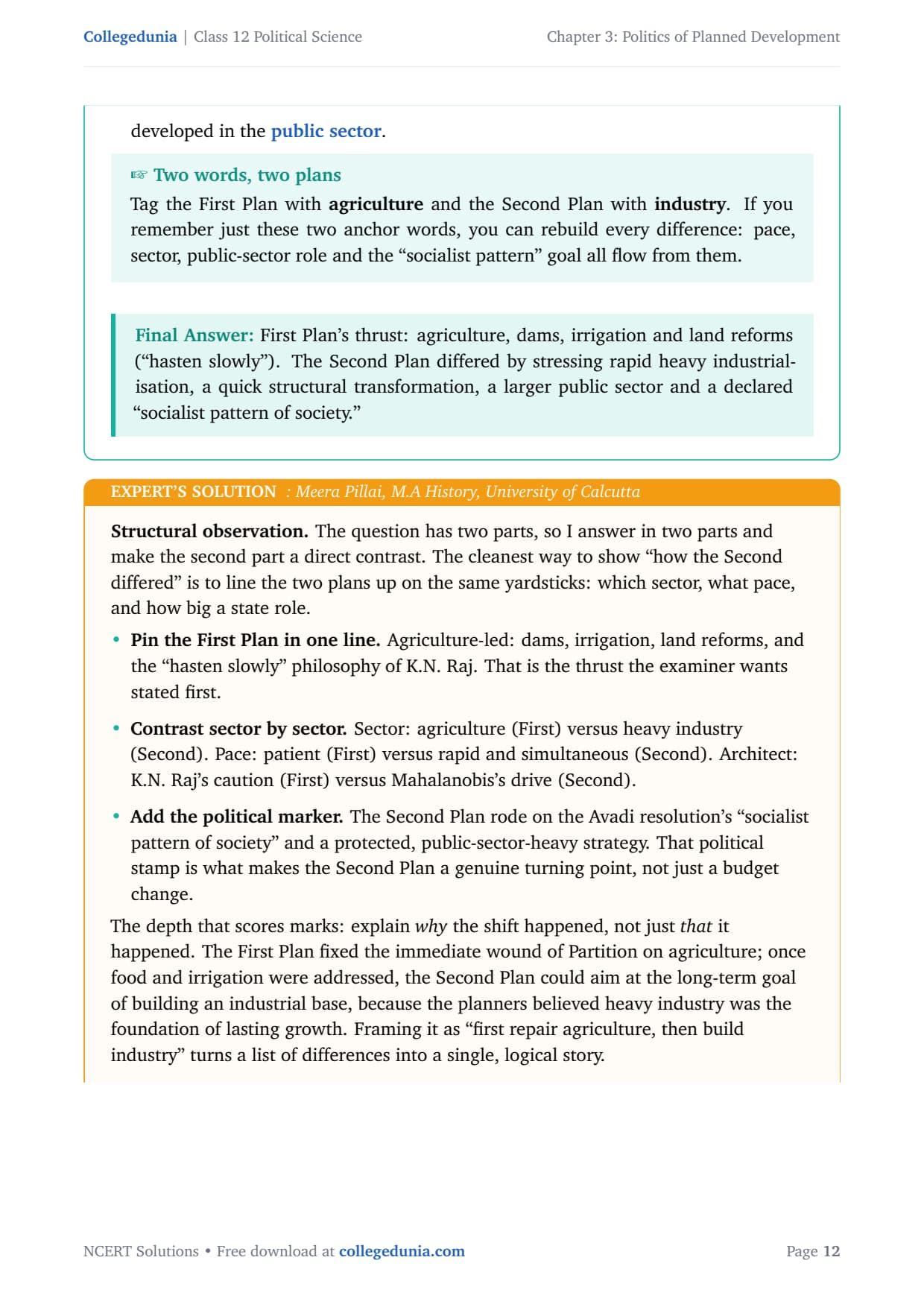
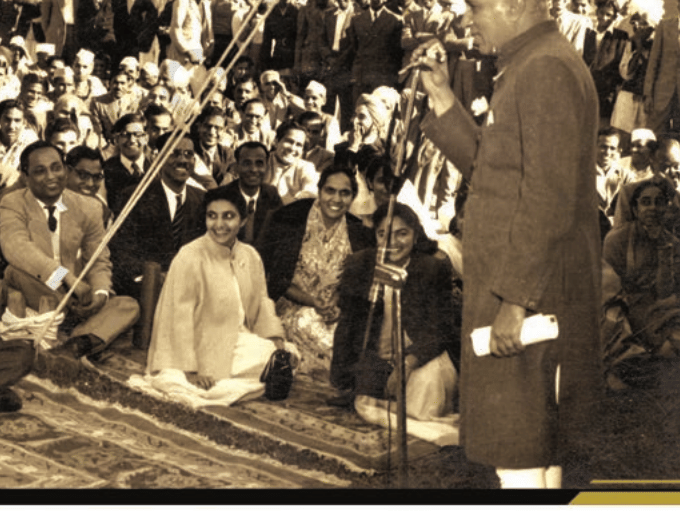
Nehru addressing the staff of the
Planning Commission, the central body that drew up the Five Year Plans.
NCERT Politics in India Since Independence, Class 12, Chapter 3.
How the Second Plan differed from the First:
Heavy industry instead of agriculture. The Second Plan
shifted the main thrust to heavy industries like steel,
electricity, railways, machinery and communication, while the
First Plan had centred on agriculture.
Quick transformation instead of patience. Where the First
Plan ``preached patience'' and went slowly, the Second Plan, drawn
up by a team under P.C. Mahalanobis, wanted rapid,
simultaneous, structural change across the economy.
A bigger public sector and a ``socialist pattern.'' Just
before the Second Plan, the Congress at its Avadi session declared
a socialist pattern of society as its goal. The state
imposed high tariffs to protect home industry, and key industries
were developed in the public sector.
Two words, two plans
Tag the First Plan with agriculture and the Second Plan with
industry. If you remember just these two anchor words, you can
rebuild every difference: pace, sector, public-sector role and the
``socialist pattern'' goal all flow from them.
First Plan's thrust: agriculture, dams, irrigation and land
reforms (``hasten slowly''). The Second Plan differed by stressing rapid
heavy industrialisation, a quick structural transformation, a larger public
sector and a declared ``socialist pattern of society.''
MP
Meera Pillai
M.A History, University of Calcutta
Verified Expert
Structural observation. The question has two parts, so I answer in
two parts and make the second part a direct contrast. The cleanest way to
show ``how the Second differed'' is to line the two plans up on the same
yardsticks: which sector, what pace, and how big a state role.
Pin the First Plan in one line. Agriculture-led: dams,
irrigation, land reforms, and the ``hasten slowly'' philosophy of
K.N. Raj. That is the thrust the examiner wants stated first.
Contrast sector by sector. Sector: agriculture (First)
versus heavy industry (Second). Pace: patient (First) versus rapid
and simultaneous (Second). Architect: K.N. Raj's caution (First)
versus Mahalanobis's drive (Second).
Add the political marker. The Second Plan rode on the
Avadi resolution's ``socialist pattern of society'' and a protected,
public-sector-heavy strategy. That political stamp is what makes
the Second Plan a genuine turning point, not just a budget change.
The depth that scores marks: explain why the shift happened, not
just that it happened. The First Plan fixed the immediate wound of
Partition on agriculture; once food and irrigation were addressed, the
Second Plan could aim at the long-term goal of building an industrial base,
because the planners believed heavy industry was the foundation of lasting
growth. Framing it as ``first repair agriculture, then build industry''
turns a list of differences into a single, logical story.
First Plan: agriculture-first (dams, irrigation, land reforms,
go slow). Second Plan differed by pushing rapid heavy industrialisation
under Mahalanobis, a bigger public sector, import-protecting tariffs and a
declared ``socialist pattern of society.''
Q 3.7
Read the following passage and answer the questions below: [3pt]
``In the early years of Independence, two contradictory tendencies
were already well advanced inside the Congress party. On the one hand, the
national party executive endorsed socialist principles of state ownership,
regulation and control over key sectors of the economy in order to improve
productivity and at the same time curb economic concentration. On the other
hand, the national Congress government pursued liberal economic policies
and incentives to private investment that was justified in terms of the
sole criterion of achieving maximum increase in production.'' : Francine
Frankel [4pt]
(a) What is the contradiction that the author is talking about? What would
be the political implications of a contradiction like this?
(b) If the author is correct, why is it that the Congress was pursuing this
policy? Was it related to the nature of the opposition parties?
(c) Was there also a contradiction between the central leadership of the
Congress party and its State level leaders?
Concept used. This passage describes a contradiction inside
the Congress party in the early years of Independence: it preached
socialism but practised liberal, pro-private-investment
policies at the same time. We answer the three sub-parts in order.
(a) The contradiction and its political implications. The
contradiction is that the Congress followed two opposite paths at
once. Its party executive endorsed socialist principles,
state ownership, regulation and control over key sectors, to raise
productivity and curb the concentration of wealth. Yet its
government followed liberal economic policies, giving
incentives to private investment to push up production. So the same
party was both pro-state and pro-private. Political implications: such a contradiction means policy can
look inconsistent and please neither side fully. It can create
confusion and tension within the party, give critics on both the
left and the right an opening to attack, and make it hard to fix a
single clear direction for development.
(b) Why the Congress pursued this policy. The Congress was
a broad, big-tent party that contained people of many views,
socialists, moderates and pro-business members, all under one roof.
To hold this wide coalition together, it tried to accommodate
everyone, which produced a mixed, middle-path policy. Was it related to the opposition? Yes, partly. The
opposition was scattered on both sides: socialist and communist
parties pulled from the left, while parties friendly to business
pulled from the right. By taking up a bit of each side's agenda,
the Congress could occupy the centre and leave little distinct
ground for the opposition to stand on.
(c) Contradiction between central and State leaders. Yes,
there was. The central leadership, especially Nehru,
leaned more firmly towards socialist, planning-led, pro-public-sector
ideas. Many State-level leaders, who were closer to
landlords, rich farmers and local business interests, were less
keen on radical socialist measures such as serious land reforms. So
the party's socialist promises at the top were often diluted or
slowed down when they reached the States.
Why the contradiction was useful
A contradiction is usually a weakness, but for a dominant party it can be a
strength. By holding both socialist and pro-business ideas together, the
Congress could appeal to almost everyone and keep its rivals boxed out.
That same breadth is what made it so dominant in this period.
(a) The Congress preached socialism but practised pro-private
liberal policy, an inconsistency that could confuse policy and invite
attack from both sides. (b) It did so to hold its broad coalition together
and to crowd out an opposition split between left and right. (c) Yes, the
socialist central leadership often clashed with more conservative
State-level leaders, who watered down measures like land reform.
IM
Ishaan Malhotra
M.A Political Science, Banaras Hindu University
Verified Expert
Strategic angle. A passage-based question rewards answers that
stay anchored to the passage and then add chapter knowledge. I treat the
three sub-parts as three short essays, each opening with a one-line direct
answer and then a reason, so the examiner sees the point before the
explanation.
(a) Name the contradiction crisply, then its fallout.
Socialism in principle, capitalism in practice: state control on
paper, private incentives in action. Politically, this hands
ammunition to both left critics (``not socialist enough'') and
right critics (``too much state''), and blurs the party's identity.
(b) Explain it through the Congress's nature. The Congress
was an umbrella party that had to keep socialists and businessmen
together. A mixed policy was the glue. And because the opposition
was divided between left and right, straddling the centre let the
Congress absorb both their appeals and stay dominant.
(c) Use the centre-versus-State fault line. Yes: a
socialist-minded high command under Nehru versus more conservative
State bosses tied to land and local capital. This is exactly why
bold reforms, land redistribution above all, were announced
nationally but blunted locally.
The insight that earns full marks: tie all three parts back to one idea,
that the Congress in this era was a ``catch-all'' dominant party. Its
ideological contradiction (a), its coalition-holding motive (b) and its
centre-State tension (c) are not three separate facts; they are three faces
of the same thing, a single party trying to be everything to everyone.
Saying that out loud shows the examiner you have understood the chapter,
not just the passage.
(a) Socialism preached, capitalism practised, an inconsistency
that exposed the party to criticism from both flanks. (b) The Congress was
a broad coalition that needed a mixed policy to stay united and to outflank
a left-and-right-split opposition. (c) Yes, the socialist central
leadership clashed with conservative State leaders, who diluted measures
such as land reform.
FAQs on Politics of Planned Development Class 12 NCERT Solutions
Politics of Planned Development Class 12 Political Science Common Questions
Ques. Where can I get the class 12 political science chapter 3 NCERT Solutions PDF?
Ans. You can download the Politics of Planned Development Class 12 Political Science NCERT Solutions PDF directly from this page. It is free, follows the 2026-27 NCERT, and answers all 7 exercise questions step by step.
Ques. How many questions are there in Politics of Planned Development class 12 questions and answers?
Ans. The chapter has 7 exercise questions. The first four are MCQ and match-the-following items, while Questions 5 to 7 are short, long and passage-based written answers, including a source-based question by Francine Frankel.
Ques. What was the major difference between the First and Second Five Year Plans?
Ans. The First Plan (1951 to 1956) stressed agriculture, dams, irrigation and land reforms, and followed a "hasten slowly" approach. The Second Plan (1956 to 1961), drawn up under P.C. Mahalanobis, shifted to rapid heavy industry, a bigger public sector and a declared "socialist pattern of society".
Ques. What was the Bombay Plan in Politics of Planned Development?
Ans. The Bombay Plan was a joint proposal drafted in 1944 by a section of leading industrialists. It asked the State to lead investment in industry and strongly supported the idea of planning. It was a private input into the planning debate, not the official national blueprint.
Ques. Why is development called a political choice in this chapter?
Ans. Because every development decision helps some groups and hurts others, as the Orissa-POSCO case shows. Choosing a steel plant over tribal land, or industry over agriculture, weighs one group's needs against another's, so it must be decided by people's representatives through public debate, not by experts alone.
Ques. Is class 12 political science chapter 3 easy to score in the board exam?
Ans. Yes. It is a high-scoring chapter if you keep the two plans straight and remember the capitalist-versus-socialist debate. Practise the MCQs and the match question, and keep the First Plan and Second Plan contrast ready for the long answer.










Comments