



Exams Prep Master
Aluminium phosphate is an ionic compound formed by reacting aluminium with phosphoric acid. It is white and odourless, and is not soluble in water. It has several uses, such as catalyst and ion-exchanger. It is mainly used in its gel form, but can also be found commercially in its liquid or gel form. It is an acidic salt, and reacts exothermically with bases in a neutralization reaction. It has a melting point of 1800 °C and a density of 2.567 g/ml-1. Let’s learn more about the compound and discuss some important questions.
Read more: First Order Reactions
| Table of Contents |
Key takeaways: Aluminium Phosphate, Inorganic Compound, Alkaline, Anhydrous Salt, Aluminium Salt.
What is Aluminium Phosphate?
[Click Here for Sample Questions]
Aluminium phosphate, a highly toxic inorganic compound, is prepared by exposing soluble aluminium salts to alkaline conditions containing hydrated aluminium orthophosphate with the formula AlPO4.

Aluminium Phosphate
The highly viscous aluminium phosphate solutions tend to form polymeric aggregates, and equilibria are reached only very slowly. It reacts slowly with gastric acid to form soluble aluminium salts and phosphoric acid. It absorbs bile acids less strongly than aluminium hydroxide.
Read more: Hydrogen Spectrum
Aluminium Phosphate Structure
[Click Here for Sample Questions]
Aluminium phosphate exists in nature as berlinite, a mineral. Its chemical formula is AlPO4, and its structure is as shown below. It exists in nature as its anhydrous salt, and also in its dihydrate (AlPO4.2H2O) and pentahydrate forms (AlPO4.5H4O). The anhydrous salt structure is similar to quartz, with a trigonal crystal system.
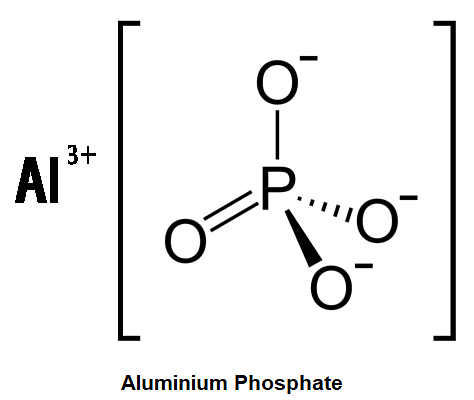
Aluminium Phosphate Structure
Properties of Aluminium Phosphate
[Click Here for Sample Questions]
| AlPO4 | Aluminium Phosphate |
| Density | 2.57 g/cm³ |
| Molecular Weight/ Molar Mass | 121.9529 g/mol |
| pH | 3.0 to 7.5 |
| Melting Point | 1,800 °C |
| Chemical Formula | AlPO4 |
Physical Properties of Aluminium Phosphate
- Aluminium phosphate can be a white crystalline powder, and when in its aqueous form, it’s a colourless liquid.
- It has a foul odour in aqueous form.
- When in its solid state, it has a density of 2.56gcm3.
- It has a melting point of 1800°C.
- When it reaches its boiling point, it decomposes.
- It is completely insoluble in water, and partially soluble in hydrochloric acid and nitric acid.
- It has a molar mass of 121.9529 g/mol in its powder form.
- It has a refractive index of 1.546.
Chemical Properties of Aluminium Phosphate
- It is an acid, and neutralises bases. This neutralisation releases heat.
- It doesn’t usually act as an oxidising or reducing agent, but it is still a possibility.
- It helps catalyse certain reactions.
- When aluminium phosphate is reacted with hydrochloric acid, the products are aluminium trichloride and phosphoric acid.
AlPO4 + 3HCL → AlCl3 + H3PO4
- When aluminium phosphate is reacted with magnesium chloride, the products are aluminium trichloride and magnesium phosphate.
2AlPO4 + 3MgCl2 → Mg3(PO4)2 + 2AlCl3
- It displays piezoelectric properties
- It is a chiral molecule
Read more: Electronic Configuration of Iron
Safety
[Click Here for Sample Questions]
- It is corrosive to the tissues, i.e. eyes and skin.
- It is toxic to be inhaled, ingested, or to come into contact with the skin.
- It can release toxic fumes on heating.
- It is non-combustible, so it doesn’t burn on its own.
- It can ignite other combustibles such as oil and paper.
- Flammable hydrogen gas can be released upon contact with metals.
- Containers holding aluminium phosphate may be subject to exploding upon heating.
- Gives an extreme reaction upon interaction with reducing agents or strong bases.
- Leftover waste or runoff can corrode surfaces and pollute areas.
Preparation of Aluminium Phosphate
[Click Here for Sample Questions]
- An aluminium salt is treated with phosphoric acid to give aluminium phosphate.
- This aluminium salt could be one of hydroxide, nitrate, or an alkoxide.
- It has to be done under controlled pH and an organic amine has to be present.
- Given below is an example of one such reaction.

Preparation of Aluminium Phosphate
Uses of Aluminium Phosphate
[Click Here for Sample Questions]
Aluminium phosphate has several uses, and can be found in many substances:
- Aluminium phosphate can be used as a high-temperature dehydrating agent
- It can be found used in ceramics as flux, for example, it works as cement mixed with calcium sulphate and sodium silicate.
- It can also be used as an antacid, which provides comfort to people suffering from acidity.
- It can be found in dried gel.
- It has the traits desirable in a catalyst as well as a catalyst support. It can be the catalyst for almost all the reactions that boron phosphate has been the catalyst for, at a lower level of activity.
- It has been used as an adsorbent.
- Since aluminium has dual acid-base properties, it can make the Prins reaction happen.
- One of its main uses is as a binder.
- It’s also used as a curing agent when producing high-temperature refractory materials to be used in kiln.
- Its porous structure ensures that it has been used vastly in ion exchange and separations.
- It can be used as a fungicide due to its lethal properties.
- It can be used as a vaccine adjuvant, to enhance the effect of vaccine on the body.
- It can be used as an adhesive due to its strong surface attachment properties, and due to the fact that it resists separation.
Read more: P-Block Elements MCQ
Things to Remember
- Aluminium phosphate is a white solid, and can be found in the industry in liquid, powder, or gel form.
- It is formed by reacting an aluminium salt with phosphoric acid.
- It can be toxic when not handled properly.
- It is corrosive, and can act as a pollutant.
- It is used as a catalyst in several reactions, among some other uses.
- It can’t dissolve in water and can only partially dissolve in HCl and HNO3.
Sample Questions
Ques 1. Describe the structure of aluminium phosphate. (2 marks)
Ans. Aluminium phosphate is formed by an aluminium cation and a phosphate anion ionically bonded together in a trigonal crystal manner.
Ques 2. Give 5 of aluminium phosphate’s physical properties. (3 marks)
Ans.
- It is white in powder form, and colourless in aqueous form.
- It has a high melting point of 1800°C.
- It decomposes when it reaches its boiling point.
- It has a density of 2.56 gcm3
- It has a refractive index of 1.546
Ques 3. Name 5 uses of aluminium phosphate. (3 marks)
Ans.
- Catalyst
- Antacid
- Vaccine adjuvant
- Adhesive
- Fungicide
Ques 4. What goes into the formation of aluminium phosphate. (1 marks)
Ans. Aluminium phosphate is formed by reacting an aluminium salt, such as aluminium hydroxide or aluminium nitrate, with phosphoric acid.
Ques 5. What are some of the safety concerns around aluminium phosphate? (1 marks)
Ans. It causes irritation for the nose, eyes, and throat. It can react violently with water or any type of humidity to release extremely toxic fumes.
Ques 6. What is the reaction of aluminium phosphate as an antacid? (2 marks)
Ans. As aluminium phosphate is an antacid, it provides comfort to the stomach by reacting with stomach acid (HCl) and forming neutral AlCl3.
Ques 7. Give 2 examples of chemical reactions of aluminium phosphate. (2 marks)
Ans. AlPO4 + 3HCL → AlCl3 + H3PO4
2AlPO4 + 3MgCl2 → Mg3(PO4)2 + 2AlCl3
Ques 8. List 3 chemical properties of aluminium phosphate. (2 marks)
Ans.
- It is an acid and reacts exothermically with bases.
- It exhibits chirality
- It is piezoelectric
Check-Out:



Comments