



Exams Prep Master
The anatomy of a flowering plant can be explained as the study of the internal organism structure of a particular flowering plant. We know that, like every living thing, plants too have cells. A group of cells that have similar functions and a common origin makes a tissue. Hence, to understand the detailed anatomy of a flowering plant, we need to understand the various tissues of the plant. Based on the ability of cell formation and division, these tissues can be divided into two basic groups- 1. Meristematic Tissue, 2. Permanent Tissue. These two can be further divided into various sub-categories.
NCERT Solutions of: Class 11 Biology Chapter 6 Anatomy of Flowering Plants
Very Short Answer Questions [1 Mark Questions]
Ques.1. Where is the product of photosynthesis stored?
Ans. The product of photosynthesis is stored in Phloem, which is a type of Complex Permanent Tissue.
Ques.2. What are Casparian strips?
Ans. The thickenings of lignin and suberin formed around the artificial walls of the endodermis are called Casparian strips. Casparian strips are helpful to prevent plasmolysis.

Ques.3. Name the tissue represented by the jute fibers used for making the ropes.
Ans. The name of the tissue represented by the jute fibers used for making the ropes is Sclerenchyma.
Ques.4. What are the three types of meristematic tissues?
Ans. Meristematic tissues are a kind of plant tissue, that is a group of young and actively dividing cells. The three types of Meristematic tissue are-
- Apical Meristem
- Intercalary Meristem
- Lateral Meristem
Ques.5. Why are xylem & phloem called complex tissues?
Ans. Complex tissues are those that include more than one type of cell. In the case of xylem and phloem, there are different types of cells that work together as a unit. Hence, xylem and phloem are called complex tissues.

Xylem and Phloem
Ques.6. What is the function of tracheids?
Ans. The functions of tracheids are to transport water. It also provides mechanical supports to the tree.
Ques.7. Name two specialized kinds of parenchyma.
Ans. Aerenchyma and Chlorenchyma can be counted as the two special types of parenchyma.

Aerenchyma and Chlorenchyma
Ques.8. Name the aerating pores in the bark of stems.
Ans. The name of the aerating pores in the bark of step is Lenticels.
Read more: Differences between Monocot and Dicot stem
Short Answer Questions [2 Marks Questions]
Ques.1. State the differences between the guard cells and epidermal cells. Which epidermal cell surrounds the guard cell?
Ans.
| Guard Cells | Epidermal Cells |
|---|---|
| 1. Guard cells contain Chloroplast. | 1. Whereas the Epidermal cells do not include Chloroplast. |
| 2. Guard cells are smaller in size and it is kidney-shaped. | 2. Whereas the Epidermal cells are comparatively larger in size and are barrel-shaped. |
| 3. Guard cells have thick and non-uniformed walls. | 3. Epidermal cells have thin and uniform walls. |
Ques.2. Mention four characteristics of sunflower's vascular bundles.
Ans. Here are the four characteristics of sunflower’s vascular bundles-
- Xylem and phloem have the same radius.
- Sunflower’s vascular bundles are open and generally collateral.
- In this case, the phloem is external and the xylem is internal.
- There is a cambium present between the xylem and phloem.
Ques.3. From which part of the plant are these plant fibers obtained?
- Jute
- Hemp
- Cotton
- Coir
Ans. 1. Jute is obtained from Corchoruscapsularis
2. We get Hemp from the Stem of Cannabis sativa
3. Cotton can be derived from Gossypiumhirsutum seeds.
4. Coir is obtained from Coconut Husk.
Ques.4. What is phellogen? What does it produce?
Ans. According to the Merriam-Webster dictionary, the phellogen can be defined as “a secondary meristem that initiates phellem and phelloderm in the periderm of a stem or root”. It is also called cork cambium.
Phellogen, which is developed from hypodermal cells, helps to protect the inner tissues. It is also able to produce secondary tissues.
Ques. 5. Why do we notice distinct rings in the tree of the temperate region while the tree of the coastal area is not distinct?
Ans. The activities of the cambium are highly affected by the weather conditions. Therefore, in temperate regions, the cambium activity varies from time to time as the weather changes. Whereas, in coastal areas, the weather remains almost the same resulting in a steady cambium activity throughout the year. As a result of this phenomenon, we notice different types of ring formations between the trees of the temperate region and the coastal region.
Ques.6. What value is the study of plant anatomy?
Ans. The anatomy of a plant can be explained as the study of the internal organism structure of a particular flowering plant. The study of the anatomy of a plant is very important because-
- By understanding the anatomy of any plant, we get to know about the structure and mechanical properties of that plant.
- We can use the knowledge of the plant anatomy to produce various plant-based products like- coffee beans, jute, cotton, various spices, plant-based medicines, etc.
- This knowledge can also help us to categorize plants and conclude about the age of the old trees.
Read More: Difference Between Dicot and Monocot Root
Long Answer Questions [3 Marks Questions]
Ques.1. Draw a well-labeled diagram of T.S. of monocot stem.
Ans. The hollow circular-shaped axial part of a plant that controls the rise to nodes, flowers, leaves, etc. is called the Monocot stem. This kind of stems can be seen in different sizes and forms depending upon the types of plants. It has vascular bundles near the outer part of the stem.
Here is a labeled diagram of t.s. of monocot stem-

Labeled diagram of T.S. of monocot stem
Ques.2. State the location & function of different types of meristems.
Ans. Meristematic tissues are a kind of plant tissue, that is a group of young and actively dividing cells. The three types of Meristematic tissue are-
- Apical Meristem
- Intercalary Meristem
- Lateral Meristem
- Apical Meristem:
Location- Apices of stems, roots, and branches.
Function- Helps in the growth of any plant.
- Intercalary Meristem:
Location- Internodes and stem region
Function- Helps in the growth of the middle part of any plant
- Lateral Meristem:
Location- Near the side edges of the stem.
Function- Makes the plants thick.
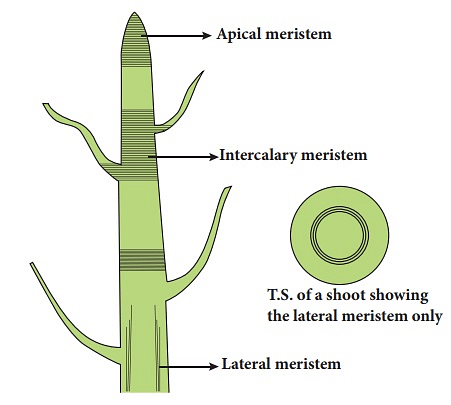
Different types of Meristematic Tissues
Ques.3. Give the differences between sapwood and heartwood?
Ans. Here are the basic differences between Hardwood and Sapwood-
| Heartwood | Sapwood |
|---|---|
| Heartwood is dark-colored and heavily weighted. | In comparison, Sapwood is light-colored and less heavy. |
| Heartwood cells are older as it is situated in the central part of an old stem. | Sapwood cells are comparatively juvenile as they can be seen on the outer edge of any old stem. |
| It is a durable wood and suitable for making furniture. | Sapwood is not much durable, hence, not suitable for making furniture. |
| Heartwood is actually a non-functional part of the xylem. | Whereas, the sapwood is a proper functional part of the xylem. |
| Examples- Pine, Beech, Ash, Maple, etc. | Examples- Chestnut, Mulberry, Sassafras, etc. |
Ques.4. What is a stomatal apparatus? Draw a well-labeled diagram of stomata.
Ans. Stomata can be described as the tiny pores or holes that can be found in the epidermis of leaves. It helps in regulating gaseous exchange. These tiny pores are surrounded by the guard cells.
These tiny stomatal pores, those guard cells, and the subsidiary cells all together create the stomatal apparatus.
Here is a labeled diagram of stomata-
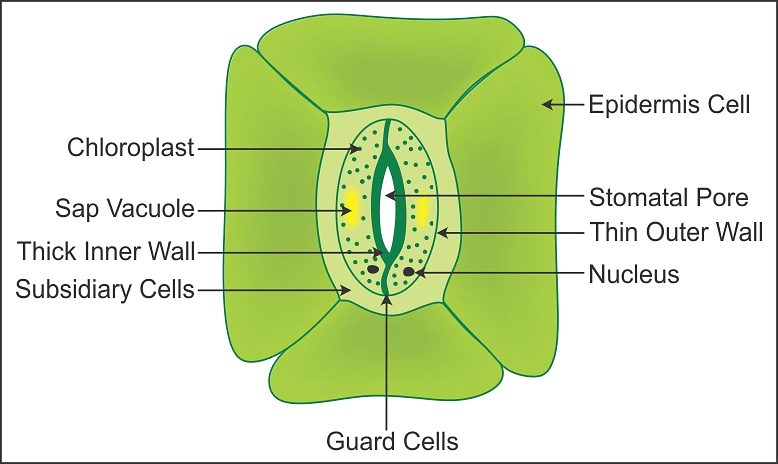
A labeled diagram of stomata
Read More: Monocot Dicot Plants Anatomy
Very Long Answer Questions [5 Marks Questions]
Ques.1. Describe the elements of the xylem with the help of a suitable diagram.
Ans. Xylem is a specialized complex permanent tissue. It helps transport water and other necessary elements from the root to the whole body of a plant. It also works as the storage for the plants. Hence, it can be categorized as vascular tissue.
It includes four basic parts or elements-
i) Tracheids
ii) Vessels
iii) Xylem Parenchyma
iv) Xylem Fibers
- Tracheids: These are dead parts of the xylem that look like a long tube. Tracheids work as water and minerals conductors.
- Vessels: Vessels are also a dead and comparatively narrow element of the xylem. It is tube-like in structure and helps to channel foods and water from the roots to the other parts of the plant.
- Xylem Parenchyma: Unlike tracheids and vessels, xylem parenchyma is living cells. They store the food and help transport the substances.
- Xylem Fibers: These fibers are consisting of dead sclerenchymatous cells, which are also called wood fibers. It helps in supporting and strengthening plants.
Here is the diagram of the elements of xylem-

Ques.2. Describe briefly the various types of vascular bundles.
Ans. Vascular bundles can be defined as the collection of tube-shaped tissues that helps in the circulation of important substances throughout the whole-body parts of a plant.
Vascular bundles can be mainly divided into three types- Radial, Conjoint, and Concentric. These vascular bundles can be divided further.
- Radial Vascular Bundles: It is an uncomplicated formation of xylem and phloem. In this case, xylem and phloem stay side by side on different radii, where they remain separated by non-conductive tissues. Radial vascular bundles can be found in the dicot and monocot roots.
- Conjoint Vascular Bundles: It is an arrangement where the xylem and phloem stay in the same radius. It can be seen in the stems and leaves.
Conjoint vascular bundles can be further divided into two categories- Collateral and Bicollateral.- Collateral: As a type of conjoint vascular bundle, the collateral vascular bundle too has xylem and phloem on the same radius, where the xylem is situated internally and the phloem is situated externally.
This type can be further divided into open and closed collateral bundles. - Bicollateral: In this case, phloem can be found in two parts. One part of the phloem is situated outside the xylem and the other part of the phloem is situated on the inner side of the xylem tissues.
This kind of vascular bundles can be found in pumpkins.
- Collateral: As a type of conjoint vascular bundle, the collateral vascular bundle too has xylem and phloem on the same radius, where the xylem is situated internally and the phloem is situated externally.
- Concentric Vascular Bundles: In this kind of vascular bundles, one type of tissue surrounds the other type of tissue. These can be further divided into two categories-
Amphicribal, where phloem surrounds the xylem; and Amphivasal.
Ques.3. What is wood? What are its different types?
Ans. Wood is the combination of porous and fibrous structural tissues that can be found in the stems of trees. It is actually the secondary xylem that is created by the metabolism of a plant. Wood includes the plant body, especially the dicot stems and roots. Woods can be categorized into six types that are- Hardwood, Softwood, Heartwood, Sapwood, Earlywood, and Latewood.
- Hardwood: Hardwood is produced from Angiosperms. It is mostly made of xylem vessels. Therefore, it is also called porous wood. Examples- Cedar, Larches, Cypresses, etc.
- Softwood: it is produced from Gymnosperm. It is mostly made of xylem tracheids. Therefore, it is also called non-porous wood. Examples- Pine, Fir, Spruce, etc.
- Heartwood: Heartwood is formed while secondary growth happens. Heartwood is dark-colored and heavily weighted. It is actually a non-functional part of the xylem. Examples- Pine, Beech, Ash, Maple, etc.
- Sapwood: Sapwood cells are comparatively juvenile as they can be seen on the outer edge of any old stem. It contains living cells. Examples- Chestnut, Mulberry, Sassafras, etc.
- Earlywood: Earlywood can be created during favorable weather conditions. The formation of the vessels and tracheids dimensions are comparatively larger.
- Latewood: Lakewood can be formed during unfavorable weather conditions. The formation of the vessels and tracheids dimensions are comparatively smaller.
Related links:



Comments