



Content Curator
Antilog Table is a table designed to reduce the calculations while finding the antilog of any number. The inverse of the log function is a function called antilog. As we use log tables for using the calculation for finding the log, similarly we use antilog tables for finding antilog.
- The antilog of any number, whether positive or negative, is always positive since antilog (x) is equal to 10x.
- When we find the antilog of a number, use its mantissa to see its corresponding number from the log table, and use its characteristic for placing the decimal point.
- Every time we use a logarithm to perform a calculation, we must first simplify the expression's log before applying antilog. Make sure that mantissa is positive.
Antilog, also known as "Anti-Logarithms," of a number is the opposing method of determining its logarithm. We can say that y is the antilog of x to b if x is the logarithm of the number y with base b. Let’s assume log y = x, then we have y = antilog x
The basis of a logarithm and an antilog is 2.7183. If the base of the logarithm and antilogarithm is 10, they should be multiplied by 2.303 to obtain the natural logarithm and antilog.
Read Also: Mean, Median and Mode
Key Terms: Antilog Table, Antilogarithm, Logarithms, Characteristic, Mantissa, Logarithmic Expressions
What is Antilog Table?
[Click Here for Sample Questions]
The Antilog table provides us with the antilog values of any positive or a negative number. The inverse of the logarithmic function is known as Antilog of that particular number, i.e., if log x = y then we have x = antilog (y).Thus, if "log" switches place across the equal to “=” sign then it becomes an antilog. So
log x = y ⇒ x = antilog (y) …….. (1)
However, we can change a logarithmic equation into an exponential equation by applying the log formula. From this,
log x = y ⇒ x = 10y …….. (2)
From the above two equations, (1) and (2) we can say that antilog(y) = 10y. This is referred to as the antilog formula. For example:
- antilog (2) = 102 = 100
- antilog (-3) = 10-3 = 0.001
- antilog (3.572) = 103.572 = ?
The final antilog, which is antilog (3.572) = 103.572 ≈ 3732, can only be determined with a calculator.
Common Antilog Table
[Click Here for Sample Questions]
There are 3-blocks in the anti-log table.
- The first block of the table is the first column, i.e., main column, which has numbers from .00 to .99.
- The second block of the table is the differences column, which shows the digits from 0 to 9.
- The third block of the table is the mean differences columns, this column shows the digits from 1 to 9.
The values of the number's characteristic part and mantissa part can be found using the table below.
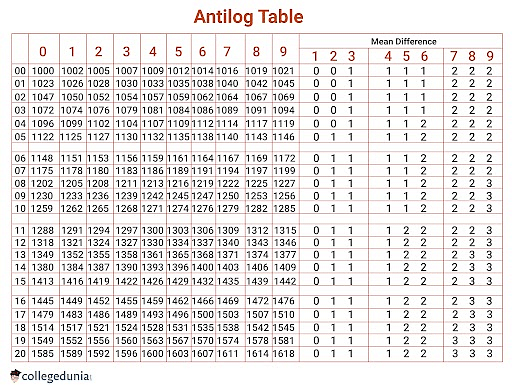
Detailed Antilog Table Diagram
Also Read:
How to Use Antilog Table?
[Click Here for Sample Questions]
For every number's logarithm, antilog is calculated. We are aware that the mantissa must always be positive and that the characteristic might be either positive or negative when expressing the logarithm of any number.
Calculating Antilog
[Click Here for Sample Questions]
First we need to know about the characteristic and mantissa part so we can find the antilog of a number.
Characteristic Part
The whole part of the value is called the characteristic part. If the characteristic of the logarithm of any number greater than one is positive and is one less than the number of digits in the left side of the decimal point.
Mantissa Part
The mantissa section, which is always a positive value, is the decimal portion of the logarithm number for the supplied number. If the mantissa part is in a negative value, convert into the positive value.

Antilog Classification
Let’s consider a number 7.345
Here,
- 7 is the characteristic
- 345 is the mantissa
Finding Antilog
[Click Here for Sample Questions]
There are two ways to calculate the Antilog of a number. They are:
Method 1: Find Antilog using the Antilog Table?
Here is how you use the antilog table to determine the antilog of a given number. Let's assume that antilog will be discovered (3.5723).
- Step 1: Locate the mantissa and characteristic. Mantissa in this case is 5723, and the characteristic is 3.
- Step 2: Now work on the mantissa part in this step. Find the matching number from using the first two digits following the decimal point as the row number and the third digit as the column number of the log table. The number that corresponds to row 0.57 and column 2 is 3733.
- Step 3: Find the mean difference that corresponds to the fourth digit of the mantissa in the same row. Add this to the value we got in Step 2. Here, the 4th digit of the mantissa is 3 and the corresponding mean difference is 3.
→ 3733 + 3 = 3736 - Step 4: Always place a decimal point immediately following the first digit (of the number from Step 3). Then it becomes 3.736.
- Step 5: Following the same, multiply the number received from Step 4 by 10characteristic.
The result we get is the antilog of that number.
Hence, Antilog (3.5723) = 3.736 × 103 = 3736.
Method 2: Finding Antilog Without Using Antilog Table
The antilog(x) formula is antilog(x) = 10x in the first part. But only when x is an integer can this formula be applied without a calculator. Calculating 10x will require the assistance of a calculator if x is not an integer.
Antilog (3.5723) = 103.5723 ≈ 3735 was right since it is quite close to the earlier response. Here are more examples:
- Antilog of 1 = 101 = 10
- Antilog of 2 = 102 = 100
- Antilog of 3 = 103 = 1000
- Antilog of 4 = 104 = 10000
Antilog Table Calculations
[Click Here for Sample Questions]
The log and antilog tables' primary use is to simplify the process of multiplying, dividing, finding exponents, and determining square roots or other roots. For simplifying an expression involving product, quotient, or exponents:
- Apply log first.
- To expand the log, use the following logarithm properties.
log (xy) = log x + log y
log (x/y) = log x - log y
log xm = m log x - Then reduce the expression to a single integer, use the log table to get the logarithm of each number.
- The outcome of the above will be determined by using the antilog table to find the antilog of the number from the previous step.
Things to Remember
- Any positive or negative number has a positive antilog, regardless of sign.
- When calculating the antilog of a number, the relevant number from the log table is selected using the mantissa of the number, and the decimal point is located using the characteristic of the number.
- Any calculation involving logarithms requires the application of antilog after the log of the equation has been simplified.
- When finding negative numbers, we add and subtract 1 to make mantissa positive.
- If log y = x, then the outcome is y = antilog x.
Read More:
Previous Year Questions
- If log72=?, then the value of log49(28) is….
- The derivative of y = xsinx is...[UPSEE 2016]
- The derivative of (logx)x with respect to log x is….
- The differential coefficient of f (Sinx) w.r.t. x where f(x)=logx….[KCET 2004]
- The differential coefficient of log10x with respect to logx10 is…[KCET 2016]
- The sum of the divisors of 24⋅33⋅53 is…..
- The value of =dxd[xnlogaxex]=…
- The value of dxd[xnlogaxex] is...[JKCET 2013]
Sample Questions
Ques: Find the antilog of 2.7531 (4 marks)
Ans: To find the antilog of the number 2.7531, we have to:
- Step 1: First, separating the characteristic from the mantissa. Here, the mantissa portion is 7531 and the characteristic part is 2.
- Step 2: Find mantissa value that corresponds using the antilog table. Choose the column number after determining the row number that is equal to 75. The corresponding value is 5662.
- Step 3: Now from the mean difference column, use the .75 row once more to get the value that belongs in column 1. The value in this instance is 3.
- Step 4: Add values got in stages 2 and 3. In this case, 5662 + 3 = 5664.
- Step 5: Now the decimal is added. Step 1 gives us a distinctive component. Add 1 to the characteristic part. In this instance, we discovered that the characteristic portion is 2. Thus, there must be three integers before the decimal point in this case.
Therefore, the antilog of 2.7351 = 566.4
Ques: Find the antilog of 1.4265. (3 marks)
Ans: Step 1: First, separate the characteristic from the mantissa component. Here, the mantissa portion is 4265 and the characteristic part is 1.
Step 2: Determine the mantissa, by choosing the column number after determining the row number that corresponds to .42. The corresponding value is 2667.
Step 3: Go to the column for the mean difference now. Use the.42 row once more to get the value that belongs in column 5. The value in this instance is 4.
Step 4: Combine the figures you ascertained in stages 2 and 3. In this case, 2667 + 4 equals 2671.
Step 5: Here, the decimal is added. Step 1 gives us a distinctive component. In this instance, we learned that the distinctive component is 1.
Therefore, the antilog of 1.4265 = 26.71
Ques: Find the antilog of 3.3010. (3 marks)
Ans: Given, antilog (3.3010)
- Step 1: Mantissa part = 3010 and characteristics portion = 3.
- Step 2: Use the antilog table to calculate row.30 and column.1, which gives you 2000.
- Step 3: Determine the value in the mean difference column for the rows 0.30 and 0, which yields the value 0.
- Step 4: Add the results from steps 2 and 3 to get 2000 + 0, which is 2000.
- Step 5: Now insert the decimal place. We are aware that the characteristic part is 3, and we must add 1 to it. Therefore, we get the value 4. We obtain 2000 when we add the decimal point after four places.
As a result, 2000 is the answer to the antilog 3.3010 problem.
Ques: Using the antilog table, get the antilog of the following numbers: (a) 0.0052 (b) -3.2778. (2 marks)
Ans: (a) 0.0052 = 0 + 0.0052.
Its mantissa is 0.7222 and its characteristic is -4.
Find the number in row.72 and column 2, then multiply it by the corresponding mean difference in column 2.
So we get 1012+0 = 1012.
Then antilog (0.0052) = 1.012 × 100 = 1.012.
(b) -3.2778= -3 - 0.2778
= (-3-1) + (1 - 0.2778)
= - 4 + 0.7222
Its mantissa is 0.7222 and its characteristic is -4.
Find the number in row.72 and column 2, then multiply it by the corresponding mean difference in column 2.
Ques: Evaluate √(0.00153) using log and antilog table. (5 marks)
Ans: Let x = √(0.00153) = (0.00153)1/2.
Apply log on both sides:
log x = log (0.00153)1/2
= 1/2 log (0.00153) (Using the property of logarithms)
= (1/2) (-2.8153) (Using the log table)
= -1.40765
Now, take antilog on both sides. Then
x = antilog (-1.40765)
Here, we have -1.40765= -1 - 0.40765 = (-1 - 1) + (1 - 0.40765) = -2 + 0.59235.
Here, mantissa is 0.59235. Find the value in the row and column 2 of the antilog table's column 2 that is labelled 0.59, and then add that row's mean difference to column 3 of the identical table (we are ignoring the 5th digit which is 5 here as the antilog table can be used only till 4 digits). 3908 + 3 = 3911 is the result.
When you add a decimal point immediately behind the first digit, you get 3.911. Multiply this by 10characteristic = 10-2.
Next, x = antilog(-1.40765) = 3.911 × 10-2 = 0.03911 is obtained.
Therefore, √(0.00153) ≈ 0.03911.
Ques: Use log and antilog tables to multiply 6.723 by 21.572. (4 marks)
Ans: Let x = 6.723 × 21.572.
Taking log on both sides,
log x = log (6.723 × 21.572)
Using one of the properties of logarithms,
log x = log 6.723 + log 21.572
Using the log table,
log x = 0.8276 + 1.334
log x = 2.1616
Using anti logarithms,
x = antilog (2.1616)
Using antilog table,
x = 145.1
Hence we get the approximation value of 6.723 × 21.572 is 145.1.
Ques: Does Antilog Exist for Negative Numbers? (1 mark)
Ans: In response, a number's logarithm can either be positive or negative. Yes, antilog exists for negative integers as well because it is the inverse of log. To conclude:
Despite producing both positive and negative values, a log only exists for positive numbers.
Both positive and negative numbers can have an antilog, although it can only produce positive values.
Ques: How to Convert Antilog into Log? (1 mark)
Ans: Since antilog is the inverse of log, it follows that whenever antilog (x) = y, x = log y. Or, to put it another way, "y is the antilog of x" if "x is the logarithm of y".
Ques: How to Convert Log into Antilog? (1 mark)
Ans: The two functions that are inverses of one another are log and antilog. Log thus becomes an antilog when it is moved to the opposing side of the equation. For instance, if log (m) = n then m = antilog (n).
Ques: Why Do We Use Antilogarithm Tables? (1 mark)
Ans: We use the antilogarithm table to calculate the antilog of a number. For instance, if there is a logarithmic equation like log x = y, then we can track the actual value of x using x = antilog (y).
Check-More:



Comments