




AP EAPCET Syllabus 2027 (also searched as AP EAMCET syllabus 2027) is based on the Andhra Pradesh Intermediate (Class 11 and Class 12) curriculum. The AP EAPCET MPC syllabus for the Engineering paper covers Mathematics, Physics and Chemistry. The AP EAPCET BiPC syllabus for the Agriculture and Pharmacy paper covers Botany, Zoology, Physics and Chemistry. APSCHE has not yet released the 2027 syllabus, and the notification is expected in February 2027.
- AP EAPCET (earlier AP EAMCET) is a computer-based test of 160 questions in 3 hours, with 1 mark for each correct answer.
- There is no negative marking, so you can attempt every question.
- The Engineering paper has Mathematics (80 questions), Physics (40 questions), and Chemistry (40 questions).
- The Agriculture and Pharmacy paper has Botany (40 questions), Zoology (40 questions), Physics (40 questions), and Chemistry (40 questions). It has no Mathematics section.
- Mathematics alone carries 50% of the Engineering paper. So you must focus more on this section.
- The 2027 syllabus PDF is not out yet. The 2026 syllabus is the best reference until the notification is released.
- The AP EAPCET syllabus is issued separately for the MPC stream (Engineering) and the BiPC stream (Agriculture and Pharmacy). Physics and Chemistry are common to both.
- Applications of Derivatives, Conic Sections, Laws of Motion, Current Electricity, and p-Block Elements are among the most important chapters in past papers.
- AP EAMCET Exam Pattern 2027: Marking Scheme, Subject-Wise Questions, Important Topics, and Duration
- AP EAMCET Chapter-Wise Weightage: Check Topic-Wise Marks, High-Weightage Chapters
- AP EAMCET Previous Year Question Paper- Download Solution PDF with Answer Keys
Key Summary
- AP EAPCET 2027 is expected in May 2027, with the notification expected in the first week of February 2027.
- The syllabus follows the AP Intermediate first-year and second-year courses (Intermediate 1A, 1B, 2A and 2B for Mathematics).
- The MPC syllabus covers Mathematics, Physics and Chemistry. The BiPC syllabus covers Botany, Zoology, Physics and Chemistry.
- Engineering has 6 Mathematics units, 30 Physics chapters and about 26 Chemistry units.
- Calculus, Algebra and Coordinate Geometry make up about 75% of the Mathematics section.
- Mechanics, and current electricity with magnetism, carry the most Physics questions.
- APSCHE publishes the syllabus on its portal, and the 2027 PDF will follow the notification.
AP EAPCET Syllabus 2027: Overview
AP EAPCET is the Andhra Pradesh Engineering, Agriculture and Pharmacy Common Entrance Test. It was earlier called AP EAMCET. The Andhra Pradesh State Council of Higher Education (APSCHE) holds the test through a university it nominates each year. In 2026 that university was JNTU Kakinada. Admissions to B.Tech, B.Sc (Agriculture and Horticulture), B.V.Sc and A.H, B.F.Sc, B.Pharm and Pharm.D run through the test.
- The syllabus is set for two streams.
- MPC students write the Engineering paper.
- BiPC students write the Agriculture and Pharmacy paper.
- Physics and Chemistry are common to both streams.
- All questions come from the Intermediate first-year and second-year courses, so Class 12 board preparation also counts as AP EAPCET preparation.
| Particular | Engineering (MPC) | Agriculture and Pharmacy (BiPC) |
|---|---|---|
| Subjects | Mathematics, Physics, Chemistry | Botany, Zoology, Physics, Chemistry |
| Questions and Marks | 80 + 40 + 40 = 160 | 40 + 40 + 40 + 40 = 160 |
| Syllabus Source: | AP Intermediate first-year and second-year curriculum | |
| Courses Covered | B.Tech and allied engineering programmes | B.Sc (Agriculture, Horticulture), B.V.Sc and A.H, B.F.Sc, B.Pharm, Pharm.D |
AP EAPCET Syllabus 2027 for MPC and BiPC
Candidates choose a stream based on their Intermediate group. The two streams share Physics and Chemistry, so the overlap saves preparation time if you are comparing both papers.
- The MPC syllabus has 160 questions: Mathematics 80, Physics 40 and Chemistry 40.
- Mathematics has six units, Physics has 30 chapters and Chemistry has about 26 units.
- The BiPC syllabus has 160 questions: Botany 40, Zoology 40, Physics 40 and Chemistry 40.
- The Physics and Chemistry portions follow the same syllabus as the MPC stream.
| Stream | Paper | Subjects and Syllabus |
|---|---|---|
| MPC | Engineering | Maths (Intermediate 1A, 1B, 2A, 2B), Physics, Chemistry |
| BiPC | Agriculture and Pharmacy | Botany, Zoology, Physics, Chemistry |
Also Check:
AP EAPCET Maths Syllabus 2027 (MPC)
The AP EAPCET Maths syllabus carries 80 questions, which is half of the Engineering paper. The syllabus has six units drawn from Intermediate 1A, 1B, 2A and 2B.
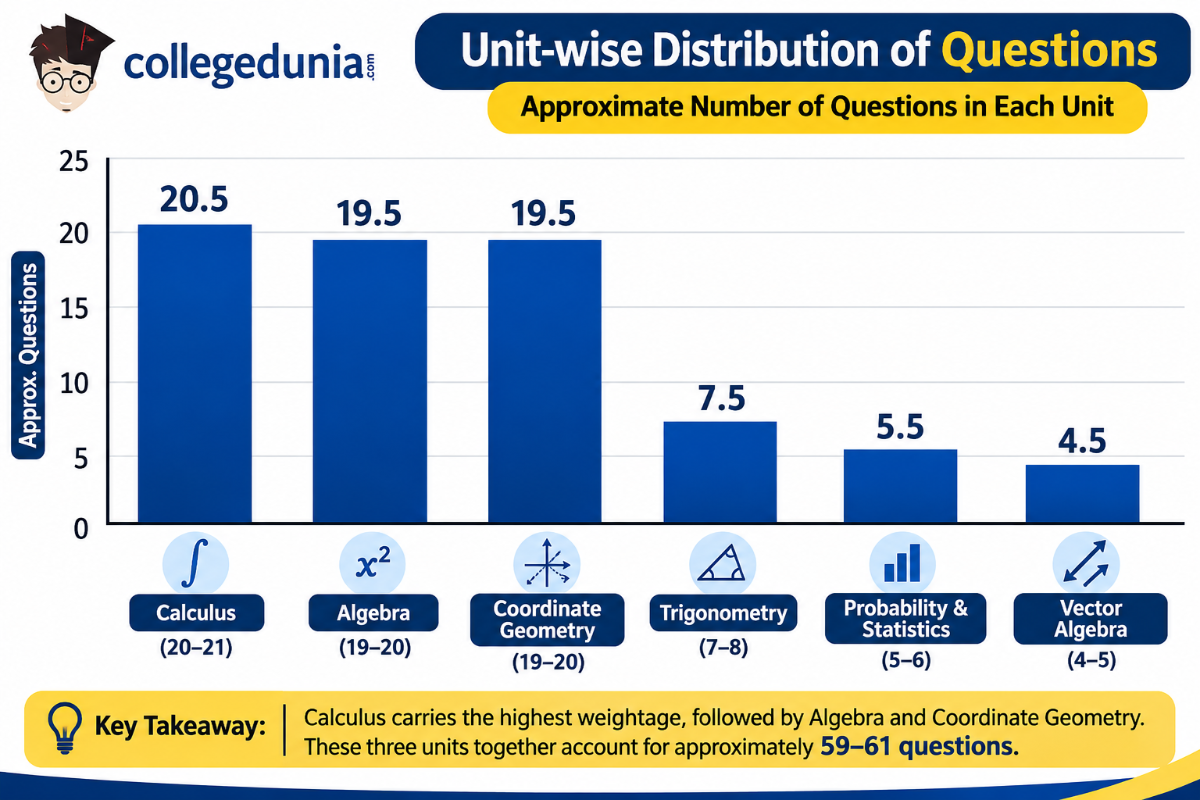
- Calculus, Algebra and Coordinate Geometry together cover about 75% of the Mathematics section.
| Unit | Topics Covered | Approx. Questions |
|---|---|---|
| Calculus | Limits and continuity, differentiation, applications of derivatives, indefinite and definite integration, area, differential equations | 20-21 |
| Algebra | Functions, mathematical induction, matrices and determinants, complex numbers, De Moivre's theorem, quadratic expressions, theory of equations, permutations and combinations, binomial theorem, partial fractions | 19-20 |
| Coordinate Geometry | Locus and transformation of axes, straight lines, pair of straight lines, circles, system of circles, parabola, ellipse, hyperbola, 3D coordinates, planes | 19-20 |
| Trigonometry | Trigonometric ratios and equations, inverse trigonometric functions, hyperbolic functions, properties of triangles | 7-8 |
| Probability and Statistics | Measures of dispersion, probability, random variables and distributions | 5-6 |
| Vector Algebra | Addition of vectors, scalar and vector products | 4-5 |
Related Links:
AP EAPCET Physics Syllabus 2027 (MPC and BiPC)
The AP EAPCET Physics syllabus carries 40 questions in both papers. The syllabus has 30 chapters from the first-year and second-year Intermediate courses.
- Each chapter carries one or two questions, so no single chapter decides the section.
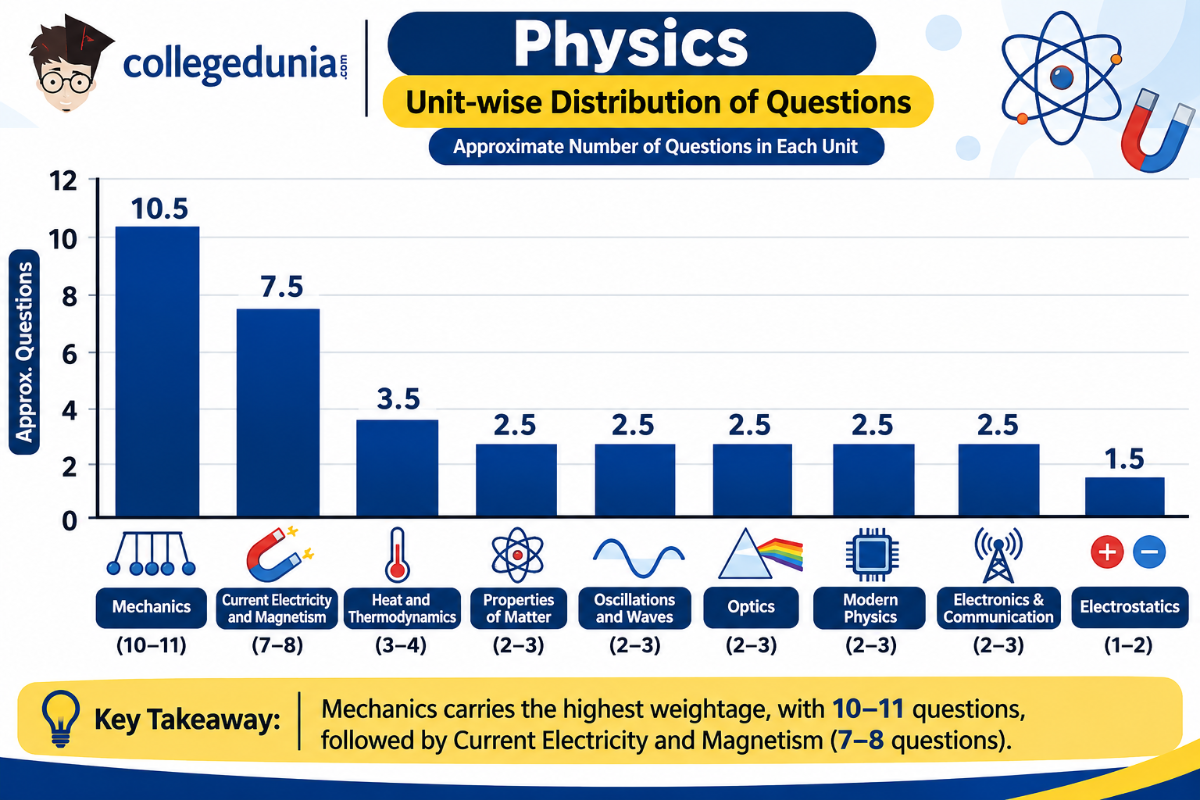
- The grouped counts below are totalled from the chapter-wise question counts in the weightage section.
| Unit | Chapters Covered | Approx. Questions |
|---|---|---|
| Mechanics | Physical World, Units and Measurements, Motion in a Straight Line, Motion in a Plane, Laws of Motion, Work Energy and Power, System of Particles and Rotational Motion, Gravitation | 10-11 |
| Current Electricity and Magnetism | Current Electricity, Moving Charges and Magnetism, Magnetism and Matter, Electromagnetic Induction, Alternating Current, Electromagnetic Waves | 7-8 |
| Heat and Thermodynamics | Thermal Properties of Matter, Thermodynamics, Kinetic Theory | 3-4 |
| Properties of Matter | Mechanical Properties of Solids, Mechanical Properties of Fluids | 2-3 |
| Oscillations and Waves | Oscillations, Waves | 2-3 |
| Optics | Ray Optics and Optical Instruments, Wave Optics | 2-3 |
| Modern Physics | Dual Nature of Radiation and Matter, Atoms, Nuclei | 2-3 |
| Electronics and Communication | Semiconductor Electronics, Communication Systems | 2-3 |
| Electrostatics | Electric Charges and Fields, Electrostatic Potential and Capacitance | 1-2 |
Related Links:
AP EAPCET Chemistry Syllabus 2027 (MPC and BiPC)
The AP EAPCET Chemistry syllabus carries 40 questions in both papers. It covers Physical, Inorganic, and Organic Chemistry across about 26 units.
- Past analyses put Organic Chemistry at around 35% to 40% of the section
- Physical Chemistry at around 32% to 35% and Inorganic Chemistry at around 27% to 30%.
- Chemical bonding, atomic structure, periodicity and p-block elements carry the most inorganic and physical questions.
| Branch | Topics Covered | Approx. Share of Section |
|---|---|---|
| Organic Chemistry | Basic principles and techniques, hydrocarbons, haloalkanes and haloarenes, alcohols, phenols and ethers, aldehydes, ketones and carboxylic acids, organic compounds with nitrogen, polymers, biomolecules, chemistry in everyday life | 35-40% |
| Physical Chemistry | Atomic structure, states of matter, stoichiometry, chemical thermodynamics, chemical equilibrium and acids-bases, solid state, solutions, electrochemistry and chemical kinetics, surface chemistry | 32-35% |
| Inorganic Chemistry | Classification of elements and periodicity, chemical bonding and molecular structure, hydrogen and its compounds, s-block, p-block (groups 13 to 18), d- and f-block elements, coordination compounds, general principles of metallurgy, environmental chemistry | 27-30% |
Related Links:
AP EAPCET Botany Syllabus 2027 (BiPC)
Botany has 40 questions in the Agriculture and Pharmacy paper. It draws on the Intermediate Botany courses of both years. Students from the MPC stream do not write this section.
- Plant physiology and plant reproduction are the chapters most often listed as high-scoring.
| Unit | Topics Covered |
|---|---|
| Diversity in the Living World | Classification of living organisms, plant kingdom |
| Structural Organisation in Plants | Morphology of flowering plants, anatomy of flowering plants |
| Plant Reproduction | Sexual reproduction in flowering plants, reproduction in plants |
| Cell Structure and Function | Cell theory, cell organelles, cell division |
| Plant Physiology | Photosynthesis, respiration, mineral nutrition, plant growth and development |
| Plant Ecology | Organisms and populations, ecosystems, biodiversity |
| Microbiology | Micro-organisms and their role |
| Genetics and Molecular Biology | Principles of inheritance and variation, molecular basis of inheritance |
| Biotechnology | Principles and processes, applications of biotechnology |
AP EAPCET Zoology Syllabus 2027 (BiPC)
Zoology has 40 questions in the Agriculture and Pharmacy paper. Human anatomy and physiology is spread over several Intermediate chapters, so it makes up a large part of the section.
| Unit | Topics Covered |
|---|---|
| Diversity in the Living World | Classification of animals, animal kingdom |
| Structural Organisation in Animals | Animal tissues, organ systems, type study of Periplaneta |
| Animal Diversity | Non-chordates and chordates, locomotion and reproduction in Protozoa |
| Human Anatomy and Physiology | Digestion and absorption, breathing, circulation, excretion, locomotion, neural and chemical control, immunity |
| Human Reproduction | Reproductive system, gametogenesis, reproductive health |
| Genetics | Principles of inheritance, molecular basis of inheritance |
| Organic Evolution | Origin of life, evidence and theories of evolution |
| Ecology and Environment | Organisms and populations, ecosystems, environmental issues |
| Biology and Human Welfare | Human health and diseases, enhancement of food production |
| Applied Biology | Biotechnology and its applications |
AP EAPCET Weightage 2027: Chapter-Wise and Topic-Wise
APSCHE does not publish chapter-wise weightage. The figures below come from analyses of previous AP EAPCET papers. Treat them as a guide and not as a guarantee, because the count for a chapter can change from year to year.
AP EAPCET Syllabus: Subject-Wise Weightage
Past trends also show a near-even split between the two Intermediate years.
- Mathematics has drawn about 40 questions from each year.
- Physics has drawn about 20 questions from each year.
- Chemistry has drawn about 21 from the first year and 19 from the second.
| Subject | Engineering (Questions) | Agriculture and Pharmacy (Questions) | Share of Paper |
|---|---|---|---|
| Mathematics | 80 | Not asked | 50% (Engineering) |
| Physics | 40 | 40 | 25% |
| Chemistry | 40 | 40 | 25% |
| Botany | Not asked | 40 | 25% (Agri and Pharmacy) |
| Zoology | Not asked | 40 | 25% (Agri and Pharmacy) |
| Total | 160 | 160 | 100% |
AP EAPCET Syllabus: Mathematics Chapter-Wise Weightage
| Chapter | Approx. Questions | Importance |
|---|---|---|
| Applications of Derivatives | 6 | Very High |
| Conic Sections | 5 | Very High |
| Circles, Differentiation and Derivatives, Indefinite Integration | 4 each | High |
| Permutations and Combinations, Product of Vectors, Probability, Straight Lines, 3D Geometry, Differential Equations | 3 each | High |
| Theory of Equations, Functions, Matrices, Determinants, Complex Numbers, De Moivre's Theorem, Binomial Theorem, Trigonometric Ratios, Trigonometric Equations, Properties of Triangles, Addition of Vectors, Random Variables, Locus and Transformation, System of Circles, Limits and Continuity | 2 each | Medium |
| Mathematical Induction, Quadratic Expressions, Partial Fractions, Inverse Trigonometric Functions, Hyperbolic Functions, Measures of Dispersion, Pair of Straight Lines, Definite Integration, Area | 1 each | Low |
AP EAPCET Syllabus: Physics Chapter-Wise Weightage
| Chapter | Approx. Questions | Importance |
|---|---|---|
| Motion in a Straight Line, Laws of Motion, System of Particles and Rotational Motion, Mechanical Properties of Fluids, Thermal Properties of Matter, Waves, Ray Optics and Optical Instruments, Current Electricity, Moving Charges and Magnetism, Semiconductor Electronics | 2 each | High |
| Physical World, Units and Measurements, Motion in a Plane, Work Energy and Power, Oscillations, Gravitation, Mechanical Properties of Solids, Thermodynamics, Kinetic Theory, Wave Optics, Electric Charges and Fields, Electrostatic Potential and Capacitance, Magnetism and Matter, Electromagnetic Induction, Alternating Current, Electromagnetic Waves, Dual Nature of Radiation and Matter, Atoms, Nuclei, Communication Systems | 1 each | Medium |
AP EAPCET Syllabus: Chemistry Chapter-Wise Weightage
| Chapter | Approx. Questions | Importance |
|---|---|---|
| p-Block Elements | 4-5 | Very High |
| Chemical Bonding and Molecular Structure | 3-4 | Very High |
| Atomic Structure, Classification of Elements and Periodicity, Organic Chemistry: Basic Principles | 3 each | High |
| Electrochemistry and Chemical Kinetics | 2-3 | High |
| Solutions, s-Block Elements, Chemical Equilibrium and Acids-Bases, Hydrocarbons, d- and f-Block with Coordination Compounds, Aldehydes, Ketones and Carboxylic Acids | 2 each | Medium |
| Chemical Thermodynamics | 1-2 | Medium |
| Environmental Chemistry, Chemistry in Everyday Life, Solid State, Hydrogen and its Compounds, Surface Chemistry, Stoichiometry, Haloalkanes and Haloarenes, General Principles of Metallurgy, Organic Compounds with Nitrogen, States of Matter | 1 each | Low to Medium |
Related Links:
AP EAPCET Exam Pattern 2027
AP EAPCET has a total of 160 questions to be answered in 3 hours.
| Particular | Details |
|---|---|
| Mode of Exam | Computer-based test (online) |
| Duration | 3 hours |
| Number of Questions | 160 multiple-choice questions |
| Total Marks | 160 |
| Marking Scheme | +1 for each correct answer, no marks for unattempted questions |
| Negative Marking | None |
| Average Time Per Question | About 1.1 minutes |
| Medium | English, Telugu and Urdu |
Best Books for AP EAPCET 2027
| Subject | Book Name | Author / Publisher | Why This Book |
|---|---|---|---|
| All Subjects | AP Intermediate first-year and second-year textbooks | Telugu Akademi / AP Board | The syllabus follows these courses, so questions trace back to them |
| All Subjects | NCERT Class 11 and Class 12 textbooks | NCERT | Clear concepts and practice questions for all five subjects |
| Mathematics | Class 11 and Class 12 Mathematics | R.D. Sharma | Large question bank for calculus, algebra and coordinate geometry |
| Mathematics | Plane Trigonometry and Coordinate Geometry | S.L. Loney | Strong practice for trigonometry and conic sections |
| Physics | Concepts of Physics (Vol 1 and 2) | H.C. Verma | Builds concept clarity for mechanics, electricity and magnetism |
| Physics | Objective Physics | D.C. Pandey | Objective practice in the MCQ format of the exam |
| Chemistry | Physical Chemistry | O.P. Tandon | Covers numerical topics such as solutions and electrochemistry |
| Chemistry | Concise Inorganic Chemistry | J.D. Lee | Useful for p-block, d-block and bonding |
| Botany and Zoology | Objective Biology | Trueman's / Dinesh | Objective practice for BiPC candidates |
AP EAPCET Syllabus PDF 2027: How to Download MPC and BiPC PDF
The AP EAPCET 2027 syllabus PDF is not out yet. APSCHE normally publishes the syllabus on its portal with the notification and the information brochure. The brochure also carries the syllabus as an annexure. Follow these steps to get the PDF.
- Visit the official website at cets.apsche.ap.gov.in/EAPCET.
- Open the syllabus or information brochure link for your stream, MPC (Engineering) or BiPC (Agriculture and Pharmacy).
- Click the PDF link to open the syllabus.
- Save the PDF to your device and print a copy for tracking your progress.
- Compare it with the 2026 syllabus once the 2027 version is released, and note any added chapters or deleted topics.
AP EAPCET Syllabus Preparation Tips
Syllabus and Planning Tips
- Print the syllabus and rate your confidence from 1 to 5 for every chapter before you begin.
- Start with high-weightage units: Calculus, Algebra and Coordinate Geometry in Mathematics.
- Use the 2026 syllabus now, and update your list when the 2027 PDF is released.
- With the exam expected in May 2027, plan about six months and fix one revision week per subject.
- Link your Intermediate board preparation with the entrance syllabus, since both draw on the same books.
Subject-Wise Tips
- Mathematics: Practise 30 to 40 problems a day on one chapter, and memorise standard formulas for conics and integration.
- Physics: Revise mechanics, current electricity and magnetism first, then cover the one-question chapters in short sessions.
- Chemistry: Keep a one-page sheet for each of bonding, periodicity, p-block and named organic reactions.
- Botany and Zoology: Read the textbook line by line, because many questions are direct statements from it.
Exam Strategy Tips
- Attempt every question, because AP EAPCET has no negative marking.
- Aim for about one minute a question, and spend longer only on calculation-heavy Mathematics questions.
- Solve AP EAPCET previous year question papers and take full-length mock tests in the 3-hour computer-based format.
- Practise chapter-wise important questions for the high-weightage chapters before each mock.
- Keep an error log for each subject and review it in the last week.
AP EAPCET Syllabus 2027: FAQs
Ques. Has APSCHE released the AP EAPCET 2027 syllabus?
Ans. Not yet. APSCHE normally publishes the syllabus with the notification, which is expected in the first week of February 2027. Until then, you can use the 2026 syllabus as your reference.
Ques. Is there an official AP EAPCET syllabus PDF?
Ans. Yes. APSCHE publishes separate syllabus PDFs for the Engineering stream and the Agriculture and Pharmacy stream on cets.apsche.ap.gov.in. The 2027 PDFs will appear after the notification.
Ques. What subjects are in the AP EAPCET syllabus?
Ans. The Engineering paper covers Mathematics, Physics and Chemistry. The Agriculture and Pharmacy paper covers Botany, Zoology, Physics and Chemistry.
Ques. Is Mathematics asked in the AP EAPCET Agriculture and Pharmacy paper?
Ans. No. The BiPC paper has Botany, Zoology, Physics and Chemistry, with 40 questions each. Mathematics appears only in the Engineering paper.
Ques. What is the AP EAPCET MPC syllabus 2027?
Ans. The MPC syllabus is for the Engineering paper and covers Mathematics, Physics and Chemistry. The paper has 80 Mathematics questions and 40 each for Physics and Chemistry.
Ques. What is the AP EAPCET BiPC syllabus 2027?
Ans. The BiPC syllabus is for the Agriculture and Pharmacy paper. It covers Botany, Zoology, Physics and Chemistry, with 40 questions in each subject.
Ques. How many units are there in the AP EAPCET Maths syllabus?
Ans. The Maths syllabus has six units: Algebra, Trigonometry, Vector Algebra, Probability and Statistics, Coordinate Geometry and Calculus. It draws on Intermediate 1A, 1B, 2A and 2B.
Ques. Where can I download the AP EAMCET syllabus 2027 PDF?
Ans. Download it from cets.apsche.ap.gov.in/EAPCET once APSCHE releases it with the notification. Until then, the 2026 syllabus PDFs for the MPC and BiPC streams are available for reference.
Ques. What are the important chapters for AP EAPCET 2027?
Ans. In Mathematics, Applications of Derivatives, Conic Sections, Circles, Differentiation and Indefinite Integration lead. In Physics, Laws of Motion, Current Electricity and Moving Charges and Magnetism lead. In Chemistry, p-Block Elements and Chemical Bonding lead. For BiPC, plant physiology, human physiology and genetics are the usual priorities.
Ques. Are there any deleted topics in the AP EAPCET 2027 syllabus?
Ans. APSCHE has not announced any deletions. Compare the 2027 PDF with the 2026 PDF once it is released to spot added chapters or deleted topics.
Ques. Which Intermediate classes does the AP EAPCET syllabus cover?
Ans. It covers the Intermediate first-year and second-year courses of the Andhra Pradesh board, so you need to study both years.
Ques. Which chapters have the highest weightage in AP EAPCET?
Ans. In Mathematics, Applications of Derivatives and Conic Sections lead, followed by Circles, Differentiation and Indefinite Integration. In Physics, mechanics and current electricity with magnetism lead. In Chemistry, p-block elements and chemical bonding lead. These counts come from past analyses, since APSCHE does not publish weightage.
Ques. How many questions are asked in AP EAPCET?
Ans. The paper has 160 multiple-choice questions to be solved in 3 hours. Each correct answer earns 1 mark.
Ques. Is there negative marking in AP EAPCET?
Ans. No. There is no negative marking, so you should attempt all 160 questions. Confirm this in the 2027 brochure when it is released.
Ques. Will the AP EAPCET 2027 syllabus change from 2026?
Ans. APSCHE has not announced any change. The syllabus is expected to stay close to 2026, but you should check the 2027 notification to be sure.
Ques. Is AP EAPCET the same as AP EAMCET?
Ans. Yes. AP EAPCET is the renamed form of AP EAMCET, and the syllabus pages and papers of both names refer to the same exam.
Ques. When is AP EAPCET 2027 expected to be held?
Ans. The exam is expected in May 2027, based on the 2026 schedule. APSCHE will announce the official dates with the notification.



Comments