



Content Curator
Salicylic acid is a type of beta-hydroxy acid (BHA) and phenolic acid.
- This organic compound is lipophilic monohydroxybenzoic acid.
- The chemical formula of Salicylic acid is C7H6O3.
- The IUPAC name of salicylic acid is 2-hydroxybenzoic acid.
- Salicylic acid is a crystalline organic carboxylic acid and possesses keratolytic, bacteriostatic, and fungicidal characteristics.
- It is poisonous when consumed in large quantities.
- When consumed in small amounts, it can be used as an antiseptic and a food preservative.
- Salicylic acid contains a carboxyl group, i.e. COOH.
- It has no odor and no color.
- It is most likely well-known for being an important ingredient in topical anti-acne medications.
- The salts and esters of salicylic acid are salicylates.
- Salicylic acid is one of the safest and most effective medicines used in healthcare.
| Table of Content |
Key Terms: Salicylic acid, Chemical formula, Organic compound, Acetic acid, IUPAC name, Beta-hydroxy acid, Hybridization, Aspirin, Chemical reaction
What is Salicylic Acid?
[Click Here for Sample Questions]
Salicylic acid has the chemical formula C7H6O3 and is a type of beta hydroxy acid (BHA) and phenolic acid.
- It is a BHA found naturally in plants.
- It functions as a plant hormone.
- This lipophilic monohydroxybenzoic acid is derived from the metabolism of salicin.
- It is an organic carboxylic acid that is crystalline and has keratolytic, bacteriostatic, and fungicidal properties.
- It can be used as an antiseptic and a food preservative when used in small amounts.
- It can be toxic when consumed in large amounts.
| Salicylic Acid | |
|---|---|
| Chemical Formula | C7H6O3 |
| IUPAC Name | 2-hydroxybenzoic acid |
Also check:
| Related Concepts | ||
|---|---|---|
| Aspartic Acid | Ethanoic Acid | Difference Between Acid and Base |
| List of Strong Acids | Acid Strength | Glutamic Acid |
Salicylic Acid Structure
[Click Here for Sample Questions]
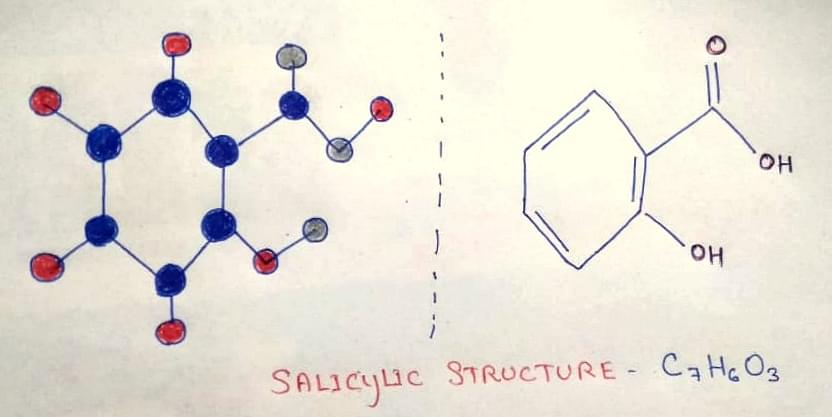
The structural formula for salicylic acid is HOC6H4CO2H.
- Salicylic acid has a hydroxyl group (–OH group), attached at the ortho position to the carboxylic acid.
- This COOH group can be present on the benzene ring.
- All carbon atoms in the benzene ring of salicylic acid are sp2 hybridized.
Physical Properties of Salicylic Acid
[Click Here for Sample Questions]
The following are the physical properties of Salicylic acid
| Physical Properties | |
|---|---|
| Chemical Formula | C7H6O3 |
| Density | 1.44 g/cm3 |
| Molecular Weight/ Molar Mass | 138.121 g/mol |
| Boiling Point | 211 ∘C |
| Melting Point | 158.6 ∘C |
| Flash point | 157 ∘C |
| Appearance | Colorless to white crystals |
| Odor | Odorless |
| Sublimation conditions | Sublimes at 76 ∘C |
| Acidity (pKa) | 2.97 (at 25 ∘C) |
| Vapor pressure | 10.93 mPa |
| Dipole moment | 2.65 D |
Chemical Properties of Salicylic Acid
[Click Here for Sample Questions]
The following are the chemical properties of Salicylic acid
Formation of Aspirin
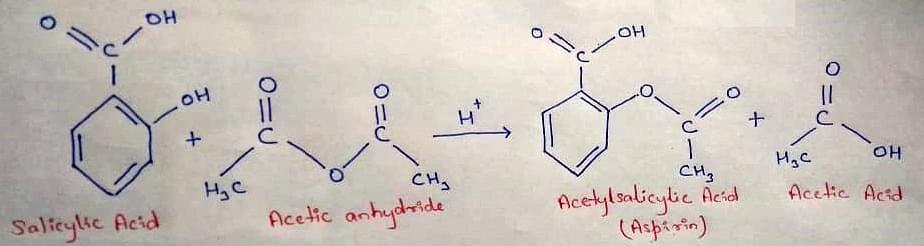
The most important reaction related to the usage of salicylic acid in the pharmaceutical industry is the formation of aspirin (acetylsalicylic acid).
- It is one of the most commonly used analgesics and blood-thinning agents.
- In this reaction, salicylic acid reacts with acetic anhydride in an acidic media.
- This results in the acetylation of the salicylic acid's hydroxyl group and the formation of acetylsalicylic acid (aspirin).
- Acetic acid is produced as a by-product of this reaction.
- This acetic acid is one of the impurities during the large-scale production of aspirin.
- This can be removed by various refining processes.
Esterification Reaction
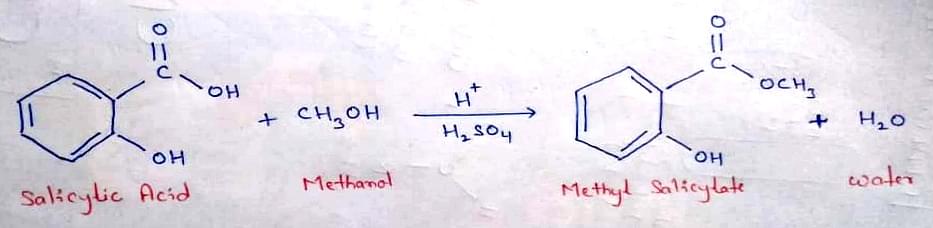
As salicylic acid is an organic acid, it can combine with organic alcohol groups to form a new organic chemical class known as ester.
- When salicylic acid reacts with methanol in an acidic medium (preferably sulphuric acid) in the presence of heat, a dehydration reaction occurs.
- This results in the formation of methyl salicylate (an ester).
Uses of Salicylic Acid
[Click Here for Sample Questions]
The following are the applications of Salicylic acid
- The most common and famous use of salicylic acid is in the formation of acetylsalicylic acid (aspirin).
- It is also used in the production of methyl salicylate (oil of wintergreen).
- Salicylic acid is a keratolytic (peeling agent) that helps in the removal of the outer layer of the skin.
- As a bacteriostatic agent, it exhibits a mild antiseptic property and hence is used in toothpaste.
- It is helpful in the treatment of acne, dandruff, seborrhea, or psoriasis, and in removing corns, calluses, warts, and many other skin-related problems.
- It also helps in the removal of whiteheads and blackheads as it does not allow the pores to clog and opens the pores that are already clogged.
- A very rare genetic skin disorder, named Ichthyosis, is cured with its use.
- Instrumental in treating some ringworm infections and the wet form of tinea pedis infection (also known as the athlete’s foot).
- Used as a food preservative, when used in small quantities.
Methods of Preparation of Salicylic Acid
[Click Here for Sample Questions]
Salicylic acid is prepared generally in two ways. These are:
Kolbe-Schmitt Process
This method is used to produce salicylic acid commercially.
- It is a carboxylation chemical reaction in which at first sodium phenoxide is formed by reacting phenol and sodium hydroxide.
- It is then followed by a series of distillation and dehydration.
- The phenoxide ion formed is more reactive than phenol.
- Hence, it undergoes an electrophilic substitution reaction with a weak electrophile (carbon dioxide), that results in the formation of sodium salicylate.
- Sodium salicylate is a salt of salicylic acid that further reacts with an acid ( or with any species that denotes a proton) to form salicylic acid.
Saponification Reaction
In this reaction, methyl salicylate is used to form salicylic acid.
- Methyl salicylate or oil of wintergreen is a common analgesic used widely.
- Methyl salicylate reacts with sodium hydroxide which results in the formation of disodium salicylate (a sodium salt intermediate of salicylic acid).
- Disodium salicylate then further reacts with sulfuric acid to form salicylic acid.
Also check:
| Other Concepts | ||
|---|---|---|
| Atoms and Molecules | Interhalogen compounds | PbO2 |
| Difference between Elements and Compounds | Oxoacids of Phosphorus | Carboxylic Acids Acidity |
Things to Remember
- Salicylic acid is a type of beta-hydroxy acid (BHA) and phenolic acid.
- The structural formula for salicylic acid is HOC6H4CO2H.
- The IUPAC name of salicylic acid is 2-hydroxybenzoic acid.
- The chemical formula of Salicylic acid is C7H6O3.
- Salicylic acid reacts with acetic anhydride to form aspirin.
- All carbon atoms in the benzene ring of salicylic acid are sp2 hybridized
- It can be used as an antiseptic and a food preservative when used in small amounts.
Sample Questions
Ques. What is the chemical formula of salicylic acid? (1 Mark)
Ans. The chemical formula of salicylic acid is C7H6O3.
Ques. Define Kolbe-Schmitt’s reaction. (3 Marks)
Ans. In this reaction, sodium phenoxide is formed by reacting phenol and sodium hydroxide. It is then followed by a series of distillation and dehydration. The phenoxide ion formed is more reactive than phenol. Hence, it undergoes an electrophilic substitution reaction with a weak electrophile (carbon dioxide), that results in the formation of sodium salicylate. Sodium salicylate is a salt of salicylic acid that further reacts with an acid ( or with any species that denotes a proton) to form salicylic acid.
Ques. What is the melting point of salicylic acid? (1 Mark)
Ans. The meting point of salicylic acid is 158.6 ∘C.
Ques. What is another name for salicylic acid? (1 Mark)
Ans. Salicylic acid has the chemical formula C6H4(OH)CO2H, where the OH group is adjacent to the carboxyl group. 2-hydroxybenzoic acid is another name for it.
Ques. What contains salicylic acid at home? (2 Marks)
Ans. Salicylates are abundant in broccoli, cauliflower, cucumber, mushrooms, radishes, spinach, and zucchini. Salicylates are also found in nightshade vegetables such as eggplant and peppers. Tomatoes contain a lot of salicylates.
Ques. What is the IUPAC name of salicylic acid? (1 Mark)
Ans. The IUPAC name of salicylic acid is 2-hydroxybenzoic acid.
Ques. Is salicylic acid safe? (2 Marks)
Ans. Although the use of low-concentration salicylic acid products is generally regarded as safe, excessive quantities of salicylic acid can produce moderate chemical burns. If these compounds are consumed, they can produce dangerous intoxication.
Ques. What does salicylic acid do to your skin? (2 Marks)
Ans. Salicylic acid acts by loosening and breaking away desmosomes in the skin's outer layers, which are cell attachments. This action helps in the exfoliation of the skin and the unclogging of the pores. Salicylic acid can lower the secretion of sebum, which is another way that can help to reduce acne.
Ques. Write down the structural formula of salicylic acid. (1 Mark)
Ans. The structural formula of salicylic acid is HOC6H4CO2H.
Ques. What are the uses of salicylic acid? (2 Marks)
Ans. Salicylic acid acts as a keratolytic (a peeling agent). Salicylic acid facilitates and causes the skin's outer layer to shed. Topical salicylic acid is used to treat acne, dandruff, seborrhea, and psoriasis, as well as to eliminate cotton, calluses, and warts. Salicylic acid can be present in a variety of common products.
For Latest Updates on Upcoming Board Exams, Click Here: https://t.me/class_10_12_board_updates
Also Read:



Comments