



Content Curator
A leaf is the most important component of the plant as a lateral appendage or a structure that arises from and is joined to the main plant body on the sides. It grows above ground as part of the shoot together with the stem. A leaf is primarily a component of a vascular plant. Plant leaf’s main job is to provide food or sustenance for the plant through the process of photosynthesis. Let’s discuss its structure and other properties in detail.
| Table of Content |
Key Takeaways: Leaf, Photosynthesis, Chlorophyll, Petiole, Pores, Trees, Plants
Why does a plant need a leaf?
[Click Here for Sample Questions]
A leaf's primary function is to provide nourishment for a plant. Leaves achieve this by extracting water from the earth and carbon dioxide from the air with the help of sunshine. Photosynthesis is a broad term that refers to the process of creating something new (synthesis) using light (photo). Water is delivered to the leaf via a series of pipes that run the way down to the tree's roots. Roots draw water from the earth so that the tree may utilise it. Carbon dioxide from the air enters the leaf through tiny apertures on the leaf's bottom side. These little pores also allow air to escape, air that contains a small amount of additional oxygen due to the leaves' use of carbon dioxide and water to produce food.

Also Read:
Parts of a leaf
[Click Here for Sample Questions]
Following are the parts of a leaf:
- The apex or tip is the top part of the leaf that can be round, pointed, and smooth.
- On most leaves, the lamina, or leaf blade, is the widest part of the leaf.
- A petiole is a leaf that links to the plant stem.
- Stipules, which are little green appendages near the base of the petiole, can also be seen on leaves.
- Most leaves have a midrib that branches out to generate vascular tissue veins on the sides.
- Margin refers to the leaf's outer border, which varies depending on the plant type.
- Base is found at the bottom of the blade; it can be flat, heart-shaped, and round.
Also Read:
Functions of a leaf
[Click Here for Sample Questions]
Following are the functions of a leaf:
- Photosynthesis: It is the most crucial function of a leaf. They have chloroplasts, which contain the pigment chlorophyll, which aids in photosynthesis and also provides the green colour to the leaf.
- Food storage: Some plants' leaves have been adapted to store food. Succulent leaves are common in these plants, as they are in desert plants.
- Aids the plant's respiration: Guard cells in the epidermis of the leaf govern and regulate the tiny pores called stomata on the surface of leaves. Stomata control the flow of water to or from the cell.
Also Read:
Structure of leaf
[Click Here for Sample Questions]
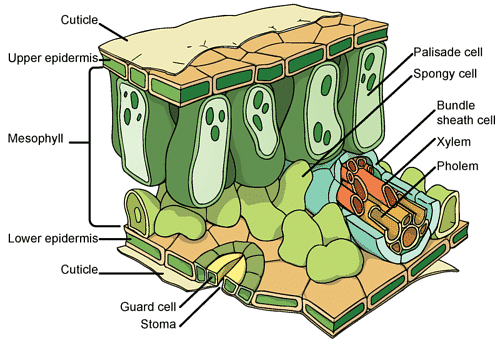
Epidermis
It is the outermost layer of the leaf, which covers the top and bottom surfaces, encloses and protects the interior structure of the leaf. The stem epidermis is connected to this epidermis and it secretes a waxy material known as the cuticle.
Mesophyll
Mesophyll is the leaf's middle layer. It is divided into palisade and spongy mesophyll layers. The chloroplasts are discovered in this region. Chloroplasts are cell organelles that contain chlorophyll, an essential component of photosynthesis.
The Vascular Tissue
The vascular tissue consists of the visible linings on the leaf surface known as veins. The vascular tissue, which is found in the spongy layer of the mesophyll, is responsible for transporting the nutrients and minerals between the leaf and the plant body.
Also Read:
Modification in leaf
[Click Here for Sample Questions]
For particular activities like climbing and substrate attachment, storage, defense against predation or climatic conditions, or catching and digesting insect prey, the entire leaf or portions of the leaf are sometimes changed. The spines of cactus plants, for example, are entirely modified leaves. The purpose of leaves in cactus plants is to defend the plant from herbivores, to radiate heat from the stem during the day, and to collect and drop condensed water vapour during the night. Carnivorous plants attract and catch insects with their highly modified leaves.
Also Read:
Types of leaf
[Click Here for Sample Questions]
Following are the types of leaf:
Leaf (Simple)
A simple leaf is a single leaf that cannot be split into smaller units or leaflets. This form of leaf connects to the stem via the petiole. Pear, Maple, Hibiscus, Mango, Guava, Oregano, Black Oak, and so on are some examples.
Leaf (Compound)
Compound leaves have leaf blades that are split into multiple smaller leaflets that attach to the stem through the petiole. Neem, Rose, Desert Cotton, Horse Chestnut, Buckeye, Baobab, Poison Ivy, and other plants are examples.
Also Read:
Points to Remember
Following are some important points:
- Phyllotaxy is the classification of leaves on a stem; alternating, spiral, opposite, and whorled leaves are the most common.
- Outside the epidermis, the cuticle guards against water loss, whereas trichomes deter predation.
- Raphia regalis is the plant with the world's largest leaves.
- "Abscission" is the term for the process that results in colored leaves. At the base of the leaf stem, cells multiply.
- The spines of the cactus, the needles of pines and other conifers, and the scales of an asparagus stalk or a lily bulb are all modified leaves that are generated in the same way as the typical green leaf.
Sample Questions
Ques: What are the different bases on which leaves are differentiated? (4 Marks)
Ans: The type of leaves can be categorised on the bases of:
- The petiole: petiolate leaves and sessile or seated leaves
- The location on the stem: opposite, alternate, basal, and connate leaves
- The division of the blade: simple and compound leaf
- The shape: elliptical sheet, linear leaf, acicular leaf, and lanceolate leaf
- The base: sharp, rounded, dimmed, and roped
- The edge: whole leaf, Lobed leaf, and Wavy leaf
- The shape of their margin: pointed, smooth, sloping, and small margin
- The veins: palmate, pinnate, parallel, and reticulate
Ques: Can a plant's morphological leaf features be used to predict climatic change? (2 Marks)
Ans: Photosynthetic machinery is named after leaves, which are one of the essential components that play a significant part in food production. Furthermore, leaves are more sensitive than other components and operate as external environment receivers. As a result, if there are any changes in the environment, and the changes continue and are extended, leaves may be impacted.
Ques: What are evergreen and deciduous leaves in plants? (2 Marks)
Ans: Evergreen plants keep their leaves all year, whereas deciduous plants drop their leaves. Autumn is when deciduous trees and shrubs lose their leaves. The leaves change colour before this happens. In the spring, the leaves will regrow. The chlorophyll present in the chloroplasts gives leaves their usual green hue. Plants without chlorophyll are unable to photosynthesize.
Ques: What causes the leaves to fall? (2 Marks)
Ans: Leaves are basically temporary structures. Even if they last for two or three years, as they do in coniferous and broad-leaved evergreens, they contribute nothing to the plant more than the first year. The presence of a weak zone, the abscission layer, near the base of the petiole causes leaves to fall, whether in the first autumn in most deciduous trees or after several years in evergreen. The tree may not have enough water to operate effectively during a protracted dry season. If the tree's leaves begin to die, the branches that are attached to them may also perish.
Ques: What do you understand by the term photosynthesis? (2 Marks)
Ans: Photosynthesis is the process through which plants use light as a source of energy to create nutrients from carbon dioxide and water. The sugar glucose, which is utilised as a plant's sustenance, and oxygen, which is removed as a waste product, are the final results of photosynthesis. The chloroplasts located inside the palisade parenchyma cells of the mesophyll are the photosynthesis site.
Ques: What does the term guttation mean? (2 Marks)
Ans: Plants release water from the tips of their leaves, which is known as guttation. Guttation occurs in vascular plants including grass, grain, barley, tomatoes, strawberry, and other tiny plants. It cannot be done by big plants such as trees because it needs a lot of pressure. When the soil is excessively wet and the roots retain water, guttation occurs at night. Pressure of Root makes the flow of water out of the plant.
Ques: What are the types of conducting tissues in the veins of a plant? (4 Marks)
Ans: Within the veins of the leaf are two forms of conducting tissue: xylem and phloem. Water and dissolved minerals are transported from the stem to the leaf via the xylem, which passes via the petiole. Food is transported from the leaf to the whole plant via the phloem. The plant will perish if the phloem is damaged and the root's food supply is cut off. given below is a diagram to understand the working of the xylem and phloem.

Ques: What does venation mean? (2 Marks)
Ans: venation means the veins arrangement in a leaf. Veins may be parallel, running next to each other in the same direction, or netting, splitting off from a central vein or midrib, depending on the kind of leaf. The veins in pinnately net-veined leaves are arranged in two rows in a feather-like pattern along a central axis. The veins of palmately net-veined leaves extend in a fan-like pattern from a central point.
Also Read:



Comments