



Content Writer
Water Scarcity is defined as an insufficient supply of freshwater resources to meet the standard water demand of the population. The requirement for environmental water is also included in it.
- Water Scarcity is also related to water stress or water crisis.
- It is divided into two categories, namely physical scarcity and economic scarcity.
- Water is a precious resource which is utilized for various purposes, such as cooking, washing, bathing, and cleaning.
- According to the reports released by the United Nations, a person needs at least 50 litres of water each day.
- However, a substantial portion of the population needs access to this modest amount of water.
- Water Scarcity has affected the majority of the population globally.
- The resource is being squandered owing to human indifference and ignorance towards the planned system.
- As a result, many people are experiencing water scarcity.
Read More: The Role of Atmosphere in Climate Control
Key Terms: Water Scarcity, Water, Population, Freshwater, Climate, Pollution, Industrialization, Urbanisation, Human Beings
Water Scarcity: Definition
[Click Here for Sample Questions]
Water Scarcity is sometimes known as water stress or a water emergency. It occurs when the resources of freshwater, which is required to meet the typical water demand, are insufficient.
- Water Scarcity is arising due to climatic changes, which result in extremely wet and dry geographic areas.
- Water Stress is used as a parameter to measure water scarcity.
- Around half a billion people live in the area of scarcity of water.
- In addition, industries have contributed to a significant increase in the demand for freshwater.
- Increasing pollution, less rainfall, and expanding droughts contribute to water scarcity.
- Enormous spatial and temporal fluctuations in water demand and availability result in a water shortage.
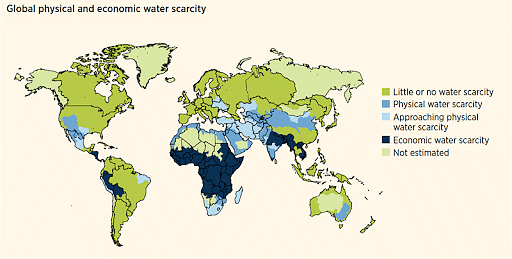
Read More: Hard Water and Soft Water
Types of Water Scarcity
[Click Here for Sample Questions]
Water Scarcity is divided into two parts which are as follows:
Physical Water Scarcity
Physical Water Scarcity is a type of scarcity when there is not enough natural resources to meet the demand of human being and the environment. It is also known as absolute water scarcity.
- Some indicators of physical water scarcity include environmental degradation reducing groundwater and water allocations.
- In this type of scarcity, water patterns become unpredictable.
- Around one-fifth of people suffer from physical water scarcity.
Read More: Crop Production
Economic Water Scarcity
Economic Water Scarcity is a type of water scarcity when there is not enough infrastructure and technology to extract water from rivers and lakes. This causes people to travel longer distances to fetch freshwater. Around a quarter of the world's population suffers from economic water scarcity.
Read More: Manures and Fertilizers
Causes of Water Scarcity
[Click Here for Sample Questions]
The various causes of water scarcity are as follows:
- Freshwater is the sole usable water supply, but, unfortunately, this freshwater is only present in small amounts.
- Humans use too much water and waste it in many circumstances.
- Water covers approximately 71% of the earth's surface.
- However, the majority of the water on the planet is unfit for human consumption.
- Water loss due to leaks, excessive home water consumption, and taps left open contribute to water scarcity.
- Rainwater is a valuable source of clean and fresh water.
- However, it must be harvested to be used in the future.
- Bifurcation, in general, is based on water scarcity.
- Water consumption is skyrocketing because of industrialization and urbanization.
- As the world's population grows, so does the requirement for water.
- Another major contributor to water scarcity is global warming.
- Water from rivers and lakes evaporates more quickly as the average air temperature rises, perhaps contributing to the drying up of water bodies.

Water Scarcity
Read More:
Effects of Water Scarcity
[Click Here for Sample Questions]
The effects of water scarcity are as follows:
- Most severe effect of water scarcity is that people cannot obtain safe & pure drinking water.
- Unless there is no fresh water available to assist in the irrigation of crops, people will go hungry.
- Animals will also perish, resulting in a shortage of meat.
- Water scarcity leads to catastrophic famine among both humans and wildlife inside the locality.
- It may indeed result in mass migration.
- Millions of people may lose their business if significant swaths of land become unsuitable for cultivation due to water scarcity.
- People are unable to obtain the education they require due to a lack of water.
- The reason is that kids are too unwell to go to school.
- Flora and fauna may no longer be capable of obtaining enough water, causing them to die or migrate to new areas.
- If people do not have any clean drinking water, they are pretty vulnerable to infection from the water.
- Those infections will enter the body regardless of whether you drink it or bathe in it.
- Many vegetation may be unable to survive and reproduce in adequate numbers due to water scarcity.

Water Scarcity
Read More:
Preventive Measure for Water Scarcity
[Click Here for Sample Questions]
Individuals can take following preventive measure to avoid water scarcity.
Factory Farming
Factory farming contributes significantly to water contamination. However, many policies that encourage sustainable agriculture and other environmentally friendly farming practices help protect freshwater resources from chemical contamination.
Water Tax
A heavy-user water tax could discourage inefficient water usage in industry and agriculture while maintaining residential water rates. In an ideal world, a fee like this would help detach economic growth from water consumption. In addition, replacement reimbursements for water-guzzling equipment like toilets and sprinkler systems are a cost-effective option.
Education
Education plays a vital role in resolving the humanitarian crisis. It is crucial to significantly alter all points of consumption to meet future water demands. Individuals should commence it and create awareness about the problem.
Stormwater Management
Stormwater management collection and recycled sewage allow for shortages of water to be handled. It will also reduce constraints on underground and other ecological bodies of water. Groundwater recharge is a prevalent method of preventing water scarcity by allowing water to travel from the surface to the earth.
Borewells
It is recommended that direct borewells be installed in villages. This allows people to recharge anywhere they can, which results in increasing the availability of water for drinking and increase opportunities for cultivation. It is also crucial to repair existing but underutilized water structures.
What is WorldWide Fund for Nature (WWF)?
[Click Here for Sample Questions]
The Worldwide Fund for Nature (WWF) is an international non-governmental organization that seeks to preserve wilderness and reduce the human effect on the environment. It was created in 1961. The last name of WWF is World Wildlife Fund, and it is still used in the United States and Canada.
- With over five million volunteers globally, WWF is the world's largest conservation organization.
- It operates in over 100 countries and sponsors over 3,000 preservation of natural resources projects.
- Since 1995, they have sponsored over $1 billion in over 12,000 conservation projects.
- WWF has been working for 60 years to help humans and wildlife coexist.
- It operates in approximately 100 countries as the world's foremost environmental organization.
- They work with people worldwide to design and deliver creative solutions that safeguard communities and environments.
Read More:
What is WWF doing for the Water Scarcity?
[Click Here for Sample Questions]
Worldwide Fund For Nature has released a number of programs and conventions to increase awareness about the dearth of water being faced across the globe.
Promotion of Water Stewardship
WWF promotes and supports organizations that are responsible for water stewardship to benefit both people and nature. Through the Water Stewardship Alliance, they handle projects to build a water stewardship standard implemented internationally.
- Like the Water Footprint Network, they also support water footprinting technologies.
- It promotes other worldwide initiatives with the UN's CEO Water Mandate and the World Economic Forum.
- WWF conducts initiatives on a local level to evaluate water consumption.
- It collaborates with businesses and industry to identify and mitigate water-related risks.
Read More: Conservation of natural resources
Protection of Wetlands
The Ramsar Convention is an international convention that was formed to conserve wetlands all over the world. Over 2,000 wetlands have been classified as Wetlands of International Importance in the last 40 years.
- This indicates that the country in which the wetland is situated has pledged to safeguard it against pollution.
- Around 75% of the sites that were added to the list since 1999 have resulted from WWF's efforts.
Adapting to Climate Change
Before the worst effects of climate change materialize, WWF strives to solve institutional obstacles in managing water resources and safeguarding habitats. This effort includes advocating for adaptation to climate change in international treaties and aiding wetlands preservation and restoration.
Read More: Natural Resources Management
Things to Remember
- Water Scarcity is defined as the imbalance between the demand for water and the supply of water.
- Water plays a role in 90% of all-natural catastrophes.
- Every day, females are projected to spend 200 million hours hauling water.
- There are 2.3 billion people who need access to proper sanitation.
- Water Scarcity is of two types, namely physical water scarcity and economic water scarcity.
- WWF are taking preventive measure to tackle the problem of scarcity of water.
Read More: Difference Between Compost and Vermicompost
Sample Questions
Ques: What are the financial consequences of water scarcity? (2 marks)
Ans: Water scarcity impacts the price of exchanged products and services in a global economy. According to Liu et al. (2009), scarcity of water will result in losses relating to the trade for countries that make water-intensive industries. When these behaviours are sponsored, however, the distortion becomes even worse.
Ques: What impact does water scarcity have on the environment? (2 marks)
Ans: Water Scarcity has several impacts on the environment:
- The abuse of water as a result of water shortages is primarily found in irrigation agriculture.
- It has several adverse effects on the ecosystem, which include the increment in salinity, depletion of nitrogen gas, and the loss of wetlands and floodplains.
Ques: How is water squandered? (2 marks)
Ans: The most common way individuals use wastewater is by keeping the water flowing through faucets while shaving, brushing their teeth, or washing dishes. The tap should be switched off when you begin your day-to-day tasks. To save water, fill up your one sink with clean water to rinse and the other sink with soapy water for washing the dishes.
Ques: What are the consequences of a lack of water? (4 marks)
Ans: The consequences of water scarcity are:
- The implications of water scarcity can be summed together in four classifications: insecurity, well-being, education and hunger.
- Because there is less water, sewage doesn't move, and mosquitoes, like most insects, grow in stagnant, dirty water.
- Thus, water scarcity is the cause of severe malaria and other diseases.
- Water deficiency damages the human body, constipation, causing renal issues, and various mental disorders.
- Water drinking keeps the pressure of blood and heat that flows in our bodies in check.
- To live a healthy and sustainable life, the earth's usable water must be conserved.
Ques. What are the types of water scarcity? (2 marks)
Ans. Water Scarcity is divided into two categories, which are as follows:
- Physical Water Scarcity: Physical Water Scarcity is a type of scarcity when there is not enough natural resources to meet the demand of human being and the environment. It is also known as absolute water scarcity.
- Economic Water Scarcity: Economic Water Scarcity is a type of water scarcity when there is insufficient infrastructure and technology to extract water from rivers and lakes. This causes people to travel longer distances to fetch fresh water.
Ques. Explain the World Wide Fund for Nature? (3 marks)
Ans. World Wide Fund for Nature, also known by the name WWF, is an international non-governmental organization that seeks to preserve wilderness and reduce the human effect on the environment. It was created in 1961.
- WWF is the world's largest conservation organization, with over five million volunteers globally,
- It operates in over 100 countries and sponsors over 3,000 preservation of natural resources projects.
- It has been working for 60 years to help humans and wildlife coexist.
- They work with people worldwide to deliver creative solutions safeguarding communities and environments.
Ques. What are the simple ways an individual can carry out at their home to prevent water scarcity? (3 marks)
Ans. The simple ways an individual can carry out at their home to prevent water scarcity are as follows:
- Do brushing and bathing by keeping the tap closed to avoid water wastage.
- Reuse the water collected from air conditioners.
- Wash your car with the help of a bucket to avoid wastage.
- Create awareness regarding water safety among your friends, family and relatives.
Ques. What are the causes of water scarcity? (3 marks)
Ans. The causes of water scarcity are as follows:
- Freshwater is the sole usable water supply, but, unfortunately, this freshwater is only present in trace amounts.
- Humans use too much water and waste it in many circumstances.
- Water covers approximately 71% of the earth's surface.
- However, the majority of the water on the planet is unfit for human consumption.
- Water loss due to leaks, excessive home water consumption, and taps left open contribute to water scarcity.
Ques. What are the effects of water scarcity? (3 marks)
Ans. The effects of water scarcity are as follows:
- Water scarcity leads to catastrophic famine among both humans and wildlife inside the locality.
- Millions of people may lose their business if significant swaths of land become unsuitable for cultivation due to water scarcity.
- Flora and fauna may no longer be capable of obtaining enough water, causing them to die or migrate to new areas.
- If people do not have any clean drinking water, they are pretty vulnerable to infection from the water.
- Those infections will enter the body regardless of whether you drink it or bathe in it.
- Many vegetation may be unable to survive and reproduce in adequate numbers due to water scarcity.
Ques. Why people in villages are asked to install borewells? (2 marks)
Ans. A borewell is a narrow shaft bored into the ground for the extraction of water in villages. This allows people to recharge anywhere they can, which results in increasing the availability of water for drinking and increasing opportunities for cultivation. It is also crucial to repair existing but underutilized water structures.
Ques. What are the types of convention programs released by WWF to deal with the problem of water scarcity? (3 marks)
Ans. The type of convention program released by WWF to deal with the problem of water scarcity are as follows:
- Promotion of Water Stewardship: In this, WWF promotes and supports organizations that are responsible for water stewardship to benefit both people and nature. Through the Water Stewardship Alliance, they handle projects to build a water stewardship standard implemented internationally.
- Protection of Wetlands: For this, WWF launched the Ramsar Convention. The Ramsar Convention is an international convention that was formed to conserve wetlands all over the world. Over 2,000 wetlands have been classified as Wetlands of International Importance in the last 40 years.
- Adapting to Climate Change: Before the worst effects of climate change materialize, WWF strives to solve institutional obstacles in managing water resources and safeguarding habitats. This effort includes advocating for adaptation to climate change in international treaties and aiding wetlands preservation and restoration.
Check-Out:



Comments