



Content Curator
Beckmann Rearrangement is a chemical phenomenon where the purpose of the reaction is to convert a ketoxime into an N-substituted amide in the presence of an acidic reagent. This mechanochemical approach allows for the creation of novel amide frameworks by cutting and pasting C–C and C–N bonds on the oxime backbone in an environment friendly manner. The use of low-cost, commonly available reagents like p-tosyl imidazole (p-Ts-Im) and oxalic acid helps to generate a library of structurally diverse amides in good to high yields.
| Table of Content |
Keyterms: Phenomenon, p-tosyl imidazole, Oxalic acid, Ketoxime, C–C bond, C–N bond, Amides
Beckmann Rearrangement
[Click Here for Sample Questions]
The Beckmann Rearrangement is an acid-induced oxime rearrangement that yields amides. In this reaction, an electropositive nitrogen is produced, which initiates an alkyl migration, similar to the Hofmann, Schmidt Reactions, and the Curtius Rearrangement.
The protonation of the oxime's alcoholic group initiates the Beckmann rearrangement reaction. A better leaving group is created due to the protonation of the alcohol group. With the release of an H2O molecule, the R group migrates to a nitrogen atom linked to the leaving group, forming a carbocation. A carbocation is formed as a result of the trans 1,2 – shift. The regiochemistry of the reaction can be predicted as a result of this. A water molecule now attacks the carbon atom of the carbocation, resulting in the formation of the final amide product by deprotonation and tautomerization.
Beckmann Rearrangement
Also Read:
| Related Articles | ||
|---|---|---|
| Clemmensen Reduction Reaction | Uses of Carboxylic Acids | |
| Aldehydes | Cannizzaro Reaction | |
Mechanism of Beckmann Rearrangement
[Click Here for Sample Questions]
Beckmann rearrangement is the acid-catalyzed conversion of an oxime to an amide with the following reaction:

Mechanism of Beckmann Rearrangement
The mechanism of Beckmann Rearrangement is as follows:

Mechanism of Beckmann Rearrangement
Applications of Beckmann Rearrangement
[Click Here for Sample Questions]
- 17-progesterone, DHEA, benazepril, enprazepine, ceforanide, olanzapine, elantrine, prazepine, and etazepine are all synthesised using the Beckmann rearrangement.
- The Beckmann rearrangement is often used for the thermal rearrangement that happens during the production of ketamine.
- Hoechst–Celanese discovered an industrial paracetamol synthesis that involves converting a methyl ketone to an acetanilide via a Beckmann rearrangement.
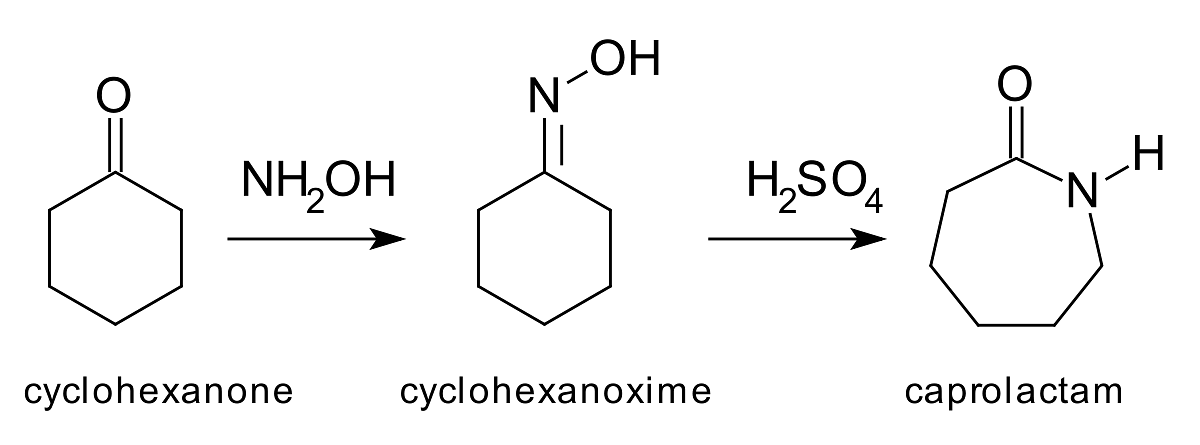
- It is utilized in the manufacture of Nylon 6 raw material. Nylon – 6 is made from caprolactam, which is a raw ingredient. The Beckmann rearrangement reaction of cyclohexanone and oxime can yield caprolactam.
- There have been no negative environmental consequences reported. It is essential in the manufacture of Nylon 12 monomer units.
Read More: Aqua Regia
Points to Remember
- General representation of the Beckmann Rearrangement mechanism is:

- The mechanism of the Beckmann Rearrangement mechanism is:

- The Beckmann solution, which is made up of acetic acid, hydrochloric acid, and acetic anhydride, was commonly employed to catalyze the reaction. Other acids have been utilized, including sulfuric acid, polyphosphoric acid, and hydrogen fluoride.
- The Beckmann rearrangement's most typical reaction mechanism is an anti-periplanar alkyl migration followed by the expulsion of a leaving group, resulting in the formation of a nitrilium ion. Solvolysis to an imidate is subsequently followed by tautomerization to the amide.
- Although neptunium's applications are extremely limited, it does see some use in research, specifically for its potential use as fissile nuclear fuel.
Also Read:
| Related Articles | ||
|---|---|---|
| Etard Reaction | Nucleophilic Addition Reaction | |
| Tollens’ Test | Addition Reaction | |
Sample Questions
Ques 1. What is the Beckmann Rearrangement? Explain in detail. (4 marks)
Ans. The Beckmann Rearrangement is an oxime reaction that synthesizes either amides or nitriles, depending on the material one starts with. Oximes that are obtained from ketonic compounds get transformed into amides, while oxime compounds obtained from aldehydes get transformed into nitriles. The Beckmann Rearrangement is a spontaneous reaction that can be used to convert an oxime to an amide in acidic conditions. The reaction eventually kicks off with the protonation of the alcohol group, resulting in the development of a desired leaving group. The R group transitions to the species which is departing, after that to nitrogen, resulting in the formation of a carbocation and the synthesis of water particles are seen. After deprotonation and tautomerization, the water atom attacks the carbocation, producing the amide.
Reaction in which an oxime is converted to an amide is known as the Beckmann Rearrangement. An aldehydic compound or ketonic compound is treated with hydroxylamine to produce the oxime compound. The Beckmann Rearrangement reaction derives its name from the German chemist Ernst Otto Beckmann.
Ques 2. Give the mechanism of Beckmann Rearrangement structure. (3 marks)
Ans. 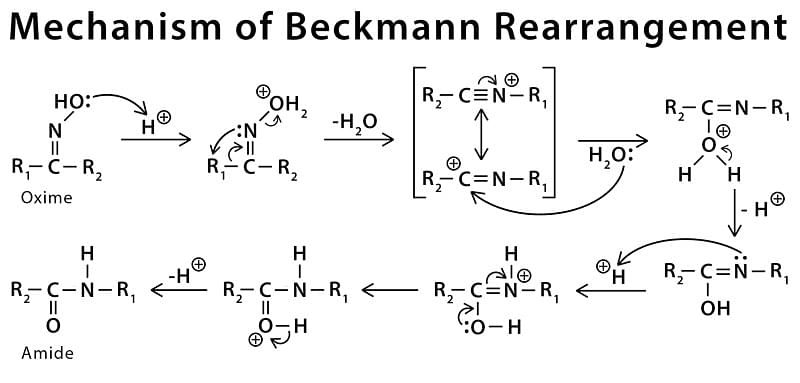
Mechanism of Beckmann Rearrangement structure
Ques 3. What is Beckmann fragmentation? (3 marks)
Ans. If a stable carbocation is created, Beckmann fragmentation occurs. The Beckmann fragmentation route can be favored by a variety of reaction circumstances. For instance, a quaternary carbon core boosts the process of Beckmann fragmentation by promoting the formation of carbocation by hyperconjugation. The fragmentation mechanism is additionally aided by oxygen and nitrogen atoms. The Beckmann fragmentation mechanism can potentially be aided by sulphur and silicon.
Ques 4. What are the applications of Beckmann Rearrangement? (5 marks)
Ans. Applications of Beckmann Rearrangement are:
- It is utilized in the manufacture of Nylon 12 monomer units.
- It is utilized in the manufacture of Nylon 6 raw material. Nylon – 6 is made from caprolactam, which is a raw ingredient. The Beckmann rearrangement reaction of cyclohexanone and oxime can yield caprolactam.
- Hoechst – Celanese used Beckmann rearrangement at the industrial level to generate the drug paracetamol. The Beckmann rearrangement reaction converts methyl ketone to acetanilide in this procedure.
- Beckmann rearrangement can be used to produce androstenolone or DHEA.
- It's also used to make benazepril, ceforanide, olanzapine, etazepine, and enprazepine, among other things.
- The Beckmann pathway is used in the process of Schmidt reaction.
Ques 5. What are Benzil and Benzilic acid rearrangement? What is Benzil used for? (3 marks)
Ans. The benzilic acid rearrangement is the 1,2-rearrangement of 1,2-diketones to create alpha-hydroxy-carboxylic acids using a base. The potassium hydroxide reaction of benzil to create benzyl acid gives rise to this reaction. The response is a ring contraction when applied on cyclic diketones. Insecticides and therapeutic agents for medicinal intermediates are both commonly utilized with benzil. It's utilized in organic synthesis. Its major function in polymer chemistry is as a photoinitiator. It's employed in the free-radical curing of polymer networks.
Ques 6. What is the purpose of Beckmann Rearrangement? (2 marks)
Ans. The purpose of Beckmann Rearrangement is to convert a ketoxime into an N-substituted amide in the presence of an acidic reagent. This mechanochemical approach allows for the creation of novel amide frameworks by cutting and pasting C–C and C–N bonds on the oxime backbone in an environment friendly manner. The use of low-cost, commonly available reagents like p-tosyl imidazole (p-Ts-Im) and oxalic acid helps to generate a library of structurally diverse amides in good to high yields.
Ques 7. Name the commonly available reagents. What is it used for? (2 marks)
Ans. The commonly available reagents like p-tosyl imidazole (p-Ts-Im) and oxalic acid which are also low in cost. It helps in the generation of a library of structurally diverse amides in good to high yields. It includes value-added commercial compounds like caprolactam and the active pharmaceutical ingredient (API) paracetamol. This technique which does not use any solvent has also been improved and effectively used to a variety of ketones that serve as oxime precursors.
For Latest Updates on Upcoming Board Exams, Click Here: https://t.me/class_10_12_board_updates
Check-Out:



Comments