



Content Curator
Canal Ray Experiment led to the discovery of protons. The discovery of protons after the electron strengthened the area of atomic structure. During his experiment, he applied a high voltage across the discharge tube containing a perforated cathode. The discharge tube was called Crookes tubes. Canal rays can also be called anode or positive rays as it’s a beam of positive ions.
| Table of Content |
Key Terms: Canal rays, cathode rays, ionization, charged particle, electrodes, Crookes tube, cathode ray tube
Read More: Number of Moles Formula
Apparatus Required
[Click Here for Sample Questions]
- A Cathode ray tube made of glass with two metal electrodes (anode and cathode) on each differentiated side.
- A high voltage source (external) is connected to the metal electrodes.
- The glass tube pressure is minimized through vacuum pumps or evacuating the air.
Procedure
[Click Here for Sample Questions]
- To maintain a low pressure inside the glass tube, evacuate the air through the vacuum pump.
- Connect the two electrodes (anode and cathode) to a high external voltage source.
- High voltage passing through the electrode ionizes the air and makes it conduct the electricity like a conductor. This leads to the completion of the circuit and apparatus setup.
- Increase the external voltage source to several thousand volts, which results in the emission of faint luminous rays emerging from the cathode electrode holes.
- The rays which were moving in opposite to the cathode rays were called canal rays.
Explanation
[Click Here for Sample Questions]
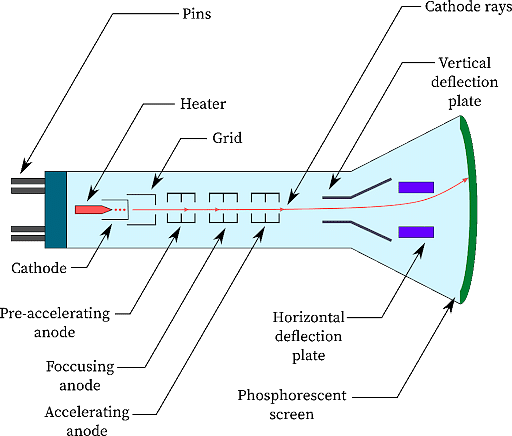
Fig 1 Canal Ray Experiment
When a high external voltage source is applied to the glass tube via electrodes, it ionizes the gas present inside the tube where the positive ions constitute the origin of the canal ray. In addition, the canal rays are considered to be the nucleus of the gas which has differentiated properties compared to cathode rays.
Conclusion
[Click Here for Sample Questions]
The canal rays depend on the nature or type of gas present inside the glass tube and are different from cathode rays. It is because the canal rays consist of positive ions formed as a result of gas ionization. In addition, the charge to mass ratio of ionized particles was found to be different and depended on the type of gasses.
Further, the particle behavior of canal rays is quite opposite to cathode rays when exposed to electric and magnetic fields. They also carry multiples of fundamental charges during emission. Finally, from the experiment of E.Goldstein, he concluded that the canal rays that move from the positive electrode to the negative electrode led to the discovery of “Proton ''.
Things to Remember
- Canal rays are ionized particles emerging from the ionization of gas and moving from positive to negative electrodes when external high voltage sources are applied.
- Canal rays are beams of positive ions discovered in 1886 by E.Goldstein.
- Canal ray experiment led to the discovery of subatomic particle called “Proton”
- The charge to mass ratio of canal rays varies in accordance with the type of gasses used within glass-tube or Crookes tubes.
- The particle behavior of canal rays, when exposed to electric and magnetic fields, was opposite compared to cathode rays.
Read More: Gay-Lussac’s Law
Sample Questions
Ques. Who discovered the canal rays? (2 Marks)
Ans. E.Goldstein
Scientist Dempster was the one who used a spectrometer with ion sources but failed to achieve it in the magnetic field. But during later years, E.Goldstein discovered the canal rays through his glass-tube experiment using fluorescent patches.
Ques. Why are canal rays referred to as anode rays? (2 Marks)
Ans. Both anode rays and canal rays travel in opposite directions compared to cathode rays.
We know that the canal rays move from the positive electrode to the negative electrode similar to the anode rays. But, the cathode rays travel from the negative electrode to the positive electrode. Therefore, canal rays can also be called anode rays.
Ques. Write the difference between Cathode and Canal rays. (2 Marks)
Ans.
- Cathode rays are negatively charged and emerge from negative electrodes whereas canal rays are positively charged and do not emerge from positive electrodes.
- In an electric field, cathode rays are attracted towards positive electrodes whereas canal rays are attracted toward negative electrodes.
- The charge to mass ratio of canal rays varies with respect to the type of gasses used within glass tubes whereas the charge to mass ratio of cathode rays does not change.
Ques. How are canal rays produced? (2 Marks)
Ans. When a high source of electric charges is applied to the electrodes of a glass tube containing low-pressure gasses, the gas gets ionized. The electrons emerging from the cathode collide with ionized particles to produce particles of positive charge which we call canal rays.
Ques. State the characteristics of canal rays. (2 Marks)
Ans.
- Canal rays are positively charged particles or ions that travel from positive to negative electrodes along with the gas.
- Canal rays are deflected in opposite direction compared to cathode rays when exposed to an electric and magnetic field
- Canal rays travel in unidirectional and at lower velocity compared to cathode rays
- It affects the photographic plate and produces fluorescence through gas ionization.
Ques. Does the charge of mass ratio vary for canal rays? (1 Mark)
Ans. Yes. We know that the charge to mass ratio of canal rays varies and is different for different types of gasses present within the glass tube. It is because canal rays are produced from the ionized gasses and each gas has different properties. So, the answer is “Yes''.
Ques. Explain the condition under which the canal rays are produced. (1 Mark)
Ans.
- A glass-tube (Crookes tube) with low pressured air achieved through vacuum pump or air evacuation and two metal electrodes (anode and cathode)
- A high external voltage source is applied to the two metal electrodes.
Ques. Why is fluorescent material applied to the near anode in the glass tube of the canal ray experiment? (2 Marks)
Ans. We know that fluorescence is the emission of light through the absorption of electromagnetic radiation. So, to figure out the charge to mass ratio of cathode rays during electron discovery, the fluorescent material is applied to the near anode so that it can absorb the electrons to showcase through light.
Ques. What type of gases can be used in the canal ray experiment tube? (2 Marks)
Ans. E.Goldstein took helium gas in the cathode ray tube. But to achieve better results, we can use low-pressure hydrogen gas. It is because the ionization energy of helium is higher than that of hydrogen. Since canal rays emerge from gas ionization, hydrogen would be an ideal choice for this experiment.
Ques. Write down the difference between the canal ray experiment tube and the anode ray experiment tube. (2 Marks)
Ans.
- Anode ray experiment tube has a perforated cathode in the middle of the tube
- Canal ray experiment tube has cathode and anode as two metal electrodes at each end.
Also read:



Comments