



Content Writer
A cartesian product is a set of all ordered pairs and tuplets. It is most commonly implemented in set theory. Various real-life examples can be used to explain the cartesian product of sets like chess boards, computer images, and decks of cards. The digital images displayed by the computers are represented as pixels, the graphical representation of cartesian products.
While plotting a graph paper one must note the axes like the x-axis and y-axis. Example (7,6) depicts the value on the x-axis as 7 and that on the y-axis as 6. This is not the same as (6,7). The value of the x-coordinate always comes before that of the y-coordinate. A Cartesian product is the product of x and y in an ordered fashion.
Read more: Coordinate geometry
| Table of Content |
KeyTerms: Cartesian products, Non-empty sets, Coordinates, Ordered pairs, Distributive properties, Equivalence sets
Cartesian Product of Sets Definition
[Click Here for Sample Questions]
The product of two non-empty sets in an ordered fashion is called the cartesian product of sets. The product of two non-empty sets gives a collection of all ordered pairs and it is the final product of the sets. Two elements are taken from each set for an ordered pair.
To understand better the cartesian product of sets, here is an example:
- Let A and B be the two sets such that A is a set of three colors of curtains and B is a set of three colors of the sofa, i.e.
A = {brown, green, yellow}
B = {red, blue, purple}
- The number of pairs of colored objects that we can make from a set of curtains and sofa in different combinations can be paired as given below:
(brown, red), (brown, blue), (brown, purple), (green, red), (green, blue), (green, purple), (yellow, red), (yellow, blue), (yellow, purple)
- The Cartesian product has nine such pairs since each of the defined sets A and B contains three members.The above-ordered pairs represent the definition for the Cartesian product of the sets given. This product is denoted by “A × B”.
Read More:
| Related Articles | ||
|---|---|---|
| Sets | Venn diagram of sets | Vertex |
| Union and intersection of sets | Disjoint Sets | Types of Functions |
Cartesian Product of Sets Formulas
[Click Here for Sample Questions]
- Given: Two non-empty sets P and Q. The set of all ordered pairings of elements from P and Q make up the Cartesian product P x Q, i.e.,
P × Q = {(p,q): p ∈ P, q ∈ Q}
- If either P or Q is the null set, then P × Q will also be an empty set, i.e., P × Q = φ.
Finding Cartesian Product
[Click Here for Sample Questions]
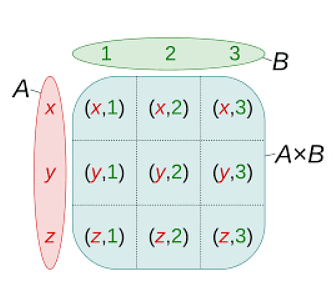
- Consider two non-empty sets C = {x, y, z} and D = {1, 2, 3}
- The cartesian product, also known as the cross-product or the product set of P and Q is obtained as explained:
- The first element x is taken from the set P {x, y, z} and the second element 1 is taken from the second set Q {1, 2, 3}
- Both these elements are multiplied to form the first ordered pair (x,1)
- The same step is repeated for all the other pairs too until all the possible combinations are chosen
- The entire collection of all such ordered pairs gives us a cartesian product P x Q = {(x,1), (x,2), (x,3), (y,1), (y,2), (y,3),(z,1), (z,2), (z,3)}.
- Similarly, we can find the cartesian product of Q x P.

Finding Cartesian Product
Cartesian Product of Two sets
[Click Here for Sample Questions]
The cartesian product of the two sets C and D, where C = {11,12,13} and D = {7, 8}. After following the steps mentioned above:
- The resultant product C x D will be: {(11,7), (11,8),(12,7),(12,8),(13,7),(13,8)}.
- Similarly, we can find the cartesian product of D and C as D × C = { (7,11),(7,12),(7,13),(8,11),(8,12),(8,13)}.
- The cartesian products C × D and D × C do not contain exactly the same ordered pairs. Hence, in general, C × D ≠ D × C.

Cartesian Product of Two sets
Cartesian Products of Three Sets
[Click Here for Sample Questions]
Suppose P is a non-empty set and the Cartesian product P × P × P represents the set P × P × P ={(x, y, z): x, y, z ∈ P} which means the coordinates of all the points in three-dimensional space. This forms the basis for the Cartesian product of three sets.
Example: Find the Cartesian product of three sets P = {p, q}, Q = {1, 2} and R = {x, y}.
Solution: Given,
P = {p, q}
Q = {1, 2}
R = {x, y}
The ordered pairs of P × Q × R can be formed as given below:
1st pair ⇒ {p, q} × {1, 2} × {x, y} ⇒ (p, 1, x)
2nd pair ⇒ {p, q} × {1, 2} × {x, y} ⇒ (p, 1, y)
3rd pair ⇒ {p, q} × {1, 2} × {x, y} ⇒ (p, 2, x)
4th pair ⇒ {p, q} × {1, 2} × {x, y} ⇒ (p, 2, y)
5th pair ⇒ {p, q} × {1, 2} × {x, y} ⇒ (q, 1, x)
6th pair ⇒ {p, q} × {1, 2} × {x, y} ⇒ (q, 1, y)
7th pair ⇒ {p, q} × {1, 2} × {x, y} ⇒ (q, 2, x)
8th pair ⇒ {p, q} × {1, 2} × {x, y} ⇒ (q, 2, y)
Thus, the ordered pairs of P × Q × R can be written as:
P × Q × R = {(p, 1, x), (p, 1, y), (p, 2, x), (p, 2, y), (q, 1, x), (q, 1, y), (q, 2, x), (q, 2, y)}
Cartesian Product of Three sets
Properties of Cartesian Product
[Click Here for Sample Questions]
| Properties | Representation |
|---|---|
| Non-commutative: The results depend on the order of sets. | C × D ≠ D × C C × D = D × C, if and only if C = D. C × D = ∅. if either C = ∅ or D =∅ |
| Non-associative: Rearranging the parentheses will change the result. | (C × D) × E ≠ C × (D × E) |
| Distributive properties over the intersection of sets. | C × (D∩E) = (C × D) ∩ (C × E) |
| Distributive properties over the union of sets | C × (D∪E) = (C × D) ∪ (C × E) |
Things to Remember
- The set of all ordered pairs and tuplets is called a cartesian product.
- It is the product of x and y in an ordered fashion.
- Ordered pairs are also referred to as 2−tuples.
- The cartesian product of two sets C and D are also known as the cross-product or the product set of C and D.
- The final cartesian product of two sets will be a collection of all ordered pairs obtained by the product of these two non-empty sets.
- Cartesian products are non-commutative and non-associative.
- Cartesian products have distributive properties over the intersection of sets and over the union of sets.
For Latest Updates on Upcoming Board Exams, Click Here: https://t.me/class_10_12_board_updates
Sample Questions
Ques. What is the cartesian product of sets? (1 mark)
Ans. The Cartesian product of sets is the product of two non-empty sets in an ordered way. The assortment of all ordered pairs attained by the product of two non-empty sets. An ordered pair basically means that two elements are taken from each set.
Ques. Cartesian Product is invented by whom? (1 mark)
Ans. René Descartes invented the Cartesian product. It is named after the same person. René formulated analytic geometry which helped in the origin of this concept which further generalized in terms of direct product.
Ques. What is a Cartesian Product used for? (2 marks)
Ans. A Cartesian product is applicable to matrix applications. In SQL it explains a bug where you join two tables wrongly and get many records from one table being connected to each of the records of the other, instead of the expected one.
Ques. If A = {5, 6}, form the set A × A × A. (1 mark)
Ans. A × A × A = {5, 6} × {5, 6} × {5, 6}
= {(5, 5, 5), (5, 5, 6), (5, 6, 5), (5, 6, 6), (6, 5, 5), (6, 5, 6), (6, 6, 5), (6, 6, 6)}
Ques. The Cartesian product B × B has 9 elements, among which are found (–1, 0) and (0, 1). Find the set B and the remaining elements of B × B. (2 marks)
Ans. If n(B) = p and n(C) = q, then n(B x C) = pq
Thus, n(B x B) = n(B) x n(B)
Given,
n(B x B) = 9
n(B) x n(B) = 9
⇒ n(B) = 3….(i)
Also, given that (- 1, 0) and (0, 1) are two of the nine ordered pairs of B x B.
We know that B x B = {(b, b) : b ∈ B} .
Therefore, – 1, 0, and 1 are the elements of B…..(ii)
From (i) and (ii),
B = {-1, 0, 1}
Hence, the remaining elements of set B x B are (- 1, – 1), (- 1, 1), (0, – 1), (0, 0), (1, – 1), (1, 0), and (1, 1).
Ques. Find the cartesian product of B2 where, B = {1,2}. (2 marks)
Ans. The first element 1 is taken from the set B {1,2} and the second element 1 is taken from the same set B {1, 2}. The same step is repeated until all the possible combinations are chosen. Thus, we obtain 4 ordered pairs after multiplying all the pairs: {(1,1),(1,2),(2,1),(2,2)}. This is the cartesian square of set B.
B2 = {(1,1),(1,2),(2,1),(2,2)}.
Ques. What is the Cartesian Product of Relations? (2 marks)
Ans. The cartesian product of relations does not exist because the relations itself is an ordered pair, which relates the elements of one set with the elements of another. Relations in math is another form of connecting the elements of two sets, similar to the cartesian product of sets.
Ques. Is order important in cartesian products? (2 marks)
Ans. The order in which the sets are multiplied in a cartesian product matters as the cartesian product is not commutative. The cartesian product does not satisfy the commutative property.
Two sets A and B are such that the cartesian product P × Q will not be equal to the cartesian product Q × P.
P x Q ≠ Q x P.
Ques. How to find the cardinality of a cartesian product? (2 marks)
Ans. The cardinality of a set is the total number of elements in the set. The cardinality of a cartesian product of two sets C and D is equal to the product of the cardinalities of these two sets: n(C × D) = n(D × C) = n(C) × n(D). Consider two sets A = {2,5} and C = {4,1}. The cardinality of A and C are 2 and 2. Hence, the cardinality of their product will be n(A × C) = n(A) × n(C) = 2 × 2 = 4.
Ques. Cartesian Product an Equivalence Relation? (1 mark)
Ans. A cartesian product is an equivalence relation if and only if it is a product of a set with itself. An equivalence relation is a relation that is reflexive, symmetric, and transitive.
Check out:



Comments