


Which is the nearest planet to the sun?

Jasmine Grover logo

Jasmine Grover

Education Journalist | Study Abroad Lead

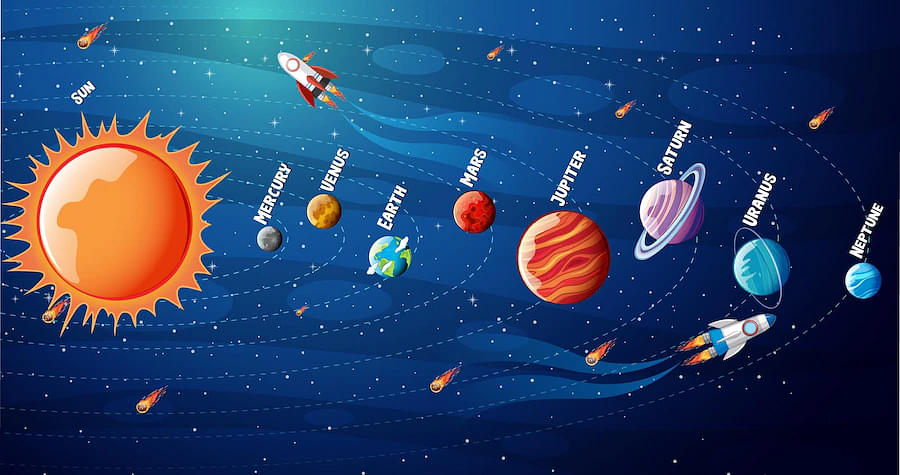
There are 8 planets in our solar system. The order of the planets in our solar system, from the nearest to the sun to outwards is – Mercury, Venus, Earth, Mars, Jupiter, Saturn, Uranus, and Neptune

  • Hence, Mercury is the closest planet to the Sun.
  • The temperature on Mercury varies extremely from 90 K to 700 K.
  • Mercury, the nearest planet to the sun, is the second densest major celestial body in space after our Earth.

The solar system includes the four inner planets, the asteroid belt, the four gas giants, and then and on to the Kuiper Belt. 
Mercury

Mercury is the nearest planet to the sun and is the smallest planet in the solar system. It moves around the sun in 88 days. 

  • The temperature at Mercury is extremely thin. 
  • It is mainly made of oxygen, sodium, helium, hydrogen, and potassium.
  • Its surface is filled with craters just like the moon.

Also Read:

CBSE CLASS XII Related Questions

  • 1.
    Suppose a pure Si crystal has \( 5 \times 10^{28} \) atoms per \( \text{m}^3 \). It is doped with \( 5 \times 10^{22} \) atoms per \( \text{m}^3 \) of Arsenic. Calculate majority and minority carrier concentration in the doped silicon. (Given: \( n_i = 1.5 \times 10^{16} \, \text{m}^{-3} \))


      • 2.
        What is displacement current (\( i_d \))? Considering the case of charging of a capacitor, show that \( i_d = \varepsilon_0 \frac{d\Phi_E}{dt} \). What is the value of \( i_d \) for a conductor across which a constant voltage is applied?


          • 3.
            Draw the number of scattered particles versus the scattering angle graph for scattering of alpha particles by a thin foil. Write two important conclusions that can be drawn from this plot.


              • 4.
                If both the number of protons and the neutrons are conserved in each nuclear reaction, in what way is mass converted into energy (or vice versa) in a nuclear reaction? Explain.


                  • 5.
                    Photoemission of electrons occurs from a metal (\( \phi_0 = 1.96 \, \text{eV} \)) when light of frequency \( 6.4 \times 10^{14} \, \text{Hz} \) is incident on it. Calculate: Energy of a photon in the incident light, The maximum kinetic energy of the emitted electrons, and The stopping potential.


                      • 6.
                        A long solenoid of length \( L \) and radius \( r_1 \) having \( N_1 \) turns is surrounded symmetrically by a coil of radius \( r_2 \, (r_2>r_1) \) having \( N_2 \) turns (\( N_2 \ll N_1 \)) around its mid-point. Derive an expression for the mutual inductance of solenoid and coil. Is \( M_{12} = M_{21} \) valid in this case?

                          CBSE CLASS XII Previous Year Papers

                          Comments


                          No Comments To Show
