



Content Curator
A circuit component is any device that is connected to an electrical circuit.
- Electrical components in circuits enable us to change the properties of electricity, such as adjusting its voltage, the internal resistance of a cell, or storing it, among other things.
- Electricity has been adapted for a wide and growing number of different purposes in our daily lives.
- Whether it is to power our equipment such as light bulbs, fans, air conditioners, electric irons, and washing machines, or to charge our batteries, mobile phones, and so on.
- The entire electronic system is dependent on the flow of electric current to work.
- But for something to flow, it must have a path to flow. The electric circuit is the path through which electric current flows.
A basic electric circuit can be created with the following circuit components:
- Cell
- Light bulb
- Switch
- Connecting wire
| Table of Content |
Key Terms: Electric circuit, Electric current, Resistance, Light bulb, Cell, Battery, Electrons, Types of switches, Conductors
What is an Electric Circuit?
[Click Here for Sample Questions]
Electric circuits are closed loops or channels through which current flows.
- Various components are added to electric circuits to perform various tasks.
- In other terms, an electric circuit is a collection of components that are designed to conduct electric current in a specified direction.
- The source is the point where the current starts and the return is the point where it terminates.
Many different types of electrical circuits serve a purpose in everyday life; some of the most common include
- Open Circuit: An open circuit is one in which the switch is open and no current flows across the circuit.
- Closed Circuit: An open circuit is one in which the switch is closed and current flows through the circuit.
- Short Circuit: When the current in the circuit takes a shorter path rather than its usual path, a short circuit occurs.
- Series Circuit: A series circuit is one in which all of the resistances of the circuit are connected in series.
- Parallel Circuit: A parallel circuit is one in which all of the resistances of the circuit are connected in parallel.

Electric circuit
Components of Electric Circuit
[Click Here for Previous Year Questions]
Every circuit component contributes to the functionality of the device in which it is located, regardless of how basic or specialized it might be. The following are some basic components of electrical circuits:
Cell
A cell is an electrical device that continually converts chemical energy into electric power to maintain the flow of electricity in the circuit.
- Cells are used in electrical circuits, and a battery is formed by combining many cells.
- A cell has two terminals, also known as poles.
- These are the positive terminal and the negative terminal.
- When connected to electrical circuits, the negative terminal works as an electron source.
- The cell provides electrons because it has electrons stored within it.
- The positive and negative terminals are typically marked or easily distinguishable visually on most cells.
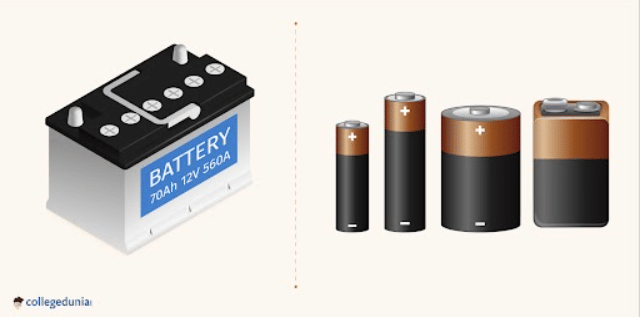
Cell
Cells are usually used in circuits that require less electrical power, such as watches and hearing aids.
- Most circuits use a collection of cells (battery) rather than a single cell.
- The batteries are available in a variety of shapes, sizes, and capacities.
- Batteries include standard flashlight batteries, clock batteries, AAA batteries, lead-acid batteries, and other types.
Switch
A switch is an electrical device used to interrupt the flow of electric current, or to turn on or off any electric appliances such as fans, lights, televisions, computers, washing machines, and so on.
- A switch is used to turn off or open an electrical circuit.
- When the switch is turned on, the circuit is closed and the current begins to flow through the circuit.
- When it is turned off, the circuit is open and no current will flow through the circuit.
In general, two types of switches are used in an electrical circuit:
- Electrical switches: Electrical switches are devices that control the flow of electricity in a circuit and work under the influence of a semiconductor.
- Mechanical switches: Mechanical switches are physical switches that must be manually or mechanically activated. They are usually made of metal or plastic, and they include two or more electrical contacts that connect when the switch is turned on. When the switch is turned off, the contacts separate and the circuit is closed.

Switch
Light Bulb
A light bulb is an electrical device that produces light from electricity.
- Light bulbs produce light by passing current through a thin wire known as the filament.
- The filament is commonly made of tungsten, a substance that emits light when an electric current passes through it.
- The emission of light is caused by the high resistance of the substance tungsten.
- Along with lighting purposes, light bulbs have applications in electrical devices such as indicators, traffic signals, motor vehicle indicator lights, and so on.

Light Bulb
Connecting Wires
Connecting wires are one of the most essential components of an electrical circuit because they allow electricity to flow from one component to another.
- It is a flexible metal strand that is generally cylindrical.
- They offer a minimum resistance to the flow of electric current.
- Electricity is transferred from a cell to a light bulb by the use of wire.
- Wires are formed of metals that conduct electricity well and allow current to pass through them.
- All of the connecting wires are insulated to prevent electrical shocks and to maintain the path along which electricity is supposed to flow.

Connecting wires
Basic Electrical Circuit
[Click Here for Sample Questions]
A basic electrical circuit is a closed loop that allows electricity to flow. It consists of four main components:
- A source of electricity, such as a battery
- A conducting path, such as a wire
- A load, such as a light bulb
- A switch to control the flow of electricity
The circuit is completed when the switch is turned on, and the electricity flows from the battery through the wire to the light bulb. The light bulb glows because the electricity heats the filament inside, which causes it to emit light.

Basic Electrical Circuit
Things to Remember
- A flow of charged particles, such as electrons or ions, traveling through an electrical conductor or space is referred to as an electric current.
- The term electric circuit refers to a closed loop or channel through which current flows.
- A cell, key (switch), wire, bulb, and other devices that are used in an electric circuit are called the electrical components of the circuit.
- A cell is a single electrical energy source that generates current through chemical reactions.
- A switch is an electrical circuit component that can connect or separate a conducting channel by stopping or controlling electron passage through the circuit.
- A connecting wire allows an electric current to flow from one place to another without resistance.
Do Check Out:
Previous Year Questions
- Extraction of metal from the ore cassiterite involves...[JEE Advanced 2011]
- Commonly used vectors for human genome sequencing are...[NEET UG 2014]
- Interfascicular cambium and cork cambium are formed due to..
- Pneumotaxic centre is present in...[UP CPMT 2007]
- Reaction of HBr with propene in the presence of peroxide gives….[NEET UG 2004]
- Assuming the expression for the pressure exerted by the gas on the walls of the container, it can be shown that pressure is...[MHT CET 2016]
- Which among the following is the strongest acid?...[TS EAMCET 2017]
- Isopropyl alcohol on oxidation forms..
- A vector is not changed if..
- Which of the following arrangements does not represent the correct order of the property stated against it?...[JEE Main 2013]
- The major product of the following reaction is...[JEE Main 2019]
- Major product of the following reaction is..[JEE Main 2023]
- The percentage of nitrogen in urea is about..
- The electric field at a point is
- Which of the following statements is true?..[JKCET 2006]
Sample Questions
Ques. How does a light bulb in the flashlight glow? (2 Marks)
Ans. Because of the electrical resistance, when current flows through a very small filament, it warms up to a very high temperature. This allows the filament to burn strongly, causing the light bulb in the flashlight to illuminate.
Ques. The circuit in which current has a complete path to flow is called ______ circuit. (2 Marks)
(a) Open loop
(b) Short
(c) Open
(d) Closed
Ans. The correct answer is d. Closed
Explanation: A closed circuit is one in which current has a complete channel to flow. An open circuit occurs when the current path is interrupted, preventing the current from flowing.
Ques. What are the main components of an electric circuit? (2 Marks)
Ans. A circuit has the following components:
- A cell or battery i.e. the source of electricity
- Key or switch to control the circuit
- Connecting wires that act as a conductor to flow electric current
- A bulb or electric device acts as a load on the circuit
Ques. If the voltage-current characteristic is a straight line through the origin, then the element is said to be? (2 Marks)
(a) Unilateral element
(b) Non-linear element
(c) Linear element
(d) Bilateral element
Ans. The correct answer is c. Linear element
Explanation: The element is considered to be linear if the voltage-current characteristic is a straight line across the origin. Potential difference refers to the difference in potential energy of charges.
Ques. What are electric circuits? (2 Marks)
Ans. Electric circuits are closed-loop or paths of electrical components through which electrons can flow.
- This path consists of electrical wires and is powered by an external source, such as a battery.
- The point where electrons begin to flow is referred to as the source, while the point where electrons leave the electrical circuit is referred to as the return.
Ques. What are complex circuits? (1 Mark)
Ans. Complex circuits are those that have components connected in both series and parallel configurations.
Ques. The potential difference in electrical terminology is known as (2 Marks)
(a) Resistance
(b) Voltage
(c) Current
(d) Conductance
Ans. The correct answer is b. Voltage
Explanation: Voltage is a potential difference in electrical terminology that is represented by V. It is measured in energy per unit charge.
Ques. What is a series circuit? (2 Marks)
Ans. A series circuit is one in which several resistances are connected in series. This type of connection is also known as an end-to-end connection or a cascade connection. The flow of current follows a single path.
Ques. What are parallel circuits? (2 Marks)
Ans. A parallel circuit is one in which multiple resistances are connected across one another in such a way that one terminal of each resistance is connected to form a junction point while the remaining end is likewise connected to produce another point.
Ques. What are the uses of batteries? (5 Marks)
Ans. The following are the uses of batteries
- Use of battery at home: We depend on batteries for a variety of household devices such as remote controls, torches, clocks, etc. Rechargeable batteries, such as alkaline batteries, are used in mobile phones, portable video game consoles, digital cameras, and many other devices.
- Use of battery in health instruments: Batteries may be found in a variety of medical devices. Battery-powered equipment includes artificial limbs, insulin pumps, hearing aids, and valve support devices. Mercury batteries are helpful for photography light meters and electrical devices such as appliance real-time clocks.
- Use of batteries in the medical sector: Batteries are widely used in the medical industry. The ECG heart monitor is powered by a battery and can be moved with the patient. It is always turned on to display the health data of the patients. In hospitals, rechargeable batteries such as lithium-ion and nickel-cadmium batteries are commonly used.
- Use of battery in logistics and construction: Because smoke and carbon monoxide are produced, and combustion can be harmful in confined places, heavy-duty batteries are used to power equipment such as forklifts. Lead-acid batteries are used in automobiles.
Ques. What are electrical conductors? (2 Marks)
Ans. Electrical conductors are materials that allow electricity to easily flow through them. Conductivity is the characteristic of conductors that allows them to conduct electricity.
Ques. What is a semiconductor? (2 Marks)
Ans. A semiconductor is a material whose electrical conductivity is in between that of a conductor and that of an insulator. Germanium and silicon are two examples.
Ques. What are the properties of electric circuits? (5 Marks)
Ans. The following are the properties of electric circuits
- A circuit is a closed path.
- A circuit always requires at least one energy source that also acts as an electron source.
- Electric elements include unregulated and controlled power, as well as resistors, capacitance, and inductors.
- In an electric circuit, electrons flow from the negative electrode to the positive electrode.
- Traditional current moves from the positive to the negative terminal.
- The current flow causes a potential decline in the various elements.
Ques. Define a cell. (2 Marks)
Ans. A cell is a single electrical energy source that produces current through chemical reactions. It converts chemical energy that has been stored into electrical potential energy. The cell is made up of two electrodes and an electrolyte.
Ques. What is Static Electricity? (2 Marks)
Ans. Static electricity is an imbalance of electric charges within or on the surface of a material. It is caused by the transfer of electrons from one material to another. Static electricity can be generated by friction, contact, and induction.
For Latest Updates on Upcoming Board Exams, Click Here: https://t.me/class_10_12_board_updates
Check-Out:



Comments