



Education Journalist | Study Abroad Lead
Types of switches are two, Electrical switches and Mechanical switches. Switches are a type of electrical component used to turn any electrical device on or off. An open circuit means that the switch is off and the current is not flowing. A closed circuit means that the current is flowing and the switch is on.
| Table of Contents |
Key Terms: Switch, Circuit, Electric Current, Mechanical Switch, Electrical Switch, Bipolar Transistor, Semiconductor Electronics
What is a Switch?
[Click Here for Sample Questions]
Switch is an electronic device that is used to make or break the flow of the electric current. Current flows when the switch is ON because the electric circuit is closed. Similarly, the current stops flowing when the switch is off because the circuit is open.
As a result, switches are an important part of the control system, and control operation would be impossible without them. This can be better understood with the help of the diagram below:
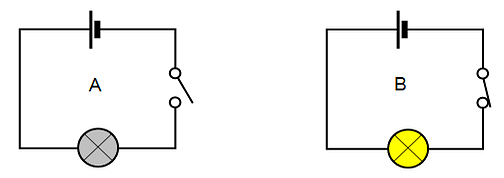
The following deductions can be made:
- In diagram A, the switch is off and the circuit is open because of which the bulb doesn’t glow.
- In diagram B, the switch is ON, the circuit is closed because of which the bulb glows.
Also Check:
| Related Articles | ||
|---|---|---|
| Transistor | Semiconductor Electronics Important Questions | Rectifier |
| Optical Instruments | Carbon Resistor | Construction and Uses of LED |
Types of Switches
[Click Here for Previous Year Questions]
Generally in an electric circuit, two types of switches are being used-
- Electrical switches: They work under the influence of a semiconductor.
- Mechanical switches: These require manual contact with the switch to operate and are divided into different types based on the number of poles (number of input circuits available to the switch) and throws (no. of the path for the flow of current available to the switch).
What are Electrical Switches?
[Click Here for Sample Questions]
These are also known as solid-state switches as there is no physical part in these switches so no physical contact. The majority of appliances, such as motor drives and HVAC equipment, are controlled by semiconductor switches.
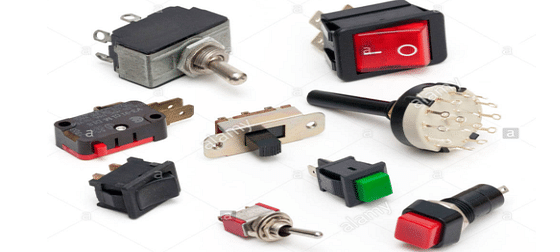
Types of Electrical Switches
There are a variety of electrical switches, some of them include:
- Bipolar Transistors
Bipolar transistor works like a normal switch. The transistor's active region is not used in switching applications. The transistors is on when it works in the saturation region and off when it works in the cut-off region. When an NPN or PNP transistor is turned on, it requires a base current to function as a switch.

Bipolar Transistor Circuit
- Power Diode
Silicon is used for the making of power diodes. When the power diode's PN junction is forward biased, it acts as a switch on; when it is reverse biased, it acts as a switch off.

- MOSFET
The full form of MOSFET is Metal Oxide Semiconductor Field Effect Transistor. It’s a unipolar switching device. The on and off states of the device can be determined by controlling the input voltage and resistance across the drain and source because the device is voltage controlled.

What are Mechanical Switches?
[Click Here for Previous Year Questions]
Mechanical switches are classified based on Poles and throws. There are 6 types of mechanical switches:
- Single pole single throw switch
- Single pole double throw
- Double pole single throw switch
- Double pole double throw switch
- Two poles six throw
- Momentary control switches

Mechanical Switches
Single Pole Single Throw Switch
It has one input terminal call pole and one output terminal called through this which is the best example of the simple switch and can be used in a single loop or 1 closed path.
Single Pole Double Throw Switch
It has one input terminal and two output terminals and can be used as a selector switch with a selector switch which means we can supply the current two loops.

Single Pole Double Throw Switch
Double Pole Single Throw Switch
These are used to simultaneously control two circuits. There are two input terminals and two output terminals on this device. In these types of circuits, the two switches are connected with a single lever and operate at the same time.
Double Pole Double Throw Switch
This switch has six terminals, two poles, and four throws, two, one for each pole's terminal. It has two ON positions since it’s a dual ON/off switch.

Two Pole Six Throw Switch
Each pole has one input terminal (pole) and six output terminals (throw). There are a total of 12 output terminals in this configuration. This is used in the circuit to switch between features for the same input terminals.
Momentary Control Switches
Momentary switches are divided into various categories-
- Temperature Switch: This type of switch can be found in devices like RTD (resistance temperature device). The working of this switch is dependent on the measured temperature.

- Toggle Switch: It is the most common switch found in most household appliances with the help of the lever we can turn the device on or off by moving it up and down

- Rotary Switch: the main use of this switch is to connect one line with another line. Apart from the arrangement of the switch, the rotary switch is very similar to a single-pole multi-throw switch. This type of switch includes knobs for multimeters, channel selectors, range selectors, metering devices, and band selectors in communication devices.

Previous Year Questions
- The angular frequency of a tuned collector … [KEAM]
- The barrier potential of a p−n junction … [NEET 2014]
- The input signal given to a CE amplifier … [NEET 2015]
- The current I … [KEAM]
- The depletion layer of a p-n junction … [KEAM]
- The TV signals have a bandwidth of … [COMEDK UGET 2014]
- The layer in earth's atmosphere which reflects radio waves … [COMEDK UGET 2012]
- Advantages of optical fibre communications over two wire … [GUJCET 2008]
- In an amplitude modulation with modulation … [KEAM]
- A ground receiver in line-of-sight … [KEAM]
- In the circuit shown in the figure, the input voltage … [NEET 2018]
Things to Remember
- The switch is an electronic device that is used to make or break the flow of the electric current.
- Current flows when the switch is ON because the electric circuit is closed similarly Current doesn’t flow when the switch is off because the circuit is open.
- There are two types of switches, Mechanical switch and Electrical switch.
Also Check:
Sample Questions
Ques: Name and explain the function of the following device depicted in the figure below: (2 marks)

Ans: The name of the device is a switch, and its function in this circuit is to control the light bulb by establishing or interrupting the electrical continuity of the circuit.
Ques: Among these two switches which one will have a longer lifeline? (2 marks)
a.Single break switch
b.Double break switch
Ans: b. Double break switch.
Explanation - Breaking two times The switch's quenching effect in suppressing the arc is doubled when it breaks the circuit in two places. This decrease in arcing at the contacts extends the contacts' life.
Ques: What goes into making an electrical switch? What happens inside the switch when it “makes” or “breaks” an electric current path? (2 marks)
Ans: Metal contacts are typically used in switches, which are touched together or separated by an actuating lever, shaft, or another mechanical assembly.
Ques: Following the diagram, which option is correct and why? (2 marks)
a.The bulb will glow
b.The bulb will not glow.

Ans: b. The bulb will glow
Explanation - The light bulb will receive full voltage from the battery only when the switch is closed. The light bulb receives less voltage when the switch is open (and correspondingly, less current). Hence when the circuit is closed the blue will glow otherwise it will not glow.
Ques: How many types of mechanical switches are there? (3 marks)
a.2
b.6
Ans: b.6
Explanation - mechanical switches are divided into 6 categories based on poles and throws. Which are as follows-
- Single pole single throw switch
- Single pole double throw
- Double pole single throw switch
- Double pole double throw switch
- Two poles six throw
- Momentary control switches
Ques. What is a Toggle Switch? (1 mark)
Ans. Toggle switch is one of the common switches found in most household appliances with the help of the lever we can turn the device on or off by moving it up and down.
Ques. What is a Two Pole Six Throw Switch? (2 marks)
Ans. Each pole, in a two pole six throw switch, has one input terminal (pole) and six output terminals (throw). There are a total of 12 output terminals in this configuration. This is used in the circuit to switch between features for the same input terminals.
Ques. What is a Switch? (1 mark)
Ans. Switch can be defined as an electronic device that is used to make or break the flow of the electric current.
For Latest Updates on Upcoming Board Exams, Click Here: https://t.me/class_10_12_board_updates
Check-Out:



Comments