



Education Journalist | Study Abroad Lead
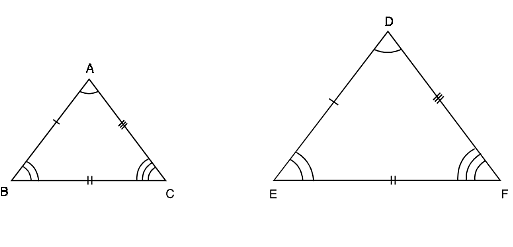
Similar triangles are an essential concept in geometry that involves constructing two triangles with the same shape but different sizes. When constructing similar triangles, the same angles between corresponding sides are maintained, while scaling the triangles by a common factor.
- Two triangles are considered similar if they have the same shape but are of different sizes.
- This means their corresponding angles are congruent, and their corresponding sides are proportional.
Angle-angle (AA), side-side-side (SSS), and side-angle-side (SAS) methods are the commonly used congruency rules.
| Table of Content |
Key Terms: Triangle, Side, Angle, Congruence, Similarity, Construction, Scale factor, Arc.
What are Similar Triangles?
[Click Here for Sample Questions]
Similar triangles are a pair of triangles that have the same shape but are not necessarily the same size.
- When two triangles are similar, their corresponding angles are congruent (equal), and their corresponding sides are proportional (have the same ratio).
- In other words, if we were to scale one of the triangles up or down, the resulting triangles would still have the same shape and angles as the original triangles.
The ratio of the lengths of the corresponding sides of two similar triangles is called the scale factor. This ratio remains the same regardless of the size of the triangles.
For example, if the scale factor between two similar triangles is 1:2, then the corresponding sides of the larger triangle are twice as long as the corresponding sides of the smaller triangle.
Also Read:
| Related Articles | ||
|---|---|---|
| Properties of Triangle | Elimination Method | Nature of Roots |
| Construction | Triangle Theorems | Determinant Formula |
Properties of Similar Triangles
[Click Here for Sample Questions]
The properties of similar triangles are as follows –
- Angle-angle (AA) similarity criterion: Similar triangles have the same shape, meaning their corresponding angles are congruent (equal).
- Side-Side-Side (SSS) similarity criterion: The sides of similar triangles are proportional to each other.
- Side-Angle-Side (SAS) similarity criterion: The ratio of the lengths of corresponding sides of two similar triangles is constant, regardless of the size of the triangles.
- The ratio of the areas of two similar triangles is equal to the square of the ratio of their corresponding sides.
- The ratio of the perimeters of two similar triangles is equal to the ratio of their corresponding sides.
- The heights and medians of similar triangles are proportional to the corresponding sides of the triangles.
Properties of Similar Triangles
Theorems to Prove Similarity of Triangles
[Click Here for Sample Questions]
To prove that two triangles are similar, the following congruency rules can be used:
- Angle-Angle (AA) similarity: If two angles of one triangle are congruent to two angles of another triangle, then the triangles are similar.
- Side-Side-Side (SSS) similarity: If the lengths of the corresponding sides of two triangles are proportional, then the triangles are similar.
- Side-Angle-Side (SAS) similarity: If the ratio of the lengths of two pairs of corresponding sides of two triangles is equal, and the included angles between these pairs of sides are congruent, then the triangles are similar.
- Angle-Side-Angle (ASA) similarity: If two angles and the included side of one triangle are congruent to two angles and the included side of another triangle, then the triangles are similar.

Theorems to Prove Similarity of Triangles
Also read: Congruence of Triangles
Construction of Similar Triangles Using Scale Factor
[Click Here for Sample Questions]
When constructing a similar triangle, there are two cases to consider: one where the triangle to be constructed is larger than the given triangle, and the other where it is smaller. The degree of similarity is determined by the scale factor, which is the ratio of the corresponding sides of the constructed triangle to those of the given triangle.
- In Case 1, the scale factor is greater than 1, resulting in a larger similar triangle than the given triangle.
- In Case 2, the scale factor is less than 1, resulting in a smaller similar triangle than the given triangle.
It's important to note that the scale factor is a measure of how much larger or smaller the constructed triangle is relative to the given triangle.
Case 1: Scale factor is greater than 1
Construct a triangle similar triangle to the given triangle with a scale factor of 4/3 i.e., the new triangle should have side lengths 4/3 times the corresponding side lengths.
Step 1: Construct a triangle of the given parameters.

Step 2: Draw a line segment making an acute angle with the base of the triangle.

Step 3: Make four equal arcs on the newly drawn line segment using a compass (as the given scale factor is 4/3).

Step 4: Extend the base of the original triangle and join the 3rd and 4th arcs to that extended line segment such that they are parallel to each other.

Here 3rd and 4th arcs are considered as the scale factor is 4/3.
Step 5: Extend the other side of the original triangle and draw a parallel line from the 4th arc meeting baseline to the newly extended side.

Hence newly constructed triangle is similar to the original triangle with a scale factor of 4/3.
Case 2: Scale factor is lesser than 1
Construct a triangle similar triangle to the given triangle with a scale factor of ⅔ i.e., the new triangle should have side lengths 2/3 times the corresponding side lengths.
Step 1: Construct a triangle by given parameters.

Step 2: Draw a line segment making an acute angle with the base of the triangle.

Step 3: Make three equal arcs on the newly drawn line segment using a compass (as the given scale factor is 2/3).

Step 4: Join the 2nd and 3rd arcs to the base of the original triangle such that they are parallel to each other.

Here 2nd and 3rd arcs are considered as the scale factor is 2/3.
Step 5: Draw a parallel line from the 2nd arc meeting base line to the other side of the original triangle.

Hence newly constructed triangle is similar to the original triangle with a scale factor of 2/3.
Also Read:
Things to Remember
- The scale factor determines the ratio of the lengths of the corresponding sides of the new triangle to those of the original triangle.
- Two triangles are similar if their corresponding angles are equal.
- The corresponding sides of two similar triangles are in proportion.
- The construction involves drawing lines parallel to one or more sides of the original triangle and creating corresponding angles with those lines.
- If the given scale factor is greater than 1, the new triangle will be larger than the original triangle, and if the scale factor is less than 1, the new triangle will be smaller than the original triangle.
Sample Questions
Ques. Construct a triangle similar to triangle PQR with a scale factor of 1/2. Given the triangle PQR, where PQ = 6 cm, QR = 8 cm, and PR = 10 cm. (5 marks)
Ans. Step 1: Draw triangle PQR as per the given dimensions.
Step 2: Draw a ray from point Q in any direction, let's say towards the right-hand side, to form a line segment QX.
Step 3: Mark a point Y on the line QX such that QY = 3 cm.
Step 4: Draw a line from point Y that passes through point R to intersect the line segment PQ, let the point of intersection Z.
Step 5: Draw a line from point X that passes through point Z to intersect the line segment PR at point S.
Step 6: Connect points S and Q with a line segment to complete the triangle QSX.
Step 7: Triangle QSX is similar to triangle PQR with a scale factor of 1/2.

Ques. Construct a triangle similar to triangle XYZ with a scale factor of 1/2. (5 marks)
Ans. Step 1: Draw triangle XYZ with the given measurements of XY = 6 cm, XZ = 8 cm, and YZ = 10 cm.
Step 2: Choose a point P on the line segment YZ such that YP is one-third of YZ, i.e., YP = (1/3) x YZ = (1/3) x 10 = 10/3 cm.
Step 3: Draw a line through P and parallel to XY. Let this line intersect XZ at point Q.
Step 4: Join points Q and Y.
Step 5: Draw a line through Q and parallel to YZ. Let this line intersect XY at point R.
Step 6: Join points R and Z.
Step 7: Triangle PQR is the required triangle, which is similar to triangle XYZ with a scale factor of 1/2.

Ques. Construct a triangle similar to triangle PQR with a scale factor of 3/5. (5 marks)
Ans. Step 1: Draw triangle PQR.
Step 2: Draw a ray PQ, and mark points Q1, Q2, Q3, Q4, and Q5 on the ray such that PQ1 = Q1Q2 = Q2Q3 = Q3Q4 = Q4Q5.
Step 3: Draw a line through Q3 and R, and extend it to point Q5 on the ray PQ.
Step 4: Draw a line parallel to RP through Q5, and let it intersect side PQ at point P'.
Step 5: Draw a line parallel to PQ through R, and let it intersect side P'Q at point R'.
Then, triangle P'Q'R' is the required triangle.

Ques. Construct a triangle similar to triangle XYZ with a scale factor of 2/3. (5 marks)
Ans: Step 1: Draw triangle XYZ.
Step 2: Draw a ray XY, and mark points Y1, Y2, Y3, and Y4 on the ray such that XY1 = Y1Y2 = Y2Y3 = Y3Y4.
Step 3: Draw a line through Y3 and Z, and extend it to point Y4 on the ray XY.
Step 4: Draw a line parallel to XZ through Y4, and let it intersect side XY at point X'.
Step 5: Draw a line parallel to XY through Z, and let it intersect side X'Y at point Z'.
Then, triangle X'Y'Z' is the required triangle.

Ques. Construct a triangle similar to triangle LMN with a scale factor of 4/7. (5 marks)
Ans. Step 1: Draw triangle LMN.
Step 2: Draw a ray LM, and mark points M1, M2, M3, M4, M5, and M6 on the ray such that LM1 = M1M2 = M2M3 = M3M4 = M4M5 = M5M6.
Step 3: Draw a line through M4 and N, and extend it to point M6 on the ray LM.
Step 4: Draw a line parallel to LN through M6, and let it intersect side LM at point L'.
Step 5: Draw a line parallel to LM through N, and let it intersect side L'M at point N'.
Then, triangle L'N'M' is the required triangle.

Ques. Construct a triangle similar to triangle ABC with a scale factor of 2. (5 marks)
Ans: Steps of Construction:
Draw triangle ABC.
From point A, draw a line parallel to BC, intersecting AB at A'.
From point C, draw a line parallel to AB, intersecting BC at C'.
Draw a line connecting A' and C'.
Triangle A'C'B is the required triangle, which is similar to ABC with a scale factor of 2.

Ques. Construct a triangle similar to triangle PQR with a scale factor of 1/2. (5 marks)
Ans. Steps of Construction:
Draw triangle PQR.
From point P, draw a line parallel to QR, intersecting PQ at P'.
From point R, draw a line parallel to PQ, intersecting QR at R'.
Draw a line connecting P' and R'.
Triangle P'R'Q is the required triangle, which is similar to PQR with a scale factor of 1/2.

Ques. Construct a triangle similar to triangle XYZ with a scale factor of 3. (5 marks)
Ans: Steps of Construction:
Draw triangle XYZ.
From point X, draw a line parallel to YZ, intersecting XY at X'.
From point Z, draw a line parallel to XY, intersecting YZ at Z'.
Draw a line connecting X' and Z'.
Triangle X'Z'Y is the required triangle, which is similar to XYZ with a scale factor of 3.

Ques. Construct a triangle similar to triangle DEF with a scale factor of 1/3. (5 marks)
Ans. Steps of Construction:
Draw triangle DEF.
From point D, draw a line parallel to EF, intersecting DE at D'.
From point F, draw a line parallel to DE, intersecting EF at F'.
Draw a line connecting D' and F'.
Triangle D'F'E is the required triangle, which is similar to DEF with a scale factor of 1/3.

Ques. Construct a triangle similar to triangle ABC with a scale factor of 4. (5 marks)
Ans. Steps of Construction:
Draw triangle ABC.
From point A, draw a line parallel to BC, intersecting AB at A'.
From point C, draw a line parallel to AB, intersecting BC at C'.
Draw a line connecting A' and C'.
Triangle A'C'B is the required triangle, which is similar to ABC with a scale factor of 4.

For Latest Updates on Upcoming Board Exams, Click Here: https://t.me/class_10_12_board_updates
Check-Out:



Comments