



Education Journalist | Study Abroad Lead
A corolla is a flower's cluster of coloured petals. Flowers are the primary reproductive structures of angiosperms. A flower is a modified reproductive shoot tip of determinate growth bearing either only stamens or carpels or both and is meant for the production of fruit and seeds.
- A flower has four primary components sepals, petals stamens and carpels from the periphery to the centre.
- These are called whorls.
- These whorls are arranged on the thalamus.
- These whorls are discussed in brief in the later sections.
- One or more flowers develop on a floral axis either in the axil of the leaf or at the apex of the stem or its branch.
- Inflorescence is the arrangement of flowers along the floral axis.
- The inflorescence axis bearing flowers is called the rachis which may be branched or unbranched.
- The inflorescence is often stalked which is known as the peduncle.
- The stalk of a solitary flower is called the pedicel.
Read More: Fungus Life Cycle
| Table of Content |
Key Terms: Flower, Inflorescence, whorl, calyx, corolla, stamen, carpel, petals, pollination.
Whorls of a flower
[Click Here for Sample Questions]
From the periphery to the centre, four whorls are present in a complete flower— calyx, corolla, androecium and gynoecium. The first two are the non-essential whorls while the last two are the essential whorls.
- Calyx: It is the outermost and first floral set consisting of some green-leaf-like structures known as sepals. The calyx protects the inner parts of the flower in bird conditions from heat, cold, rain etc. It is usually green and colour and can prepare food in the presence of sunlight. When coloured, they can attract insects for pollination.
- Corolla: It lies just above the calyx and is the second floral set consisting of several leafy structures called petals. The petals can be free or joEach stamen has a short stalk called the filament and a sac-like structure called the anther at the apex of the filament.ined, and are therefore classified as polypetalous or gamopetalous. The corolla attracts insects for pollination and protects the essential whorls from heat, cold, rain, etc.
- Androecium: It lies above the corolla and is the third floral set consisting of a number of male organs, known as the stamens. Each stamen possesses a slender stalk called the filament and a sac-like structure at the top of the filament called the anther. The anther bears four chambers called the anther lobes and each anther lobe consists of a pollen sac. The pollen sac contains a powdery mass of pollen or pollen grains.
- Gynoecium: It is the flower's innermost fourth and topmost set. The gynoecium or pistil consists of one or more female organs known as carpels. Each carpel is differentiated into a receptive terminal portion called the stigma, a long slender stalk called style, and a swollen basal portion called the ovary. The ovary contains ovules. After fertilization, the ovary converts into fruit and the ovules convert into seeds.
Read More: Double Fertilization
Parts of a Flower
[Click Here for Sample Questions]
Most flowers have four main parts: sepals, petals, stamens, and carpels. The carpels are the feminine component of the flower, while the stamens are the male component. The majority of flowers are hermaphrodites, which means they have both male and female components. Others can be either masculine or female and have one of the two components.
- Peduncle: A flower's stem.
- Receptacle: The portion of a flower stem to which the flower's components are connected.
- Sepal: The outer components of the flower that envelop a growing bud (typically green and leaf-like).
- Petals are the sections of a flower that are frequently brightly coloured.
- Stamen: The pollen-producing part of a flower, which is usually held together by a slender thread.
- Anther: The portion of the stamen that produces pollen.
- Pistil: The pistil is the flower's ovule-producing component. The ovary frequently supports a lengthy style that is capped with a stigma. The mature ovule is a seed, and the mature ovary is a fruit.
- Stigma: The portion of the pistil where pollen germinates is known as the stigma.
- Ovary: The expanded basal part of the pistil where the ovules are located.
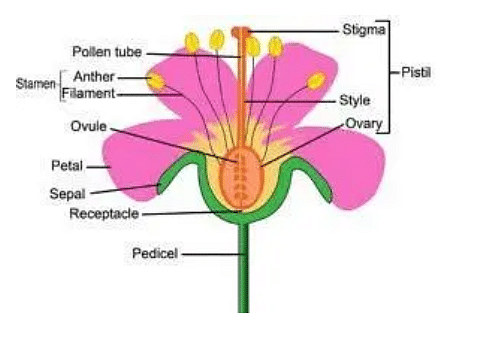
Parts of a Flower
Read More: Translation Protein Synthesis
Features of Corolla
[Click Here for Sample Questions]
A few mentionable features of the corolla in a flower are described below–
- Corolla may be regular or irregular, usually variously coloured.
- Colour of the petals is due to the presence of pigments like anthocyanin, anthoxanthin, carotenoids, etc.
- In some flowers, the petal is green in colour, called sepaloid as seen in Polyalthia sp.
- Sometimes the corolla has organs called nectar glands that produce sugar-rich nectar which attracts pollinators.
- Sometimes, petals are narrow below into a stalk-like structure called a claw and the actual expanded portion is called a limb.
Read More: Difference Between Fertilizers and Manure
Forms of Corolla
[Click Here for Sample Questions]
These are of various types as follows—
- Polypetalous Corolla
Regular forms:
- Cruciform or cruciate corolla: This is a characteristic of the mustard family i.e. Cruciferae. In this case, four clawed petals are placed in one whorl in a diagonal cross.
- Rosaceous: Each petal has an outwards extending very wide limb and a very small claw. Originally, there are 5 petals (although numerous petals as in roses are due to the reconversion of stamens into petals as a result of culture). Examples: Rosa sp. (Rosaceae), Camellia sinensis (Theaceae), etc.
- Caryophyllaceous: There are 5 clawed petals, the limbs of which are at right angles to the claws. Example: Dianthus sp.
Irregular forms:
- Papilionaceous: This type of corolla is a unique characteristic of the Papilionaceae family. There are 5 petals of which the odd fifth posterior is the outermost forming standard or vexillum, the lateral 2 petal wings are clawed covering almost the 2 anterior petals which are loosely connate to form a boat-shaped structure called the keel.
- Gamopetalous Corolla
Regular forms:
- Tubular corolla: All of the petals are joined together to form a more or less uniform tube. It is present in sunflower disc florets.
- Campanulate or bell-shaped corolla is seen in Cucurbita maxima. In this type, both the tube and limb are almost of the same dimension, the corolla resembles a bell.
- Hypocrateriform or Salver-shaped corolla is seen in the Catharanthus roseus (periwinkle) plant of the Apocynaceae family. The limb in this case is fairly broad and is positioned at right angles to the narrow tube.
- Rotate or wheel-shaped corolla has a short tube with a spreading wheel-shaped limb. Examples- Solanum sp. (Solanaceae), Nyctanthes arbor-tristis (Oleaceae), etc.
- Urceolate or urn-shaped corolla is swollen in the middle and contracted at both ends. Examples- Erica sp. (Ericaceae), Bryophyllum sp. (Crassulaceae).
- Infundibuliform or funnel-shaped corolla is seen in Datura sp. (Solanaceae). The limb gradually tapers into a tube once the petals are connected and the corolla tube extends like a funnel.
Irregular forms:
- Bilabiate or two-lipped corolla is a characteristic feature of the flowers of Lamiaceae, Acanthaeae, etc. The 5 petals are united to form a bilabiate structure, the upper lip consists of 2 petals, the lower lip consists of 3 petals, and the mouth remains open at the throat.
- Personate or masked corolla is a kind of bilabiate corolla in which the throat of the corolla is closed by a projection of the lower lip, known as the palate. Examples- Antirrhinum, Lindenbergia, etc.
- Ligulate or strap-shaped corolla is seen in the ray florets of the capitulum inflorescence (for example- sunflower), in which the 5 petals connate to form a strap or tongue-shaped structure.
Read More: Biomass
Functions of Corolla
[Click Here for Sample Questions]
The main three functions of the Corolla are–
- Pollination: The corolla is usually brightly colored and fragrant and attracts insects for pollination.
- Nectar glands present at the base of the corolla attract pollinators.
- Protection: Corolla protects the essential whorls of the flower, i.e. stamens and carpels.
Read More: Pollination
Things to Remember
- A complete flower contains in it all the four floral whorls— calyx, corolla, androecium, and gynoecium.
- Individual units of the calyx are called sepals which are often green-colored.
- Individual units of the corolla are called petals. These are brightly colored and often fragrant to attract pollinating agents.
- The male part and female part of the flower are androecium and gynoecium respectively.
- Corolla can be polypetalous or gamopetalous.
- Gamopetalous corolla contain united petals.
- Petals are free and easily separable in polypetalous corolla.
- Corolla can be regular or irregular.
- Papilionaceous corolla is a characteristic feature of the pea family Papilionaceae.
- Petals often contain nectar glands that release nectar which attracts pollinators.
Sample Questions
Ques: What do you mean by a complete flower? (2 Marks)
Ans: Complete flowers are those which contain all four floral whorls— calyx, corolla, androecium, and gynoecium. Examples- Hibiscus, Datura, etc.
Ques: What are unisexual flowers? (2 Marks)
Ans: Unisexual flowers contain either androecium or gynoecium.
Examples- pumpkin, papaya, etc.
Ques: Why are roses red? (2 Marks)
Ans: Roses are red in color due to the presence of anthocyanin pigment in the corolla. Anthocyanins belong to the family of flavonoid compounds.
Ques: Differentiate between pedicel and peduncle. (3 Marks)
Ans: The differences between pedicel and peduncle are as follows—
| Pedicel | Peduncle |
|---|---|
| 1. It is the stalk of individual flowers. | 1. It is the main stalk supporting the whole inflorescence. |
| 2. In one inflorescence there may be several pedicels. | 2. In one inflorescence, only one peduncle is present. |
| 3. Pedicel is always unbranched. | 3. Peduncle may be branched or unbranched. |
Ques: Write the differences between gamopetalous and polypetalous corolla. (3 Marks)
Ans: The differences between gamopetalous and polypetalous corolla are as follows—
| Gamopetalous corolla | Polypetalous Corolla |
|---|---|
| 1. The petals are united. | 1. The petals of the flowers are free. |
| 2. The petals usually form a tube-like structure. | 2. The petals are distinct and separable. |
| Example- Rose, Mustard, etc. | Examples- Datura, pumpkin, etc. |
Ques: What is aestivation? (2 Marks)
Ans: Aestivation is the arrangement of sepals and petals on the thalamus in the floral bud with respect to the other units of the same whorl.
Ques: What is a papilionaceous corolla? Give examples of plants that contain this type of corolla. (3 Marks)
Ans: A papilionaceous corolla is an irregular form of the polypetalous corolla. There are 5 petals of which the odd fifth posterior is the outermost forming standard or vexillum, the lateral 2 petal wings are clawed covering almost the 2 anterior petals which are loosely connate to form a boat-shaped structure called the keel.
Examples of plants that contain papilionaceous corolla are peas, beans, etc.
Ques: In which plant families bilabiate corolla is seen? (1 Mark)
Ans: Bilabiate corolla is seen in plant families like Lamiaceae and Acanthaceae and in some members of Scrophulariaceae.
Ques: What is pollination? (2 Marks)
Ans: Pollination is the transfer of pollen grains from the anther of a stamen to the stigma of the pistil of the same or different flower of the same species.
Ques: Write two functions of the Corolla. (2 Marks)
Ans: The two functions of the corolla are as follows—
Corolla is brightly colored, and fragrant and may contain nectar glands at its base which attract pollinators.
Corolla also protects the inner essential whorls, stamens, and carpels, from external injury.
For Latest Updates on Upcoming Board Exams, Click Here: https://t.me/class_10_12_board_updates
Check-Out:



Comments