



Content Writer
Cubic metre is defined as the volume of a cube whose edges are one metre in length. It is denoted by m3 or meter cube. A cubic meter is used when the calculation of the amount of stuff placed inside a cube is calculated.
- The cubic metre is the SI unit of volume.
- It can also be written in the form cu m.
- A cube is a three-dimensional object that has a total of six faces.
- The volume of an object is defined as the amount of space occupied by a closed object in three dimensions.
- The volume of an object is the measure of its capacity to hold something in it.
- One cubic metre is the same as 1000 litres.
- Due to this, cubic metre was also referred to as kilolitre.
Read More: Difference between Mass and Volume
| Table of Content |
What is Volume?
[Click Here for Sample Questions]
Volume of an object is defined as the amount of space occupied by a closed object in three dimensions. The volume of an object is the measure of its capacity to hold something in it.
- It is measured in cubic units.
- If the length of an object is given in metres, its volume is calculated in cubic metres (m3).
- It is sometimes referred to as capacity.
- Similarly, if the length is in centimetres, the volume is measured in cubic centimetres (cm3).
- However, the SI unit of volume is considered to be cubic metre (m3).
- For example, water placed in a cylindrical jar is measured by the volume.
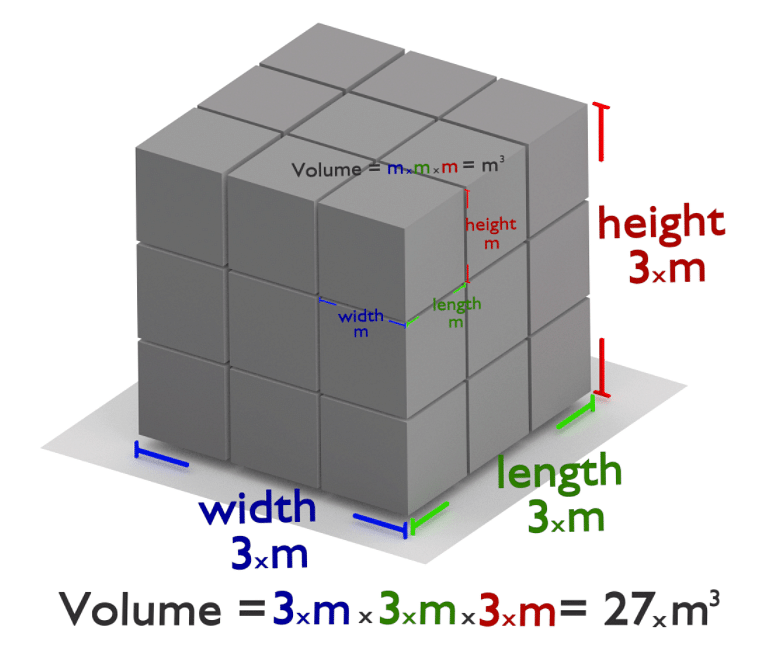
Volume of a Cube
Other units of volumes are cubic inch, cubic yard, cubic feet, cubic mile, gallon, pint, quart, the fluid ounce etc. Also, these units of volume can be converted into one another.
Read More:
Volume Formulas
[Click Here for Sample Questions]
The formula of volume for any three-dimensional shapes are given below:
- Volume of cube = a3 , where a = length of the side of a cube.
- Volume of cuboid = l x b x h
- Volume of prism = Base Area x height
- Volume of cone = 1/3 π r2h
- Volume of cylinder = π r2h
- Volume of sphere = 4/3 π r3
Read More:
Cubic Metre Conversions
[Click Here for Sample Questions]
The cubic metre unit can be converted into various other units as follows.
Cubic Metre to Cubic Centimetre
We know, One metre = 100 cm
- So, One cubic metre = 100 100 100 cm3
- Hence, One cubic metre = 1000000 cm3
Read More: Isosceles Triangle Theorems
Cubic Metre to Square Metre
A square metre represents the unit of area, whereas a cubic metre is the unit of volume. The formula for calculating volume is length x breadth x height, and for area is length x breadth
- For converting cubic metres into square metres, we need to divide the volume by thickness.
- So, we can conclude that one cubic metre is equal to one square metre.
The table of the conversion of other values of cubic metre into square metre is given below:
| Cubic Metre (m3) | Square Metre (m2) |
|---|---|
| 1 | 1 |
| 2 | 1.5874 |
| 3 | 2.0801 |
| 4 | 2.5198 |
| 5 | 2.924 |
| 6 | 3.3019 |
| 7 | 3.6593 |
| 8 | 4 |
| 9 | 4.3267 |
| 10 | 4.6416 |
Cubic Metre to Metre
To convert cubic metres to metres, divide the volume by width and height. The conversion values are given below:
| Cubic Metre (m3) | Metre (m) |
|---|---|
| 1 | 1 |
| 2 | 1.2599 |
| 3 | 1.4422 |
| 4 | 1.5874 |
| 5 | 1.71 |
| 6 | 1.8171 |
| 7 | 1.9129 |
| 8 | 2 |
| 9 | 2.0801 |
| 10 | 2.1544 |
Cubic Metre to Cubic Feet
We know, 1 metre = 3.2808399 feet
- And, 1 cubic metre = 1m x 1m x 1m
- So, 1 cubic metre = 3.2808399 x 3.2808399 x 3.2808399
- 1 cubic metre = 35.31466688252347 cubic feet
Some of the conversion values are given below:
| Cubic Metre (m3) | Cubic Feet (ft3) |
|---|---|
| 1 | 35.31 |
| 2 | 70.63 |
| 3 | 105.94 |
| 4 | 141.26 |
| 5 | 176.57 |
Cubic Metre to Cubic Yards
One cubic metre = 1.31 cubic yards
Some conversion values are given below:
| Cubic Metre (m3) | Cubic Yards (yd3) |
|---|---|
| 1 | 1.308 |
| 2 | 2.6159 |
| 3 | 3.9239 |
| 4 | 5.2318 |
| 5 | 6.5398 |
| 6 | 7.8477 |
| 7 | 9.1557 |
| 8 | 10.4636 |
| 9 | 11.7716 |
| 10 | 13.0795 |
Read More:
Things to Remember
- Volume is defined as the space enclosed by a three-dimensional object.
- The SI unit of volume is cubic metre. It is the volume of a cube of length 1 metres.
- The volume of the cube is given by a3, where ‘a’ is the side of the cube.
- One cubic metre is equal to 1000 litres.
- To convert cubic metres into square metres, divide the volume by thickness.
- One cubic metre is the same as 1.31 cubic yards.
Sample Questions
Ques. Find the volume of the cone of radius r/2 and height 2h. (2 marks)
Ans. Volume of cone = 1/3 π r2h
- 1/3 x π × (r/2)2 × 2h
- 1/3 x π × r2/4 × 2h
- 1/6 π r2h cubic units
Ques. A spherical ball is divided into two equal halves. If the curved surface area of each half is 56.57 cm, find the volume of the spherical ball. [use π= 3.14] (3 marks)
Ans. Curved surface area of half ball = 56.57 cm2
- 2πr2 = 56.57
- r2 = 56.57 / 2 × 3.14
- r2 = 9
- r = 3 cm
Volume of spherical ball = 4/3 πr3
- 4/3 × 3.14 × 3 × 3 × 3
- 113.04 cm3
Ques. Find the capacity in litres of a conical vessel having height 8 cm and slant height 10 cm. (3 marks)
Ans. Height of the vessel (h) = 8 cm
Slant height (l) = 10 cm
- r2 + h2 = l2
- r2 + 82 = 102
- r2 = 100 - 64
- r2 = 36
- r = 6 cm
Now, volume of conical vessel = 1/3 πr2h
- 1/3 × 22/7 × 6 × 6 × 8
- 301.71 cm3
- 0.30171 litre
Ques. A school provides milk to the students daily in cylindrical glasses of diameter 7 cm. If the glass is filled with milk upto a height of 12 cm, find how many litres of milk is needed to serve 1600 students. (3 marks) [CBSE March 2011]
Ans. Diameter (d) = 7 cm
- Radius (r) = 7/2 cm
- Height (h) = 12 cm
- Volume (V) = πr2h
- 22/7 × 7/2 × 7/2 × 12 = 462 cm3
Total milk for 1600 students = 462 × 1600
- 739200 cm3
- 739200 / 1000 = 739.2 litres
Ques. The curved surface area of a cylinder is 176 cm2 and its area of the base is 38.5 cm2. Find the volume of the cylinder. (5 marks) [CBSE March 2012]
Ans. Area of the base = 38.5 cm2
πr2 = 38.5 cm2
r2 = 38.5 / 7 × 22 = 121 cm2
r = 11 cm
Curved Surface Area of a cylinder = 176 cm2
- 2πrh = 176
- 2 × 22/7 × 11 × h = 176
- h = 176 × 7 / 2 × 22 × 11
- h = 28 / 11 cm
Volume = πr2h
= 38.5 × 28/11 = 98 cm3
Ques. The slant height and base diameter of the conical tomb are 25 m and 14 m respectively. Find the cost of white-washing its curved surface area at the rate of Rs 210 per 100 m2. (3 marks) [NCERT]
Ans. Slant height of conical tomb (l) = 25 m
- Radius = 14/2 = 7 m
- CSA of conical tomb = πrl
- 22/7 × 7 × 25 = 550 m2
- Cost of white washing 100 m2 = 210 Rs
- Cost of white washing 1 m2 = 210 / 100
- Cost of white washing 550 m2 = 210 / 100 × 550
- 1155 Rs
Ques. The capacity of a cuboidal tank is 50000 litres of water. Find the breadth of the tank, if its length and depth are respectively 2.5 m and 10 m. (3 marks) [NCERT]
Ans. Volume of the tank = l × b × h
- 2.5 × b × 10 = 25b m3 = 25000 × b litres
Capacity of the cuboidal tank = 50000 litres
- 25000 × b = 50000
- b = 2 m
So, the breadth of the tank is 2 metres.
Ques. A river 3 m deep and 40 m wide is flowing at the rate of 2 km per hour. How much water will fall into the sea in a minute? (3 marks) [NCERT]
Ans. Depth of the river (h) = 3 m
Width of the river (b) = 40 m
Rate of water flow = 2 km per hour = 2000 m / 60 min = 100/3 m/min.
Volume of water flowing in 1 min. = 100/3 × 40 × 3 = 4000 m3
Ques. The length, breadth, and height of a cuboid are 10 feet, 12 feet, and 11 feet respectively. Find the volume of the cuboid in a cubic meter. (2 marks)
Ans. Since length = 10 feet, breadth = 12 feet and height = 11 feet
- Volume = length x breadth x height
- So required volume = 10 x 12 x 11 = 1320 feet3
Ques. What is the Value of 6 Cubic Meters in Cubic Feet? (2 marks)
Ans. As we know, 1 Cubic Meter = 35.314667 cubic Feet
Therefore,
- 6 Cubic Meters = 35.314667 × 6
- 6 Cubic Meters = 211.888002 cubic feet
Therefore, the value of 6 cubic meters is approximately equal to 211.888002 cubic feet. (2 marks)
Ques. Calculate the amount of air that can be accumulated in a room that has a length of 8 m, breadth of 14 m and a height of 12 m.
Ans. Amount of air that can be accumulated in a room = capacity of the room = volume of a cuboid
- Volume of cuboid = l × b × h = 8 × 14 × 12 = 1344 m3
Thus, this room can accommodate the maximum of 1344 m3 of air.
Ques. Find the volume of a cone whose radius is 4 inches and height is 14 inches. (Use π = 22/7). (2 marks)
- Given that: r = 4 inches, h = 14 inches and π = 22/7
- Thus, Volume of cone, V = (1/3) π r2 h
- V = (1/3) × (22/7) × (4)2 × (14) = 22 × 3 = 234.66 in3
The volume of cone is 234.66 in3.
Read More:



Comments