



Education Journalist | Study Abroad Lead
Volume of a Prism is defined as the space or region occupied by it. A prism is a three dimensional solid shaped figure with a base and top. Face is the name given to the sides of prisms which are flat in shape. Prisms and pyramids are two key members of the polyhedron family. A line segment called an edge connects the two faces of the prism whereas a vertex is the location where three or more edges of the prism cross.
| Table of Content |
Key Terms: Prism, Volume, Parallelogram, Area, Geometry
What is a Prism?
[Click Here for Sample Questions]
A prism is a polyhedron with all of its faces flat and all of its bases parallel to one another. It's a solid item with flat faces, identical ends, and a cross-section that matches its length. The different types of prisms, such as a triangular prism, pentagonal prism, and hexagonal prism, will be covered in Geometry. A prism has a surface area and volume because it is a three-dimensional form.
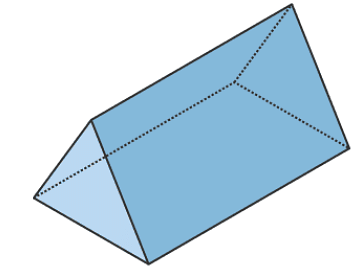
Prism
Volume of Prism
[Click Here for Sample Questions]
The overall space occupied by a three-dimensional object is defined as the volume of a prism. It is defined mathematically as the product of the base area and the length.
| Volume of Prism = Base Area x Length |
Cubic units are the measuring units used to indicate the volume of a three-dimensional object.
How to Calculate the Volume of Prism?
[Click Here for Sample Questions]
The following are the steps to determining the prism's volume:
Step 1: Make a list of the prism's dimensions.
Step 2: Use the formula V = B H to calculate the volume of the prism, where V, B, and H are the volume, base area, and height of the prism, respectively.
Step 3: Once the value of the prism's volume has been determined, add the unit of prism volume at the end (in terms of cubic units).
Types of Prism
[Click Here for Sample Questions]
A prism is a three-dimensional solid geometric shape having two identical ends and all flat sides. The base of the prism is named by it, hence a prism with a triangular base is termed a ‘triangular prism’. As a result, the names of the many varieties of prisms are based on the cross-sectional figure generated. Different types of prisms are given below.
- Cube Prism
- Cuboidal/ Rectangular Prism
- Triangular Prism
- Square Prism
- Pentagonal Prism
- Hexagonal Prism
Formula for Volume of Different Prism
[Click Here for Sample Questions]
The volume of different prisms varies. As a result, the formula for calculating the volume of various prisms is given below:
Cube: A cube is a three-dimensional solid shape with six square faces, eight vertices, and twelve edges. It's also a normal hexahedron, according to legend. The 3x3 Rubik's cube is the most popular example in real life. Similarly, numerous real-life instances, such as 6 sided dice, will be encountered. The subject of solid geometry is three-dimensional solids and figures with surface areas and volumes.
| Volume of a cube = a3 |
where ‘a’ is the side of the cube.

Cube Prism
Cuboidal/ Rectangular Prism: A rectangular prism is a six-sided three-dimensional shape (two at the top and bottom and four are lateral faces). The prism's faces are all rectangular in form. As a result, there are three pairs of similar faces in this picture. A rectangular prism is sometimes known as a cuboid because of its form. A rectangular prism can be found in a geometry box, journals, diaries, rooms, and other places.
| Surface area = 2× (bl + lh + hb) Volume = l × b × h |
where b is base length, l is base width and h is height.

Cuboidal/ Rectangular Prism
Triangular Prism: A triangular prism is a three-sided prism made up of a triangular base, a translated reproduction, and 3 faces connecting equal facets in geometry. The sides of a proper triangular prism are square; otherwise, they may be indirect. A right triangular prism with equilateral bases and square aspects is referred to as a uniform triangular prism.
It is a polyhedron with parallel facets and the floor regular of the opposite three in the equal aircraft, or vice versa (which isn't necessarily parallel to the base planes). Parallelograms are the shapes of these 3 faces. The identical triangle appears in all pass-sections parallel to the bottom faces.
| Base area = 1/2ab Surface area = ab + 3bh Volume = ½ abh |
where b is base length, l is apothem length and h is height.

Triangular Prism
Square Prism: A three-dimensional cuboid with square bases is known as a square prism. It has six faces, two of which are square on opposing sides while the other four are rectangular. It's worth noting that not all square prisms are cubes, but all cubes are square prisms since cubes have square prism features.
| Volume of a Square Prism = l x b x h |
where b is base length, l is apothem length and h is height.

Square Prism
Pentagonal Prism: A pentagonal prism is a three-dimensional solid with bottom and top pentagonal bases. A rectangle is the form of all the other sides of a pentagonal prism. Drawing a pentagon on a sheet of paper using straight lines is a simple way to grasp the form of a pentagonal prism. Then visualise it rising from the piece of paper. The resulting 3D shape will be a pentagonal prism.
| Base Area = 5/2 ab Surface area = 5ab + 5bh Volume = 5/2 abh |
where b is base length, l is apothem length and h is height.

Pentagonal Prism
Hexagonal Prism: A hexagonal prism is a polyhedron having eight faces, eight edges, and twelve vertices, with six faces shaped like rectangles and two faces shaped like hexagons. The hexagonal prism's top and bottom are fashioned like a hexagon and are equal in size. Long diagonals in the hexagonal prism always cross the centre point of the hexagon starting from the base vertex, however short diagonals do not cross the centre point since the diagonal is from one base vertex to the other.
| Base area = 3ab Surface area = 6ab + 6bh Volume = 3abh |
where b is base length, l is apothem length and h is height.

Hexagonal Prism
The video below explains this:
Prism Formula Detailed Video Explanation:
Things to Remember
[Click Here for Sample Questions]
- A prism is a polyhedron with all of its faces flat and all of its bases parallel to one another.
- A prism is a three-dimensional solid geometric shape having two identical ends and all flat sides.
- Volume of a Prism is the product of Base Area and Length.
- There are many types of prisms having different numbers of faces, like pentagonal prisms, hexagonal prisms, octagonal prisms, etc.
- A triangular prism is a three-sided prism made up of a triangular base.
- A pentagonal prism is a three-dimensional solid with bottom and top pentagonal bases.
- A hexagonal prism is a polyhedron having eight faces, eight edges, and twelve vertices, with six faces shaped like rectangles.
Sample Questions
Ques. What is a Polygon? (2 marks)
Ans. A polygon is a geometric figure with a finite number of sides in two dimensions. A polygon's sides are made up of straight line segments that are joined end to end. As a result, a polygon's line segments are referred to as sides or edges. The intersection of two line segments is known as the vertex or corner, and an angle is generated as a result. A triangle with three sides is also an example of a polygon.
Ques. What is 2 Dimensional Geometry? (2 marks)
Ans. A two-dimensional shape is a flat planar figure or a shape with two dimensions – length and width – in geometry. Two-dimensional (or 2-D) shapes have no thickness and can only be measured in two directions.
Ques. What is 3 Dimensional Geometry? (2 marks)
Ans. 3-Dimensional geometry is the study of shapes in three dimensions. It uses three coordinates in the XYZ plane: x-coordinate, y-coordinate, and z-coordinate. Three-dimensional shapes are those that occupy space. Solid shapes with three dimensions of length, breadth, and height are known as 3D shapes. All known matter exists in three-dimensional space, which is a geometric three-parameter model.
Ques. What is a Prism? (2 marks)
Ans. A prism is a polyhedron with all of its faces flat and all of its bases parallel to one another. It's a solid item with flat faces, identical ends, and a cross-section that matches its length. The different types of prisms, such as a triangular prism, pentagonal prism, and hexagonal prism, will be covered in Geometry. A prism has a surface area and volume because it is a three-dimensional form.
Ques. What exactly is a pyramid? (2 marks)
Ans. A pyramid is a solid object with a base that is any polygon and side faces that are triangles with a shared vertex. The square pyramid, which has a square base and four triangular side faces, is the most widely used pyramid. Five vertices, eight edges, and five faces make up a square pyramid.
Ques. What is the volume of a triangular prism with the following dimensions: 10m, 12m, and 20m? (2 marks)
Ans. V = Area of base x Height of Prism gives the volume of a triangular prism.
Because the base is triangular, the triangle's area is
Area of Triangle ½ × base × height = ½ × base × height =\(½\) × 10 × 12 = 60
So, Volume of prism = 60 × 20 = 1200 cubic metre.
Ques. Find the volume of a prism with a base area of 3 square inches and a height of 7 inches. (2 marks)
Ans. The volume of the prism is V = B H, as we all know.
If B = 3 square inches and H = 7 inches,
As a result, the prism's volume is V = B H V = 3 7 = 21 in3.
As a result, the volume is 21 cubic inches.
Ques. What is the base area of the prism if the volume of the prism is 324 cubic units and the height of the prism is 9 units? (3 marks)
Ans. The given dimensions are the volume of the prism = 324 cubic units and the height of the prism = 9 units. Let the base area of the prism be "B".
Substituting the values in the volume of the prism formula, Volume of prism = V = B × H = 324 cubic units
⇒ 9B = 324
⇒ B = 36 square units
Therefore, the base area of the prism is 36 square units.
Ques. Find the height of the prism if the volume of the prism is 729 cubic units and the base area is 27 square units. (3 marks)
Ans. The given dimensions are the volume of the prism = 729 cubic units and the base area of the prism = 27 square units. Let the height of the prism be "H".
Substituting the values in the volume of the prism formula, Volume of prism = V = B × H = 729 cubic units
⇒ 27H = 729
⇒ H = 27 units
Therefore, the height of the prism is 27 units.
Ques. What happens to the Volume of Prism if the Base Area of Prism is doubled? (2 marks)
Ans. We know that the volume of a prism depends on the base radius of the prism. Hence, the volume of a prism is doubled if the base area of the prism is doubled as "V" is substituted by "2V". Also, V = (2B) × H = 2 (B × H) which is double the original volume of the prism.
Read More:



Comments