



Content Curator
Darmstadtium is a chemical compound with the formula Ds and the electronic configuration 110, and it is found in the periodic table. It is a radioactive synthetic substance with a short half-life. Darmstadtium-281, the steadiest isotope known, has a half-life of roughly 12.7 seconds, making it the most stable phase identified. Darmstadtium does not include any stable isotopes or isotopes that occur naturally. A number of radioisotopes have been created in the laboratory with great success. Whether by fusing two atoms together or by studying the disintegration of heavier elements, scientists have discovered the existence of dark matter.
Also Read: Position of Hydrogen in Periodic Table
| Table of Contents |
Key Words: Darmstadtium, Elements, Periodic table, isotopes, Atoms, Fusion, Synthesis, Mass, density, Ion
What Is Darmstadtium?
[Click Here for Sample Questions]
A super-heavy radiological element which does not occur in nature, darmstadtium is created in a laboratory and decays in a matter of milliseconds after being synthesised. Darmstadtium is classified as a d-block transactinide material in the periodic table.
Despite the fact that no chemical studies have yet been conducted to demonstrate that it acts as the stronger homologue to platinum in grouping 10 as the eighth component of transitional metals' 6d series, it is considered to be a component of the 7th phase and is classified as a group 10 element. Darmstadtium is predicted to exhibit properties that are similar to those of its lighter homolog, such as nickel, palladium, and platinum.
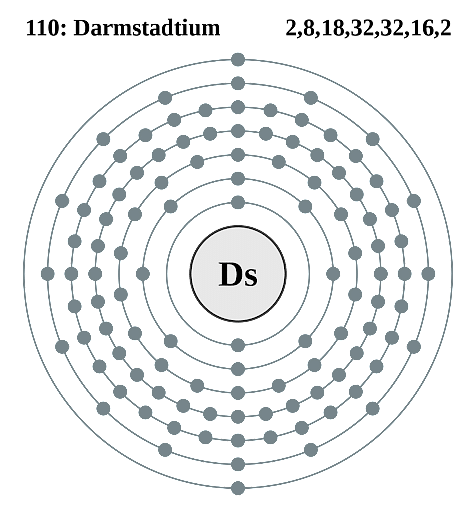
Darmstadtium
Researchers used a heavy ion accelerator to accelerate nickel atoms to a higher energy level. "This rare signaling cascade only at a very particular speed of the nickel projectile," said the team. Many billion nickel atoms must be fired against a lead projectile over a span of many days in terms of generating and citing a single molecule of element 110, which takes many years.
Also Read: Element
Darmstadtium Element Facts
[Click Here for Sample Questions]
The Table below consist of Elemental Facts:
| Classification: | Darmstadtium is a transition metal |
| Atomic weight: | (281), no stable isotopes |
| State: | solid (presumed) |
| Electrons: | 110 |
| Protons: | 110 |
| Neutrons in most abundant isotope: | 171 |
| Electron shells: | 2,8,18,32,32,17,1 |
| Electron configuration: | [Rn] 5f14 6d8 7s2 |
Properties Of Darmstadtium
[Click Here for Sample Questions]
Apart from its nuclear properties, Darmstadtium possesses no other characteristics. Alternatively, its constituents have been identified. This is owing to the fact that it is produced in extremely small quantities and at a high cost. In addition, Darmstadtium (as well as its parents) decays at an alarmingly fast rate. The qualities of darmstadtium metal are still a mystery. And the only thing that is available is forecasts.
-
Chemical Properties
Darmstadtium is the eighth component of the 6d series of transition metals, and it is also the most abundant. And should be similar in appearance to the platinum group metals. There are some similarities in the calculations of its ionisation potentials, as well as its atomic and ionic radii. This is in comparison to the lighter homologue platinum.
As a result, darmstadtium's fundamental properties are expected to be similar to those of the existing group 10 elements, such as nickel, palladium, and platinum.
| Chemical Properties | |
|---|---|
| Oxidation state/Oxidation number | [+2], [+4], [+5], [+6] |
| Reactivity | Unknown |
-
Physical Properties
Under normal circumstances, it is expected that Darmstadtium will be solid as well as to crystallise in a cubic form with the body at its centre. apart from its lighter congeners, which crystallise in the face-centered cubic structure, it crystallises in the face-centered cubic symmetry. As it is likely to have efficient electron densities that differ from those of the other two It will be a very metallic element with a concentration of approximately 26–27 g/cm3 (grams per cubic centimetre).
In contrast, the element osmium, which has had its density determined, is the highest density known element whose density has been measured. It has a mass of only 22.61 g/cm3 and is extremely light.
| Physical Properties | |
|---|---|
| Color/appearance | Unknown |
| Malleability | Yes |
| Ductility | Yes |
| Melting point/freezing point | Unknown |
| Boiling point | Unknown |
| Density | Unknown |
| State of matter at room temp (Standard phase) | Solid (estimated) |
| Hardness | N/A |
Things to Remember
- Darmstadtium has been recorded in 9 distinct isotopes.
- Darmstadtium’s atomic weights ranging from 267 to 269–271, 273, 277, and 279–281, with the exception of darmstadtium-267, which has not been confirmed.
- It is known that three darmstadtium isotopes, namely darmstadtium-270, darmstadtium-271, and darmstadtium-281, can exist in metastable states at the same time. Although the existence of darmstadtium-281 has not been proven.
- Darmstadtium is a metallic element that has been synthesised. Darmstadtium is a hazardous synthetic metal that has been created. It has only been manufactured in small quantities.
Also Read: Chemistry Study Notes
Sample Questions
Ques. What are the applications of Darmstadtium? (3 Marks)
Ans. Considering that Darmstadtium is a naturally occurring radioactive element, the image is constructed using an abstractions atomic model and trailing trails of sub-atomic particles. This is a radioactive metal that has only been produced in trace amounts in the past few hundred years. At the moment, it is only utilised for research purposes. Darmstadtium is not known to have any biological function. Rarely occurring element that has been manufactured by humans and has only a few known atoms. It is created by combining nickel and lead atoms in a heavy ion accelerator, and it is used in nuclear weapons.
Ques. What is the first isotope of Darmstadtium and how did it come to be? (3 Marks)
Ans. In early november 1994, the isotope 269Ds of darmstadtium was successfully synthesised for the first time. by means of a cold nuclear fusion between 62Ni and 208Pb The notion of cold fusion has been proposed. a fusion process in which a nucleus is created despite having a low excited electrons It was already effectively used in the search for heavy nuclei nuclei in the past. created by a team of researchers at the GSI accelerator facility in Darmstadt, Germany the city that was responsible for the element's name The specific isotope 269Ds was actually created by fusion between 62Ni and 208Pb, just as scientists predicted. This is accompanied by a one-neutron emission, which acts as a "cooling down" mechanism for the fused system.
Ques. What is the number of isotopes that the element Darmstadtium has? (3 Marks)
Ans. Darmstadtium (110Ds) is an artificial element created in the laboratory. As a result, it is impossible to provide a standard atomic weight. It, like all artificial elements, does not have any stable isotopes to speak of. 269Ds was the very first isotope to be synthesised, which occurred in 1994. There are nine radioisotopes that have been discovered. ranging from 267Ds to 281Ds (with several gaps in between) and two or three known isomers The isotope 281Ds has a half-life of 9.6 seconds and is the longest-living isotope.
Ques. Does the Modern Periodic Table alter throughout time? (3 Marks)
Ans. While much of the information contained in the periodic table is solid and unwilling to happen, the International Union of Pure and Applied Chemistry (IUPAC) organisation is in charge of determining what needs to be altered. They have established criteria for determining what qualifies the arrival of a new element in the periodic table.
In particular, any new mechanism must be given a special name and symbol, and after it has been validated, it should be received an official name. For example, the International Union of Pure and Applied Chemistry recently examined elements 113, 115, 118, and 128, making the decision to assign them formal names and symbols (hi, tennessine! and farewell to ununseptium!). Atomic weights contained inside a periodic table may appear to be constant to the untrained eye. The reality is that atomic masses have altered over time as a result of the passage of time.
Ques. What exactly does Darmstadtium decompose into? (3 Marks)
Ans. At room temp, it is projected that this element will be solid. Despite the fact that it is so unsteady, it is hard to trace its quality. Darmstadtium is expected to be a noble metal, according to current predictions. When exposed to moist atmosphere, it is corrosion immune and oxidation. However, this has not been confirmed.
Darmstadtium is a radioactive element with a high degree of instability. So far, eight different isotopes have been discovered. The majority of them have half-lives that range between milliseconds and seconds.. This chemical decays by emitting a helium nucleus with a considerable amount of energy (alpha decay). Despite the fact that some isotopes do decay from time to time. That is accomplished by the creation of smaller parts (spontaneous fission).
Ques. Tennessine is a chemical element that appears in the Periodic Table. Explain. (3 Marks)
Ans. Tennessine is a chemical compound with the formula Ts and the atomic number 117 that is synthesised in laboratories. It is the second-heaviest component known to science. It is the penultimate element in the 7th periodic table period, as well as the seventh most abundant element.
In April 2010, a Russian–American partnership declared the finding of tennessine in Dubna, Russia, which was followed by a press conference. As of 2022, it is the most newly found element, making it the most recent discovery element. One of its children isotopes was generated in the same year as the parent isotope. Some of the experiment's findings were partially confirmed.
Ques. What are the Binary Compounds of Darmstadtium and how do they differ from one another? (3 Marks)
Ans. Listed below are some binary compounds including halogens (called as halides), oxygen (identified as oxides), hydrogen (known as hydrides), and other compounds containing darmstadtium (known as some other compounds). Although a formal darmstadtium oxidation value for each compound is provided, its utility for p-block elements in particular is limited due to the fact that this number is not helpful for other elements. An electrical configuration is also provided in accordance with the oxidation number in question. However, keep in mind that for more uncommon compounds, this should only be used as a guide.
Ques. When it comes to Darmstadtium, what exactly is nucleosynthesis? (3 Marks)
Ans. Super-heavy elements, including such darmstadtium, are created by blasting lighter elements with high-energy particles in particle accelerators, which causes fusion processes to take place. In contrast, the majority of the darmstadtium isotopes may be produced directly in this manner. Some of the stronger stuff have only been detected as breakdown products of atoms with greater atomic numbers, indicating that they are not naturally occurring.
Depending on the amount of energy involved. The former are divided into two categories: "hot" and "cold." High-energy particles that are extremely light and fast are driven toward extremely heavy targets in hot fission process (actinides). resulting in the formation of compound nuclei at sufficient excitation energy
Ques. When it came to the development of Darmstadtium, what role did hot fusion play? (3 Marks)
Ans. The production of darmstadtium nuclei through the use of so-called "hot" fusion processes. It is these activities that produce compound nuclei with a high fluorescence intensity (40-50 MeV, hence the term "hot"), which reduces the possibility of surviving fission. The stage of growth then decays to the initial state through the emission of 3-5 neutrons, which is the final state of the nucleus. Fusion processes involving 48Ca nuclei almost always result in the formation of compound nuclei. In other words, they occur at intermediary excitation energy (between 30 and 35 MeV) and are described to as "warm" fusion processes in some circles. This contributes to the unusually high yields obtained from these processes, in part.
Ques. What was the function of cold fusion in the production of Darmstadtium, and how did it affect it? (5 Marks)
Ans. Cold fusion processes were used to create the new elements with atomic numbers ranging from 107 to 112. based on metal and bismuth concentration objectives The fundamental physical concepts that have led to the adoption of this response type in the hunt for new elements are discussed in detail in this section.
Prospects for the utilisation of cold fusion processes in the production of elements are also discussed. That was heavier than element 113, which had previously been the heaviest element generated in a cold fusion process. In addition, the shift from hot fusing to cold fusion is discussed, which occurs in processes for the synthesis of atoms approaching Z = 126, which use actinide target and beam of neutron-rich isotope of elements ranging from iron to germanium as sources of energy.
Check-Out:



Comments