



Content Curator
DC Voltage Drop Formula determines the voltage drop across two points in the electrical circuits. Also, it is defined as the arithmetic difference between a higher and a lower voltage.
- Voltage drop is the decrease in the electric potential when the current travels in the circuit.
- This decrease in voltage is caused due to impedance.
- The unit of voltage drop is volts or Amp-Ω or Joule-A/s.
Read More: NCERT Solutions for Class 12 Physics Chapter 3: Current Electricity
| Table of Content |
Key Terms: DC Voltage Drop, DC Voltage Drop Formula, Direct Current, Resistance, Circuit, Impedance, Potential
Introduction to Direct Current
[Click Here for Sample Questions]
Direct current is a current that flows in a single direction and at a constant rate.
- A direct current is created in the circuits directly connected to the battery.
- Direct Current flows through conductors like wire. Also, it can flow in a semiconductor or even in a vacuum.
- The frequency of DC is zero because it flows only in one direction.
- Direct current differs from alternating current (ac) in the direction of flow. Alternating current flows in two directions.
- Direct Current is also known as Electric Current.
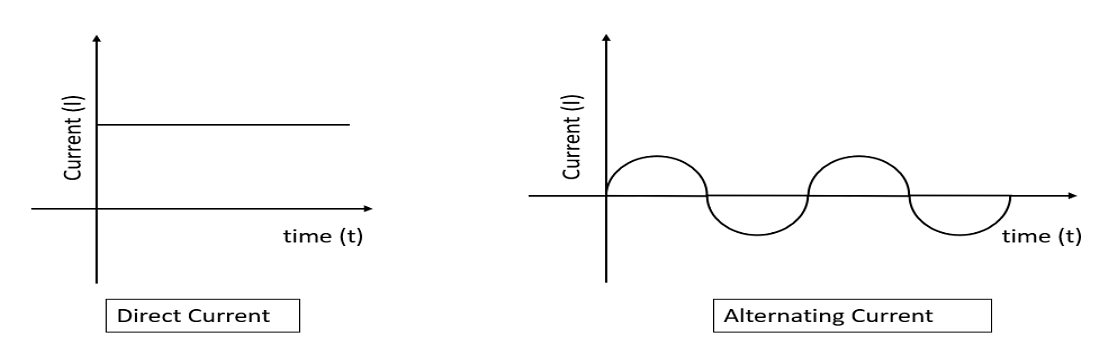
(Graph of direct current with time)
Some real-life examples of direct currents are
- Mobile battery charging mobile phones through DC power.
- The laptop battery charges the laptop through DC power
- Power banks provide DC power for charging.
- Solar panels generate direct currents.
Also Read:
| Related Topics: | ||
|---|---|---|
| Types of Current | Electric Field | Power in Alternating Current |
DC Voltage Drop - Formula
[Click Here for Sample Questions]
Direct Current Voltage Drop Formula is given by:
Vd = I x R
Here,
- Vd is the voltage drop
- R is the resistance
- I is the current in the circuit
DC Voltage Drop formula is also given as
Vd = L x I/T
Here,
- V = Voltage Drop (in volts)
- L = Length of the circuit (in meters)
- I = Current moving in the circuit (in Amperes)
- T = total time the current has flowed in the circuit (in seconds)
Also Read:
| Related Topics: | ||
|---|---|---|
| Ohm’s Law | Kirchhoff’s Law | Voltage Divider Formula |
Solved Examples
[Click Here for Sample Questions]
Ques. A direct current of 4 A is flowing in a wire and the voltage drop measured is 30 V. Find the resistance in the wire.
Ans. The voltage drop (V) due to the flow of direct current is:
V = IR
Given,
V = 30 volts,
I = 4 Ampere
Thus,
30 = 4 x R
R = 30/4
R = 7.5 Ω
Ques. A current of 800 mA flows in the circuit having resistance 4 Ω. Find the voltage drop in the circuit.
Ans. The direct voltage drop (V) due to the flow of direct current is:
V = IR
Given,
- I = 800 mA = 0.8 A
- R = 2 Ω
Put values in the formula
V = (0.8 A) x (4 Ω)
V = 3.2 volts
Read Also: Difference between AC and DC
Things to Remember
- The DC Voltage Drop in an electrical circuit is given by, V = IR. It is measured in volts.
- DC voltage drop can also be given as; V = L x I/T.
- Voltage drop is a measure of the voltage difference between higher potential and lower potential points.
- The difference in voltage in a wire is produced due to the impedance of a wire.
- The Voltage drop is given as V = PI, where P is power measured in Joules and I is direct current.
Also Read:
Sample Questions
Ques. 5 A current flows in a wire of resistance 10 Ω. Find the voltage drop across the wire. [2 Marks]
Ans. DC Voltage Drop is given by:
V = I x R …(1)
Given,
- I = 5A
- R = 10 Ω
Substitute the values in eq (1)
V = 5 x 10
V = 50 volts.
Ques. A direct current of 8 A is flowing in a wire and the voltage drop measured is 50 V. Find the resistance in the wire. [2 Marks]
Ans. The voltage drop (V) due to the flow of direct current is:
V = IR
Given,
- V = 50 volts,
- I = 8 Ampere
Thus,
50 = 8 x R
R = 50/8
R = 6.25 Ω
Ques. A current of 1200 mA flows in the circuit having resistance 2 Ω. Find the voltage drop in the circuit. [2 Marks]
Ans. The direct voltage drop (V) due to the flow of direct current is
V = IR
Given,
- I = 1200 mA = 1.2 A (1 A = 1000 mA)
- R = 2 Ω
Put values in the formula
V = (1.2 A) x (2 Ω)
V = 2.4 volts
Ques. In a circuit of length 500 cm a current of amplitude 6 A flows for 30 seconds. Determine the dc voltage drop in the circuit. [3 Marks]
Ans. Direct current voltage drop is given by;
V = L x I/T
Given,
- L = 500 cm = 5 m
- I = 6 A
- T (time) = 30 s
Put these values in the formula,
V = 5 x (6/30)
V = 1 Volt
Ques. A wire of resistance 6 ohm produces a dc voltage drop of 42 volts. Find how many amperes of current flow in the wire. [2 Marks]
Ans. Direct current voltage drop (V) is given by;
V = I x R
Given,
- Voltage drop = 42 volts
- Resistance = 6 Ω
Substitute values in the formula,
42 = I x 6
I = 42/6
I = 7 Amperes
Ques. In the given figure, Vin = 5 V, Vout = 2 V, and R1 are 1.5 Ω. [5 Marks]

Find
The voltage drop across R1
Current in resistance R1
Ans. Given,
- Vin = 5 V
- Vout = 2 V
- R1 is 1.5 Ω
- Voltage drop (VDrop ) across R1 is given as
VDrop = Vin - Vout (current travels from high potential to low potential)
VDrop = 5V - 2V
VDrop = 3 V
- Current in Resistor R1 is
I = VDrop/R1
I = 3/1.5
I = 2 A
Ques. A wire has a voltage drop of 2 V. The length of a wire is 20 m and the wire carries a current of 4 A. Find its unit resistance. [3 Marks]
Ans. Voltage drop is given by:
Vd = I x R
Given,
- Vd (voltage drop) = 2 V
- I (current) = 4 A
- Length of a wire = 30 m
Put values in the formula,
2 = 4 x R
R = 0.5 Ω
Here,
R = Unit resistance * length of a wire
Thus,
0.5 = R’ x 20
⇒ R’ = 0.5/20
R’ = 0.025 Ω/m
Therefore, the unit resistance of a wire is 0.025 â¦/m.
Ques. A copper wire of length 30 m has a unit resistance of 0.008 Ω/m and carries a current of 4 A. Find voltage drop in a wire. [3 Marks]
Ans. Voltage drop in a wire is given by:
Vd = I x R …(1)
Given,
- I = 4 A
- R’ (unit resistance) = 0.008 Ω/m
- Length of wire (L) = 30 m
Resistance (R) = Unit resistance (R’) x L
R = 0.008 x 30
R = 0.24 Ω
Put values in eq (1)
Vd = 4 x 0.24
Vd = 0.96 volts
Ques. Find the length of a wire if it carries a current of amplitude 4 A for 20 seconds and observes a voltage drop of 5 V. [2 Marks]
Ans. The voltage drop formula is
Vd = L x I/T
Given,
- Vd = 5 volts
- I = 4 A
- Time duration of current flow = 20 s
Put values in the formula
5 = L x (4/20)
⇒ L = 5/0.2
L = 25
Hence, the length of the wire is 25 m.
Ques. In a current-carrying wire, an inductor of 5 H is introduced, and 2 A of current flows in 10 s. Find dc voltage drop. [3 Marks]
Ans. DC Voltage drop produced is given by;
Vd = L x I/T
Given,
- L = 5 H
- I = 2 A
Total time flow of current (T) = 20 s
Thus,
Vd = 5 x (2/10)
Vd = 1 V
Ques. A wire carries a current of 0.25 A and produces a power of 10 watts. Determine the voltage drop in a wire. [2 Marks]
Ans. Voltage drop in a wire is determined by
Vd = P x I
Given,
- Power (P) = 10 Watts
- I = 0.25 A
Put values in the eq.
Vd = 10 x 0.25
Vd = 2.5 W-A or J-A/s
For Latest Updates on Upcoming Board Exams, Click Here: https://t.me/class_10_12_board_updates
Check-Out:



Comments