


Define the principal focus of a concave mirror.

Collegedunia Team logo

Collegedunia Team

Content Curator

The point on the principal axis of a concave mirror where the rays of light coming from infinity or parallel to the principal axis meet after reflection from the mirror is called the principal focus of a concave mirror.

  • It is denoted by the symbol F.
  • The principal focus is also referred to as simply focus or focal point.
  • The principal focus of a concave mirror lies in front of the mirror.
  • The distance between the pole and the principal focus of the concave mirror is called the focal length.
  • A line passing through the principal focus and perpendicular to the principal axis on which the rays of light coming from a distant object making different angles with the principal axis converge or diverge is known as a focal plane.
  • A concave mirror is also known as a convergent mirror.
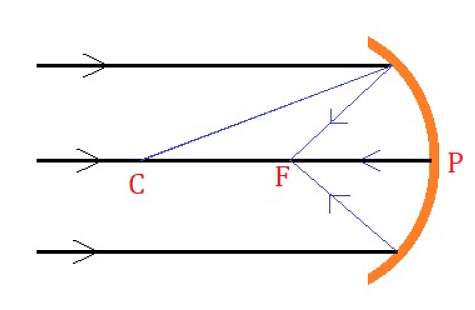
Location of principal focus of the concave mirror

Location of principal focus of the concave mirror


Read More: 

CBSE X Related Questions

  • 1.
    How many bulbs of resistance \( 8 \ \Omega \) each should be connected in parallel combination to draw a current of \( 2 \text{ A} \) from a battery of \( 4 \text{ V} \) ?


      • 2.
        State two differences between the act of chewing food and salivation on sight of food.


          • 3.
            When you look at an object very close to your eyes, the:

              • Ciliary muscles of your eye contract and the eye lens becomes thick.
              • Ciliary muscles of your eye get relaxed and the eye lens becomes thick.
              • Ciliary muscles of your eye contract and the eye lens becomes thin.
              • Ciliary muscles of your eye get relaxed and the eye lens becomes thin.

            • 4.
              (i) \( \text{AgNO}_3 + \text{NaCl} \rightarrow \text{NaNO}_3 + \text{AgCl} \)
              (ii) \( \text{K}_2\text{SO}_4 + \text{BaCl}_2 \rightarrow \text{BaSO}_4 + 2\text{KCl} \)
              Which of the following options clearly describes both the reactions?

                • (i) is double displacement, (ii) is displacement reaction.
                • Both, (i) and (ii) are displacement reactions and precipitation reactions.
                • Both, (i) and (ii) are double displacement reactions and precipitation reactions.
                • (i) is displacement, (ii) is double displacement reaction.

              • 5.
                From the given situations, identify 'Chemotropic' and 'Geotropic' movements in parts of plants, respectively:
                (i) Growth of pollen tube towards ovule.
                (ii) Movement of sunflower towards sunlight.
                (iii) Movement of root towards Earth/Gravity.
                (iv) Movement of leaves due to breeze.

                  • (i) and (iii) respectively
                  • (iii) and (i) respectively
                  • (i), (ii) and (iii), (iv) respectively
                  • (i), (iii) and (ii), (iv) respectively

                • 6.
                  Assertion (A): Reflex actions do not involve thinking.
                  Reason (R): Most reflex actions are controlled by the spinal cord.

                    • Both Assertion (A) and Reason (R) are true and Reason (R) is the correct explanation of the Assertion (A).
                    • Both Assertion (A) and Reason (R) are true, but Reason (R) is not the correct explanation of the Assertion (A).
                    • Assertion (A) is true, but Reason (R) is false.
                    • Assertion (A) is false, but Reason (R) is true.

                  Comments


                  No Comments To Show
