


Define the principal focus of a concave mirror.

Collegedunia Team logo

Collegedunia Team

Content Curator

The point on the principal axis of a concave mirror where the rays of light coming from infinity or parallel to the principal axis meet after reflection from the mirror is called the principal focus of a concave mirror.

  • It is denoted by the symbol F.
  • The principal focus is also referred to as simply focus or focal point.
  • The principal focus of a concave mirror lies in front of the mirror.
  • The distance between the pole and the principal focus of the concave mirror is called the focal length.
  • A line passing through the principal focus and perpendicular to the principal axis on which the rays of light coming from a distant object making different angles with the principal axis converge or diverge is known as a focal plane.
  • A concave mirror is also known as a convergent mirror.
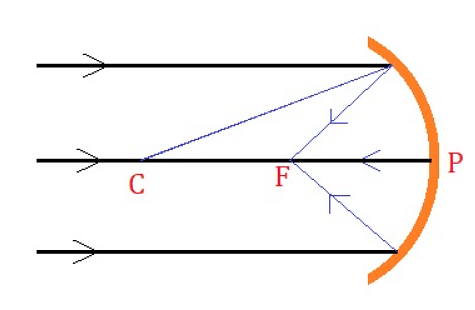
Location of principal focus of the concave mirror

Location of principal focus of the concave mirror


Read More: 

CBSE X Related Questions

  • 1.
    When you look at an object very close to your eyes, the:

      • Ciliary muscles of your eye contract and the eye lens becomes thick.
      • Ciliary muscles of your eye get relaxed and the eye lens becomes thick.
      • Ciliary muscles of your eye contract and the eye lens becomes thin.
      • Ciliary muscles of your eye get relaxed and the eye lens becomes thin.

    • 2.
      Which of the plant hormones are responsible for the following processes? Promote cell division Inhibition of growth Detection of light Wilting of leaves


        • 3.
          Which structure in a leaf is mainly responsible for gaseous exchange?

            • Xylem
            • Stomata
            • Phloem
            • Cuticle

          • 4.
            (a) Study the given electric circuit in which 2 A electric current is flowing between points X and Y.

            (i) Using the battery, key, voltmeter and ammeter in this given electric circuit, redraw a circuit diagram in which 2 \(\Omega\) and 4 \(\Omega\) resistors are connected between X and Y in parallel combination.
            (ii) Circuit drawn by you, in which resistors are connected in parallel combination, calculate the electric current flowing through 4 \(\Omega\) resistor.


              • 5.
                How does the change in curvature of the eye lens help us in the process of seeing the nearby objects clearly?


                  • 6.

                    The reasons for excessive generation of wastes are:
                     (i) Use and throw policy. 
                    (ii) Increased availability of packaged food. 
                    (iii) Increased construction wastes. 
                    (iv) Non-sorting of dry and wet wastes

                      • (i), (iii) and (iv)
                      • (i), (ii) and (iii)
                      • (i), (ii), (iii) and (iv)
                      • (ii), (iii) and (iv)

                    Comments


                    No Comments To Show
