



Content Curator
Dendrites can be described as a number of highly branching, finger-like tapering processes making up a neuron's cell body, or soma. These processes carry impulses back to the soma.
- Dendrites are a collection of processes close to the cell body that receive information from other neurons via synapses.
- They work in contrast to axons, which are a single, long process that transmits impulses away from the cell body to other neurons.
- Every person has at least 100 billion neurons at birth.
- While reading, writing, speaking about, practicing something, or listening to something, dendrites sprout from the neurons.
- Because new dendrites need a lot of practice to develop, they take some time to form.
Read More: Nervous System Diseases
| Table of Content |
Key Terms: Dendrites, Neurons, Synapses, Impulses, Axon, Nissl bodies, Mitochondria, Organelles, Depression.
What are Dendrites?
[Click Here for Sample Questions]
A neuron's (nerve cell) dendrites are its extracellular extensions, which are where it receives signals (information) from other neurons. Electrochemical signals that is, chemical and electric impulses allow information to be transferred from one neuron to another.
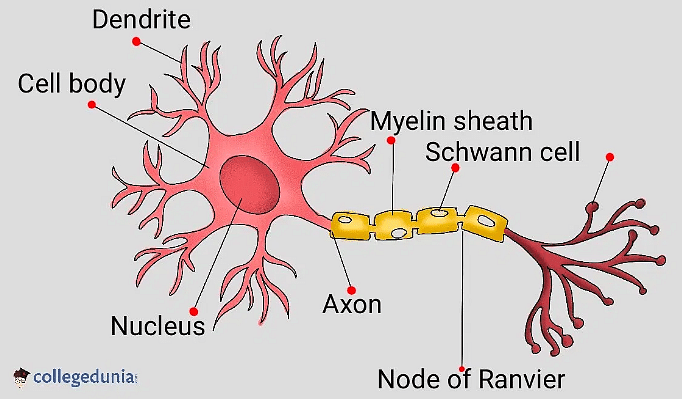
Dendrites
- The information transfer is typically initiated at the dendrites through chemical signals and continues along the neuronal axon as electric impulses.
- It is then passed on to the following neuron at the synapse, which is the location where the two neurons exchange information through chemical signals.
- They have specialized proteins that receive, process, and transport the numerous signals that they receive from other neurons to the cell body.
- Additionally, dendrites have organelles that allow them to vary protein density in response to variations in the frequency of neuronal inputs.
- Axonal connections (synapses) developed on the surfaces of dendrites allow them to receive messages from neighboring neurons.
- In the area of the cell body, dendrites typically branch out widely, resembling a tree or bush.
- Nissl bodies, mitochondria, and other organelles are found in the cytoplasm of dendrites.
- The dendrite gives the other neurons a larger surface area to receive stimuli from the outside world.
- The shortest fiber that extends from a neuron's cell body is called a dendrite.
Read More: Neural Control and Coordination Important Question
Structure of Dendrites
[Click Here for Sample Questions]
Dendrites measure roughly two millimeters in length and range in number from 5 to 7.
- The majority of the time, they branch widely and project through the soma.
- As a result, the dendritic tree, also known as the arborization, usually forms surrounding the neuron.
- Numerous cytoskeletal elements, the Golgi apparatus, ribosomes, and the smooth endoplasmic reticulum are all found in dendrites.
- They are involved in the protein synthesis activity that occurs there during signal transmission.
Read More: Sense organs
Function of Dendrites
[Click Here for Sample Questions]
Receiving electrical signals and transmitting them to the soma, or the cell body of the neuron, is the primary role of dendrites. Dendrites have further functions, such as
- Dendrites have a critical function in sexual activity.
- Receiving signals or information from another neuron is the dendrites' primary function.
- Additionally, dendrites gather all incoming data from axon terminals.
- Dendrites gather information from other neurons and transmit it to the brain.
- The instructions are then relayed by the brain to other bodily parts so that a reaction can take place.
- Therefore, dendrites, synapses, soma, axon, and other components of a neuron play an important part in how our body functions on a daily basis.
- Organelles found in dendrites modify protein density in response to variations in the frequency of neural inputs.
- Dendrites encourage neurons' regular activity as a result, which aids in preventing neurological conditions like epilepsy.
- Dendrites are crucial for psychological processes including memory formation.
Read More: Peripheral Neuropathy
Dendrites Malfunction
[Click Here for Sample Questions]
In the exchange of information between neurons, dendrites are crucial. Therefore, it is not surprising that various nervous system illnesses are linked to dendritic dysfunction.
- Malfunctions range from abnormal morphology to disturbances in dendritic branching, anomalies in dendritic development, and dysfunctional loss of dendrite branching and dendrite genesis.
- They also vary in form and severity. All of these have been related to illnesses like schizophrenia, autism, depression, anxiety, Alzheimer's, and Down syndrome, among others.
Read More: Neuroscience
Things to Remember
- A neuron's or nerve cell's dendrites as projections that receive informational impulses from other neurons.
- The edge of the neuron contains dendrites, which receive messages from other neurons.
- Dendrites are typically five to seven in number and have a length of roughly two micrometers.
- The Golgi apparatus, ribosomes, and smooth endoplasmic reticulum are all components of dendrites.
- Dendrites are also crucial to psychological processes including memory consolidation.
- The synapse is the place where numerous dendrites that are growing together come into touch.
- Dendrites gather information from other neurons and transmit it to the brain.
Sample Questions
Ques. What are the parts of a neuron cell? (2 Marks)
Ans. The cornerstones of our nervous system are neurons or nerve cells. Our nervous system's around 80 billion neuron cells collaborate to maintain our bodies in order. A neuron cell can be viewed as a standard cell with dendrites, the cell body or soma, axons, and synapses as its four basic structural components. A nerve is made up of a number of neurons.
Ques. Do dendrites malfunction? (1 Mark)
Ans. Dendrites can malfunction, yes. A variety of nerve system illnesses are linked to dendritic dysfunction. Schizophrenia, autism, depression, anxiety, Down syndrome, and other illnesses are among the several conditions linked to dendritic dysfunction.
Ques. What are dendrites? (2 Marks)
Ans. The finger-like cells called dendrites are found on the terminal of a neuron. They are tiny, branching filaments that protrude from the nerve cell's cell body. This fiber expands the area that can be used to receive incoming data.
The receiving or input parts of a neuron are called dendrites. Typically, they are brief, thin, and heavily branching structures.
These dendrites in neurons extend from the nerve cell's cell body and resemble a tree or a tree's branches. Organelles such as mitochondria and Nissl bodies can be found in the cytoplasm of dendrites.
Ques. What are the functions of dendrites? (3 Marks)
Ans.
- A different neuron sends information or signals to dendrites.
- Dendrite receives and stores every bit of data arriving from axon terminals.
- Neurons have projections called dendrites that carry electrical impulses to the nerve cell's cell body.
- Dendrites gather information from other neurons or the body's nerves. These signals are sent from the nerve systems to the brain, which then relay them to other sections of the body so that a reaction can take place.
Ques. What are synapses? (1 Mark)
Ans. A void is where one nerve cell ends and another cell begins. Neurotransmitters are substances that are released by nerve cells and taken up by other cells on the other side of the synapse to transfer nerve impulses to the adjacent cell.
Ques. What are called dendrites? (1 Mark)
Ans. Dendrites, which average 5-7 per neuron and are around 2 m in length, are membrane tree-like projections that emerge from the body of the neuron.
Ques. How many dendrites can a neuron have? (1 Mark)
Ans. Each of a neuron's 128 basal dendritic segments has up to 40 functional synapses.
Ques. Describe how an electrical impulse travels in a neuron. (2 Marks)
Ans. A neuron's dendrites are where an impulse enters. An impulse is sent to the cell body, where it is processed, as a result of the information gathered at the dendritic tip of a nerve cell. The impulse leaves the cell body and travels via the axon to the axonal ends. The impulse exits the neuron at the axonal terminals and can go across the synapse to the dendrites of another neuron.
For Latest Updates on Upcoming Board Exams, Click Here: https://t.me/class_10_12_board_updates
Check-Out:



Comments