



Education Journalist | Study Abroad Lead
Benzoic acid is an organic compound in which a carboxyl group is attached to a benzene ring. It is a colourless crystalline compound with the chemical formula C6H5COOH.
- The salt of benzoic acid is used as a preservative in many foods and cosmetics.
- The pleasant aroma of the compound is because of the aromatic benzene ring which is attached to the carboxyl group.
- The commercial production of benzoic acid can be obtained through the partial oxidation of toluene with oxygen, catalyzed by either manganese or cobalt naphthenates.
- Since the benzoic acid chemical formula is C6H5COOH, its Carboxylic acid functional group (-COOH) is considered to be a strong electron-withdrawing group.
- When the Carboxylic acid attaches itself with the Benzene ring and retreats electron density from Benzene to yield positive sites at ortho- and para-positions, it can be said that Benzoic acid produces resonating structures.
| Table of Content |
Key Terms: Benzoic Acid, Benzoin, Partial Oxidation, Toluene, Oxygen, Grignard Reagent, Benzyl Compound, Hydrolysis, Benzene
What is Benzoic Acid?
[Click Here for Sample Questions]
Benzoic acid is an organic compound. The benzoic acid chemical formula is C6H5COOH.
- Benzoic Acid comprises a carboxyl group that is attached to a benzene ring.
- Thus, benzoic acid is often known as an aromatic carboxylic acid.
- Benzoic Acid is a compound that exists in the form of a crystalline, colourless solid under normal conditions.
- The term ‘benzoate’ is usually referred to esters and salts of C6H5COOH.
- The empirical benzoic acid formula is C7H6O2.
- The benzoic acid structure typically has a carboxylic acid group connected to a benzene ring.
- The benzoic acid structure has six hydrogen atoms, seven carbon atoms, and two oxygen atoms.
- The six carbon rings in the structure have alternate single and double covalent bonds, alongside the -COOH group.

Benzoic Acid
Chemical Data of Benzoic Acid
The chemical data of benzoic acid:
| Type | Classification |
|---|---|
| Benzoic Acid Formula | C7H6O2 or C6H5COOH |
| Molecular Weight/ Molar Mass | 122.12 g/mol |
| Density | 1.27 g/cm3 at 15oC |
| Boiling Point | 523K |
| Melting Point | 395 K |
Benzoic acid’s commercial production can be acquired via partial oxidation of toluene with oxygen, catalyzed by manganese or cobalt naphthenates. The salts of Benzoic Acid are often used as food preservatives.
Also Read:
Production of Benzoic Acid
[Click Here for Previous Year Questions]
Benzoic acid is prepared by the industrial method, laboratory synthesis method, by hydrolysis, Grignard reagent, and oxidation of benzyl compound.
- Initially, the only source of benzoic acid was gum benzoin.
- Benzoic acid is commercially produced by the method of partial oxidation of toluene and oxygen, with cobalt naphthenates or manganese acting as a catalyst.
- Benzoic acid is also prepared by the reaction of calcium hydroxide and tri-chlorotoluene, with water as the catalyst, and also by reacting hydrochloric acid with the product of calcium benzoate.
There are several types of Reactions of Benzoic Acid.
Some include:
Hydrolysis
Upon hydrolysis of benzonitrile and benzamide, it then converts into benzoic acid. It can help convert it to the conjugate base in acid or basic conditions.
Grignard reagent
Bromobenzene can be converted into benzoic acid by the help of the carboxylation of the intermediate phenylmagnesium bromide.
Oxidation of Benzyl Compounds
All benzyl derivatives, benzyl alcohol and benzyl chloride can be readily oxidized to benzoic acid.
Nitration Reaction
In the presence of sulphuric acid (a catalyst), the benzoic acid undergoes a reaction with a nitrating agent. The nitro (NO2) group possesses the meta position relative to the position of the carboxyl group found in the benzene ring. Thus, the nitro-substituted benzoic acid, i.e., O2N-C6H4-COOH, is formed.
Halogenation Reaction
When benzoic acid reacts with halogens, under the presence of ferric chloride (FeCl3) in the form of a catalyst, the meta-substituted halo benzoic acid is created.
Sulfonation Reaction
When benzoic acid reacts with fuming sulfuric acid (H2SO4), the sulfonation of the benzene ring takes place. Here, the functional group SO3H substitutes the H- atom in the meta position of benzoic acid. So, the product that is formed is known as meta-sulfonic derivative benzoic acid.
Acid Halide Formation
Benzoic acid, when reacted with Phosphorus pentachloride (PCl5) or Thionyl chloride (SOCl2), forms benzoyl chloride. It is a prime instance of acid or acyl halides.
Formation of Esters
When benzoic acid is reacted with any sort of alcohol, under the presence of a dehydrating agent like sulphuric acid (H2SO4), it then undergoes a process known as Esterification. Thus, it forms pleasant-smelling salts.
Salt Formation
The carboxyl group in benzoic acid is known to be acidic. Thus, it is treated with alkaline compounds, an example includes sodium hydroxide (NaOH), to yield its salt derivative called sodium benzoate. This occurs due to a neutralization reaction.
Decarboxylation of Benzoic Acid
When soda lime is reacted with the sodium salt of benzoic acid, it produces benzene as the major product. Coupled with benzene, carbon dioxide can be released in the form of sodium carbonate. Carbon dioxide removal is known as the process of decarboxylation.
Reduction of Benzoic Acid
When benzoic acid is reacted with the presence of lithium aluminium hydride (LiAlH4) and is then followed by the process of acidic hydrolysis, it produces benzyl alcohol as the product, lacking selectivity.
Dehydration Reaction
If two molecules of benzoic acid or benzoyl chloride react with dehydrating agents like acetic anhydride or phosphorus pentoxide P2O5, it gives rise to anhydride with water molecule removal.
Benzoic Anhydride Reduction
If benzoic anhydride, which is a benzoic acid derivative, reacts with sodium borohydride (NaBH4) and is then followed by acidic hydrolysis, it gets converted into benzyl alcohol and benzoic acid.
Controlled Oxidation of Benzyl Alcohol
Upon reaction with benzoic acid with lithium aluminium hydride (LiAlH4), the final product that can be produced is benzyl alcohol. In case this reaction is controlled, the product acquired will be benzaldehyde.
Structure of Benzoic Acid
[Click Here for Sample Questions]
The molecular formula of benzoic acid is C6H5COOH. It contains 7 carbon atoms, 6 hydrogen atoms, and 2 oxygen atoms. The empirical benzoic acid formula is C7H6O2.
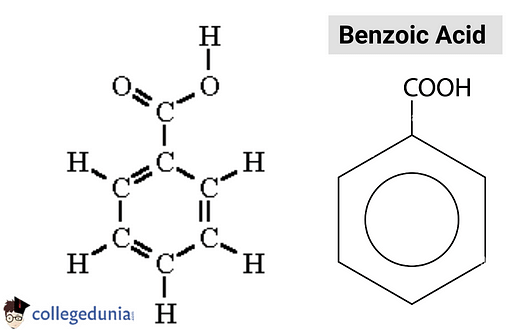
Benzoic Acid Structure
The structural formula of benzoic acid is made up of six rings of carbon where the single and double bonds exist alternatively and the benzene ring is extended with an attachment of – COOH or carboxyl functional group.
Properties of Benzoic Acid
[Click Here for Previous Year Questions]
The several properties of Benzoic Acid include:
Physical Properties of Benzoic acid
The Physical Properties of Benzoic Acid are:
- It is colorless and crystalline in nature.
- It has a faintly pleasant odor.
- The crystal structure of benzoic acid is monoclinic.
Chemical Properties of Benzoic Acid
The Chemical Properties of Benzoic Acid are:
- Molar mass or molecular weight of 122.12g/mol
- Density at 15°c is 1.27g/cm3.
- The boiling point is 523k and the melting point is 395k.
- It can dissolve in organic solvents such as alcohol, ether, and benzene but is insoluble in water.
- The reaction can take place either in the aromatic ring or in the carboxyl group.
- Reactions such as nitration, sulfonation, and halogenation take place in the benzene ring whereas reactions such as the formation of salts, acid halides, and esters in the carboxyl group. These reactions lead to the modification of the carboxyl group as well as the benzene ring.
- It can dissolve easily in carbon tetrachloride, benzene, alcohol, and acetone.
Uses of Benzoic Acid
[Click Here for Sample Questions]
The uses of Benzoic Acid are:
- It is used for the production of phenol
- It is used in the production of insect repellants, dyes, cosmetics, and toothpaste.
- It is also used as ointment to treat fungal skin diseases, insect bites, skin irritations, fungal infections, etc.
- There are some specific esters of benzoic acid that act as a plasticizer.
- As it acts as a pH adjuster, it is used in the production of fragrances.
- Its preservative properties are the maximum in the acidic medium.
- Sodium benzoate which is a sodium salt of benzoic acid is used to control the glycerine level of the blood.
- It is also used in toothpaste, mouthwash and face creams.
Things to Remember
- The chemical formula of benzoic acid is C7H6O2 or C6H5COOH
- The faintly pleasant odour of the compound is due to the presence of the aromatic ring.
- The solubility of benzoic acid in water increases with the increase in temperature.
- Benzoic acid is the primary compound of benzoyl chloride.
- Benzyl compounds such as benzyl alcohol and benzyl chloride are easily oxidized to benzoic acid.
- It is used for the production of phenol, insect repellants, dyes, cosmetics, and toothpaste.
- It is also used as an ointment to treat fungal skin diseases, insect bites, skin irritations, fungal infections, etc.
Also Read:
Previous Year Questions
- Which of the following compounds has the lowest boiling point? [NEET 1994]
- Which of the following has zero dipole moment? [NEET 1996]
- Identify Z in the sequence of reactions, CH3CH2CH [NEET 2014]
- The compound that is not a Lewis acid, is?
- The pKa of a weak acid HA and pKb of a weak base BOH are [KEAM]
- Which of the following alkane cannot be made in good yield by Wurtz reaction ? [NEET 2020]
- An alkyl bromide (X)(X) reacts with Sodium in ether to form 4, 54,5 -diethyl [KCET 2013]
- Ethyl benzene cannot be prepared by [KCET 2011]
- Conversion of benzene to acetophenone can be brought by [KCET 2013]
- Cycloalkane formed when 1, 41,4 -dibromopehtane is heated with Sodium [KCET 2013]
- In electrophillic aromatic substitution reaction, the nitro group [KCET 2009]
Sample Questions
Ques: What is the pH of benzoic acid? (1 Mark)
Ans: Benzoic acid is used as a food preservative in carbonated beverages as it has a pH range of 2.5 – 4.0. It has the strongest antibacterial property.
Ques: Benzoic acid is found in which foods? (1 Mark)
Ans: Food items such as yoghurt, cranberries, prunes, apples, and strawberries contain benzoic acid. It is a weak acid with a pKa of 4.19.
Ques: Is benzoic acid soluble in water? Explain. (1 Mark)
Ans: Benzoic acid is partially soluble in water. The solubility of benzoic acid in water is directly proportional to the temperature.
Ques: Define controlled oxidation of Benzyl Alcohol. (1 Mark)
Ans: Upon reaction with benzoic acid with lithium aluminium hydride (LiAlH4), the product produced is benzyl alcohol. If this reaction is controlled, the product acquired will be benzaldehyde
Ques: How is benzoic acid manufactured from the process of hydrolysis? (2 Marks)
Ans: benzoic acid is produced when benzamide and benzonitrile are converted by the process of hydrolysis. In acid or basic conditions, It can also get converted into its related base.
Ques: Describe the primary application of benzoic acid. (2 Marks)
Ans: The industrial production of aromatic compounds such as phenol uses benzoic acid. This is carried out by the process of oxidative decarboxylation under the temperature of 300°C - 400°C. the food industry uses benzoic acid as a food preservative.
The solubility of benzoic acid is 1.7 gm per litre in water at 0° temperature which increases to 56.31 gms per litre when heated at a temperature of 100°C.
Ques: What are the uses of benzoic acid? (2 Marks)
Ans: The main use of benzoic acid is seen in the industrial production of the aromatic compound phenol.
- Aromatic Compound Phenol can be produced via a process called oxidative decarboxylation. The ideal temperature under which it can be carried out is in the range of 300°C to 400°C.
- Benzoic acid and its salts are used in the food industry as food preservatives.
Ques: Name the three most weak acids along with their chemical formula. (3 Marks)
Ans: The common weak acids are:
- Formic acid with the chemical formula of HCOOH
- Acetic acid with the chemical formula of CH3COOH
- Benzoic acid with the chemical formula of C6H5COOH
Ques: Which production process of benzoic acid gives out the highest yield? (3 Marks)
Ans: The highest yield can be achieved by:
- Benzoic acid being cheap and having easy access makes it suitable for the process of laboratory synthesis.
- The property of benzoic acid is highly soluble in hot water and its poor solubility in cold water results in the purification of benzoic acid by recrystallization.
- It is regarded as a common process of preparation that gives a high yield of 65%.
Ques: What are the different types of chemical reactions related to benzoic acid? (5 Marks)
Ans: The different types of chemical reactions of benzoic acid are:
- Formation of Salt
- Formation of Esters
- Formation of Acid Halides
- Sulfonation
- Nitration
- Halogenation
- Decarboxylation of Benzoic Acid
- Reduction of Benzoic Anhydride
- Controlled Oxidation of Benzyl Alcohol
For Latest Updates on Upcoming Board Exams, Click Here:https://t.me/class_10_12_board_updates
Do Check Out:



Comments