



Content Curator
Diamagnetism is the phenomenon of a material that can create a magnetic field in response to an external magnetic field. It is also called Magnetism.
A diamagnetic material is a material that is repelled by a magnetic field. The most common example of diamagnetism is when a piece of paper or other thin material is held over a bar magnet and observed. The paper will be attracted towards the magnet, but will not be pulled down because it is not strong enough to overcome gravity.
- A diamagnet is an object made from materials that can be magnetized, but do not in themselves produce a magnetic field.
- There are no atomic dipoles in the material as the magnetic moment is zero in each atom .
- They can be repelled by magnets.
- These materials have a strength to move from strong to weak parts in a magnetic field.
- Materials like Copper, Bismuth, Zinc, Silver, Gold, and Antimony are Diamagnetic in nature.
Read also: Force of Attraction
Key terms: Diamagnetism, Magnetic Materials, Magnetic field, Magnets , Diamagnetic Materials, Ferromagnetic
Types of Magnetic Materials
[Click Here for Sample Questions]
A material's magnetic properties are its response to an external magnetic field. According to the magnetic properties of solids, they can be divided into five types.
- Diamagnetism: A substance with no net magnetic moment. Not attracted to magnets.
- Paramagnetism: A substance that has a net magnetic moment, but is too small to detect with the naked eye.
- Ferromagnetism: Attracts substances with a large net magnetic moment to a magnet.
- Ferrimagnetism: The magnetic fields associated with individual atoms are spontaneously aligned, some aligned in parallel or in the same direction.
- Antiferromagnetism: Neighboring ions acting like tiny magnets spontaneously align in an opposite or antiparallel arrangement.
| Magnetic Material | Definition | Examples |
|---|---|---|
| Diamagnetism | Materials that are not attracted to magnetic fields | Mercury, water, copper, bismuth, and gold |
| Paramagnetism | Materials that are weakly attracted to magnetic fields | Magnesium, lithium, Molybdenum |
| Ferromagnetism | Materials that are strongly attracted to magnetic fields | Iron, Cobalt, and Nickel |
| Ferrimagnetism | Materials aligned in parallel or in the same direction. | Magnetite, Aluminum, Cobalt, Nickel, Manganese, and Zinc |
| Antiferromagnetism | Material’s neighboring ions act in opposite directions. | Hematite, Chromium, Alloys |
What is Diamagnetism?
[Click Here for Sample Questions]
Diamagnetism is a type of magnetism displayed by certain materials, including copper, silver, gold, and other non-magnetic materials, that causes them to be weakly repelled by a magnetic field. Diamagnetism simply occurs in materials that have no magnetic moment of their own.
- The diamagnetic effect is the result of the fact that all electron in an atom act like tiny magnets and these magnetic moments are directed in the opposite direction to the direction of the external magnetic field.
- This effect was first discovered by Michael Faraday in 1845. He found that when bismuth, silver, and copper were brought close to a magnet, the magnet repelled them.
- Faraday concluded that "the cause of this repulsive force must lie in the atoms or in the space between atoms".
Read also:
Langevin Theory of Diamagnetism
[Click Here for Sample Questions]
Diamagnetism, the orbit motion of the atom negatively charged electrons creates tiny current-carrying rings creating a magnetic field. In the absence of an external magnetic field, the total magnetic moment is zero because the vector sum of all magnetic moments in the direction of electron orbits inside an atom is zero.
The current loop formed by an electron e with charge -qe per unit time is:
Z Current in atoms with electrons,
I= -qe/t
The current of the atom with Z electrons in it,
I= - Ze/t …………………………………………………….(1)
When a magnetic field of intensity B acts on an electron of charge and mass m, it produces an angular frequency ω known as the Larmor frequency, with revolutions per unit time equal to ω/2π. .
Then the current produced per atom is:
I= -Ze2B/4Πm …………………………………………….(2)
The magnetic moment produced by this energized loop is the product of the energized loop I times the area of the loop.
If "a" is the average radius of the loop:
μ=I × Π(a2) ………………………………………..(3)
Now , we get
μ= Ze2B/4Πm × Π(a2)
Simplifying the equation gives the result: I suspect diamagnetism, then:
μ= -Ze2B/4m (a2) ………………………………(4)
If the magnetic field is in z direction and orbit plane is in x-y direction:
(a2) = (x2) + (y2)
The mean square distance (r2) of electron from the nucleus:
(r2) = (x2) + (y2) + (z2) ……………………………………………… (5)
(x2) = (y2) = (z2)
From this equation:
(r2) = 3/2 (a2)
Replace the value of a2 in eq.4 :
μ=-Ze2B/4m × ⅔(r2)
Getting the equation:
μ=-Ze2B/6m × (r2) ………………………………………………….(6)
Then, M=N*μ ………………………………………………………(7)
From equation 6 and 7
M= -NZe2B/6m × (r2) …………………………………………………(8)
Since, B=μ0 H and
is diamagnetic suspect then:
Xdia = -NZe2μ0/6m × (r2) ……………………………………………….(9)
Now if N is a number. Number of atoms per volume:
From the equation, the diamagnetic susceptibility of any material does not depend on the external magnetic field and external temperature. It is proportional to the number of atoms per unit volume. The higher the number of atoms in the volume, the higher the diamagnetic energy of the material.
Read also: Faraday Constant
What is a Diamagnetic Material?
[Click Here for Sample Questions]
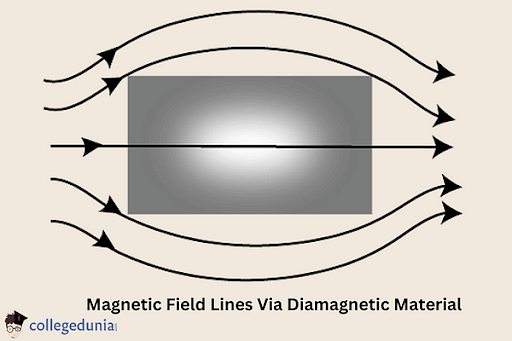
Diamagnetic materials are those that exhibit a weak, negative susceptibility to magnetic fields. When subjected to an external magnetic field, diamagnetic materials produce a magnetic field in the opposite direction, which weakens the applied field.
- A diamagnetic material creates a magnetic field in the opposite direction to the applied external magnetic field.
- A diamagnet is attracted by a magnet and repelled by an applied electric field.
- Examples of diamagnetic materials include bismuth, magnesium, nickel, platinum and silver.
- Diamagnetism induces no net magnetization in the direction of an applied magnetic field. Diamagnetism, or negative magnetism, is a physical property that is repelled by a magnetic field due to relative motion between a particle and an external source.
- The term diamagnetism was introduced in 1882 by William Henry Bragg and William Lawrence Bragg.
Diamagnetic Material
Properties of Diamagnetic Materials
[Click Here for Sample Questions]
Now that we understand what diamagnets are, the next step is to understand their properties.
- Diamagnets have no atomic dipoles. This is because the net magnetic moment of each atom is zero due to the pair of electrons.
- A diamagnet is repelled by a magnet.
- These materials are weakly repelled by magnetic fields, so in a non-uniform magnetic field, they tend to move from strong to weak areas of the external magnetic field.
- The relative permeability is slightly less than 1.
Things to Remember
- Diamagnetic materials are repelled by magnetic fields and are not attracted to a magnet.
- A diamagnet is an object made from materials that can be magnetized, but do not themselves produce a magnetic field.
- Diamagnetism is the phenomenon by which certain materials are repelled by a magnetic field, and can be thought of as magnetism from the opposite direction.
- The materials are attracted to magnetic fields, but if the magnetic field is strong enough, they will be pushed away.
- Diamagnetism is universal. It is present in all materials. But it is weak and hard to detect if the substance is para- or ferromagnetic.
Read also:
Sample Questions
Ques. Water is a diamagnetic material. It is boiled at 373 K temperature. What is the change in diamagnetic susceptibility of water? (1 mark)
Ans. Zero. Diamagnetic susceptibility is not dependent on temperature; therefore the diamagnetic susceptibility of water will be the same even after boiling. But the steam generated will have different diamagnetic susceptibility as compared to water.
Ques. Give some examples of Diamagnetic Materials. (1 mark)
Ans. Wood, copper, gold, bismuth, mercury, silver, lead, neon, water, and etc are all examples of Diamagnetic Materials.
Ques. What are the different types of Magnetic Materials? (2 marks)
Ans. On the basis of magnetism, the following are the different types of Magnetic Materials:
- Diamagnetism
- Paramagnetism
- Ferromagnetism
- Ferrimagnetism
- Antiferromagnetism
Ques. What are Paramagnetic Materials? (1 mark)
Ans. Paramagnetic Materials are the Materials that are weakly attracted to magnetic fields.
Ques. Define the term magnetic susceptibility? (2 marks)
Ans. Magnetic susceptibility is the measurement of the diamagnetic nature of the material. Magnetic susceptibility of a material is the ratio of the internal magnetic field to the external magnetic field. As this is a ratio of two magnetic fields therefore magnetic susceptibility is dimensionless.
Ques. What is the opposite of Diamagnetism ? (1 mark)
Ans. The opposite of Diamagnetism is Paramagnetism.
Ques:. What is the Meissner Effect? (2 marks)
Ans: When a substance is in the process of transition to superconductor, it loses its resistance to electric current when it is cooled below the transition temperature (the temperature very close to absolute zero). During this process, the substance begins to expel the magnetic field, which is known as the Meissner effect.
German physicists R. Ochsenfeld and W. Meissner discovered the Meissner effect in 1933 and found that this effect is the common property of all superconductors.
Ques: Define the term magnetic susceptibility? (2 marks)
Ans: Magnetic susceptibility is the measure of the diamagnetic property of a material. The magnetic susceptibility of a material is the ratio of the inner magnetic field to the outer magnetic field. Since it is a ratio of two magnetic fields, magnetic susceptibility is dimensionless.
Ques:State true or false: diamagnetic materials normally attract a magnet. (1 mark)
Ans: False.
Explanation: Diamagnetic materials are usually repelled by a magnet.
Ques: A diamagnetic material in a magnetic field moves (1 mark)
(a) perpendicular to field
(b) from stronger to weaker parts of the field
(c) from weaker to stronger parts of field
(d) None of these
Ans: (b) from stronger to weaker parts of the field
Explanation: A diamagnetic material in a magnetic field moves from stronger to the weaker parts of the field.
Ques: When a diamagnetic substance is introduced into a current-carrying coil, the magnetic field inside the substance. (1 mark)
(a) decreased
(b) increased
(c) unchanged
(d) increased or decreased depending upon the relative volume of the substance.
Ans: (a) decreased
Explanation: The field decreases when a diamagnetic substance is inserted since all dipoles don't align in the direction of the field.
Ques:Draw magnetic field lines when a
(a) diamagnetic,
(b) paramagnetic substances are placed in an external magnetic field.
Which magnetic property distinguishes this behaviour of the field lines due to the two substances? (3 marks)
Ans:(a) When a diamagnetic material is placed in an external magnetic field.

Diamagnetic Material
(b) When a paramagnetic material is placed in an external magnetic field.

Paramagnetic Material
Magnetic susceptibility distinguishes this behaviour of the field lines due to the two substances.
Ques: A circular coil of N turns and radius R carries a current I. It is unwound and rewound to make another coil of radius R/2, current I remaining the same. Calculate the ratio of the magnetic moments of the new coil and the original coil. (3 marks)
Ans: Magnetic moment
=NIA= N1IΠr2
N12ΠR = N2.2Π(R/2)
N2 = 2N1 When radius of another coil = R/2
Then magnetic moment of new coil
= N2I * Π(R/2)2 = N2I * Π(R2/4)
Magnetic moment of new coil / Magnetic moment of original coil
2 N1I * Π(R2/4) / N1I * Πr2 = ½
hence Ratio = 1 : 2
Ques: How is an electromagnet different from a permanent magnet? (2 marks)
Ans: Difference between electromagnet and permanent magnet :
The differences between electromagnet and permanent magnet are as follows:
| Electromagnet | Permanent Magnet |
|---|---|
| Electromagnet‘s magnetic properties are shown when current passes through it | Permanent magnet properties remain when the material is magnetized |
| The strength of the electromagnet can be settled according to flow to current | The strength of the permanent magnet realizes on the nature of the material used. |
| magnetic properties of electromagnet can be removed temporary | If the magnetic properties of the permanent magnet are removed it becomes useless. |
For Latest Updates on Upcoming Board Exams, Click Here: https://t.me/class_10_12_board_updates
Do Check:



Comments