



Content Curator
Compact bone is also known as cortical bone is a dense material which is used to create most of the hard structure of the skeleton whereas Spongy bone is a very porous type of bone which is generally found in animals. There are 206 bones in the human body. It helps in protecting the vital organs and provides strength to the muscle. There are five different types of bones in the human skeleton system - Short bones, long bones, flat bones, sesamoid bones, irregular bones. Bones are made up of calcium phosphate and collagen. Calcium helps in hardening the framework and the combination of collagen and it makes bones strong and flexible to suffer counter stress.
Read More: Joints
| Table of Content |
Key Terms: Compact Bone, Spongy Bone, Bones, Cartilage, Osteoids
Compact Bone
[Click Here for Sample Questions]
Compact bone is also known as cortical bone is a dense material which is used to create most of the hard structure of the skeleton. They form the cortex, or the hard outer shell of most of the bones in the body. It is formed from a number of osteons, which are the circular units of bone material and blood vessels. Each osteon is composed of a number of different cells which are responsible for the maintenance of bones including osteocytes and osteoblasts.
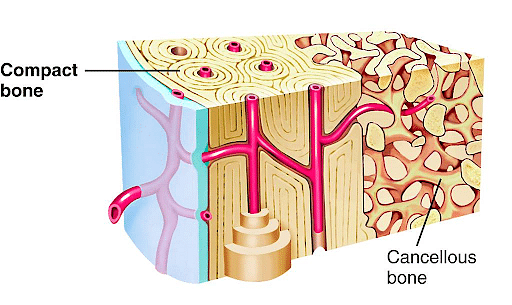
Compact Bone
Also Read: Nerves
Functions of Compact Bones
- Compact bones serve as a function in storing and releasing calcium in the body when needed.
- It also provides strong mechanical levers, against which the muscles can create movements.
- It is carried by joints created by the spongy bone and connective tissues such as tendons and ligaments.
Read More:
| Related Articles | ||
|---|---|---|
| Bones of Leg | Bones of Wrist | Bones of Ankle |
Spongy Bone
[Click Here for Sample Questions]
Spongy bone is a very porous type of bone which is generally found in animals. It is highly vascularized and has red bone marrow. It is usually situated at the ends of long bones with the harder compact bone which surrounds it. It can be found inside the vertebrae, ribs, skull and joints of the body. This bone is softer and weaker than the compact bone but it is more flexible.
Functions of Spongy Bone
- Reduces the weight of the skeleton - The light weight and low density of spongy bone balance the heavier and denser compact bone to reduce the overall weight of the skeleton.
- Storage of bone marrow - Spongy bone is ideal for making and storing bone marrow within the lattice-like trabeculae network.
- Adds strength and flexibility to bones - The trabeculae of spongy bone tends to form along lines of stress, which gives bone strength and flexibility in that area.
Also Read: Nervous System Disease

Spongy Bone
Also Read:
Difference between Compact Bone and Spongy Bone
[Click Here for Sample Questions]
Key differences between Compact and Spongy bones are tabulated below.
| Parameters of Comparison | Compact Bone | Spongy Bone |
|---|---|---|
| Definition | Compact bones are made up of osteons and they construct the external layer of the bones. | Spongy bones are made up of trabeculae and they are involved in the construction of the inner part of bones. |
| Another name | Another name for compact bones is cortical bones. | Another name of spongy bone is cancellous or trabecular bones. |
| Nature | Compact bones are heavy and compact in nature. | Spongy bones are light, soft and spongy in nature. |
| Bone Marrow cavity | It is present in the center of the compact bones. | It is absent in spongy bones. |
| Forms | They are responsible for the construction of shafts or diaphysis of long bones. | They are responsible for the construction at the ends or epiphyses of the long bones. |
| Made of | Compact bones are made up of osteons. | Spongy bones are made up of trabeculae. |
| Area | They fill the outer layer of most of the bones. | They fill the inner layer of most of the bones. |
| Work | Bone marrow stores the fat molecules. | Bone marrow produces the red corpuscles and the white granular corpuscles. |
| Weight | The weight of compact bone is more than that of spongy bones. | The weight of spongy bone is less than that of compact bones. |
| Surface area | The surface area of compact bone is less than that of spongy bones. | The surface area of spongy bone is more than that of compact bones. |
| Main Function | It is responsible for the formation of diaphysis of long bones. | It is responsible for the formation of epiphysis of long bones. |
| Microscopic nature | It has a tightly packed structure. | It has a loosely packed structure |
Also Read: Plasma Membrane
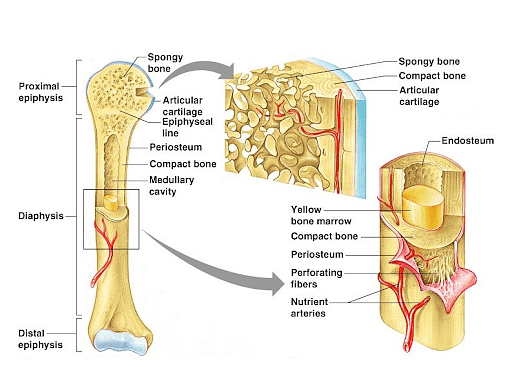
Difference between Compact and Spongy Bone
Things to Remember
- Bones and Cartilages made up the human skeletal system.
- Compact and Spongy bones both have proteins like collagens and osteoids, which mineralizes and helps in bone formation.
- There are blood vessels, nerves and bone marrow within the lamella of both the types of bones.
- Both contain osteoblasts and osteoclasts which are necessary for creation of bones.
- They are also the bone tissues which provide shape and support to the body.
Also Read:
Sample Questions
Ques. What is spongy bone made up of? (2 Marks)
Ans. Spongy bone is lighter and less denser than the compact bone. It is composed of plates and bars of bone which are adjacent to small, irregular cavities that include the red bone marrow. The canaliculi is connected to the adjacent cavities, instead of the central Haversian canal to receive the blood supply.
Ques. How is the compact bone made up of? (2 Marks)
Ans. It is made up of cylindrical units which are known as osteons, which are formed from layers of concentric circles known as lamellae around a central canal containing blood vessels and nerve fibers. Each osteon has many little spaces between its rings.
Ques. What are the similarities between Compact bone and Spongy bone? (3 Marks)
Ans. Similarities between Compact bone and Spongy bone are:
- Both compact bone and spongy bone support the functioning of muscles.
- Both are osseous tissues.
- Both are the structural bones.
- Both are a part of the skeletal system of an organism.
- Both provide a definite shape and structure to the organisms.
Ques. What are the similarities between Compact and Cancellous bone? (2 Marks)
Ans. Similarities between Compact and Cancellous bone are:
- Compact and Cancellous bones are two different types of bones.
- Both bones are made up of osseous.
- Both contain calcium.
- The main function of both bones is to assist in the movement of the body.

Cancellous Bone
Ques. Explain the different types of bones in the human body? (5 Marks)
Ans. Different types of bones in the human body are long bones, short bones, flat bones, irregular bones, sesamoid bones.
- Long bones - Long bones are some of the longest bones in the human body, such as Femur, Humerus, Tibia but some of them are smaller in size like Metacarpals, Metatarsals and Phalanges.
- Short bones - They are defined as wide as they are long and have a primary function of providing support and stability with little movement. They consist of a thin layer of compact, hard bone with cancellous bone at the inside along with relatively large amounts of bone marrow.
- Flat bones - They are strong, flat plates with the main function of providing protection to the body’s vital organs and being a base for muscular attachment. Example of a flat bone is Scapula.
- Irregular bones - They are bones in the body which do not fall in any other category due to their non-uniform shape. Examples of irregular bones are vertebrae, sacrum, mandible.
- Sesamoid bones - They are short or irregular bones which are embedded in a tendon. They are present in the tendon where it passes over a joint which serves to protect the tendon.
Ques. Describe the composition of Bones in the human body. (2 Marks)
Ans. The main components of bones are collagen fibers and inorganic bone minerals in the form of small crystals. The human’s body living bone is composed of 20% water and the dry mass is composed of approx 60-70% bone numerals. The bone also contains a trace amount of other substances such as inorganic salts and proteins but it is primarily composed of collagen.
Ques. Are spongy bone and bone marrow the same? (2 Marks)
Ans. In the human body, there are two different types of marrow present. Red marrow contains blood stem cells and these blood cell stems then become platelets, white blood cells (WBC), red blood cells (RBC). The yellow marrow is found at the center of most of the bones and it contains a lot of blood vessels too. So, the spongy bone and bone marrow are not the same. Bone marrow is generally found in the spongy bone which is located at a specific location.
Ques. What are the functions of Osteocytes? (2 Marks)
Ans. An osteocyte is a cell which is found within the material of fully formed bone. It lives in a small chamber which is known as lacuna that is constricted within the calcified matrix of bone. They are derived from osteoblasts, or bone-forming cells and are essentially osteoblasts surrounded by the released products. Nutrients and waste products are exchanged through a small channel called canaliculi to keep the osteocyte alive.
Ques. Describe the structure of Cancellous bone. (3 Marks)
Ans. Cancellous bone can also be called the spongy bone as there are many open spaces joined by flat planes of bone known as trabeculae like a sponge or honeycomb. Inside the trabeculae, there are three types of bone cells: osteoblasts, osteocytes and osteoclasts. Osteoblasts are the cells that make new bones. It produces layers of hard tissue which is made primarily of calcium and phosphate until they are completely surrounded, at this point they become osteocytes. Osteoclasts are large cells that break down and destroy the old or damaged bones so that it can be repaired and replaced by osteoblasts. This process of repair and rebuilding is constant and keeps on going to make bones strong and healthy.
Check-Out:



Comments