



Content Curator
Purines and pyrimidines are the two groups of nitrogenous bases that form nucleic acids, or the building blocks of DNA and RNA. Along with the many similarities, there are a few major differences between Purines and pyrimidines.
- Each DNA strand contains a 'backbone' composed of a sugar-phosphate chain.
- Each of these sugars is attached to a nitrogenous base made up of carbon and nitrogen rings.
- The number of rings in a base determines whether it is purine (two rings) or pyrimidine (one ring).
- The purines on one strand of DNA create hydrogen bonds with the corresponding pyrimidines on the other strand of DNA, and vice versa, to keep the two strands together.
- The most important function of DNA molecules is known as base pairing.
- Since hydrogen bonds are less strong than covalent bonds, base pairs can be readily separated, allowing replication and transcription.
- The ratio of the purines and pyrimidines remains constant within a DNA molecule because they always bind together (known as complementary pairing).
| Table of Content |
Key Terms: Purines, Pyrimidines, DNA, Nucleic acids, RNA, Nitrogenous bases, Chemical formula, Carbon rings, Nitrogen rings, Types of purines, Types of pyrimidines, Atoms, Amino acids
Difference Between Purines and Pyrimidines
[Click Here for Sample Questions]
The following are the differences between Purines and Pyrimidines
| Purines | Pyrimidines |
|---|---|
| These are double-carbon nitrogen rings with four nitrogen atoms. | These are single carbon-nitrogen rings with two nitrogen atoms present. |
| Purines are classified into two major categories. These are adenine and guanine. Both of them are found in DNA and RNA. | Pyrimidines are of three kinds. Out of these, Thymine is found in the DNA, Uracil is present in RNA, and Cytosine is found in both. |
| Purines are bigger than pyrimidines. | Pyrimidines are smaller in size as compared to purines. |
| The melting point is 214 degrees Celsius. | The melting point is 22 degrees Celsius. |
| These are easily soluble in water. | They can't be dissolved in water. |
| The molecular mass of purines is 120.11 g/mol. | The molecular mass is 80.088 g/mol. |
| Synthesis in the body takes place in the liver. | Synthesis takes place in different tissues. |
| The end product of this catabolic process includes uric acid. | Amino acids and carbon dioxide can be called the catabolic end products. |
| The Chemical formula of purines is C5H4N4 | The Chemical formula of pyrimidines is C4H4N2. |
Also Read:
| Related Articles | ||
|---|---|---|
| Human Genome Project | Molecular Basis of Inheritance | Lac Operon |
| Genome and Genomics | Translation | Bioinformatics |
What are Purines?
[Click Here for Sample Questions]
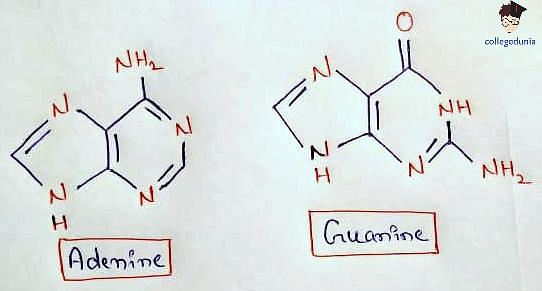
Purines are one of two nitrogenous bases present in DNA and RNA.
- They contain a double-ring structure composed of a six-membered ring fused with a five-membered ring.
- DNA and RNA contain two purines: adenine (A) and guanine (G).
- These nitrogenous bases are required for the creation of hydrogen bonds between complementary base pairs, which helps in the stability of the double helix structure of DNA.
Structure of Purines
[Click Here for Sample Questions]
Purines have a chemical formula of C5H4N4. It means it is a heterocyclic organic compound consisting of four nitrogen atoms and two carbon rings.
- It comprises a pyrimidine ring with an imidazole ring infused with it.
- This pyrimidine ring contains two nitrogen atoms present at the end positions of 1 and 3 of the ring.
- The imidazole ring has two nitrogen atoms present at positions of 7 and 9.
- The melting point of a purine occurs at 214 degrees Celsius.
- The molecular mass of purine is 120.115 g/mol.
Function of Purines
[Click Here for Sample Questions]
The following are the functions of Purines
- They are solely associated with developing DNA and RNA material in the body.
- Purines act as metabolic signals and are actively involved in the regulation of enzymes.
- They serve as a network of coenzymes.
- They provide energy to the body and help keep its metabolism stable.
- Purines control cell growth and all the life-sustaining processes of the cells.
- They actively contribute to sugar transport.
- They also act as important components of protein and starch.
What are Pyrimidines?
[Click Here for Sample Questions]
Pyrimidines are the other nitrogenous bases present in DNA and RNA.
- They contain a single-ring structure with six members.
- DNA and RNA contain three pyrimidines: Cytosine (C), Thymine (T), and Uracil (U).
- Cytosine and thymine are present in DNA, whereas cytosine and uracil are found in RNA.
- The nitrogenous base pairing rules indicate that adenine pairs with thymine (or uracil in RNA), whereas cytosine pairs with guanine.
Structure of Pyrimidines
[Click Here for Sample Questions]
Pyrimidines are a heterocyclic aromatic organic compound with a single ring called the pyrimidine ring.
- It has one carbon ring with two nitrogen atoms.
- The chemical formula of Pyrimidines is C4H4N2.
- It is a colorless compound.
- The nitrogen atoms are present at positions of 1 and 3 in the ring.
- The melting point of a pyrimidine occurs at 22 degrees Celsius.
- Their molecular mass is 80.088 g/mol.

Function of Pyrimidines
[Click Here for Sample Questions]
As nucleobases, pyrimidines are important components of the body. The following are the functions of Pyrimidines
- They include cytosine, thymine, and uracil which are the fundamental units of the genetic code and serve their function in nucleic acids.
- They activate the sugar in our body for polysaccharide and phospholipid synthesis.
- They help develop the metabolism of the body by protecting the tissue cells.
- They also act as signals and in the regulation of enzymes.
- Pyrimidines work in the glycosylation of proteins and lipids so as to maintain their structure, function, and stability.
- It's an integral part of the body and has a crucial role in pharmacological utility as antibiotics.
Things to Remember
- Purines and pyrimidines are bases of nitrogen with the common purpose of stimulating the synthesis of DNA and RNA material in the human body.
- There are two important types of purines adenine and guanine.
- Both of them can be found in the DNA as well as in the RNA.
- Pyrimidines are of three types: Cytosine, Thymine, and Uracil.
- Thymine is found in the DNA, uracil can be found in the RNA whereas cytosine can be found in both DNA and RNA.
- The chemical formula of Pyrimidines is C4H4N2.
- The chemical formula of Purines is C5H4N4.
Read More:
Sample Questions
Ques. What are purines? (2 Marks)
Ans. Purines are heterocyclic organic compounds that help build DNA and RNA. They also are essential for stimulating cell growth and metabolism in our body. They have a chemical composition of C5H4N4 and a molecular mass of 120.11 g/mol.
Ques. How many purines and pyrimidines are there in DNA? (2 Marks)
Ans. There are two types of bases in DNA: purines and pyrimidines. DNA has four nitrogen bases: two purines and two pyrimidines. Purines are composed of adenine and guanine, while pyrimidines are composed of cytosine and thymine, also known as A, G, C, and T, respectively. RNA contains both adenine and guanine purines, whereas pyrimidines include only cytosine and uracil. So all purines contain two types of molecules, whereas pyrimidines have three types of molecules.
Ques. Are Purines and Pyrimidines found in other Biological molecules? (1 Mark)
Ans. Yes, purines and pyrimidines are present in other molecules, such as ATP, a molecule that delivers energy to cells.
Ques. What is the role of purines in the body? (2 Marks)
Ans. These are naturally formed in the body and are also found in some types of food too like cauliflower, beans, mushrooms, and meat. These are of two kinds, - adenine and guanine, and help in developing genetic material. They also help in the growth of tissue cells, regulate enzymes, and metabolism, and provide energy to carry out different processes.
Ques. What are the different types of purines and pyrimidines found? (2 Marks)
Ans. Purines are of two major kinds. These contain adenine and guanine as nucleobases while pyrimidines consist of cytosine, thymine, and uracil.
Ques. What are pyrimidines? (2 Marks)
Ans. Pyrimidines are bases of nitrogen with a single ring of alternating carbon and two nitrogen atoms. It has a chemical composition of C4H4N2 and is insoluble in water. The molecular mass of pyrimidines is 80.088 g/mol and has a melting point of 20-22 degrees Celsius.
Ques. What are the similarities between purines and pyrimidines? (2 Marks)
Ans. The role of stimulating the production of DNA and RNA is what binds purines and pyrimidines together. Both of them are the bases of nitrogen.
Ques. What happens when purines don't fulfill their function? (2 Marks)
Ans. Uric acid is the end product of this metabolism. These purines actually break down into uric acid and can form deposits that cause us pain and inflammation. If the amount of uric acid increases it can lead to a condition called hyperuricemia which would promote kidney stones.
Ques. Name some foods rich in purines. (2 Marks)
Ans. Foods like oatmeal, dried peas, beans, red meat, and seafood like tuna, anchovies, and mussels, all contain very high levels of purines. Doctors advise eating a low-purine diet like eggs, peanut butter, bread, fruits and fruit juices, bread, pasta, eggs, nuts, and peanut butter, asparagus, and cauliflower for a healthy body.
Foods rich in purines lead to increased concentration of uric acid causing gout attacks and kidney stones.
Ques. Why do pyrimidines bond with purines? (3Marks)
Ans. Purines are always paired with pyramid ions because of their size and shape, which make them perfect for hydrogen bonding. Purines and pyrimidines combine to produce bases, with A-T and G-C being the most common base pairings. Nucleotides are complementary in shape, allowing them to join together via hydrogen bonds, which is what holds the DNA strands together. Purines and pyrimidines, on the other hand, perform the same function: they provide energy to cells and are required for DNA and RNA creation.
For Latest Updates on Upcoming Board Exams, Click Here: https://t.me/class_10_12_board_updates
Check-Out:



Comments