



Content Curator
Larva and Pupa are the two different stages found in the life cycle of insects. These stages occur during the development of an insect from an egg to a mature adult. Insects undergo metamorphosis which is characterised by the occurrence of different developmental stages. These developmental stages are distinct in terms of morphology and functions, eventually leading to a mature adult stage.
Also Read: Reproduction
| Table of Content |
Key Takeaways: Larva, Pupa, Metamorphosis, Holometabolous Development, Moulting, Juvenile Hormone, Ecdysone
Metamorphosis in Insects
[Click Here for Sample Questions]
Metamorphosis is the process of transformation of a larva into a sexually mature adult. During this transformation, insects undergo many developmental changes and take different forms. Each stage in their development is morphologically and functionally distinct from the other. Different stages are evident in the life cycle of different types of insects depending upon their needs.

Metamorphosis in Butterfly
It is believed that metamorphosis evolved in insects as a way to reduce competition for the same resources between young and old members of the same species, thus, ensuring the survival of younger ones till maturity.
Types of Metamorphosis
[Click Here for Sample Questions]
Insects mainly show two types of metamorphosis:
Complete Metamorphosis: In complete metamorphosis, each stage in insect development is completely different in morphology, function and behaviour from the other. These distinct stages are named differently as egg, larva, pupa and adult.
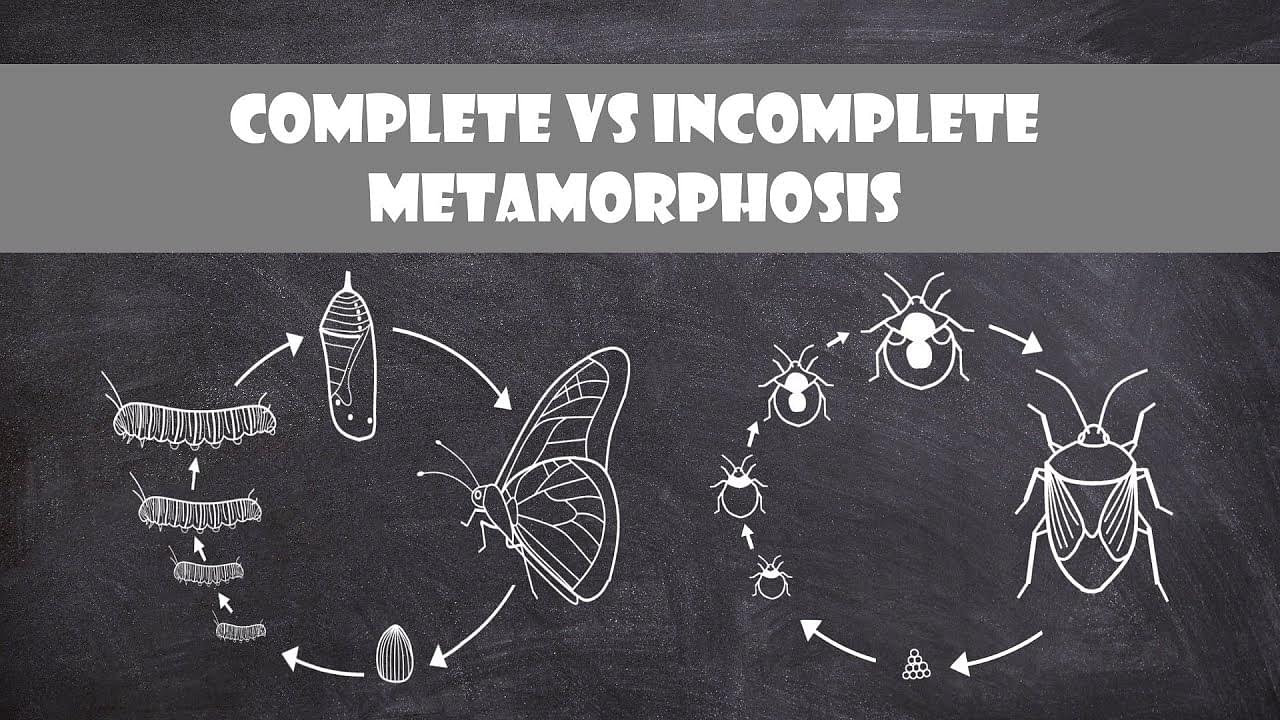
Complete and Incomplete Metamorphosis
Incomplete Metamorphosis: In incomplete metamorphosis, instead of distinct stages, insects show gradual changes eventually turning an immature egg into a mature adult. This is characterised by the presence of a nymph stage, which resembles an adult.
Read more: Phylum Protochordata
Hormonal Control of Metamorphosis
[Click Here for Sample Questions]
The process of metamorphosis is regulated by hormones in insects. These hormones are secreted mainly in the Brain, Prothoracic Gland and Corpora Allata.

Hormones Responsible for Metamorphosis
Hormones Responsible for Metamorphosis
- The neurosecretory cells in the brain secrete a hormone called Prothoracicotropic Hormone (PTTH). This activates prothoracic glands which produce Moulting Hormone (MH).
- The prothoracic glands produce ecdysone. This is responsible for the process of moulting (i.e. shedding of old cuticles of insects and formation of new ones).
- The corpora allata secretes Juvenile Hormone (JH) which is responsible for preventing larvae from turning into pupa and adults. Once its secretion stops, the larvae are transformed into pupa and later on adults.
Also Read:
Larva
[Click Here for Sample Questions]
Larva is an active stage in the life cycle of insects in which much of the feeding takes place. The nutritional reserve builds up during this stage. It is used to provide nourishment to the growing insect. Larvae in different orders of insects have different structures and functions. Depending upon the development of their appendages, larva is of following types:
- Protopod Larvae: In Protopod larva, the abdomen is not segmented. The thoracic appendages and head are primitive and such larvae hatch out from eggs that contain little amount of yolk. For example, endoparasitic larva of order hymenoptera.
- Polypod Larvae: In this, the larva body is segmented and cylindrical. They have 3 pairs of thoracic legs and 2-5 pairs of abdominal prolegs. For example, larvae of order Lepidoptera and Mecoptera.

Types of Larva
- Oligopod Larvae: They have three pairs of thoracic legs but prolegs are absent. Their body is segmented and in some caudal processes are also seen. Their mouthparts resemble those of adults. The Oligopod larvae are of further two types, Campodeiform and Scarabaeiform.
- Apodous Larvae: In this, thoracic legs, as well as abdominal prolegs, are absent. They are also divided into three types depending upon the development of the head- Eucephalic larva, Hemicephalic larva and Acephalic larva.
Read More: Catabolism and Anabolism
Pupa
[Click Here for Sample Questions]
Pupa is a sedentary stage in the life cycle of insects in which no feeding takes place. They are generally enclosed in structures called cocoons which serve to protect them from predators. During the pupal stage, adult structures start forming to give rise to a mature adult insect. Pupa is generally of three main types:
- Exarate Pupa: This is the most common type seen in holometabolous insects. The pupa has free legs and appendages. The abdomen shows movement and the pupa is also called free pupa.

Types of Pupa
- Obtect Pupa: The characteristic feature of this type of pupa is the presence of wings. The appendages are fixed to the body and do not move. This is found in butterflies and moths.
- Coarctate Pupa: In this type, the pupa is enclosed within the puparium. This puparium is externally segmented with outward-projections called spiracles. This is found in dipterans.
Difference Between Larva and Pupa
[Click Here for Sample Questions]
Larva and Pupa are the stages found in the life cycle of insects showing complete metamorphosis. Larva hatches from the egg and grows into pupae followed by an adult stage. The larval and pupal stages are different from each other in terms of their function and morphology. The main differences between them are mentioned below:
| Larva | Pupa |
|---|---|
| This is the second stage in the life cycle of insects. | This is the third stage of development. |
| Larva is motile and active. | Pupa is sessile and sedentary. |
| Larva serves to feed and maintain nutritional reserves for later use. | During Pupal stage, many adult structures start forming like wings and reproductive organs to give rise to a sexually mature adult. |
| They are not enclosed. | They are usually enclosed in structures called Cocoons. |
Things to Remember
- Metamorphosis is seen in insects as a process of transformation of an immature larva into a sexually mature adult.
- Complete metamorphosis is characterised by the occurrence of distinct developmental stages called egg, larva, pupa and adult.
- Incomplete metamorphosis occurs when insects undergo gradual changes to form mature adults.
- Larva is active and actively feeding whereas pupa is in a sedentary and non-feeding stage.
- The process of metamorphosis is regulated by hormones of the brain, prothoracic gland and corpora allata.
Read Also: Gemmule Formation
Sample Questions
Ques. What is Metamorphosis? What are its types? (3 marks)
Ans. Metamorphosis is the process of transformation of an immature larva into a mature adult capable of reproduction. Metamorphosis is characterised by the occurrence of different stages which are morphologically dissimilar and perform different functions according to their needs.
Metamorphosis is mainly divided into two types:
- Complete Metamorphosis - In this type, all the stages occurring during the development of an insect are greatly distinct from each other both in appearance and function.
- Incomplete Metamorphosis - In this, insects undergo gradual and slow changes which eventually forms a mature adult. No distinct stages can be seen. The young ones resemble adults in basic appearance.
Ques. What is Moulting? (3 marks)
Ans. Moulting is the process by which insects shed off their old cuticle and replace them with new one. It is also called Ecdysis. Insects undergo moulting for growth purpose or change in shape. It occurs in invertebrates like arthropods.
Moulting is controlled by the hormone Ecdysone secreted by the prothoracic glands. Ecdysone is also called Moulting Hormone since it is responsible for the process of moulting in insects. The brain consists of neurosecretory cells which secretes a hormone called Prothoracicotropic hormone (PTTH). This in turn activates prothoracic glands which produce moulting hormone.
Ques. What are the stages in the life cycle of a butterfly? (3 marks)
Ans. The life cycle of a butterfly is an example of complete metamorphosis. There are 4 stages in the life cycle of a butterfly: Egg, Larva, Pupa and Adult.
- Egg - A fully mature female butterfly lays eggs on the plant. They lay a large number of eggs at a time to compensate for the loss and ensure their survival.
- Larva - The larva hatches from the egg and is the second stage in the life cycle of a butterfly. The larva of butterflies is called a caterpillar. It is the feeding stage in which caterpillars eat and store this food for later needs.
- Pupa - After caterpillar, the next stage is pupa. It is a non-feeding, sedentary stage characterised by internal changes leading to the development of adult organs. The pupa of butterflies is called Chrysalis.
- Adult - The adult stage is the fully grown, sexually mature stage characterised by fully developed organs like wings, antennae, compound eyes and long legs. Their role is to reproduce and lay eggs.
Ques. What is Diapause? (3 marks)
Ans. Diapause is the stage in animals during which the physiological processes are suspended and the organism remains dormant for a period of time. It is mainly observed in insects. It occurs naturally in response to environmental changes.
The process of diapause has 6 stages namely:
- Induction
- Preparation
- Initiation
- Maintenance
- Termination
- Post-diapause quiescence
Ques. What are the different types of development seen in insects? (5 marks)
Ans. Depending upon the type of metamorphosis, there are 4 types of development seen in insects:
- Ametabolous Development - This involves little or no metamorphosis. The young ones are the same in appearance as adults. They only grow in size and develop reproductive structures.
- Paurometabolous Development - This is seen in cockroaches and grasshoppers. The young ones are called nymphs which undergo gradual changes to become adults.
- Hemimetabolous Development - This is similar to paurometabolous development and characterised by successive moults resulting in a mature adult form.
- Holometabolous Development - It occurs in insects like butterflies, moths etc. and involves completely different stages i.e. egg, larva, pupa and adult.
Ques. What is Heteromorphosis? (3 marks)
Ans. Heteromorphosis is a type of development in which successive larval instars differ from each other in morphology and habits. It is observed in order coleoptera and strepsiptera. It is of two types:
- In some, eggs are laid in the open and the larva searches for its host. The larva in this case is an active one.
- In another type, the eggs are laid either in the host or on it. It is observed in diptera and Hymenoptera.
Ques. What are the characteristics of the pupa stage? (3 marks)
Ans. The process of formation of pupa from larva is called Pupation. The main characteristics of this stage are as follows:
- It is generally a sessile stage but it may be active also as in case of mosquitoes.
- It is the non-feeding stage. The pupa do not feed, instead, it uses the nutritional reserve built up by the larva.
- Pupa is usually enclosed in structures called cocoons or shells which acts as a protective covering for it.
- This stage may last for weeks, months or even years.
- During this stage, development of reproductive organs and other adult organs start taking place.
Ques. Define asexual reproduction. Describe two methods of asexual reproduction in animals. (5 marks)
Ans. The mode of reproduction in which only a single parent is involved is called asexual reproduction. In this type of reproduction, sex cells (gametes) are not produced and no fusion of gametes takes place for the reproduction of zygote or offspring. Asexual reproduction takes place in Amoeba, Hydra, yeast, starfish, sponges, etc. There are mainly two methods of asexual reproduction:
- Binary fission: In binary fission, a single parent cell is divided into two equal individual cells as in Amoeba. It divides into two by division of their bodies, each of them gets one nucleus and develops into separate individuals. The figure given below shows how binary fission occurs in Amoeba.

- Budding: In budding, the organism develops a bulge called bud which further develops into an adult organism and separates itself from the parent body to lead an independent life. This type of reproduction is shown in Hydra. The following figure shows budding in Hydra.

Ques. Differentiate between internal fertilisation and external fertilisation. (3 marks)
Ans.
| Internal Fertilisation | External Fertilisation |
|---|---|
| The fusion of male gamete or sperm and female gamete or ova occurs inside the body of a female partner, such as human beings, birds, and mammal. | The fusion of male gamete and female gamete takes place outside the body of a female partner, such as in frogs, fish and starfish. |
| The female partner lays either fertilised eggs or a fully grown young one. | The female partner discharges unfertilised eggs. |
| Offsprings have a high chance of survival. | Offsprings have a low chance of survival. |
For Latest Updates on Upcoming Board Exams, Click Here: https://t.me/class_10_12_board_updates
Check-Out:



Comments