



Content Curator
Minerals are naturally found inorganic substances available in various conditions. There are almost 4000 types of minerals that are found in extreme geological environments. Every mineral has its own speciality and values. Minerals generally possess crystalline structures and definite chemical compositions. A mineral can easily be identified in accordance to its physical properties like density, colour, hardness and chemical properties such as solubility.
| Table of Content |
Key Takeaways: Minerals, Solubility, Inorganic Compounds, Energy Minerals, Metallic Minerals, Non-Metallic Minerals
What are Minerals?
[Click Here for Sample Questions]
Minerals are naturally occurring substances that are extracted and are known as such because of their inorganic chemical characteristics. These inorganic chemical compounds can be easily found in three different states of matter in nature. Those are - solids, liquids, and gaseous. Minerals are not properly distributed over nature. They are mostly found concentrated in a particular area or they get accumulated at one particular region to turn into solid rock structures. Some minerals are available in areas which are not easily attained such as the Antarctic and Arctic Ocean bed.

Mineral Ores
Read Also:
Types of Minerals
[Click Here for Sample Questions]
Minerals are classified into three different types. They are-
- Energy minerals
- Metallic minerals
- Non-metallic minerals
Energy Minerals
The energy minerals are a type of fossil fuels. Energy minerals are the ones that provide energy. Few examples of energy minerals are petroleum, natural gas, coal, etc. Earth is surrounded with various mineral hotspots located in various geographical demographics. For example, countries in Saudi Arabia are very well known for the oil extraction out of their soil. The various minerals that are beneath the earth's surface are divided into different categories. These minerals are categorised except for the oil to metals and non-metals minerals.

Classification of Minerals
Read More:
Metallic Minerals
Minerals containing metals inside them are known as metallic minerals. The extraction process of these minerals can give out metals. It involves extensive processes, and these metallic minerals are in higher demand in their applications. Some examples of metallic minerals are bauxite, Iron ore, etc. The metallic minerals are again differentiated into two subtypes. They are-
- Ferrous Minerals: If the metallic minerals contain any ironic substance within them, they are called ferrous minerals.
- Non-Ferrous Minerals: If the metallic mineral does not contain any ironic substance, but rather might contain gold, silver or some kind of metals, then they are known to be non-ferrous minerals.
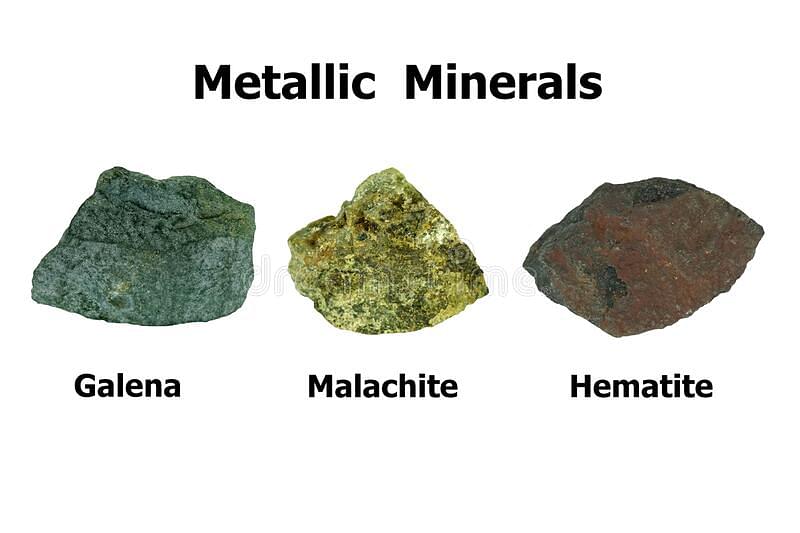
Metallic Minerals
Non-metallic Minerals: The mineral which does not contain any metals in it are known as non-metallic minerals. Examples of non-metallic minerals are Diamond, Salt, mica, etc. Mineral fuels like coal and petroleum are also examples of non-metallic minerals.
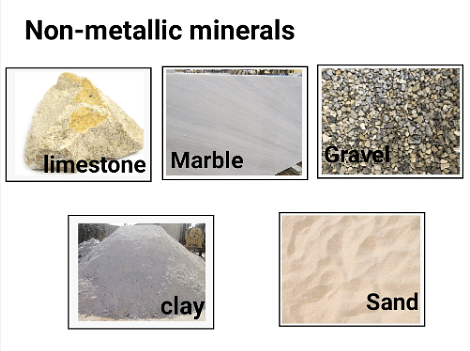
Non metallic Minerals
Read Also:
Difference Between Metallic and Non-metallic Minerals
[Click Here for Sample Questions]
The main differences between metallic and non-metallic minerals are as follows:
| Metallic Minerals | Non-Metallic Minerals |
|---|---|
| Metallic minerals have metals in them. | Non-metallic minerals do not contain any metals. |
| Metallic minerals are very lustrous in their appearances. | Non- metallic minerals are non lustrous in their appearances. |
| Metallic minerals are only present in solid state. | Non- metallic minerals are present in all the three states i.e. liquid, solid as well as gaseous state. |
| Metallic minerals are a good form of conductors of electricity and heat. | Non metallic minerals are a good form of insulators of electricity and heat. |
| In its melting state, metallic minerals can produce new substances. | However in case of non metallic minerals no new substance is formed in its melting state. |
| Metallic minerals have high malleability and ductility properties. | Non metallic minerals do not have any malleability or ductile properties, also they are easily breakable. |
| Metallic minerals are mostly found in metamorphic and igneous rock formation. | Non metallic minerals are found in sedimentary rocks or within the mountain folds. |
| Examples of metallic minerals are aluminium ore, iron, silver gold etc | Examples of non metallic minerals are salt, potash, diamond etc. |
Read More:
Things to Remember
[Click Here for Sample Questions]
- Minerals are naturally found inorganic substances available in extreme geographical conditions.
- Minerals generally possess crystalline structures and definite chemical compositions.
- Minerals can be classified into three types- energy minerals, metallic minerals and non-metallic minerals.
- Metallic minerals are the ones that have metals in it. It can again be divided into its two subtypes i.e. ferrous minerals and non-ferrous minerals.
- A non-metallic mineral does not have metals in it.
Read More:
Sample Questions
Ques. What are minerals? (2 marks)
Ans. Minerals are naturally occurring substances that are extracted and are known as such because of their inorganic chemical characteristics. These inorganic chemical compounds can be easily found in three different states of matter in nature. Those are - solids, liquids, and gaseous.
Ques. Which one of the following is NOT a characteristic of minerals? (1 mark) [NCERT]
(a) They are created by natural processes.
(b) They have a definite chemical composition.
(c) They are inexhaustible.
(d) Their distribution is uneven
Ans. c) They are inexhaustible.
Ques. What do you understand about metallic minerals? (2 marks)
Ans. Metallic minerals are the type of minerals that have metals in it. They are malleable, ductile and lustrous in nature. Some of the commonly known metallic minerals are bauxite, iron ore, aluminium ores etc.
Ques. What are the two types of metallic minerals? (1 mark)
Ans. The two types of metallic minerals are ferrous minerals and non-ferrous minerals.
Ques. State four characteristics of minerals. (3 marks)
Ans. The four characteristics of minerals are-
- Minerals are naturally occurring inorganic substances easily available in nature.
- It can be found in all three states i.e. solid, liquid and gaseous state.
- Minerals generally are available in crystalline state and have definite chemical properties
- They get concentrated unevenly throughout nature and due to its rapid accumulation to a particular zone it becomes rock solid.
Ques. Explain briefly the different uses of mineral oil. (5 marks)
Ans. The different uses of mineral oil are-
- Petroleum is a type of mineral oil which also happens to be the next major energy source in India after coal.
- Mineral oil provides fuel for lighting and heat, lubricants for machinery purposes and raw materials for various manufacturing industries.
- Petroleum refineries act as one of the most important industry for the production of synthetic textile, numerous chemical industries and fertilizers
Ques. What is the purpose of saving minerals? (2 marks)
Ans. Minerals are very essential components of our day to day lifestyle. Even though it is available in nature very easily beneath the earth surface in solid, liquid and gaseous state, there is a high possibility that people might start exploiting, leading the minerals to start exhausting. Hence to sustain the minerals and its by-products, one should use it judiciously and save it for the coming future generations as well.
Ques. State three basic properties of metallic minerals. (3 marks)
Ans. Three basic properties of metallic minerals are-
- Metallic minerals have metals in them.
- Metallic minerals are very lustrous in their appearances.
- Metallic minerals are mostly found in metamorphic and igneous rock formation.
Read Also:



Comments