



Education Journalist | Study Abroad Lead
Melting and Boiling Point highliglights the presence of covalent bonds present in any substance and the changes that take place with temperature difference. When we heat them, the covalent bonds break and the kinetic energy increases. This results in a change in state. Depending on the temperature at which the state changes we use different terminologies explained in further sections.
| Table of Content |
Keyterms: Melting Point, Boiling point, Covalent bond, Temperature, Kinetic energy, Atoms, Molecules
Melting and Boiling Point: Important Definitions
[Click Here for Sample Questions]
Melting and boiling points of a substance helps us understand the strength of covalent bonds between its molecules. It also gives us an idea about purity of a substance. Let us understand this in detail.
Below given is a presentation of melting and boiling points along with some MCQs:
Melting Point
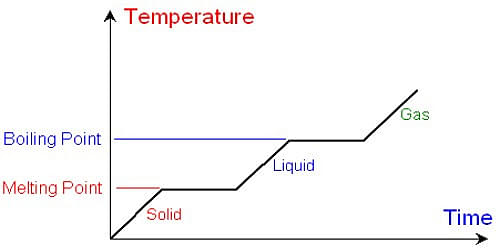
The temperature at which any substance changes its state from solid to liquid at atmospheric pressure is known as the melting point of the substance or the point of fusion.

Melting Point
Boiling Point
The temperature at which any substance changes its state from liquid to gas, i.e., it starts evaporating, it is known as the boiling point of the substance.
This also means that the liquid’s vapour pressure becomes equal to the atmospheric pressure of its environment.

Boiling Point
Freezing Point
The temperature at which any substance converts from liquid to solid state is known as the Freezing Point of the substance.
Ideally, the melting point of a solid should be the same as the freezing point of the liquid of that substance but in practice there is a slight difference.
Freezing Point
Read More:
| Related Concepts | ||
|---|---|---|
| Cis Trans Isomerism | Azeotropic Distillation | Atomic Mass of Elements |
| Mass Percent Formula | Hinsberg’s Reagent | Mole Fraction |
Latent Heat
[Click Here for Sample Questions]
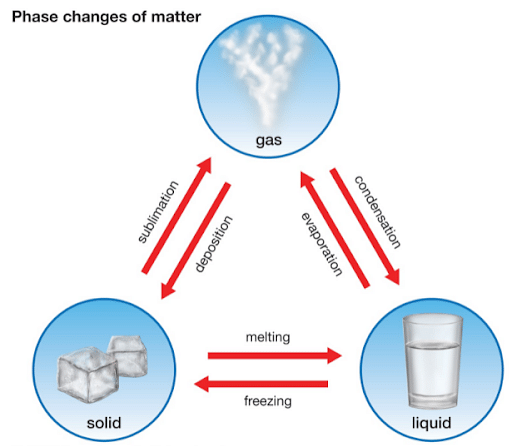
Latent heat is described as the heat required to convert the state of matter for any substance.

Latent Heat
Depending on the conversion, latent heat are of three types:
Latent Heat of Fusion
The amount of heat required while conversion of solid to liquid at a constant temperature is known as latent heat of fusion.
Latent Heat of Vaporisation
The amount of heat required while conversion of liquid to vapour at a constant temperature is known as latent heat of vapourization.
Latent Heat of Sublimation
The amount of heat required while conversion of solid to vapour at a constant temperature is known as latent heat of sublimation.
Factors affecting Melting and Boiling Points
[Click Here for Sample Questions]
Factors affecting Melting and Boiling Points
- Boiling point of a substance is dependent on its surroundings pressure. Boiling point will be higher at high pressure as compared to the boiling point at atmospheric pressure.
- Till the boiling point, melting point or freezing point is achieved there is constant change in the kinetic energies, but at these points only the transformation of state takes place and kinetic energy remains constant.
- Boiling point of water is 100oC. Melting point and freezing point of water is 0oC.
- A liquid's standard boiling point is defined as the temperature at which it boils at 1 bar of pressure.
- As freezing point is the temperature at which a substance changes from liquid to solid, it can be considered as the opposite of melting point. However, there are some liquids which are cooled below freezing point and these are known as supercooled liquids.
Things To Remember
- The temperature at which any substance changes its state from solid to liquid at atmospheric pressure is known as the melting point of the substance.
- The temperature at which any substance changes its state from liquid to gas, i.e., it starts evaporating, it is known as the boiling point of the substance.
- The temperature at which any substance converts from liquid to solid state is known as the Freezing Point of the substance.
- Heat required for conversion of substances from one state to another is known as Latent Heat. It is of 3 types: Latent heat of fusion, latent heat vapourisation, and latent heat of sublimation.
Read More:
Sample Questions
Ques. Why does food cook slower in mountains? (1 mark)
Ans. Mountains have low atmospheric pressure due to high altitude. This causes water to boil below 100oC and hence the food cooks at comparatively slower pace.
Ques. What is the physical state of water at: (a) 250°C (b) 100°C (NCERT Class 9) (1 mark)
Ans. (a) 250°C = gas (b) 100°C liquid as well as gas
Ques. For any substance, why does the temperature remain constant during the change of state? (NCERT Class 9) (1 marks)
Ans. Any substance receives heat when it undergoes a change of condition. Heat is used by the molecules of this matter to overcome the force of attraction between the particles, and temperature remains constant during this time. This additional heat is gained by the molecules in the form of latent heat, which allows them to transition from one state of matter to another.
Ques. Why is boiling point important? (1 mark)
Ans. The boiling point of organic compounds will reveal important physical and structural characteristics. The boiling point of a substance aids in its identification and characterization. A liquid with a greater boiling point has a higher boiling point than one with a lower boiling point.
Ques. What is a mixed melting point? (1 mark)
Ans. The fusion temperature of a mixture of two components that is usually lower than that of either component in the case of two different substances, or that is not lower than that of either sample in the case of a mixture of two samples of the same substance prepared by different methods as a check on their identity is known as mixed melting point.
Ques. What are the factors that affect the boiling point of water? (1 mark)
Ans. The greatest determinant of a liquid's boiling point is the surrounding pressures. The atmosphere on Earth is most definitely the air pressure in an open system. At 100 degrees Celsius, for example, water achieves the ordinary atmospheric pressure. As elevation rises, water can boil at a lower temperature.
For Latest Updates on Upcoming Board Exams, Click Here: https://t.me/class_10_12_board_updates
Check-Out:



Comments