



Content Curator
DNA polymerase is a type of enzyme that is helpful to make copies of the DNA in the form of Nucleic acid molecules. It is a group of enzymes required for the synthesis of DNA. It catalyses the synthesis of DNA during replication. Moreover, its main function is to duplicate the DNA and divide in cell division. There are various functionalities of the DNA polymerase, some of them are – Replication, Repair, and proofreading. DNA polymerases play an important role in the synthesis of the DNA and divide it into the cells while the cell suffers the division by the process of replication. It adds DNA to all the new cells produced after the process of cell division.
| Table of Content |
Key Takeaways: DNA Polymerases, Replication, Repair, Proofreading, Prokaryotic DNA, Eukaryotic DNA, DNA, Cell division, Nucleic acid, Polymer
Read Also: DNA Replication
DNA Polymerases Functions
[Click Here for Sample Questions]
The DNA is the polymer of deoxyribonucleotides and its length is dependent on the total number of nucleotides present in it. DNA is the characteristic of the living organism. There are three functions of the DNA polymerases that divide the DNA in cell division. All functions of the DNA polymerases in described form are mentioned.
Replication of DNA Polymerases
Replication is the main function of DNA polymerases. It synthesized the DNA. Replication is an important function because it maintains and transfers genetic information from one generation to another generation.
It works in pairs to replicate two strands of DNA in a Tandem. They append DNA at the 3’-OH group of growing DNA strands. The DNA grows in the direction by their polymerization activity based on 5’ -> 3’. The pairing takes place between Adenine, thymine, and guanine. The order of pairing is that the Adenine pairs with thymine and further, guanine pairs with cytosine.
The main enzyme responsible for the replication in prokaryotes is DNA polymerases While DNA polymerases is the main enzyme for replication in eukaryotes.
REPAIR
The repair process is very important for maintaining integrity in the genomes because the repair is a homogeneous function. Subsequently, it is considered a continuous process because it continuously looks if any error occurs in the genome because of the DNA breakdown.

It is very important to look for any error that occurs, for doing so, there are several mechanisms by which the DNA is repaired.
PROOFREADING
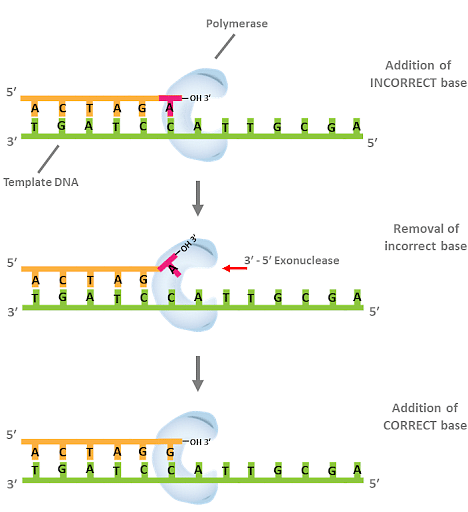
The process of DNA replication is not perfect because errors may occur often. The error may occur after every 104 to 105 nucleotides added. To remove the error nucleotides or the incorrect nucleotides sequence is very important for the correct protein functioning. Proper functioning is very important because if not corrected, it may lead to cancer.
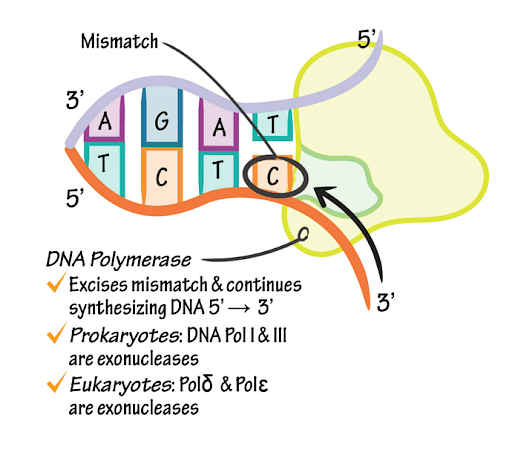
The process of removing the incorrect pairs by the DNA polymerases is known as the exonuclease activity. It works in the respect of removing by the activity which states that it steps one step back and removes the mismatched pair by 3’ -> 5’ exonuclease activity, which is known as the proofreading.
Moreover, the DNA polymerases are also involved in the post replication of the DNA process of repair. In synthesizing the process is done by the DNA polymerases.
Also Read:
| Related Articles | ||
|---|---|---|
| Structure of DNA | Structure of RNA | Transcription |
Ribonucleic Acid (RNA)
[Click Here for Sample Questions]
RNA stands for Ribonucleic acid and it is considered the first genetic material. Currently, there is much evidence available that essential life processes such as metabolism, translation, and so on, orbit the RNA.
The functioning of the RNA is that it is used as genetic material and catalyst, However, it is unstable because it is a catalyst.
The DNA suffers from the chemical modifications to evolve from RNA which make it more stable. The DNA has two complementary strands that further resists change by evolving a process of repair.
DNA Polymerases Structure and Types
[Click Here for Sample Questions]
Most of the structures of the DNA polymerase have a resembling hand that holds an active site, that site of an enzyme, has two parts – Insertion site and post-insertion site.
Basically, at the insertion site, the nucleotides are appended, and therefore, after adding, the newly formed base-pair migrates to the site of the post-insertion.
Read Also: Translation
Prokaryotic DNA Polymerases Types and its Functions
[Click Here for Sample Questions]
Concerning the Prokaryotes, there are five DNA polymerases identified in E.Coli. Further, all the DNA prokaryotes suffer in structures and other functionalities.
The five types of prokaryotic DNA polymerase are mentioned with detailed descriptions.
1. DNA Polymerases I
It is the first type of prokaryotic DNA polymerase that is coded by the polA gene. Its main roles are recombination and repair. It is a Single polypeptide.
Moreover, it has 5’ -> 3’ and 3’ -> 5’ both exonuclease activity. It removes the RNA primer with the help of 5’ -> 3’ from the lagging strand and it also fills the gap.
2. DNA Polymerases II
DNA polymerase II is the second type of prokaryotic polymerase that is coded by the polB gene. The main role of the DNA polymerase II is to keep backup of the DNA polymerase III and repair.
The only exonuclease activity the DNA polymerase II has is 3’ -> 5’.
3. DNA Polymerases III
DNA polymerase III is the third type of prokaryotic polymerase that is coded by the polC gene. It is the main enzyme that is involved in the replication of E.Coli. The rates of Processivity and polymerization are maximum in this type and it also has the exonuclease activity of 3’ -> 5’.
DNA polymerase III of an E.coli is made of 13 total subunits that comprise 9 different types of subunits. It is consists of two core domains that are mainly made up of ????, ????, and ???? subunits.
4. DNA Polymerases IV
DNA polymerase IV is the fourth type of prokaryotic polymerase that is coded by the polD gene. Its main action is in the repair of DNA in the emergency response.
When the DNA replication is put at the fork of replication. The other DNA polymerase types of II, IV, and V are considered as the translesion polymerases.
5. DNA Polymerases V
It is also involved in the synthesis process of the DNA repair and response but in the SOS. The DNA polymerase V is made up of the UmuC monomer and UmuD dimer.
Eukaryotic DNA Polymerases Types and its Functions
[Click Here for Sample Questions]
Eukaryotic cells also have many DNA polymerase like the prokaryotic cells but perform different functions such as mitochondrial DNA replication, nuclear DNA replication, and so on.The nuclear DNA is mainly initiated by the DNA polymerase types of \(\delta\) and α. Certainly, there are at least 15 DNA polymerases identified in human beings.
1. DNA Polymerases \(\delta\)
This is considered as the main enzyme for the replication in eukaryotes with proofreading of 3’ -> 5’ exonuclease activity.
2. DNA Polymerases α
The main role of this type is to synthesize the primers. The smaller subunits consist of primase activity while the largest subunit has the polymerization unit.
3. DNA Polymerases \(\epsilon\)
The main function is to Repair the DNA and to remove the primers from Okazaki fragments from the lagging strand.
4. DNA Polymerases γ
The main replication enzyme particularly for the Mitochondrial DNA.
Working of DNA Polymerases
[Click Here for Sample Questions]
The reaction that shows the working polymerase is the phosphoryl group transfer. The 3’ – OH group of strands that grows acts as the nucleophile and protects from the deoxyribonucleoside triphosphate by attacking and at the a-phosphate that leads to the formation of the phosphodiester bond.
The reaction is provided below –
(dNMP)n + dNTP → (dNMP)n+1 + PPi
Most of the polymerases require the two Mg ions at the active site and it is mandatory to take note that DNA polymerase can only append nucleotides at the 3’ end of the growing strand, because of this the replication always occurs in the 3’ -> 5’ direction.
The replication is considered to be a highly accurate process and the probability of formation of mutation is high because it can be formed if the change occurs even in a single nucleotide.
Therefore, for removing this, two mechanisms ensure there is no dependency. Those two processes are mentioned below-
- The active site’s geometry only allows the correct nucleotide base pairs to get fit. However, it is not sufficient and it is seen that it can add the error nucleotide after correctly adding 104 to 105 nucleotides.
- DNA polymerase of 3’ -> 5’ exonuclease activity is used to correct this type of error. It checks the added nucleotides and removes if there is any unorder, which is known as proofreading.
Also Read:
Things to Remember
- There are three functions of the DNA polymerases that divide the DNA in the cell division. The three types of functions in the DNA polymerase are Replication, Repair, and Proofreading.
- Replication is an important function because it maintains and transfers genetic information from one generation to another generation.
- The repair process is very important for maintaining integrity in the genomes because the repair is the homogeneous function.
- There are five types of prokaryotic DNA polymerase namely - DNA polymerase I, DNA polymerase II, DNA polymerase III, DNA polymerase IV, and DNA polymerase V.
- There are at least 15 DNA polymerases identified in human beings.
- The reaction that shows the working polymerase is the phosphoryl group transfer.
Sample Questions
Ques: What disease can be generated if the proteins didn’t react properly? (1 mark)
Ans: If the DNA polymerase didn’t properly initiate, the proteins would not react properly and can lead to Cancer.
Ques: What is the main role of DNA polymerase, also mention three functions of DNA polymerase? (1 mark)
Ans: The main role of DNA replication is to synthesize the DNA by the replication process. The three functions of the DNA polymerase are replication, Repair, and proofreading.
Ques: Name the markers used for Fingerprinting? (4 marks)
Ans: The small DNA sequences that are considered unique for an individual are known as DNA markers. Some markers that are used in DNA fingerprinting are mentioned below-
- Restrictions Fragment Length Polymorphism (RFLPS)- Restriction fragment length polymorphism is an approach for identifying DNA sequencing that is based on non-PCR. In this process, the DNA is digested at specific sites that also contain restriction enzymes.
- Random Amplified Polymorphic DNA (RAPD)- This is a PCR-based approach that is used in identifying DNA sequences. Many short primers are formed in this process. Random DNA segments are amplified using PCR by this.
- Amplified fragment length polymorphism In the Amplified length polymorphism process, DNA is digested with the restriction endonuclease enzyme. Selective amplification of fragments is done through a mixture of DNA fragments.
- Southern bloating- Insouthern bloating, the fragment of DNA is transferred to a nylon sheath. These DNA fragments are mixed with radioactive isotopes. The formed band of patterns is afterward visualized under UV or X-ray.
Ques: How many total types of DNA polymerase are there? (1 mark)
Ans: Subsequently, there are two types. One is prokaryotic that is further divided into five types and the other is eukaryotes that are of different types.
Ques: Mention a difference between DNA polymerase and RNA polymerase. (1 mark)
Ans: The difference is that the DNA polymerase synthesizes the DNA in the process of Replication while RNA polymerase synthesizes the DNA in the process of transcription.
Ques: What is cell division? (1 mark)
Ans. The process of division of the cells into further two cells with the same genetic material as of the divided cell is known as the cell division.
Ques: What are the nucleotides? (1 mark)
Ans: The nucleotides are the basic building blocks of the nucleic acids containing sugar molecules attached to the phosphate group.
Ques: Describe the Hershey and Chase experiment. Explain what it will prove and if both DNA and protein contain phosphorus and sulfur, will the result be the same? (5 marks)
Ans: The experiments on bacteriophage that are conducted by Hershey and Chase to prove that DNA is the genetic material are mentioned below-
- Bacteriophage viruses were grown on a medium containing radioactive phosphorus P32 and some other medium containing radioactive Sulfur S35.
- Viruses that are grown in the presence of radioactive phosphorus usually contain radioactive DNA.
- Likewise, viruses that contain radioactive protein were grown in the presence of radioactive sulfur.
- To effect E. coil, both the radioactive viruses are allowed.
- To remove viral coats from the bacteria, the infected bacterial cells were agitated in a blender.
In the bacterial cell, only radioactive phosphorus was found. While radioactive sulfur was found only in the surrounding medium, not in the bacterial cells.
This shows that only DNA can enter the bacterial cell and not the protein cell. DNA is the genetic material. The result may change if both DNA and protein contain phosphorus and sulfur.
Ques: Make an account of post-transcriptional modifications of a eukaryotic RNA. (4 marks)
Ans: The primary transcripts are non-functional and contain both coding regions that are exon and non-coding regions, such as intron in RNA that is generally known as heterogeneous RNA or mRNA. In eukaryotes, there are three types of RNA polymerases that are found in the nucleus.
- RNA polymerase I take down rRNAs.
- RNA polymerase II take-down the precursor mRNA, which is known as heterogeneous nuclear RNA or mRNA.
- RNA polymerase III take-down t RNA, 5 rRNA, and snRNAs.
The two additional processes, namely capping and tailing, are undertaken by mRNA. At the 5’-end of RNA/mRNA, there is an addition of an unusual nucleotide, methylguanosine triphosphate and this is done in capping.
In tailing, there is an addition of the adenylate residues at the 3’-end in a template-independent manner. After this mRNA undertakes a process in which the introns are removed and the exons are joined to form mRNA through a process named splicing.
For Latest Updates on Upcoming Board Exams, Click Here: https://t.me/class_10_12_board_updates
Check-Out:



Comments