



Exams Prep Master
J.J.Thomson discovered the electron in the year 1897. An electron is a negatively charged subatomic particle. It can either be free (not bound to any atom) or bound to the nucleus of an atom. Electrons can be found in the atoms that surround the nucleus. The negative charge of electrons is -1. An electron has a mass of around 1/1836 that of a proton. As a result, 1/1836 has a relative mass of 0.0005. And 0.0005 is close to zero. The number of protons in an atom is the same as the number of electrons. Atom charge-neutral = electron (-1) = proton (+1). There are no known components or substructures for electrons. As a result, they are commonly referred to as elementary particles. The anti-particle of electrons is known as a positron. Here, we will have a closer look at the topic and discuss some important questions related to it.
Key takeaways: Nucleus, atoms, mass, proton, neutron, subatomic particle
What is Electron?
[Click Here for Sample Questions]
The electron is the smallest and most stable subatomic particle in the universe. It has a negative charge of 1.602176634 coulomb, which is the fundamental unit of electric charge. The electron has a rest mass of 9.1093837015 1031 kg, which is only 1/1,836 that of a proton. In comparison to a proton or a neutron, an electron is essentially massless, and its mass is not taken into account when computing an atom's mass number.
Electrons revolve about the nucleus in an orderly arrangement of orbitals within any given atom, with the attraction between electrons and the nucleus overcoming repulsion among the electrons that would otherwise force them to fly apart. These orbitals are structured in concentric shells with an increasing number of subshells that radiate outward from the nucleus. The nucleus holds the electrons in the orbitals nearest to it the tightest; those in the outermost orbitals are shielded by intervening electrons and are held the loosest. Within this structure, electrons flow around, generating a diffuse cloud of negative charge that covers virtually the whole volume of the atom.
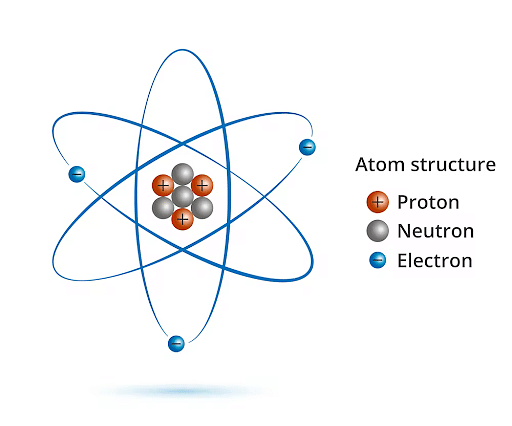
The electronic configuration of an atom is the exact structural arrangement of electrons within the atom. The electrical arrangement of a particular atom dictates not just its size but also its chemical character. The similarity in electron structures is used to classify elements within groups of similar elements in the periodic table. There are two ways to classify electrons in the discipline of particle physics. The electron is a fermion, a particle that gets its name from the Fermi-Dirac statistics that explain its behavior. All fermions are defined by half-integer spin values, where spin corresponds to the particle's inherent angular momentum. The wave equation for the electron, given by P.A.M. Dirac, embodies the concept of spin. The Dirac wave equation predicts the positron, the antimatter counterpart of the electron. The electron is classed as a lepton within the fermion category of subatomic particles. A lepton is a subatomic particle that responds only to electromagnetic, weak, and gravitational forces; it is unaffected by the short-range strong force that binds protons and neutrons in the atomic nucleus and acts between quarks.
Also Read:
| Related Articles | ||
|---|---|---|
| LASER LIGHT | Avogadro's Number | Laser |
| Alpha Particle Mass | Magnetic Quantum Number | Alpha-particle Scattering and Rutherford’s Nuclear Model of Atom |
Mass of Electron
[Click Here for Sample Questions]
A stable elementary particle in the lepton class with a mass of 9.1x 10⁻³¹ kg and a negative electric charge of 1 elementary unit (approximately 1.602 10-19 coulombs).
m(-e)=9.1x10⁻³¹ kg
The mass of an electron is given by in atomic mass units (amu)
5.489x10⁻⁴ amu
Mass of electrons in different units:
| Mass of electron | Values | Unit |
|---|---|---|
| mass of electrons in kg | 9.10938356(11) × 10−31 | kg |
| mass of electron in grams | 9.10938356(11) × 10−28 | grams |
| mass of electron in amu | 5.48579909070(16)×10−4 | amu |
| mass of electron in ev | 0.5109989461(31) | MeV/c2 |
Rest Mass of Electron
The mass of an electron at rest, indicated by the symbol me, is its mass when its speed in relation to an observer is zero. With a mass of around 9.10956 x 10 -31 kilograms (kg) or 9.10956 x 10 -28 grams, the electron is almost 2000 times less heavy than the proton (g). Every known resting electron has the same mass as every other known resting electron.
Due to relativistic effects, when an electron is accelerated to a high speed, its mass increases. This increase is not significant until the particle's speed becomes a considerable percentage of the speed of light in relation to the observer.
m e* = m e / (1 - v 2 /c 2 ) 1/2
= 9.10956 x 10 -31 / (1 - v 2 /c 2 ) 1/2 kg
In real-world circumstances, the relativistic mass increase of high-speed electrons is crucial because it amplifies the electrons' effects on the objects they strike. The term "beta particle" refers to high-speed electrons.
Charge of Electron
[Click Here for Sample Questions]
The electron charge (symbol e) is equal to 1.602176634 1019 coulomb, which is the fundamental scientific constant describing the naturally occurring unit of electric charge.

All freely existent charged subatomic particles identified thus far have an electric charge equal to this value or a whole-number multiple of it, in addition to the electron. Charges of 1/3 or 2/3 of this magnitude are found in quarks, which are constantly bonded within larger subatomic particles like protons and neutrons.
Calculation of Electron
[Click Here for Sample Questions]
Electrons are negatively charged particles with a charge of -1. As a result, an element in its neutral state will have the same number of protons and electrons as it has in its excited state. Boron (B), for example, has an atomic number of 5, which means it has 5 protons and 5 electrons. The protons and electrons will not be the same if the element contains a negative or positive ion. After the element, the ion number will appear as a little superscript.
Important Topics for JEE MainAs per JEE Main 2024 Session 1, important subtopics included in the electron are as follows:
Some memory based important questions asked in JEE Main 2024 Session 1 include:
|
Things to Remember
- The invariant mass of an electron is also known as the value of electron mass.
- An electron has a mass of around 1/1836 that of a proton. As a result, 1/1836 has a relative mass of 0.0005. And 0.0005 is about the same as zero.
- Electron (-1) =proton (+1) =atom charge neutral.
- The electron is the smallest and most stable subatomic particle in the universe. It has a negative charge of 1.602176634 coulomb, which is the fundamental unit of electric charge.
- The electronic configuration of an atom is the exact structural arrangement of electrons within the atom.
- The electron is the smallest and most stable subatomic particle in the universe.
Also Read:
Sample Questions
Ques: What are the properties of an electron? (5 marks)
Ans: The properties of an electron are as follows:
- Negatively charged particles are electrons.
- The mass of the electron is 1/2000 of the mass of the proton and neutron. As a result, the electrons do not contribute to the atom's mass.
- The electric charge of an electron is -1.602 10-19 coulombs, which is the same as the charge of a proton.
- Unlike protons and neutrons, which are located inside the nucleus, electrons are subatomic particles that exist outside the nucleus.
- According to the Bohr atom model, electrons move in orbits or shells around the nucleus all the time.
- An electron's invariant mass is roughly 9.1091031 kilograms.
- Particle and wave qualities are both present in electrons.
- The position and momentum of electrons cannot be known at the same time, according to quantum mechanics.
Ques: How do electrons revolve around the nucleus? (2 marks)
Ans: Energy levels are the set orbits or shells in which electrons rotate around the nucleus. Electrons revolve in one or more energy levels around the nucleus. These are written as 1, 2, 3, or K, L, M, N, or as an integer 'n'.
Ques: What will happen to the mass of an electron if it travels with the velocity of light? (2 marks)
Ans: The electrons have a rest mass of 9.1 x 10 - 31. However, when an electron moves at the speed of light, its velocity (v) equals the speed of light (c). The electron's mass would begin to vary, and such variations would be endless.
Ques: Why do electrons have a negative charge? (2 marks)
Ans: Protons and electrons both have a charge. Protons and electrons are considered to have equal but opposite charges because they attract each other to the point that the final system including them has a charge of virtually zero.
Ques: Why do electrons revolve around the nucleus? (2 marks)
Ans: Because the nucleus has a heavy component and a positive charge, it is immobile, whereas the electron has a light part and a negative charge with regard to the nucleus and has no more energy, thus it rotates around the nucleus.
Ques: How do electrons flow? (2 marks)
Ans: The flow of electrons is what we call electrical current. Electrons are found in every atom. New electrons will join atoms in a conductor, and each atom will spit out one electron to the next atom. The electron is taken in by the next atom, which then spits out another one on the other side.
Ques: What is an electron made up of? (2 marks)
Ans: Electrons and quarks are the two types of fundamental particles that make up an atom. Electrons occupy the region around the nucleus of an atom. The electrical charge of each electron is -1. Protons and neutrons, which make up an atom's nucleus, are made out of quarks.
Ques: What is the difference between electron and proton? (2 marks)
Ans: The main distinction between a proton and an electron is that a proton is a subatomic particle present in an atom's nucleus, whereas electrons are particles orbiting the nucleus. An atom's nucleus is made up of protons and neutrons. In orbitals, electrons circle the nucleus.
For Latest Updates on Upcoming Board Exams, Click Here: https://t.me/class_10_12_board_updates
Check-Out:



Comments