



Education Journalist | Study Abroad Lead
Quark is an elementary particle which is the fundamental constituent of matter. These quarks unite to form composite particles known as hadrons, the most stable of which are the atomic nuclei's neutrons and protons. Hadrons are composite particles that are made up of many quarks. Hadrons are particles made up of protons and neutrons. It is the fundamental particle that makes up all of the matter in our environment. The letter "q" stands for quark.
The three primary quark types are:
- Up Quark
- Down Quark
- Top Quark
- Bottom Quark
- Strange Quark
- Charm Quark
The antiparticles which correspond to each and every flavour of quarks are termed Antiquarks. The twelve fundamental particles, which are six quarks and six leptons (the other type), are known as the building blocks of the universe. Quarks and leptons can be differentiated on basis of their flavours.
| Table of Content |
Key Terms: Matter, Proton, Neutron, Atom, Quark, Antiquark, Strange Quark, Charm Quark, Up Quark, Down Quark, Bottom Quark, Top Quark, Hadrons
What is Quark?
[Click Here for Sample Questions]
Quarks are the basic building blocks and the fundamental constituent of matter. It is often defined as an elementary particle.
- Quarks combine with one another in order to produce composite particles known as Hadrons.
- Hadrons are composite subatomic particles which are composed of two or more quarks held together by a strong interaction.
- Hadrons are simply analogous to molecules held together by the electric force.
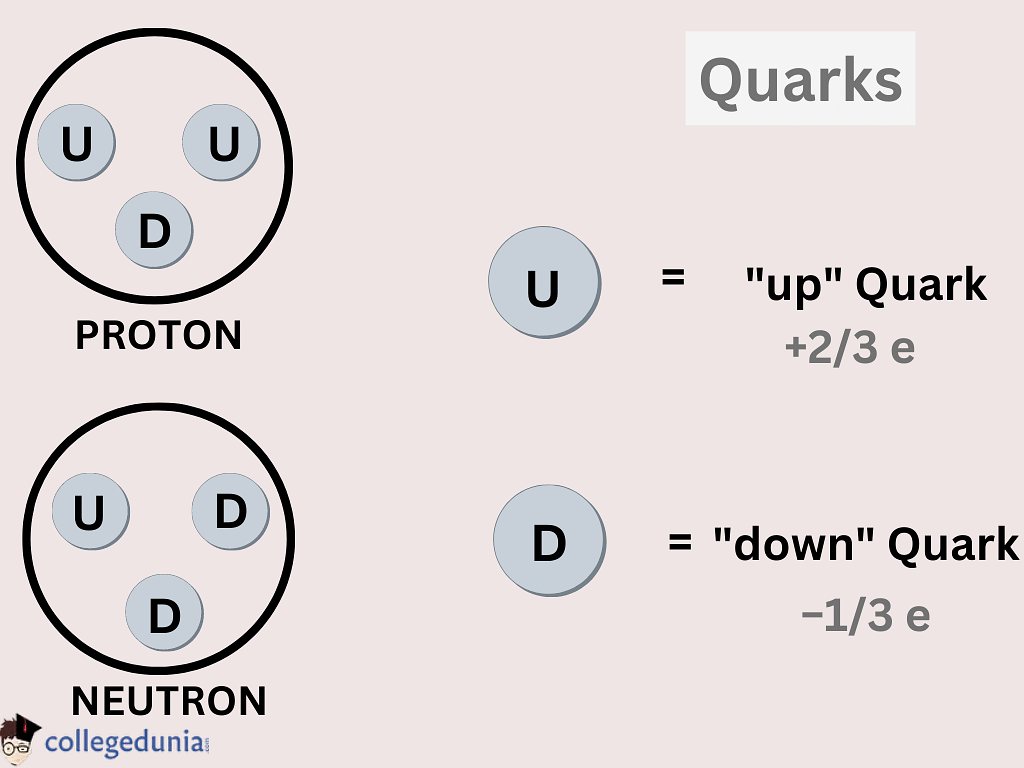
Quarks
- Quarks associate with each other through a strong force to create protons and neutrons, such that the particles then combine to compose atomic nuclei.
- There are six types, also called ‘flavours’, of quarks which differ from each other in their mass and charge characteristics.
Examples of Quarks
Protons contain two up quarks and one down quark, while a neutron is made up of two down quarks and one up quark.
- Quarks typically are unable to exist independently but they can as a constituent part of the matter.
- Its Standard Theoretical Model has been based on a conceptual framework.
- Thus, it helps to describe all the known elementary particles.
- It can also describe the unobserved particles.
Quark Meaning
Here is a summary of quark definition:
| Classification | Details |
|---|---|
| Theory of Quark | George Zweig and Murray Gell-Mann (1964) |
| Types of Quark | 6 (up, down, charm, strange, top and bottom quark) |
| Spins of Quark | 1⁄2 |
| Baryon number | 1⁄3 |
| Symbol of Quark | q |
Read Also:
| Chapter-Related Concepts | ||
|---|---|---|
| Electron Emission | Relativity | Experimental Study Photoelectric Effect |
| Particle Nature of Light | Einstein’s Photoelectric Equation | Radiation |
Types of Quark
[Click Here for Previous Year Questions]
There are six types of quarks, which include:
Up Quark
The lightest of all the quarks are Up Quarks.
- Because Up Quarks have the smallest of all masses, they have the most stability.
- U is the symbol for the antiparticle.
- Up quarks have masses ranging from 1.7 to 3.1 MeV/c2.
- It has a +2/3 e electrical charge.
Down Quark
With light mass, the down quark is next to the up quarks.
- Down quark, due to its lighter mass, has a higher level of stability.
- The antiparticle of a down quark is designated by the letter d.
- Down quarks have masses ranging from 4.1 to 5.7 5.7 MeV/c2.
- It has a -1/3 e electric charge.
Strange Quark
The strange quark is the third lightest of all the quarks.
- S stands for its antiparticle.
- It has a -1/3 e electric charge.
Charm Quark
The J/Psi particle, which is a meson, is an example of the charm quark.
- C stands for its antiparticle.
- The electric charge of a Charm Quark is +2/3 e.
Top Quark
The antiparticle of the top quark is designated by the letter t.
- The top quark has a mass of 172.9 – 1.5 GeV/c2.
- It has a +2/3 electric charge.
Bottom Quark
The bottom quark is represented by the letter b.
- The Bottom Quark mass is approximately 4.1 GeV/c2.
- It has a -1/3 e electric charge.
Properties of Quark
[Click Here for Sample Questions]
Some of the important properties of quark are:
Electric Charge
The fact that the electric charges on quarks are not integers is really unusual.
- Up, charm, and top quarks have an electric charge of 2/3 e, which is a positive fractional charge, whereas down, strange, and bottom quarks have an electric charge of -1/3 e, which is a negative fractional charge.
- Here, the letter ‘e’ indicates the value of charge, without the sign, on a single electron.
- All flavours of quarks own antiparticles (or antiquarks) and the antiparticle’s electrical charges are opposite to their corresponding quarks.
Size
Quarks are so small that they are difficult to sight or measure.
- These particles are point-like structures in quantum chromodynamics (QCD), and they are exceedingly small, in the range of 10-19 metres.
- The size was discovered in 1968 at the Stanford Linear Accelerator Center during deep inelastic scattering investigations.
Mass
The mass of a quark varies depending on its mass and the mass of the surrounding fluid, which is made up of gluons.
- The gluons, rather than the quarks themselves, account for the majority of the mass of the hadrons produced by these quarks.
- From Up quark to the top quark, the mass of quarks varies.
- Top quarks are the heaviest, whereas up quarks are the lightest.
- Up quark weight is in the range of 2 to 8 \(\frac{MeV}{c^2}\), while the weight of top quark is 170 to 180 x 103 \(\frac{MeV}{c^2}\).
Colour Charge
There are three sorts of quark colours, according to Quantum Chromodynamics (QCD).
- The colours are red, blue, and green.
- This property of quarks is known to be Color Charge.
- Antiquarks are known to have the same colours, but are denoted as antired, antiblue and antigreen.
- Gluons have two colour charges, one from red, blue and green while another is from antired, antiblue and antigreen.
- It is required in a proton to show all three colours of the quarks.
Weak interaction
Only up and down quark flavours are stable, while top, bottom, charm, and odd quark flavours are unstable.
- The interaction forces in these four flavours are so weak that they do not persist for long and convert into stable quark flavours, such as up and down quarks.
- The particle decay mechanism is responsible for the change from unstable to stable flavours.
Things to Remember
- Protons and neutrons are made up of quarks that are linked together by strong interaction.
- Quarks are classified into six types, or flavours, based on their mass and charge characteristics.
- Quarks appear to be true elementary particles, with no apparent structure and the ability to be resolved into smaller particles.
- All hadrons appear to be made up of quarks in combination with other quarks or antiquarks, their antiparticles.
- Hadrons are particles with a strong interaction that include both baryons and mesons.
Read Also:
Previous Year Questions
- An example for the best source of monochromatic light is… [JKCET 2019]
- An electron of mass m is accelerated by a potential difference V... [WBJEE 2016]
- The kinetic energy of an electron get tripled then the… [VITEEE 2012]
- A photocell stops emission if it is maintained at 2 V … [JIPMER 1999]
- The activity of ratio altitude (X100) is 6.023 curie… [AP EAPCET 1998]
- If the Planck’s constant h=6.6×10⁻³⁴Js, the de Broglie wavelength… [BITSAT 2018]
- An electron is accelerated under a potential difference … [BITSAT 2011]
- Two fast-moving particles X and Y are associated with … [KEAM 2013]
- In the ideal double-slit experiment, when a glass-plate… [JEE Advanced 2002]
- A direct X-ray photograph of the intenstines is not … [VITEEE 2012]
Sample Questions
Ques: What is a quark? (1 mark)
Ans: Quarks are the smallest elementary particles in the cosmos, and they are the constituent matter of proton and neutron atomic nuclei. They can't be separated from protons and neutrons since their elementary form isn't stable. As a result, they are present inside protons and neutrons rather than separated in nature.
Ques: What is a Hadron? (1 mark)
Ans: Hadron can be defined as a subatomic particle made of quarks, gluons, and anti-quarks. Hadrons are analogous to molecules which are held together by electric forces.
Ques: What is the electric charge of Bottom Quark? (1 mark)
Ans: The electric charge of a Bottom Quark is -1/3 e. Alongside that, down quarks have masses ranging from 4.1 to 5.7 5.7 MeV/c2.
Ques: What is the difference between quarks and leptons? (1 mark)
Ans: Quarks bind together with the help of strong interaction, for instance, protons and neutrons. Leptons typically do not partake in strong interaction, but can only interact via electromagnetic forces and weak forces.
Ques: What is antiquark? (1 mark)
Ans: Quark antiparticles are known as antiquarks. In terms of lifetime and spin, they are similar to quarks. They do, however, differ from quarks in terms of the charges they carry.
Ques: Explain the property of colour in quarks. (2 marks)
Ans: In nature, there are three sorts of quark colours, according to quantum chromodynamics (QCD). These are the colours red, blue, and green. A colour charge is a property of quarks. Antiquarks have the same colours as quarks, except they're labelled anti-red, anti-blue, and anti-green instead. Antired, antiblue, and antigreen gluons have two colour charges, one from red, blue, and green, and the other from antired, antiblue, and antigreen. It is necessary to display all three colours of quarks in a proton.
Ques: Describe the different types of quarks and their relationships. (3 marks)
Ans: Quarks come in six different types. Flavor is another phrase for the type of quarks. As a result, there are six different types of flavours: up, down, charm, strange, top, and bottom. These six flavours are grouped into three groups. These two are
- Up and down
- Charm and strange flavours
- Top and bottom flavour
Two of the six flavours, up and down, are the most stable and lightest in weight. The other four flavours are heavier and more unstable in nature, and during particle decay, they tend to change quickly to up and down quarks.
Ques: Explain the property of electric charge in quarks. (3 marks)
Ans: The fact that the electric charges on quarks are not integers is really unusual. Up, charm, and top quarks have an electric charge of 2/3 e, which is a positive fractional charge, whereas down, strange, and bottom quarks have an electric charge of -1/3 e, which is a negative fractional charge.
The letter 'e' stands for the value of charge on a single electron without the sign in this denotation. All quark flavours contain antiparticles (or antiquarks), and the electrical charges on these antiparticles are the opposite of the electrical charges on their corresponding quarks.
It denotes that the up antiquark coexists with its up quark and has a charge of 2/3 e. These particles produce protons and neutrons in the nuclei of atoms. Two up quarks and one down quark make up a proton, while one up quark and two down quarks make up a neutron. A proton has a ‘+1 e’ charge while a neutron has a ‘0’ e charge in this form.
Ques: Explain the property of binding force in quarks. (5 marks)
Ans: When quarks are close together, the gluons' binding forces tend to be weak.
- Quarks behave as if they were nearly free within a proton (or other hadrons) for distances of less than 10-15 metres.
- Asymptotic freedom is the term for this situation.
- However, as one attempts to separate the quarks, such as when attempting to knock them out of a proton, the force's influence becomes stronger.
- This is because gluons have the power to produce new gluons as they flow between quarks, as explained by QCD.
- As a result, if a quark begins to accelerate away from its companions after being impacted by an accelerating particle, the gluons use the energy derived from the quark's motion to make new gluons.
- The stronger the effective binding forces become as the number of gluons exchanged between quarks increases.
Ques: How can one be so sure of the quark model when no isolated quark has ever been seen? (5 marks)
Ans: There are valid reasons for not observing directly.
- The colour force, unlike the other observable forces, does not appear to decrease with distance.
- It is speculated that it may increase at a rate of around 1 GeV per fermi as distance increases.
- Because the energy is considerably beyond the pair formation energy for quark-antiquark pairs by the time the separation is on an observable scale, a free quark is not found.
- Because the masses of the U and D quarks are in the tens of MeV range, pair formation would occur at distances far less than a fermi.
- In very high-energy collision experiments, you'd expect a lot of mesons (quark-antiquark couples), and that's exactly what one gets.
- In essence, you can't see an isolated quark because the colour force won't let them go, and the energy required to separate them forms quark-antiquark pairings long before they're far apart enough to detect independently.
- The "bag model" is one type of visualisation of quark confinement.
- If you imagine the quarks as being confined in an elastic sack, they can move around freely as long as you don't try to rip them apart any farther.
- When you try to get a quark out of the bag, however, it expands and resists.
For Latest Updates on Upcoming Board Exams, Click Here: https://t.me/class_10_12_board_updates
Check-Out:



Comments