



Content Curator
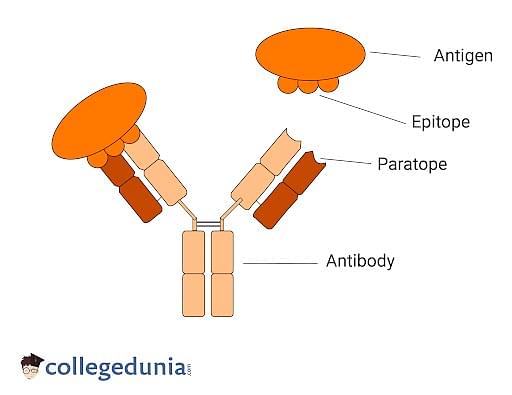
An epitope is a specific site present on the antigen surface that acts as a receptor for complementary antibodies. It is also called an antigenic receptor. Chemically, the epitope is a non-self protein and is as long as 5-6 amino acids. The complementary antibody and epitope must fit each other like 2 puzzle pieces.
- An antigen is a substance that is capable of eliciting an immune response.
- Generally, antigens are foreign proteins or fragments that enter the human body through infection.
- In some cases, our body proteins can act as antigens and initiate an auto-immune reaction.
An antibody is an immunoglobulin that combines with the antigen and is responsible for protecting our body against that antigenic substance. They are produced in response to foreign molecule invasion in the body and are of 5 types IgA, IgE, IgD, IgM, and IgG.
Key Terms: Paratope, Antibody, Major Histocompatibility Complex, Autoimmune Reaction, Conformational Epitope
What is an Epitope?
[Click Here for Sample Questions]
An epitope, also known as an antigenic determinant, is a specific site on an antigen molecule that is recognized by the immune system and specifically bound by an antibody or a T cell receptor. They are typically small, linear sequences of amino acids or carbohydrates that are essential for the function or stability of the antigen.
- Epitopes are usually located on the surface of the molecule.
- They are important in the development of vaccines because they are the targets of the immune response that is elicited by the vaccine.
- They can also be used as diagnostic tools to detect the presence of specific antigens in a sample.
Functioning of Epitopes
[Click Here for Sample Questions]
When a foreign molecule (antigen) enters the body, they are first captured by specialized cells and broken into fragments such cells are called antigen-presenting cells. These cells capture the antigen, modify its configuration, and present it to the antibodies for further reaction.
- Antigen-antibody interaction occurs only when the two fit or compliments one another.
- To initiate the process the antigen-presenting cells have already turned the antigen into an antigen-derived epitope that will complement the antibody.
- After the antigen-antibody interaction and binding occur, antibody production is stimulated.
- Antibodies are targeted against the antigen-antibody complex.
- The epitope once recognized by the antibody then removes the antigen from the host after the binding.
Functioning of Epitopes
Types of Epitopes
[Click Here for Sample Questions]
The epitopes are classified based on their structure and their interaction with the paratope.
- Conformational
- Linear (sequential)
- Discontinuous
- B-cell epitope
- T-cell epitope
-
Conformational Epitope: Conformational Epitopes are formed by the combination of amino acid residues that are disconnected from each other and brought into proximity by folding. Their numbers are unknown. They are mostly found in globular proteins and native nucleic acids. They are dependent on the 3-dimensional structure.
-
Linear Epitopes: Linear Epitopes are determined not only based on their primary structure but also based on the residue present. The amino acids that are distant from the primary structure affect the three-dimensional structure of the epitope. Mostly found in polysaccharides, fibrillar proteins, and single-stranded nucleic acids. They are the adjacent amino acids in the covalent space. They are dependent on the linear structure of 6 amino acids. They become available after the denaturation of proteins.
-
Discontinuous Epitopes: These are formed by the folding of the protein. They can contain both conformational and linear parts. Data has suggested that most of the antigen-antibody binding occurs at discontinuous epitope sites. Most of the protective antibodies for vaccines rely on this type of epitope.
-
B-cell Epitope: These are the portions of the antigen that antibodies bind to. They provide an immunologic response based on pathogen-specific memory. They are mostly proteins, polysaccharides, and nucleic acids. They can be linear or conformational in configuration. Their size is 4-8 residues. They are limited to those located on the external surface of the antigen.
-
T-cell Epitope: They are found on the surface of an antigen-presenting cell and are bound to major histocompatibility complex molecules. They provide an immunologic response based on pathogen-specific memory. They are mostly proteins and are linear in configuration. Their size is 8-15 residues. They are limited to major histocompatibility complexes.
Epitope Mapping
[Click Here for Sample Questions]
Epitope mapping is crucial for therapeutic antibody development. Its basic role is understanding the selection and function of antibodies for developing an effective vaccine, diagnostics, and therapeutics. Epitope mapping helps us identify the antigen's epitope site and the antibody’s binding mechanism. The data collected is incorporated into algorithms for the prediction of B-cell epitopes.
The methods used for epitope mapping are:
- X-ray co-crystallography is the most commonly used method as the antigen-antibody interaction can be directly visualized using it. However, not all proteins are amenable to crystallization. It is expensive, time-consuming, and complicated.
- Array-based oligo-peptide scanning.
- Hydrogen-deuterium exchange (HDX).
- Truncated resin-bound peptide.
- Bioinformatics analysis.
- Yeast/phage display and limited proteolysis: Offer high-throughput monitoring; however, lack resolution.
Significance of Epitope Mapping
[Click Here for Sample Questions]
Significance of Epitope Mapping has been elaborated below:
- Vaccine development: The epitope-based vaccine can stimulate both humoral and cell-mediated responses. More than one epitope can be used to improve its effectiveness. Silica mapping is mostly used to find the epitopes. After identification of the epitopes, the structure is designed and tested for vaccine efficacy. A possible side-effect can be a cytokine storm. The first epitope vaccine was developed in 1985 by Jacob et al.
- mAB and polyclonal antibody production.
- To know antigen-antibody reactions for developing therapeutic drugs to combat emerging pathogens and fight better against future pandemics.
Read More:
Things to Remember
- The epitope is a specific site on the antigen surface to which the antibody combines to stimulate an immune response.
- The epitope has a complementary site on the antibody which is called a paratope and they fit together like a puzzle piece.
- An antigen can have multiple sites to which an antibody can bind and antibodies have different mechanisms to bind to the epitope.
- Epitope mapping is a means to identify the ectopic sites in specific antigens for therapeutic reasons.
Sample Questions
Ques. Why choose epitope mapping? (3 Marks)
Ans. The epitope mapping is preferred because of the following reasons:
- The conventional method of vaccine production is time-consuming and expensive.
- The attenuated or killed pathogen might cause disease in the host genome.
- To know the epitope sequence.
- Epitope mapping provides high throughput analysis of different sequences for predicting potential epitopes.
Ques. What is the chemical configuration of an epitope? (2 Marks)
Ans. Epitopes are regions of a protein that triggers an immune reaction. They are a group of amino acids or other chemical groups present on the surface of a molecule. The T-cell epitopes are protein antigen-derived peptides presented by MHC molecules on antigen-presenting cells. The B-cell epitopes are either peptides or protein surface residues.
Ques. What is an autoimmune reaction and how can the epitope contribute to it? (2 Marks)
Ans. An autoimmune reaction is initiated when patients develop an immune reaction against self-proteins, that is they consider their own body proteins as foreign and start attacking them. The response is most likely due to a single immunogenic epitope on these proteins. However, the body can also target other epitope sites on the same protein.
Ques. What is MHC? (2 Marks)
Ans. A major Histocompatibility Complex is a group of genes that code for proteins that are found on the surface of cells. It helps the immune system recognize foreign antigens. They are of 2 types class I and class II.
- Class I is present on all the cell membranes in an organism.
- Class II are present only in the immune system (macrophages and lymphocytes)
Ques. What are the types of antibodies and what are their functions? (3 Marks)
Ans. There are five types of antibodies:
- IgM: Agglutination and opsonization.
- IgG: Detoxification, recognition of antigen-antibody complex, facilitate phagocytosis, immunity to fetus.
- IgA: First line of defense against pathogens, limits inflammation. Activates complement pathway.
- IgD: Acts as a receptor on B-cell surface, B-cell activation, and differentiation.
- IgE: Responds to an allergic reaction and is present in the lining of respiratory or intestinal tracts.
Ques. Describe humoral and cell-mediated immunity. (3 Marks)
Ans. Humoral Immunity: This type of immunity responds faster against pathogens and it is mediated by antibodies produced by B-cells, hence it is also called B-cell mediated immunity.
Cell-mediated Immunity: This type of immunity usually takes longer to act. It is mediated by T-helper cells and T-cytotoxic cells. The cytokines secreted by T-helper cells activate the phagocytic cells following which they kill the pathogen. There is no antibody formed in this type of immunity.
Ques. What is the difference and similarity between humoral and cell-mediated immunity? (5 Marks)
Ans. The differences.between humoral and cell-mediated immunity are as follows:
| Humoral Immunity | Cell-mediated Immunity |
|---|---|
| Antibodies are used to identify antigens. | Receptors are used to identify antigen |
| Antibodies are formed. | No formation of antibodies. |
| B-cell mediated. | T-cell mediated. |
| Antibodies stick to the antigen. | T-cell receptors bind to the T-cell, and the T-cell itself sticks to the antigen. |
| Protects against viruses and bacteria. | It protects against viruses, fungi, and other bacteria. |
| Cannot eliminate tumor cells. | Can eliminate tumor cells and can protect against cancer. |
| Only T-helper cells participate in this type of immunity. | CD4+ and CD8+ cells participate in immunity. |
| Faster response. | Delayed response. |
The similarities between humoral and cell-mediated immunity are as follows:
- Both are active immunity.
- Both have a lag period.
- Both possess immunological memories.
- Both are not effective in immunocompromised individuals.
Ques. What is an antigen-antibody complex? (2 Marks)
Ans. The association between antigen and antibody is called an antigen-antibody complex. It occurs with the help of non-covalent interaction between the two. Amino acid residue and epitope from the antigen binding site and paratope on the antibody binding site contribute to the antigen-antibody complex formation.
Ques. Write two characteristics of each antibody. (3 Marks)
Ans. Characteristics of different antibodies are provided below:
IgM: 1. It is the first antibody produced in response to a foreign attack by the B cells.
2. Largest antibody and is found in a pentameric form.
IgG: 1. It is transferred to the placenta through the fetus and protects the infant until its birth.
2. Most abundant type of antibody in plasma (80%)
IgA:1. Commonly found in liquids like breast milk, saliva, serum, etc. IgA in breast milk protects an infant’s gastrointestinal tract from microbial activity.
2. Exists in both monomeric and dimeric forms.
IgD:1. Comprises less than 1% of total antibody in serum.
2. Involved in antibody production by the B cells.
IgE:1. Present in the least amount 0.02%.
2. It Exists in monomer form and is present in the linings of the respiratory tract, and intestinal tract.
Ques. What is the difference between antigen and antibody? (5 Marks)
Ans.
| Antigen | Anti-body |
|---|---|
| They interact with antibodies or with T-cell receptors. | They are produced by B-cells and react with antigens to invoke an immune response. |
| They include a component of viral proteins, cell walls, and capsules. | They consist of 4 polypeptide chains, two heavy and two light. Forms a Y shape. |
| They are generally proteins; however, can be carbohydrates, nucleic acids, or lipids. | They are glycoproteins made of amino acids and carbohydrates. |
| Complex structure and composition. | Simpler structure. |
| Causes diseases/ allergic reactions. | Provide immunity to the body against infections. |
| Has many epitopes. | Typically a Y-shaped antibody has 2 identical paratopes. |
Also check:



Comments