



Education Journalist | Study Abroad Lead
Antigen leads to the generation of an immune response by the production of an antibody. When any function of the body is affected and it shows any symptoms of illness, we say that we are affected by a disease. The disease can be classified into infectious and non-infectious diseases. Chickenpox, common cold, and AIDS are some of the infectious diseases. COPD, asthma, and cancer are some of the non-infectious diseases. Bacteria, fungi, viruses, protozoans, and helminths are some organisms that cause diseases in humans. These disease-causing organisms are called pathogens. We need immunity to prevent our bodies from infection. Immunology is the branch of biology that deals with the study of the human immune system, types of the immune system, functions, and how the immune system protects the body from disease-causing agents such as bacteria, viruses, or fungi. Immunization is a process of inducing the immune system, especially with the help of vaccines. This helps a person to prevent any infectious or dreadful disease. In this article, we will learn more about antigen and immunology.
| Table of Content |
Key Takeaways: immunity, bacteria, antigen, antibody, antigen-antibody bond, interaction, disease
What is an Antigen?
[Click Here for Sample Questions]
Antigens are substances that stimulate immunity by producing antibodies. These are large molecules of proteins. They are present on the surface of pathogens such as bacteria, viruses, or fungi. When these substances enter our body, they make our body produce antibodies to keep it away from any disease.
For example, let us consider a common cold virus is entering our body. Then, our body will produce antibodies to prevent us from catching a cold and falling sick.
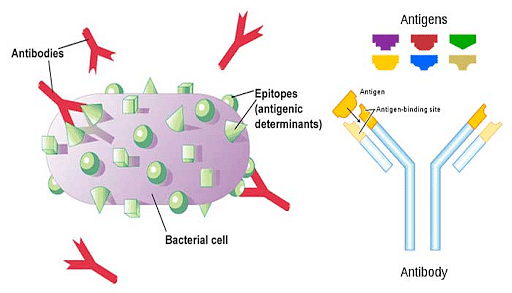
Antigens
Antigens mainly stimulate white blood cells known as lymphocytes to prevent disease or infection. These antigens are primarily divided into two types: heteroantigens and autoantigens. Heteroantigens are foreign antigens, whereas autoantigens are generated within the body.
The ability to induce an immune response by an antigen is called immunogenicity. These substances bind with antibody or T-cell receptors to stimulate the immune response. Also, we need to keep in mind that all immunogens are antigens, but not all antigens are immunogenic. There are other antigens such as carbohydrates, lipids, and nucleic acid other than proteins.
Properties of Antigen
[Click Here for Sample Questions]
The properties of antigens are as listed below.
- These substances are proteins and polysaccharides.
- They have a molecular mass of 14,000 to 6,00,000 Da.
- Antigens are long stretches with no long repeating units.
- They are chemically complex.
- They have a stable intramolecular structure.
- The complex structure defines the immunogenic property. The more complex they are, the more immunogenic they will be.
- The immunogenic property of the antigen is influenced by age. That is, immunogenicity is low for very young and very old people.
- They are species-specific.
- Peptide antigens must have an immune region with a minimum of 30% amino acids such as glutamic acid, asparagine, aspartic acid, glutamine, arginine, and lysine.

Antigen Mechanism
Read also: Human Health and Diseases
Types of Antigens
[Click Here for Sample Questions]
Basically, antigens are classified into different types based on their origin and immune response.
On the basis of origin
On the basis of origin, antigens are classified as:
- Exogenous antigens
These are external antigens that enter our body through inhalation, injection, etc. The most common types of exogenous antigens are food allergens, pollen, and aerosols.
- Endogenous antigens
These antigens are produced within the body due to viral or bacterial infection. Cellular metabolism also produces this type of antigen.
- Autoantigens
These antigens are produced due to some genetic or environmental alterations. These are self-proteins that are generated by attacking the host immune system.
- Tumour antigens
This type of antigens is produced on the surface of the tumor cells to escape the immune system of the body. These antigenic substances induce an immune response in the host. For example, MHC-I and MHC-II.
- Native antigens
These antigens are not yet processed by the antigen-presenting cell.

Exogenous antigen
On the basis of immune response
Antigens can be classified in the following categories depending on the immune response:
- Immunogen: These proteins are capable of generating immune responses on their own.
- Hapten: These non-proteins foreign substances generate an immune response with the help of a carrier molecule.
Structure of Antigen
[Click Here for Sample Questions]
Antigens are proteins with several epitopes. These epitopes are the components of the antigens. An antibody with a minimum of binding sites can only bind to the epitope of an antigen.

Antigen and Structure
The lock and key mechanism play a vital role in the binding of antigens and antibodies.
Types of Immunity
[Click Here for Sample Questions]
The immunity of the body is defined as the ability of the body to prevent and act against disease-causing agents and antigens by the immune system. The immunity developed within the body can be either inborn or acquired from vaccinations. Immunity can be divided into two types based on how it is developed.
Innate Immunity
It is known as natural immunity. This type of immunity is available from birth and is passed on from the parents to the children. Innate immunity will prevent diseases throughout the lifetime. This type of immunity has four types of barriers.
- Physical barrier: Skin is the major and important physical barrier that prevents the entry of microorganisms. Mucus coating of the epithelium lining the respiratory, gastrointestinal, and urogenital tracts also prevents the entry of microbes into the body.
- Physiological barrier: Microbial growth is prevented by the acid in the stomach, saliva in the mouth, and tears from the eyes.
- Cellular barrier: Polymorpho-nuclear leukocytes (PMNL-neutrophils), monocyte, and natural killers are some types of leukocytes (white blood cells) in the blood that help fight against the microbes.
- Cytokine barrier: Interferons are proteins that are produced by virus-infected cells. These proteins prevent the non-infected cells from infection.

Types of Immunity
Acquired Immunity
It is also known as adaptive immunity. This is obtained within the body after birth with the help of vaccines, antibodies, or immunization.
Read also: Principles of Treatment
Interaction of Antigen with Antibody
[Click Here for Sample Questions]
The interaction between antigen and antibody is weak and non-covalent in nature. This indicates that the bonding is very specific, and they depend on Van der Waals forces, hydrogen bond, and electrostatic force. But some interactions are strong in nature.

Antigen-Antibody interaction
These interactions are reversible processes. They follow the thermodynamic principle of any reversible bimolecular interaction reaction. Suppose, if they have a multivalent bond or multiple copies of epitopes, then the bonding will be stabilized complexes. These stabilized complexes will reduce the possibility of binding.
Nature of Antigen-Antibody Bond
[Click Here for Sample Questions]
The binding site in the antigen is assembled into heavy and light chains. These sites in the antigen are situated in the F(ab) portion of the molecule. The features of these sites are as given below.
- Antigen binds to any sites in the antibody, making it non-covalent in nature. Therefore, this process is reversible.
- The bonds between antigen and antibody can be hydrogen bond, electrostatic force, and van der Waals force.
- Antigen and antibody have to overcome repulsive force to form an antigen-antibody bond.
- These bonds help in overcoming hydrating energy and allowing the excretion of water molecules.
- Ionic and hydrophobic forces play a role in binding when epitopes come in contact with paratopes.

Nature of Antibody-Antigen Binding
Factors affecting Antigen-Antibody Bond
[Click Here for Sample Questions]
Few factors that affect the rate of the antigen-antibody bond are given below.
- Temperature: The optimum temperature of the antigen-antibody interaction determines the chemical nature of this bond. The bonds between antigen and antibody can be hydrogen bond, electrostatic force, and Van der Waals force.
- pH: For effective antigen-antibody interaction, the pH range must be 6.5 to 8.4. The bond is forbidden if the pH range is above this range.
- Ionic strength: Antigen-antibody interaction plays an important role in blood group serology. For this bond to play a vital in blood group serology, ionic strength is crucial.
Also Read:
| Related Articles | ||
|---|---|---|
| Difference Between Antigen and Antibody | Antibiotics | Human Insulin |
| Difference Between DNA and RNA? | Pollination | Biomass |
| Deltoid Muscle | What is Adaptation | Calcium Deficiency |
Things to Remember
- Antigens are substances that induce an immune response by producing antibodies.
- Antigens mainly induce white blood cells known as lymphocytes to fight against disease or infection.
- These antigens are primarily divided into two types: heteroantigens and autoantigens.
- Antigens are proteins and polysaccharides with a molecular mass of 14,000 to 6,00,000 Da.
- Innate immunity is known as natural immunity. This type of immunity is available from birth and is passed on from the parents to the children.
- Acquired immunity is also known as adaptive immunity. This is obtained within the body after birth with the help of vaccines, antibodies, or immunization.
- Antigen-antibody bond is a reversible process since it is non-covalent. The bonds between antigen and antibody can be hydrogen bond, electrostatic force, and van der Waals force.
- This bond is affected by temperature, pH, and ionic strength.
Sample Questions
Ques. Write the difference between antigen and immunogen? (2 marks)
Ans. Antigens can induce an immune response by the immune system, whereas immunogen is an antigen that can generate the immune system. All immunogen are antigens but not all antigens are immunogenic.
Ques. What are the properties of antigens? (5 marks)
Ans. The properties of antigens are given listed below.
- Antigens are proteins and polysaccharides.
- They have a molecular mass of 14,000 to 6,00,000 Da.
- These substances form into long stretches with no long repeating units.
- They are chemically complex.
- They have a stable intramolecular structure.
- The complex structure defines the immunogenic property. The more complex they are, the more immunogenic they will be.
Ques. What are the types of antigens? (5 marks)
Ans. Basically, antigens are classified into different types based on their origin and immune response.
Based on origin
- Exogenous antigens: These external antigens enter our body through inhalation, injection, etc.
- Endogenous antigens: These antigens are produced within the body due to viral or bacterial infection.
- Autoantigens: These antigens are generated due to some genetic or environmental alterations.
- Tumour antigens: This type of antigens is produced on the surface of the tumor cells to escape the immune system of the body.
- Native antigens: These are present within the body and not yet processed by the antigen-presenting cell.
Based on immune response
- Immunogen: These proteins are capable of generating immune responses on their own.
- Hapten: These non-proteins foreign substances generate an immune response with the help of a carrier molecule.
Ques. What is the nature of the antigen-antibody bond? (5 marks)
Ans. Nature of antigen-antibody bond
The binding site in the antigen is assembled to form heavy and light chains. These sites are situated in the molecule’s F(ab) portion. The features of these sites are given below.
- Antigen binds to any sites in the antibody, making it non-covalent in nature. Therefore, this process is reversible.
- The bonds between antigen and antibody can be hydrogen bond, electrostatic force, and van der Waals force.
- Antigen and antibody have to overcome repulsive force to form an antigen-antibody bond.
- These bonds help in overcoming hydrating energy and allowing the excretion of water molecules.
- Ionic and hydrophobic forces play a role in binding when epitopes come in contact with paratopes.
Ques. What are the types of immunity? (5 marks)
Ans. The body’s immunity is defined as the ability of the body to prevent and act against disease-causing agents such as bacteria, viruses, fungi, and antigens by the immune system. The immunity developed within the body can be either inborn or acquired from vaccinations. Immunity can be divided into two types.
Innate immunity
It is also known as natural immunity. This type of immunity is present within the body from birth. It is passed on from the parents to the children. This immunity will prevent them throughout their lifetime. This type of immunity has four kinds of barriers.
- Physical barrier: Skin is the significant and crucial physical barrier that prevents the entry of microorganisms.
- Physiological barrier: Microbial growth is prevented by the acid in the stomach, saliva in the mouth, and tears from the eyes.
- Cellular barrier: Polymorpho-nuclear leukocytes (PMNL-neutrophils), monocyte, and natural killers are some types of leukocytes (white blood cells) in the blood that help fight against the microbes.
- Cytokine barrier: Interferons are proteins that are produced by virus-infected cells. These proteins prevent the non-infected cells from infection.
Acquired immunity
It is also known as adaptive immunity obtained within the body after birth with the help of vaccines, antibodies, or immunization.
Ques. What are antigens? (5 marks)
Ans. Antigens are substances that induce an immune response by producing antibodies. These are large molecules of proteins present on the surface of pathogens such as bacteria, viruses, or fungi. When these antigens enter our body, they stimulate our body to produce antibodies to keep away from any disease.
For example, let us consider a common cold virus is entering our body. Then, our body will produce antibodies to prevent us from catching a cold and falling sick.
Antigens mainly induce white blood cells known as lymphocytes to fight against disease or infection. Heteroantigens are foreign antigens, whereas autoantigens are generated within the body.
The ability to stimulate an immune response by an antigen is called immunogenicity. These substances bind with antibody or T-cell receptors to generate the immune response. All immunogens are antigens, but not all antigens are immunogenic. Other antigens are carbohydrates, lipids, and nucleic acid other than proteins.
Ques. What are the factors affecting antigen-antibody bond? (5 marks)
Ans. There are a few factors that affect the rate of the antigen-antibody bond, which are given below.
- Temperature: The chemical nature of the antigen-antibody bond is determined by the optimum temperature of this interaction. The bonds between antigen and antibody can be hydrogen bond, electrostatic force, and van der Waals force.
- pH: The pH range must be 6.5 to 8.4 for an effective antigen-antibody bond. The bond is forbidden if the pH range is above this range.
- Ionic strength: Antigen-antibody interaction plays an important role in blood group serology. For this bond to play a vital in blood group serology, ionic strength is crucial.
Ques. What is immunology and immunization? (3 marks)
Ans. Immunology is the branch of biology that deals with studying the human immune system, types of the immune system, functions, and how the immune system protects the body from disease-causing agents such as bacteria, viruses, or fungi.
Immunization is a process of inducing the immune system, especially with the help of vaccines. This helps a person to prevent any infectious or dreadful disease.
For Latest Updates on Upcoming Board Exams, Click Here: https://t.me/class_10_12_board_updates
Check-Out:



Comments