



Education Content Expert
Factor Theorem is a polynomial remainder theorem used to factorize a polynomial and find the n roots of polynomials. Factor theorem is very useful in order to analyze polynomial equations. Factor theorem is a theorem that links factors and zeros of polynomials. Factor theorem states that if f(x) is a polynomial of degree n ≥ 1 and ‘a’ is any real number, then, (x – a) is a factor of f(x), if f(a) = 0. Thus, it can be said that if (x-a) is a factor of polynomial f(x), then f(a) = 0. This is referred to as the converse of the theorem.
Read More: NCERT Solutions for Class 9 Maths Polynomials
| Table of Content |
Key Terms: Factor Theorem, Polynomials, Remainder Theorem, Synthetic Division, Zeroes of a Polynomial, Remainder, Division, Factor
What is Factor Theorem?
[Click Here for Sample Questions]
Factor theorem is a special case of a polynomial remainder theorem.
- Factor Theorem is used for factoring a polynomial and finding the roots of the polynomial.
- Factor theorem gives the relationship between factors and zeros of polynomials.
- The factor theorem removes all the known zeros from a given polynomial and leaves all the unknown zeros.
- The polynomial received at the end has a lower degree in which the zeros can be easily found.
Check More:
| Relevant Concepts | ||
|---|---|---|
| Polynomial Notation | Division of Polynomial by Another Monomial | Multiplying Polynomials |
| Cubic Polynomials | Factorisation of Polynomials | Degree of Polynomial |
Factor Theorem Statement
[Click Here for Sample Questions]
Factor Theorem is a theorem in algebra that links the factors and zeros of a polynomial. Factor Theorem states that:
| “If f(x) is a polynomial of degree n greater than or equal to 1, and 'a' is any real number, then (x - a) is a factor of f(x) if f(a) = 0.” |
Alternatively, it can said that if (x - a) is a factor of f(x) if f(a) = 0.
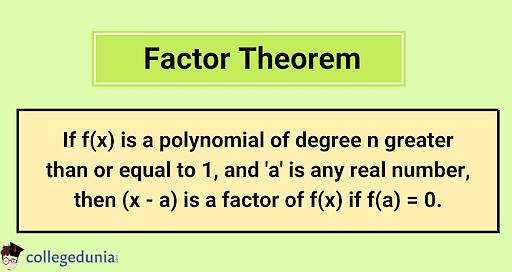
Factor Theorem
Zeroes of a Polynomial
[Click Here for Sample Questions]
To understand the concept of the Factor Theorem, one must be clear with the zeroes of a polynomial.
- The zero of a polynomial is also known as the root of the polynomial.
- It can be said that y = a is a root or zero of a polynomial g(y) only if g(a) = 0.
- y = a is a root or zero of a polynomial only if it is a solution to the equation g(y) = 0.
Solved ExampleExample: Find the zeros of the second-degree polynomial g(y) = y2 + 2y − 15. Solution: We will solve the equation by using the factorization of the quadratic equation method as: y2 + 2y − 15 = (y+5) (y−3) = 0 y = −5 and y = 3 Thus, y2 + 2y − 15 has two zeros or roots which are - 5 and 3. |
Factor Theorem Formula
[Click Here for Sample Questions]
According to Factor Theorem, (y – a) is a factor of the polynomial g(y) of degree n ≥ 1, if and only if g(a) = 0, where, a is any real number. The factor theorem formula is g(y) = (y – a) q(y). The following statements apply to any polynomial g(y):
- (y – a) is a factor of g(y).
- g(a) = 0.
- The remainder is zero when g(y) is divided by (y – a).
- The solution to g(y) is 0 is a and the zero of the function g(y) is a.
Read More: Polynomials Important Questions
Factor Theorem Proof
[Click Here for Sample Questions]
Consider a polynomial g(y) that will be divided by (y – a) only if g(a) = 0.
Using the division algorithm, we can write the given polynomial as the product of its divisor and its quotient:
Dividend = (Divisor × Quotient ) + Remainder
g(y) = (y – a) q(y) + Remainder
Here,
Using the remainder theorem, we get
g(y) = (y – a) q(y) + g(a)
Substituting the value of g(a) = 0 then the remainder is 0,
g(y) = (y – a) q(y) + 0
g(y) = (y – a) q(y)
Thus, (y – a) is a factor of the polynomial g(y). Therefore, it can be seen that the factor theorem is actually an outcome of the remainder theorem, which states that a polynomial g(y) has a factor (y – a), if and only if, a is a root which is g(a) = 0.
How to Use Factor Theorem?
[Click Here for Sample Questions]
To use the factor theorem, one must follow the given steps as follows:
- Step 1: If f(-c)=0, then (x+ c) is considered a factor of the polynomial f(x).
- Step 2: If p(d/c)= 0, then (cx-d) is considered a factor of the polynomial f(x).
- Step 3: If p(-d/c)= 0, then (cx+d) is considered a factor of the polynomial f(x).
- Step 4: If p(c)=0 and p(d) =0, then (x-c) and (x-d) are considered factors of the polynomial p(x).
Factor theorem is used to remove the known zeros from polynomials leaving all unknown zeros unimpaired, thus finding the zeros easily to get the lower degree polynomial.
Solved ExampleExample: Find out whether (y + 5) is a factor of 2y2 + 7y – 15 or not. Solution: It is given that, y + 5 = 0. Thus, y = - 5. Substitute the value of y = - 5 into the given polynomial equation, g(-5) = 2 (-5)2 + 7(-5) – 15 = 2 (25) - 35 – 15 = 50 – 35 – 15 = 0 Therefore, y + 5 is a factor of 2y2 + 7y – 15. |
Read More: Polynomials Revision Notes
Synthetic Division Method
[Click Here for Sample Questions]
Synthetic Division Method can also be used to find the remainder of a polynomial.
Let us consider the given polynomial:
f(x)= x2 +2x -15
Using 3 on the left in the synthetic division method along with the coefficients 1,2 and -15 from the given polynomial equation,

Synthetic Division
As the remainder is zero, 3 is the root of the given polynomial.
The techniques that are used for solving the polynomial equation of degree 3 or higher are not as straightforward, thus, linear and quadratic equations are used to solve the polynomial equation.
Factor Theorem Examples
[Click Here for Sample Questions]
Given below is a problem based on the factor theorem that would help us to understand factor theorem better:
Consider the polynomial function f(x)= x2 +2x -15
The values of x that satisfy f(x)=0 are called the roots of the function.
Assuming f(x)=0, we get:
x2 +2x -15 =0
x2 +5x – 3x -15 =0
(x+5)(x-3)=0
(x+5)=0 or (x-3)=0
x = -5 or x = 3
Since (x+5) and (x-3) are factors of x2 +2x -15, -5 and 3 are the solutions to the equation x2 +2x -15=0.
Verification of Zeroes of Polynomial
(I) x = -5
If x = -5 is the solution,
f(x)= x2 +2x -15
f(-5) = (-5)2 + 2(-5) – 15
f(-5) = 25-10-15
f(-5)=25-25
f(-5)=0
(II) x = 3
If x=3 is the solution,
f(x)= x2 +2x -15
f(3)= 32 +2(3) – 15
f(3) = 9 +6 -15
f(3) = 15-15
f(3)= 0
Read More:
| Related Topics | ||
|---|---|---|
| Polynomial Functions | Polynomial Formula | Multiplication of A Polynomial By A Polynomial |
| Polynomials in One Variable | Euclid's Division Lemma | Real Numbers Formula |
Difference between Factor Theorem and Remainder Theorem
[Click Here for Sample Questions]
Factor Theorem and Remainder theorem are two different concepts in Polynomials. The remainder theorem links the remainder of the division of a polynomial by a binomial with the value of a function at a point. The factor theorem on the other hand links the factors of a given polynomial to its zeros.
Taking an example of a polynomial g(y) = y2 − 2y + 1, we will differentiate between the factor theorem and the remainder theorem.
Remainder Theorem
Put 3 as y into g(y):
g(3) = (3)2 − 2(3) + 1
g(3) = 9 − 6 + 1
g(3) = 4
Thus, using the remainder, when we divide y2 − 2y + 1 by y−3 is 4. We can also use it in reverse by dividing y2 − 2y + 1 by y−3, and we will get the remainder with the
value of g(3).
Factor Theorem
We will use the factor theorem g(y) = y2 − 2y + 1 equals 0 when y =1.
g(1) = (1)2 − 2(1) + 1
g(1) = 1 − 2 + 1
g(1) = 0
It states that (y−1) is a factor of y2 − 2y + 1. It can also be used in reverse where we can factor y2 − 2y + 1 into (y − 1)2. Thus, 1 is a zero of g(y).
Things to Remember
- Factor Theorem is a special case of a polynomial remainder theorem that links factors and zeros of the polynomial.
- Factor theorem is used to factorize the polynomials and to find the n roots of a polynomial.
- According to Factor Theorem, (y – a) is a factor of the polynomial g(y) of degree n ≥ 1, if and only if g(a) = 0.
- The reverse of the factor theorem states that (x - a) is a factor of f(x) if f(a) = 0.
- Apart from factor theorem, Polynomial Division and Synthetic Division is also used to find the factors of a polynomial.
Sample Questions
Ques. Using the factor theorem, check whether y + 1 is a factor of the polynomial 3y4 + y3 – y2 + 3y + 2, or not. (3 Marks)
Ans. It is given that, y + 1 is a factor, then,
y + 1 = 0
y = -1
Substitute the value of y = -1 in the polynomial equation 3y4 + y3 – y2 + 3y + 2.= 3(–1)4 + (–1)3 – (–1)2 +3(–1) + 2= 3(1) + (–1) – 1 – 3 + 2= 3 -1 -1 -3 + 2
Adding up all the positive and negative terms,
= 5 - 5 = 0 Thus, y + 1 is a factor of 3y4 + y3 – y2 + 3y + 2.
Ques. Find out whether 2y + 1 is a factor of the polynomial 4y3 + 4y2 – y – 1 or not using the factor theorem. (3 Marks)
Ans. Equating the binomial to zero, we get
2y + 1 = 0.y = -1/2
Substitute the value of y = -1/2 in the polynomial equation 4y3 + 4y2 – y – 1.4( -1/2)3 + 4(-1/2)2 – (-1/2) – 1= -1/2 + 1 + 1/2 – 1= 0
As the remainder is zero, thus, 2y + 1 is a factor of the polynomial equation 4y3 + 4y2 – y – 1.
Ques. What is the use of Factor Theorem? (3 Marks)
Ans. Factor theorem is used to factor the polynomials. It helps us to find the n roots of a polynomial. It is a special kind of polynomial remainder theorem that links the factors of a polynomial with its zeros. It removes all the known zeros from a given polynomial equation and leaves all the unknown zeros. The resultant polynomial at the end has a lower degree in which the zeros are quite easy to find in comparison to others.
Ques. What is Factor Theorem Formula? (3 Marks)
Ans. The factor theorem states that (y – a) can be considered as a factor of the polynomial g(y) of degree n ≥ 1, if and only if g(a) = 0. The formula of the factor theorem is g(y) = (y – a) q(y). The below-mentioned statements apply to any polynomial g(y):
- (y – a) is a factor of g(y).
- g(a) = 0.
- The remainder is equal to zero when g(y) is divided by (y – a).
- The solution to g(y) = 0 is a and the zero of the function g(y) = a.
Ques. Check whether x-1 is a factor of 2x4 + 3x2 - 5x + 7. (3 Marks)
Ans. Using the factor theorem,
Putting x=1,
2x4 +3x2 – 5x + 7 = 2(1) + 3(1) – 5 + 7
= 2 + 3 - 5 + 7 = 7
As the polynomial is not equal to zero, thus, x-1 is not a factor of 2x4 + 3x2 - 5x + 7.
Ques. What is the importance of the Factor Theorem and Remainder Theorem? (2 Marks)
Ans. We can find out the factors of a polynomial using the factor theorem and the remainder theorem without using other methods like synthetic division, long division, or any other traditional methods of factoring.
Ques. Is Factor Theorem the same as the Remainder Theorem? (2 Marks)
Ans. No, the factor theorem and remainder theorem are not the same concepts. The remainder theorem gives the relationship between the remainder of the division of a polynomial by a binomial with the value of a function at a point. Whereas, the factor theorem states the relation between the factors of a given polynomial to its zeros.
Ques. How to check if x-a is a factor of a polynomial f(x)? (1 Mark)
Ans. To check if f(x) is a polynomial, then x-a is the factor of f(x), if and only if, f(a) = 0, where a is the root.
Ques. Name the other methods to find the factors of polynomials. (2 Marks)
Ans. Excluding the factor theorem to find the factors of polynomials, there are two other methods to find the factors of the polynomial which are:
- Polynomial Long Division Method
- Synthetic Division Method
Ques. What is Remainder Factor Theorem? (2 Marks)
Ans. The remainder factor theorem is a combination of two theorems that links the roots of a polynomial following its linear factors. The remainder factor theorem is used to factorize polynomials easily without taking the help of the long or synthetic division process.
Check-Out:



Comments