



Education Content Expert
Factors of 40 are those numbers that divide the number 40 and result in a whole number as the quotient. The numbers that divide 40 completely leaving zero as the remainder are the factors of 40. 40 is a composite number which means that it has more than 2 factors. 1, 2, 4, 5, 8, 10, 20, and 40 are eight factors of 40. When we multiply two factors of a number in pairs and that results in the value of the original number, then, that set of numbers is called the pair factor. The pair factors of 40 are (1, 40), (2, 20), (4, 10), and (5, 8). The pair factors of 40 can be positive as well as negative. The prime factorization of 40 is 2 x 2 x 2 x 5.
| Table of Content |
Key Terms: Factors of 40, Composite Number, Pair Factors, Prime Factors, Prime Factorization, Natural Numbers, Division, Remainder
What are the Factors of 40?
[Click Here for Sample Questions]
The number 40 is an even composite number which means that it will have more than 2 factors. Factors of 40 are the numbers that divide 40 exactly without leaving a remainder. In other words, the numbers when multiplied in pairs result in an original number are called the factors of 40.
The factors of 40 are 1, 2, 4, 5, 8, 10, 20, and 40.

Factor Tree of 40
Read More:
| Relevant Concepts | ||
|---|---|---|
| Factors of 12 | Factors of 25 | Factors of 15 |
| Factors of 48 | Factors of 16 | Factors of 72 |
| Factors of 18 | Factors of 28 | Factors of 24 |
How to Calculate Factors of 40?
[Click Here for Sample Questions]
Factors of 40 can be calculated in a similar manner as other composite numbers. There are two main methods to calculate the factors of 40 which are:
- Factors of 40 by Division Method
- Factors of 40 by Prime Factorization
Both the division method and prime factorization would result in the same set of factors which are 1, 2, 4, 5, 8, 10, 20, and 40.
Factors of 40 by Division Method
[Click Here for Sample Questions]
In the division method, we will divide 40 by different consecutive integers. If the integer divides 40 completely without leaving any remainder, then, that integer is a factor of 40, else not. We will start dividing 40 by all the numbers starting from 1:
- 40/1 = 40 (Factor 1; Remainder 0)
- 40/2 = 20 (Factor 2; Remainder 0)
- 40/4 = 10 ( Factor 4; Remainder 0)
- 40/5 = 8 (Factor 5; Remainder 0)
- 40/8 = 5 (Factor 8; Remainder 0)
- 40/10 = 4 (Factor 10; Remainder 0)
- 40/20 = 2 (Factor 20; Remainder 0)
- 40/40 = 1 (Factor 40; Remainder 0)
We can see that 1, 2, 4, 5, 8, 10, 20 and 40 divide 40 completely thus, they are the factors of 40. Any other number apart from these numbers would result in a remainder.
Read More: Multiplication and Division of Integers
Prime Factorization of 40
[Click Here for Sample Questions]
40 is a composite number that has prime factors. Here is a step-by-step procedure for the prime factorization of 40.
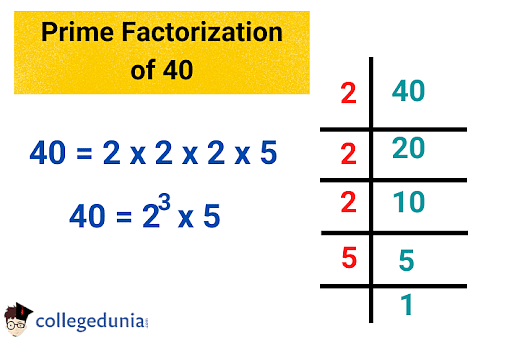
Prime Factorization of 40
- Divide the number 40 by the smallest prime factor which is 2. 40 ÷ 2 = 20
- Now divide 20 by 2, 20 ÷ 2 = 10.
- Now, keep on dividing unless you get an odd number. An odd number is not divisible by 2 and gives a fraction. So, we cannot consider a fraction as a factor. 10 ÷ 2 = 5
- If we divide 5 by 2 we will get a fraction number, so we will proceed to the next prime numbers, i.e. 3, 5, 7, and so on.
- Dividing 5 by 5 we get, 5 ÷ 5 = 1.
- 1 is received at the end and we cannot proceed with the division.
The prime factorization of 40 is thus written as 2 × 2 × 2 × 5 or 23 × 5. 2 and 5 are the prime numbers which mean that they are the prime factors of 40.
Pair Factors of 40
[Click Here for Sample Questions]
Pair factors of 40 are the numbers that when multiplied together result in an original number of 40. We know that the pair factors of 40 can be positive or negative as if we multiply the pair of negative numbers, it will give the original number 40 only. The positive and negative pair factors of 40 are as follows:
Positive Pair Factors of 40
The positive pair factors of 40 are four which are (1, 40), (2, 20), (4, 10), and (5, 8).
| Positive Factors of 40 | Positive Pair Factors of 40 |
|---|---|
| 1 × 40 | (1, 40) |
| 2 × 20 | (2, 20) |
| 4 × 10 | (4, 10) |
| 5 × 8 | (5, 8) |
Negative Pair Factors of 40
The negative pair factors of 40 are (-1, -40), (-2, -20), (-4, -10), and (-5, -8).
| Negative Factors of 40 | Negative Pair Factors of 40 |
|---|---|
| -1 × -40 | (-1, -40) |
| -2 × -20 | (-2, -20) |
| -4 × -10 | (-4, -10) |
| -5 × -8 | (-5, -8) |
Solved Examples on Factors of 40
Example 1: What are the common factors of 40 and 41?
Solution: The factors of 40 and 41 are:
- Factors of 40 are 1, 2, 4, 5, 8, 10, 20, and 40.
- Factors of 41 are 1 and 41.
The common factor of 40 and 41 is only 1.
Example 2: List the common factors of 40 and 80.
Solution: Writing down all the factors of 40 and 80, we get
- Factors of 40 are 1, 2, 4, 5, 8, 10, 20, and 40.
- Factors of 80 are 1, 2, 4, 5, 8, 10, 16, 20, 40, and 80.
The common factors of 40 and 80 are 1, 2, 4, 5, 8, 10, 20, and 40.
Read More:
| Related Topics | ||
|---|---|---|
| Prime Number Formula | Properties of LCM and HCF | LCM of Two Numbers |
| Types of Numbers | Dividend | Relation Between HCF and LCM |
Things to Remember
- Factors of 40 are the natural numbers that divide 40 completely.
- The factors of 40 leave zero as the remainder when on divisions with 40.
- There are total 8 factors of 40.
- 1, 2, 4, 5, 8, 10, 20, and 40 are the factors of 40.
- The pair factors of 40 are (1, 40), (2, 20), (4, 10), and (5, 8).
- The prime factorization of 40 is 2 × 2 × 2 × 5 or 23 × 5.
- 2 and 5 are the two prime factors of 40.
Sample Questions
Ques. List the common factors of 40 and 39. (2 Marks)
Ans. Writing down all the factors of 40 and 39, we get
- Factors of 40: 1, 2, 4, 5, 8, 10, 20, and 40.
- Factors of 39: 1, 3, 13, and 39.
Thus, there is only one common factor of 40 and 39 which is 1.
Ques. Krystle has (-4) as one of the factors of 40. What will be the other factor? (2 Marks)
Ans. We know that
40 = Factor 1 × Factor 2,
Thus, we can say that
40 = (-4) × Factor 2
Factor 2 = 40 ÷ (-4) = (-10).
Thus, the other factor is -10.
Ques. Calculate the Least Common Multiple and Greatest Common Factor of 40 and 36. (2 Marks)
Ans. We know that
- Factors of 40 are 1, 2, 4, 5, 8, 10, 20, and 40.
- Factors of 36 are 1, 2, 3, 4, 6, 9, 12, 18, and 36.
Thus, we can see that the Least Common Multiple of 40 and 36 is 360 and the Greatest Common Factor (GCF) of 40 and 36 is 4.
Ques. Anshul and Riya have rectangular papers. The length and breadth of the rectangular paper with Anshul are 8 inches and 5 inches, and the length and breadth of the second rectangular paper with Riya are 10 inches and 4 inches. According to Anshul, they don't have the same area. Is he correct? (2 Marks)
Ans. We know that
Area of a rectangle = length × breadth
- For the first rectangle with Anshul, Area = 8 × 5 = 40
- For the second rectangle with Riya, Area = 10 × 4 = 40
Thus, the two rectangles have equal areas. It means that Anshul is wrong as both papers have the same area.
Ques. List all the factors of 40. (2 Marks)
Ans. Factors of 40 are the numbers that divide 40 completely with no remainder. The 8 factors of 40 are 1, 2, 4, 5, 8, 10, 20, and 40. The factors of 40 can be calculated using the division method as well as prime factorization.
Ques. Name the Prime Factors of 40. (2 Marks)
Ans. Prime Factors of 40 are the numbers that are prime in nature and divide 40 completely. The prime factorization of 40 is 2 x 2 x 2 x 5. Thus, there are only two prime factors of 40 which are 2 and 5.
Ques. What is the sum of all the Factors of 40? (2 Marks)
Ans. The factors of 40 are 1, 2, 4, 5, 8, 10, 20, and 40, so we will add up all of them.
1 + 2 + 4 + 5 + 8 + 10 + 20 + 40 = 90
Thus, the sum of the factors of 40 is 90.
Ques. Name the Greatest Common Factor of 40 and 28. (2 Marks)
Ans. All the factors of 40 and 28 are:
- Factors of 40 are 1, 2, 4, 5, 8, 10, 20, 40.
- Factors of 28 are 1, 2, 4, 7, 14, and 28.
The common factors of 40 and 28 are 1, 2, and 4. Thus, the Greatest Common Factor of 40 and 28 is 4.
Ques. What are the common factors of 40 and 30? (2 Marks)
Ans. The factors of 40 are 1, 2, 4, 5, 8, 10, 20, 40 whereas the factors of 30 are 1, 2, 3, 5, 6, 10, 15, 30.
Thus, 1, 2, 5, and 10 are the common factors of 40 and 30.
Ques. List the positive and negative pair factors of 40. (2 Marks)
Ans. The positive and negative pair factors of 40 are
- Positive pair factors of 40: (1, 40), (2, 20), (4, 10), and (5, 8).
- Negative pair factors of 40: (-1, -40), (-2, -20), (-4, -10), and (-5, -8).
Ques. Is 16 a factor of 40 or not? (2 Marks)
Ans. To check whether 16 is a factor of 40 or not, we will divide 40 by 16.
40 / 16 =
On division with 40, 16 leaves a remainder. It means that 16 is not a factor of 40.
Read More:



Comments