



Education Content Expert
Factors of 64 are the integers that can divide the number 64 exactly without leaving a remainder. The factors of 64 are 1, 2, 4, 8, 16, 32, and 64. When two factors are multiplied together in pairs and they result in the original number 64, then they are called pair factors of 64. The pair factors of 64 are (1, 64), (2, 32), (4, 16), and (8, 8). 1 is the smallest factor of 64 while 64 itself is its biggest factor. The prime factorization of 64 is 2 × 2 × 2 × 2 × 2 × 2, with 2 being the only prime factor of 64.
| Table of Content |
Key Terms: Factors of 64, Factor Pairs, Pair Factors, Remainder, Prime Factors, Prime Numbers, Multiplication, Prime Factorization,
What are Factors of 64?
[Click Here for Sample Questions]
Factors of 64 are the numbers which when multiplied together give the product as 64. In simpler terms, the numbers that divide 64 completely without leaving any remainder at the end of the division process are known as the factors of 64. There are 7 factors of 64 in total which are 1, 2, 4, 8, 16, 32, and 64.
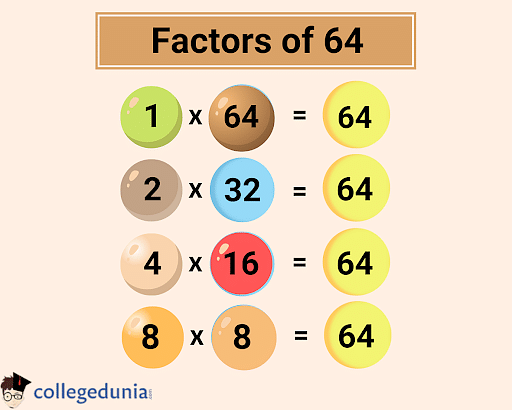
Factors of 64
Read More:
How to Calculate Factors of 64?
[Click Here for Sample Questions]
Factors of 64 can be found by dividing the original number by all the natural numbers from 1 to 64. The numbers that divide 64 completely, without leaving any remainder are the factors of 64.
- 64 ÷ 1 = 64
- 64 ÷ 2 = 32
- 64 ÷ 4 = 16
- 64 ÷ 8 = 8
- 64 ÷ 16 = 4
- 64 ÷ 32 = 2
- 64 ÷ 64 = 1
Thus, it can be seen that the numbers 1, 2, 4, 8, 16, 32, and 64 divide 64 completely with no remainder. Thus, they are the factors of 64. Any other number except them would leave a remainder at the end of the division process.
Read More: Multiplication and Division of Integers
Factors of 64 by Prime Factorization
[Click Here for Sample Questions]
64 is a composite number which means that it should have prime factors. Here are the steps to calculate the prime factors of 64.
Step 1: The first step involves dividing the number 64 with the smallest prime factor which is 2.
64 ÷ 2 = 32
Step 2: Now divide 32 by 2 and continue till there is a fraction, decimal, or 1.
- 32 ÷ 2 = 16
- 16 ÷ 2 = 8
- 8 ÷ 2 = 4
- 4 ÷ 2 = 2
- 2 ÷ 2 = 1
We got number 1 at the end of the division process, thus, we need to stop the division process. Therefore, the prime factors of 64 are written as 2 x 2 × 2 x 2 x 2 x 2 or 26, where 2 is a prime number.
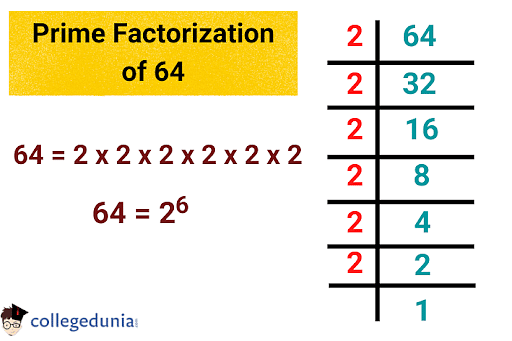
Factors of 64 by Prime Factorization
Factors of 64 in Pairs
[Click Here for Sample Questions]
When two integers on multiplication in a pair give the original number 64, the pair is referred to as the pair factor of 64. The pair factors of 64 can be both positive and negative because the product of two negative numbers also gives a positive number. Here are the factors of 64 in pairs:
Positive Pair Factors of 64
The positive pair factors of 64 are:
| Factors | Positive Pair Factors |
|---|---|
| 1× 64 = 64 | (1, 64) |
| 2× 32 = 64 | (2, 32) |
| 4 × 16 = 64 | (4, 16) |
| 8 × 8 = 64 | (8, 8) |
Negative Pair Factors of 64
The negative pair factors of 64 are:
| Factors | Negative Pair Factors |
|---|---|
| -1 × -64 = 64 | (-1, -64) |
| - 2× -32 = 64 | (-2, -32) |
| -4× -16 = 64 | (-4, -16) |
| -8 × - 8 = 64 | (-8, -8) |
Read More: HCF of Two Numbers
Solved Examples on Factors of 64
[Click Here for Sample Questions]
Example 1: Jack spends four hours a day studying. How many days will he need to complete 64 hours?
Solution: It is given that,
- Number of Hours Per Day = 4
- Total Number of Hours = 64
We know that 4 is a factor of 64, so, we can divide the total hours into an equal number of days,
64 ÷ 4 = 16
Thus, if Jack studies for 16 days at a rate of 4 hours each, he will complete 64 hours.
Example 2: List the common factors between 64, 100, and 140.
Solution: We will write down all the factors of 64, 100, and 140 to determine the common factors.
- Factors of 64: 1, 2, 4, 8, 16, 32, and 64
- Factors of 100: 1, 2, 4, 5, 10, 20, 25, and 50
- Factors of 140: 1, 2, 4, 5, 7, 10, 14, 20, 28, 35, 70, and 140
64, 100, and 140 have three common factors which are 1, 2, and 4.
Also Check:
| Related Topics | ||
|---|---|---|
| Prime Number Formula | Relation Between HCF and LCM | Addition and Subtraction of Integers |
| LCM Formula | Properties of LCM and HCF | Fundamental Theorem Of Arithmetic |
Things to Remember
- Factors of 64 are the natural numbers that divide 64 completely with zero as the remainder.
- 64 is a composite number which means that it has more than 2 factors.
- 64 has seven factors which are 1, 2, 4, 8, 16, 32, and 64.
- The factors of 64 in pairs are (1, 64), (2, 32), (4, 16), and (8, 8).
- The prime factorization of 64 is 2 × 2 × 2 × 2 × 2 × 2 which can also be written as 26.
- The sum of all the factors of 64 is 127.
Sample Questions
Ques. A whiteboard has a surface area of 64 square cm. Find the board's width if its length is 8 cm. (2 Marks)
Ans. Given that,
- Area of the Board: 64 sq cm
- Length of the Board: 8 cm
The whiteboard's area is equal to the length times the breadth.
Area of Board = Length x Breadth
64 = 8 x Breadth
Breadth = 64/8 = 8
Thus, the breadth of the board is also 8 cm.
Ques. What are the negative pair factors of 64? (2 Marks)
Ans. The negative pair factors of 64 are (-1, -64), (-2, -32), (-4, -16), and (-8, -8).
| Negative Factors | Negative Pair Factors of 64 |
|---|---|
| -1× -64 = 64 | (-1, -64) |
| - 2× -32 = 64 | (-2, -32) |
| -4× -16 = 64 | (-4, -16) |
| -8 × - 8 = 64 | (-8, -8) |
Ques. List the Factors of 64. (1 Mark)
Ans. The number 64 has a total of 7 factors which are 1, 2, 4, 8, 16, 32, and 64.
Ques. List the common factors of 64 and 57. (2 Marks)
Ans. Writing down all the factors of 64 and 57, we get
- Factors of 64: 1, 2, 4, 8, 16, 32, and 64
- Factors of 57: 1, 3, 19, and 57.
Thus, 64 and 57 have only one common factor which is 1.
Ques. Name the greatest common factor of 64 and 40. (2 Marks)
Ans. We know that
- Factors of 64: 1, 2, 4, 8, 16, 32, 64
- Factors of 40: 1, 2, 4, 5, 8, 10, 20, 40
Thus, the common factors of 64 and 40 are 1, 2, 4, and 8. Therefore, the Greatest Common Factor (GCF) of 64 and 40 is 8.
Ques. What is the sum of the factors of 64? (2 Marks)
Ans. There are 7 factors of 64 in total.
On adding all the factors of 64,
1 + 2 + 4 + 8 + 16 + 32 + 64 = 127
Thus, the sum of all the factors of 64 is 127.
Ques. Is 64 a Prime Number? (2 Marks)
Ans. No, 64 is not a prime number as it does not satisfy the definition of a prime number. The definition of a prime number states that any number is said to be a prime number if there are only two factors of it i.e. the number itself and 1. However, 64 has more than two factors which are 1, 2, 4, 8, 16, 32, and 64, thus, it is not a prime number.
Ques. What are the prime factors for 64? (2 Marks)
Ans. 64 is a composite number which means that it surely has prime factors. The prime factorization of 64 is 2 × 2 × 2 × 2 × 2 × 2. Thus, we can see that the only prime factor of 64 is 2.
Ques. Name the largest factor of 64. (1 Mark)
Ans. The largest factor of any number is the number itself as it gives one on division with itself. Thus, the largest factor of 64 is 64 itself.
Ques. List the first 10 multiples of 64. (2 Marks)
Ans. The first 10 multiples of 64 are
- 64 × 1 = 64
- 64 x 2 = 128
- 64 x 3 = 192
- 64 x 4 = 256
- 64 x 5 = 320
- 64 x 6 = 384
- 64 x 7 = 448
- 64 x 8 = 512
- 64 x 9 = 576
- 64 x 10 = 640
Check-Out:



Comments