



Education Journalist | Study Abroad Lead
The Gauss Elimination Method is a fundamental technique in linear algebra used to solve systems of linear equations. Developed by the German mathematician Carl Friedrich Gauss, this method provides a systematic approach to finding solutions for sets of equations with multiple variables.
- The significance of the Gauss Elimination Method lies in its ability to simplify complex systems and transform them into more manageable forms, facilitating further analysis and interpretation.
- Gauss Elimination Method uses a sequence of elementary row operations to transform a system of linear equations into an equivalent, but simpler, form.
- Expanding a row by a nonzero constant, swapping rows, and adding or subtracting multiples of one row from another are examples of simple row operations.
- By performing these operations carefully and systematically, the method reduces the system to a triangular form, known as the row echelon form or the reduced row echelon form.
| Table of Content |
Key Terms: Matrix, Rows, Columns, Pivot, Elimination, Linear Equations, Coefficients, Elementary Operations, Row Echelon Form
Overview of Gauss Elimination Method
[Click Here for Sample Questions]
The Gauss Elimination Method, also known as Gaussian elimination, is a widely used technique in linear algebra for solving systems of linear equations. Gauss Elimination Method involves performing a series of elementary row operations on the augmented matrix representation of the system. The augmented matrix is formed by combining the coefficients of the variables and the constant terms from the equations into a matrix.
The elementary row operations include:
Scaling a row: Multiplying all the elements of a row by a nonzero constant to change their values but maintain the relative ratios between them.
Swapping rows: Interchanging the positions of two rows within the matrix.
Adding or subtracting rows: Adding or subtracting multiples of one row to another row, which modifies the equations but maintains the underlying system's solution.
- The goal of applying these row operations is to transform the augmented matrix into a triangular form, known as the row echelon form or the reduced row echelon form.
- In the row echelon form, the matrix exhibits a triangular structure, with zeros below the leading entries (the first nonzero element) of each row.
- The row echelon form allows for straightforward solutions through back-substitution.
- Starting from the last equation in the system, the method solves for the last variable and substitutes its value into the preceding equations.
- This process continues iteratively, with each variable being determined based on the already-known values, until all variables are found.
- By applying the Gauss Elimination Method, a complex system of linear equations can be transformed into a simplified and organized form, making it easier to analyze and interpret.
- Furthermore, the method provides an algorithmic approach, ensuring consistent and reproducible results.
Also read: Pair of linear equation in two variables
Algorithm and Steps
[Click Here for Sample Questions]
The Gauss Elimination Method provides a systematic procedure for solving systems of linear equations. By following a series of steps, the method simplifies the system and transforms it into a triangular form, allowing for the determination of the unknown variables. Here is the algorithm and the corresponding steps involved in the Gauss Elimination Method:
Algorithm: Solving an equation with the help of this method few steps need to be followed–
- Start with a system of linear equations represented by an augmented matrix.
- Perform row operations to transform the augmented matrix into row echelon form, which is a triangular form with zeros below the leading entries of each row.
- Apply back-substitution to determine the values of the variables, starting from the last equation and working backward until all variables are found.
Steps: Solving an equation with the help of this method few steps need to be followed–
Form the augmented matrix: For using this method–
- Write the system of linear equations in matrix form, combining the coefficients of the variables and the constant terms into a matrix.
- This augmented matrix will have dimensions (n x n+1), where n is the number of variables.
Identify the pivot element: For using this method–
- Locate the first nonzero entry in the first column of the augmented matrix.
- This entry is the pivot element.
Perform row interchange (if necessary): For using this method–
- If the pivot element is zero, swap the current row with another row below it that has a nonzero entry in the same column.
- This step ensures that the pivot element is nonzero, preventing division by zero later.
Scale the pivot row: For using this method–
- Divide all the elements in the pivot row by the value of the pivot element.
- This step makes the pivot element equal to 1, simplifying subsequent calculations.
Eliminate the entries below the pivot: For using this method–
- For each row below the pivot row, perform row operations to eliminate the entries below the pivot element.
- Subtract a multiple of the pivot row from each subsequent row to make the elements below the pivot equal to zero.
Repeat steps 2-5 for the remaining columns: For using this method–
- Move to the next column and repeat steps 2-5 to obtain zeros below the leading entry of each subsequent row.
- Each iteration focuses on a different column until the process is completed for all columns or until the bottom-right corner of the matrix is reached.
The matrix is now in row echelon form: For using this method–
- The augmented matrix is transformed into a triangular form, with zeros below the leading entries of each row.
- The resulting matrix is the row echelon form or the reduced row echelon form.
Perform back-substitution: For using this method–
- Starting from the last equation (bottom row of the row echelon form), substitute the known values of variables into the preceding equations.
- Solve for the corresponding variable and substitute its value into the previous equations until all variables are determined.
Verify the solution: For using this method–
- Substitute the found values into the original system of equations to check if they satisfy all equations.
- If they do, the solution is valid. Otherwise, recheck the calculations or consider cases where the system has no solution or infinitely many solutions.
Read Also: Geometry Formula
Applications of Gauss Elimination Method
[Click Here for Sample Questions]
The applications of this method are–
- The primary application of the Gauss Elimination Method is to solve systems of linear equations.
- It is used in various fields such as physics, engineering, economics, and computer science, where systems of equations arise.
- The Gauss Elimination Method can be utilized to find the inverse of a matrix.
- By augmenting the matrix with the identity matrix and applying the method, the original matrix can be transformed into the identity matrix, while the augmented portion becomes the inverse matrix.
- The method can also be employed to compute the determinant of a square matrix.
- By performing row operations to reduce the matrix to upper triangular form, the determinant can be obtained by multiplying the diagonal elements.
- Gauss Elimination can determine the linear independence of a set of vectors.
- If during the elimination process, a row of zeros is encountered, it indicates that the vectors are linearly dependent.
- The method can be used in curve-fitting applications, where a best-fit line or curve is determined to approximate a set of data points.
- By setting up a system of linear equations based on the given data, the coefficients of the fitting function can be obtained using Gauss Elimination.
Solved Example
[Click Here for Sample Questions]
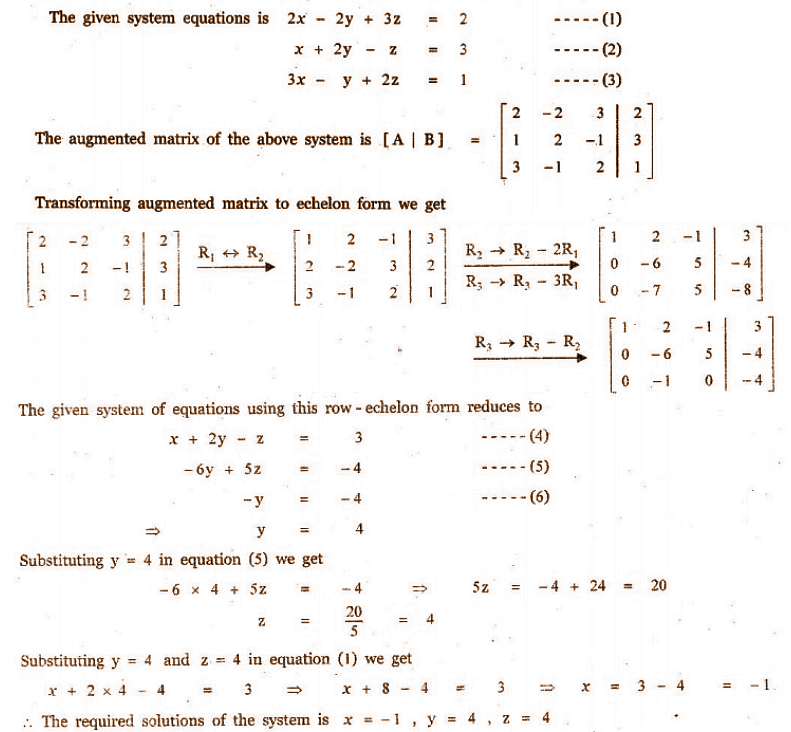
Example 1: Solve the following system of linear equations using the Gauss Elimination Method: 2x – 2y + 3z = 2, x + 2y – z = 3, 3x – y + 2z = 1
Solution: \(\begin{pmatrix} 2 & -2 & 3 \\ 1 & 2 & -1 \\ 3 & -1 & 2 \end{pmatrix}\) \( \begin{pmatrix} x \\ y \\ z \end{pmatrix}\) = \( \begin{pmatrix} 2 \\ 3 \\ 1 \end{pmatrix}\)
(i.e) AX = B
The augment matrix (A, B) is
(A, B) = \(\begin{bmatrix}2 & -2 & 3 & 2 \\[0.3em]1 & 2 & -1 & 3 \\[0.3em]3 & -1 & 2 & 1 \\[0.3em]\end{bmatrix}\) ∼ \(\begin{bmatrix}1 & 2 & -1 & 3 \\[0.3em]2 & -2 & 3 & 2\\[0.3em]3 & -1 & 2 & 1 \\[0.3em]\end{bmatrix}\) R1↔ R2
∼ \(\begin{pmatrix}1 & 2 & -1 & 3 \\[0.3em]0 & -6 & 5 & -4\\[0.3em]0 & -7 & 5 & -8 \\[0.3em]\end{pmatrix}\) R2 → R2 – 2R1 ; R3 → R3 – 3R1
∼ \(\begin{pmatrix}1 & 2 & -1 & 3 \\[0.3em]0 & -6 & 5 & -4\\[0.3em]0 & 0 & -5 & -20 \\[0.3em]\end{pmatrix}\)R3 → 6R3 – 7R2
The above matrix is in echelon form.
Now writting the equivalent equations
\(\begin{pmatrix} 1 & 2 & -1 \\ 0 & -6 & 5 \\ 0 & 0 & -5 \end{pmatrix}\)\( \begin{pmatrix} x \\ y \\ z \end{pmatrix}\) = \( \begin{pmatrix} 3 \\ -4 \\ -20 \end{pmatrix}\)
(i.e) x + 2y – z = 3
- 6y + 5z = – 4
- 5z = – 20
from (3) ⇒ z = \(\frac{-20}{-5}\) = 4
Substituting z = 4 in (2)
– 6y + 20 = – 4 ⇒ – 6y = – 4 – 20 = – 24 ⇒ y = 4
Substituting z = 4 and y = 4 in (1)
x + 8 – 4 = 3 ⇒ x + 4 = 3 ⇒ x = 3 – 4 = -1
So, x = -1; y = 4; z = 4
Also Read:
Things to Remember
- The Gauss Elimination Method is a fundamental technique in linear algebra used to solve systems of linear equations.
- Expanding a row by a nonzero constant, swapping rows, and adding or subtracting multiples of one row from another are examples of simple row operations.
- The augmented matrix is formed by combining the coefficients of the variables and the constant terms from the equations into a matrix.
- The Gauss Elimination Method provides a systematic procedure for solving systems of linear equations.
- The primary application of the Gauss Elimination Method is to solve systems of linear equations.
- The Gauss Elimination Method can be utilized to find the inverse of a matrix.
- The method can also be employed to compute the determinant of a square matrix.
Sample Questions
Ques: What type of method is the Gauss elimination method? (2 Marks)
Ans: The Gauss Elimination technique is a direct approach to solving a system of linear equations because we can solve the provided system of linear equations in a finite number of steps.
Ques: What is the difference between Gauss-Jordan Method and the Gauss-Elimination method? (2 Marks)
Ans: The Gauss-Jordan and Gauss elimination procedures are relatively similar; the only difference is that the Gauss elimination method reduces the matrix to an upper-triangular matrix, whereas the Gauss-Jordan method reduces it to a diagonal matrix.
Ques: Use Gaussian elimination to find the solution for the given system of equations. (3 Marks)
3x + y - z = 1
x - y + z = -3
2x + y + z = 0
Ans: Setup the augmented matrix
\(\begin{bmatrix}3 & 1 & -1 & 1 \\[0.3em]1 & -1 & 1 & -3 \\[0.3em]2 & 1 & 1 & 0 \\[0.3em]\end{bmatrix}\)
Perform row opertaions to reduce the matrix
\(\begin{bmatrix}1 & -1 & 1 & 3\\[0.3em]3 & 1 & -1 & 1 \\[0.3em]2 & 1 & 1 & 0 \\[0.3em]\end{bmatrix}\) R1↔ R2
\(\begin{bmatrix}1 & -1 & 1 & 3\\[0.3em]0 & 4 & -4 & 10 \\[0.3em]2 & 1 & 1 & 0 \\[0.3em]\end{bmatrix}\) – 3R1 + R2→ R2
\(\begin{bmatrix}1 & -1 & 1 & 3\\[0.3em]0 & 4 & -4 & 10 \\[0.3em]0& 3 & -1 & 6 \\[0.3em]\end{bmatrix}\) – 2R1 + R3→ R3
\(\begin{bmatrix}1 & -1 & 1 & 3\\[0.3em]0 & 1 & -1 & \frac{5}{2} \\[0.3em]0& 3 & -1 & 6 \\[0.3em]\end{bmatrix}\)R2 / 4→ R2
\(\begin{bmatrix}1 & 0 & 0 & - \frac{1}{2}\\[0.3em]0 & 1 & -1 & \frac{5}{2} \\[0.3em]0& 3 & -1 & 6 \\[0.3em]\end{bmatrix}\)R2 + R1→ R1
\(\begin{bmatrix}1 & 0 & 0 & - \frac{1}{2}\\[0.3em]0 & 1 & -1 & \frac{5}{2} \\[0.3em]0& 0 & 2 & -\frac{3}{2} \\[0.3em]\end{bmatrix}\) – 3R2 + R3→ R3
Exercise (1) continued:
\(\begin{bmatrix}1 & 0 & 0 & - \frac{1}{2}\\[0.3em]0 & 1 & -1 & \frac{5}{2} \\[0.3em]0& 0 & 1 & -\frac{3}{4} \\[0.3em]\end{bmatrix}\)R3 / 2→ R3
\(\begin{bmatrix}1 & 0 & 0 & - \frac{1}{2}\\[0.3em]0 & 1 & 0 & \frac{7}{4} \\[0.3em]0& 0 & 1 & -\frac{3}{4} \\[0.3em]\end{bmatrix}\)R3 + R2→ R2
The solution set (x, y, z) is \((-\frac{1}{2}, \frac{7}{4}, -\frac{3}{4})\)
Ques: Use Gaussian elimination to find the solution for the given system of equations. (3 Marks)
2x + 5y = 9
x + 2y - z = 3
-3x - 4y + 7z = 1
Ans:


Ques: Solve the following systems of linear equations by the Gaussian elimination method: 2x - 2 y + 3z = 2, x + 2 y - z = 3, 3x - y + 2z = 1 (3 Marks)
Ans:
Ques: Solve the following systems of linear equations by the Gaussian elimination method: 2x + 4 y + 6z = 22, 3x + 8 y + 5z = 27, - x + y + 2z = 2 (3 Marks)
Ans:


For Latest Updates on Upcoming Board Exams, Click Here: https://t.me/class_10_12_board_updates
Check-Out:



Comments