




Gujarat Secondary and Higher Secondary Education Board (GSEB) conducts the GUJCET exam. According to GUJCET exam pattern, the exam is held in offline pen-and-paper mode. The GUJCET Paper pattern comprises 120 MCQs (OMR) that need to be answered in 3 hours (180 minutes).
- GUJCET Exam Pattern is divided into Paper 1 and Paper 2. Paper 1 combines Physics and Chemistry, while Paper 2 consists of Maths for PCM and Biology for Pharmacy candidates.
- In GUJCET 2027, Paper 1 (Physics + Chemistry) carries 80 questions, and Paper 2 (Maths/Bio) has 40 questions. GUJCET total marks are 120.
- As per GUJCET marking scheme, each answer is worth 1 mark, and there is negative marking of 0.25 for every incorrect answer.
- The GUJCET question paper will be in Gujarati, Hindi and English. According to expert analysis, GUJCET question paper difficulty level is moderate.
- Candidates must attempt Paper 1 in 120 minutes and Paper 2 in 60 minutes, making it a total of 180 minutes.
- Optics, Current Electricity, and Electrostatics are high-weightage topics for GUJCET Physics, contributing approx 35 to 40%.
- Physical Chemistry carries the highest weightage of around 35%, followed by Organic Chemistry at 30%. Important GUJCET Chemistry topics include Chemical Kinetics, Electrochemistry, Aldehydes, Ketones, Alcohols, p, d and f-block elements.
- Calculus, Matrices, Determinants, and 3D Geometry are the most important chapters, contributing around 50% of the GUJCET Maths paper.
Related Article: GUJCET Chapter Wise Weightage: Check Subject-wise weightage, & Preparation tips
GUJCET Exam Pattern Highlights: 2027
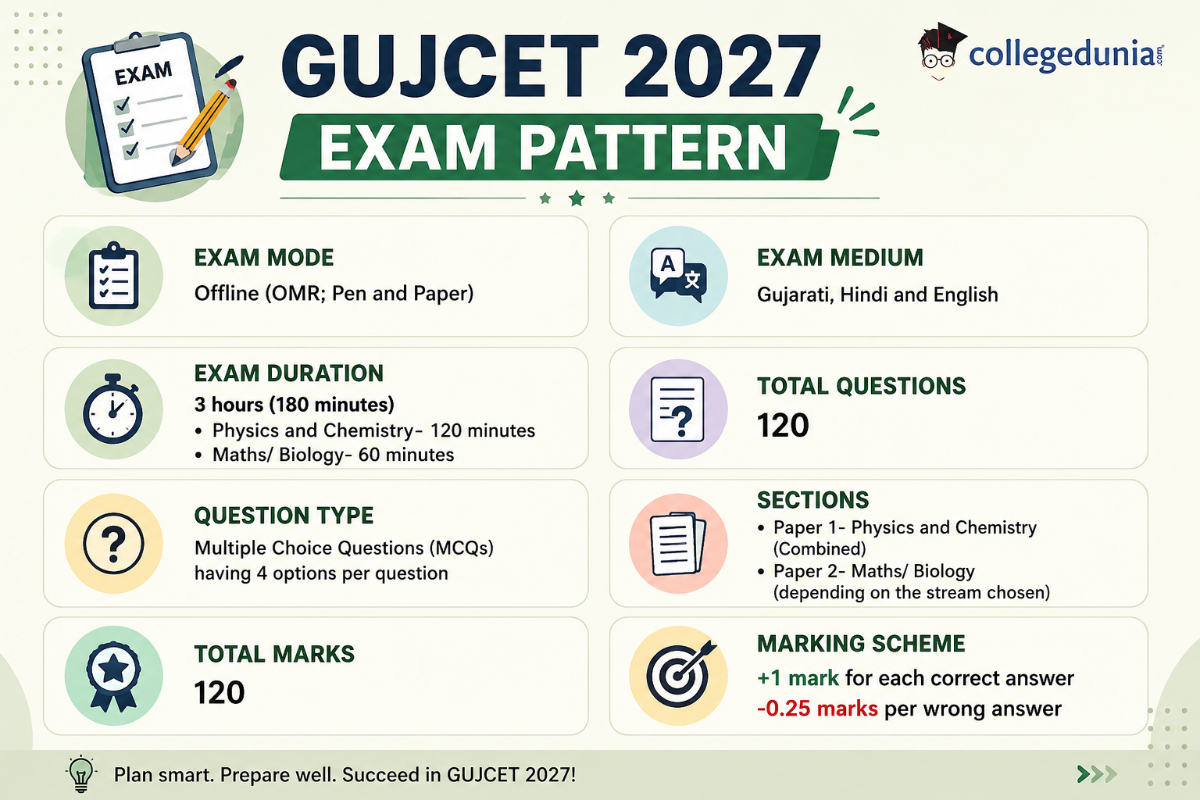
Gujarat Common Entrance Test question format and duration are crucial for your preparation. The following table outlines the GUJCET exam pattern 2027:
| Particular | GUJCET 2027 Exam Pattern Details |
|---|---|
| Exam Mode | Offline (OMR; Pen and Paper) |
| Exam Medium | Gujarati, Hindi and English |
| Exam Duration | 3 hours (180 minutes) Physics and Chemistry- 120 minutesMaths/ Biology- 60 minutes |
| Total Questions | 120 |
| Question Type | Multiple Choice Questions (MCQs) having4 options per question |
| Sections | Paper 1- Physics and Chemistry (Combined)Paper 2- Maths/ Biology (depending on the stream chosen) |
| Total Marks | 120 |
| Marking Scheme | +1 mark for each correct answer-0.25 marks per wrong answer |
Also Check: GUJCET Registration: Check Direct Link, Process, Last Date, Fees, and Form Correction
Ques. Is GUJCET easier than JEE?
Ans. Yes, GUJCET is generally easier than the JEE Main. GUJCET questions are more direct and formula-based multiple-choice questions. JEE Main requires deep, complex conceptual understanding, application, deeper analytical thinking, and higher calculation accuracy. Moreover, JEE Main is a national entrance examination, and GUJCET is a state-level exam restricted mostly to students in Gujarat.
Subject-wise GUJCET Exam Pattern 2027
The subject-wise GUJCET exam pattern for PCM and PCB candidates is as follows:
| Paper | Subjects | PCM Candidates Number of Questions | PCB Candidates Number of Questions | Paper-wise Marks |
|---|---|---|---|---|
| Paper 1 | Physics + Chemistry (Combined) | 40+ 40= 80 | 40+ 40= 80 | 80 |
| Paper 2 | Maths/ Biology | 40 (for Maths) | 40 (for Biology) | 40 |
| Total | - | 120 | 120 | 120 |
Note: PCM candidates have to appear for PCM. Pharm students must attempt Biology in Paper 2. Biology is an alternative to Maths for Pharmacy. Your Paper 2 choice is locked at the time of registration and cannot be changed later.
Also Read: GUJCET Eligibility, Check Domicile Criteria, Qualifications, Age Limit
Ques. Has the GUJCET paper pattern changed over the years?
Ans. No. The GUJCET paper pattern has remained consistent over the years, with no major structural changes in the number of questions, marks, subject-wise distribution and exam duration.
GUJCET Marking Scheme 2027
GUJCET Marking Scheme is crucial to avoid negative marking impacting your total marks.
Tip: Avoid guessing on questions where you cannot eliminate at least two options.
| Particulars | GUJCET Marking Scheme |
|---|---|
| Correct Answer | +1 |
| Incorrect Answer (Each) | 0.25 |
| Unattempted Question | 0 |
Note: Negative marking applies if you select two or more options for each question.
Is There Negative Marking in GUJCET 2027?
Yes, there is negative marking in the GUJCET examination. For every wrong answer or selecting more than one option, 0.25 marks are deducted. There is no deduction for unanswered questions as per the GUJCET paper pattern.
Student Strategy to Avoid GUJCET Negative Marking
- Attempt questions you are confident about first.
- Try to eliminate incorrect options before attempting tricky questions
- Avoid blind guessing for questions you are unsure about.
- Keep the last few minutes for checking unanswered questions and OMR marking.
- Practise mock tests as per the GUJCET marking scheme so you can identify your accuracy.
- Solving PYQs and mocks under timed conditions is highly recommended to improve speed, accuracy and time management.
Also Check: GUJCET Admit Card: Check GUJCET Hall Ticket Release Date, Download Link & Documents Required
Ques. Is GUJCET MCQ-based?
Ans. Yes, GUJCET is an offline pen-and-paper exam comprising MCQ questions only. It is conducted using an OMR sheet. Out of the four available options, you need to choose only one correct answer.
GUJCET Exam Pattern 2027: Duration
GUJCET Paper Pattern contains MCQ-type questions only. The GPAT exam lasts 3 hours (180 minutes). Each Paper has a sectional time limit, so it restricts free navigation between papers.
| Particulars | Subjects | Details |
|---|---|---|
| Paper 1 Time Limit | Combined (Physics + Chemistry) | 120 minutes |
| Paper 2 Time Limit | Bio/ Maths | 60 minutes |
| GUJCET Exam Duration (Total) | - | 3 hours (180 minutes) |
Ques. Is 100 a good score in GUJCET?
Ans. A score of 100 out of 120 in GUJCET is an excellent score that easily helps you get into the top tier for admissions. With a score of 100 in GUJCET, you will get CSE and CSE specialization course options.
GUJCET Total Marks 2027
GUJCET total marks are 120. According to the GUJCET 2027 Exam Pattern, Physics, Chemistry, and Maths/Biology each carry 40 marks.
| Type of Questions | Maximum Marks |
|---|---|
| Physics + Chemistry | 40+40= 80 |
| Maths/Bio | 40 |
| GUJCET Total Marks | 120 |
Ques. What is the total number of questions in GUJCET 2027?
Ans. GUJCET 2027 has 120 questions in total. It comprises 40 questions each from Physics, Chemistry, and Mathematics (engineering students) or Biology (pharmacy students). All questions are MCQs with a single correct answer.
GUJCET Exam Pattern Difficulty Trend Analysis
Understanding the difficulty level of the GUJCET exam helps you prepare strategically by identifying key areas to focus on. Based on trend analysis, the overall GUJCET difficulty level is moderate.
Last 5 Years' GUJCET Paper Pattern Key Highlights
- Mathematics- The Maths difficulty level and paper pattern remained consistent, with lengthy and time-consuming questions. It asks lengthy calculations from Calculus, Vectors, 3D Geometry, and Matrices.
- Physics- Questions focus heavily on direct formula application and basic concepts.
- Chemistry- Mostly direct and scoring section. Questions are aligned with NCERT and Gujarat Board syllabus guidelines
- Biology- It is factual and direct. Questions are asked from NCERT textbooks.
| Year | Overall | Maths | Physics | Chemistry | Biology (for Pharm) |
|---|---|---|---|---|---|
| 2026 | Moderate | Moderate to Difficult | Moderate | Easy to Moderate | Easy to Moderate |
| 2025 | Moderate | Moderate to Difficult | Moderate to slightly tough | Moderate | Moderate |
| 2024 | Moderate | Moderate to Difficult | Easy to Moderate | Moderate | Moderate |
| 2023 | Moderate | Moderate | Moderate | Easy to Moderate | Moderate |
| 2022 | Moderate | Moderate to Difficult | Easy to Moderate | Moderate | Easy to Moderate |
Also Check: GUJCET Question Paper (Available): Check Previous Year Question Paper with Solution PDF
Ques. What is the duration of the GUJCET 2027 exam?
Ans. As per GUJCET 2027 exam pattern, the total examination duration is expected to be 3 hours. Physics and Chemistry are allotted 120 minutes together, while Mathematics or Biology is allotted 60 minutes.
GUJCET Exam Syllabus 2027: Important Topics Based on Past Years' Trends
The GUJCET exam pattern 2027 asks questions from the NCERT and GSEB Class 11 and Class 12 syllabus. Based on the recent GUJCET paper, Class 12 chapters generally account for a slightly larger share of questions. Based on past years' trends, the key topics along with the number of questions asked are discussed below.
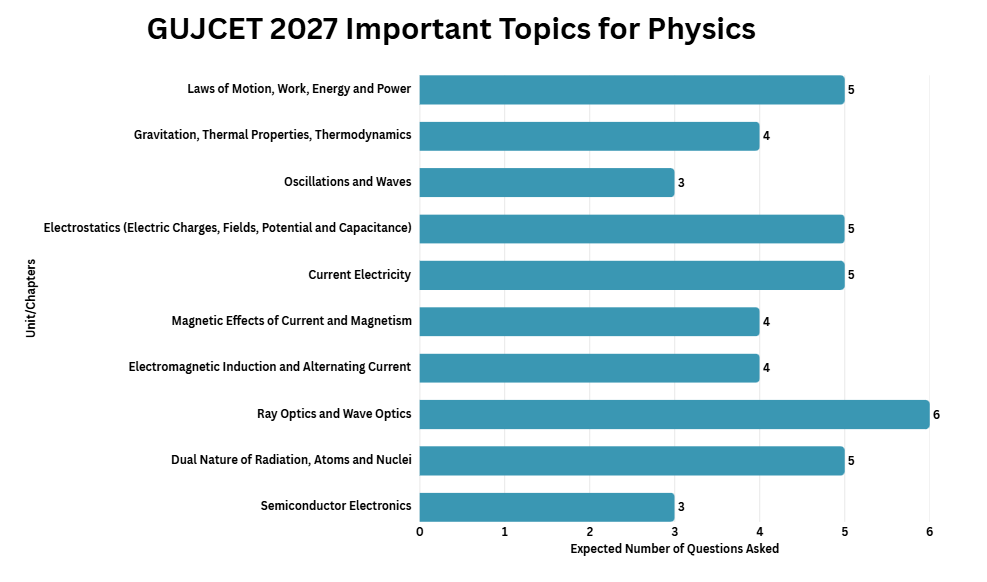
GUJCET Exam Syllabus 2027: Important Topics for Physics
Optics, Current Electricity, and Electrostatics are the high-weightage topics for the GUJCET Physics paper. They account for nearly 35 to 40% of the paper, making them a high priority for GUJCET 2027.
Tip: The GUJCET Physics question paper is application-based. Focus on formula-based numericals and high-priority topics to score maximum marks.
| Unit/Chapters | Expected Number of Questions Asked |
|---|---|
| Laws of Motion, Work, Energy and Power, Rotational Motion / Mechanics (incl. Kinematics) | 4- 5 |
| Gravitation, Thermal Properties, Thermodynamics | 3- 4 |
| Oscillations and Waves | 2- 3 |
| Electrostatics (Electric Charges, Fields, Potential and Capacitance) | 4- 5 |
| Current Electricity | 4- 5 |
| Magnetic Effects of Current and Magnetism | 3- 4 |
| Electromagnetic Induction and Alternating Current | 3- 4 |
| Ray Optics and Wave Optics | 5- 6 |
| Dual Nature of Radiation, Atoms and Nuclei | 4- 5 |
| Semiconductor Electronics | 2- 3 |
GUJCET Exam Syllabus 2027: Important Topics for Chemistry
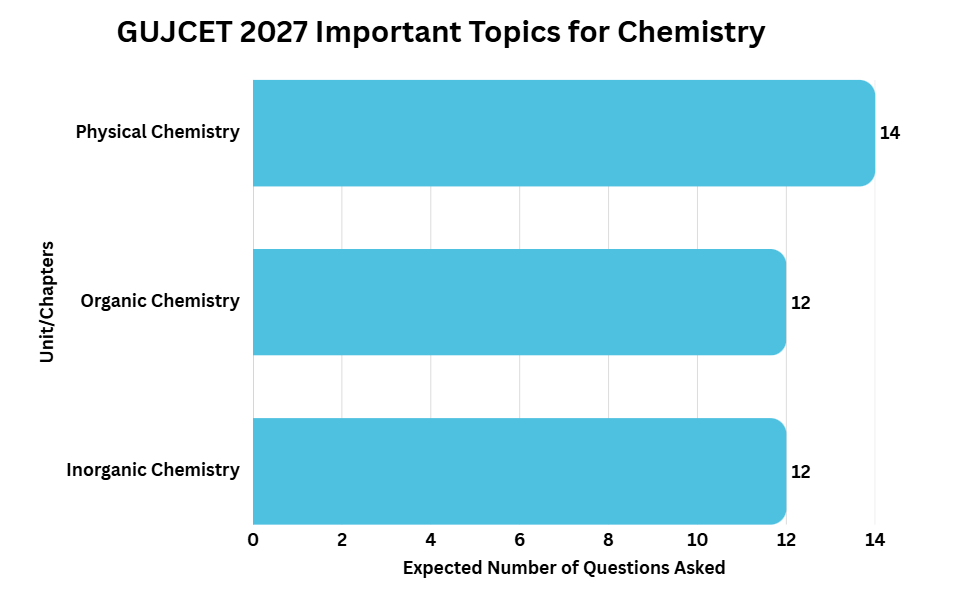
As per GUJCET Paper Pattern, chemistry questions are asked from inorganic, organic and physical chemistry. GUJCET Chemistry chapter-wise weightage accounts for 35% from physical, 30% from organic and 25- 30% from inorganic chemistry.
Tip: GUJCET Chemistry question papers are directly NCERT-based and easy to score. Focus on completing the NCERT textbook carefully.
| Unit/Chapters | Key Topics | Expected Number of Questions Asked |
|---|---|---|
| Physical Chemistry | Solutions, Electrochemistry, Chemical Kinetics, Solid State, Surface Chemistry, Thermodynamics | 12- 14 |
| Organic Chemistry | Haloalkanes/Haloarenes, Alcohols/Phenols/Ethers, Aldehydes/Ketones/Carboxylic Acids, Amines, Biomolecules, Polymers, Chemistry in Everyday Life | 10- 12 |
| Inorganic Chemistry | (p-Block, d-/f-Block, Coordination Compounds, Metallurgy/Extraction) | 8- 12 |
GUJCET Exam Syllabus 2027: Important Topics for Maths
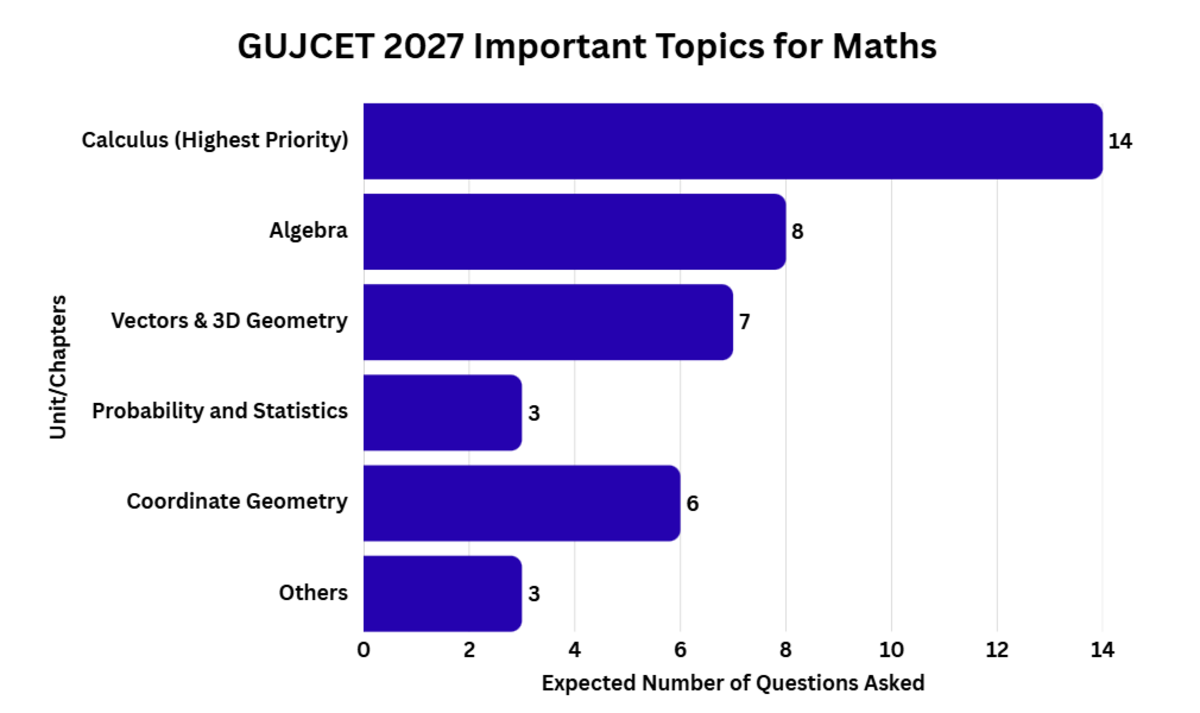
Calculus is the highest-weightage unit in GUJCET Maths paper, contributing nearly 12 to 14 questions, making it a high-priority topic. Application of Derivatives and Definite Integration are frequently asked topics.
Tip: Focus on fast formula application under strict timed conditions, as you need to complete 40 MCQs in 60 minutes.
| Unit/Chapters | Key Topics | Expected Number of Questions Asked |
|---|---|---|
| Calculus (Highest Priority) | Differentiation, Continuity & Differentiability, Application of Derivatives (AOD), Indefinite Integration, Definite Integration, Applications of Integrals, Differential Equations and Limits | 12- 14 |
| Algebra | Matrices, Determinants, Relations & Functions and Trigonometric Functions | 6- 8 |
| Vectors & 3D Geometry | Vector Algebra and Three-Dimensional Geometry | 5- 7 |
| Probability and Statistics | Conditional Probability and Bayes’ Theorem | 2- 3 |
| Coordinate Geometry | Straight Lines, Circles, Conic Sections | 4- 6 |
| Others | Linear Programming, Sets and miscellaneous | 1- 3 |
GUJCET Exam Syllabus 2027: Important Topics for Biology (Pharm Students)
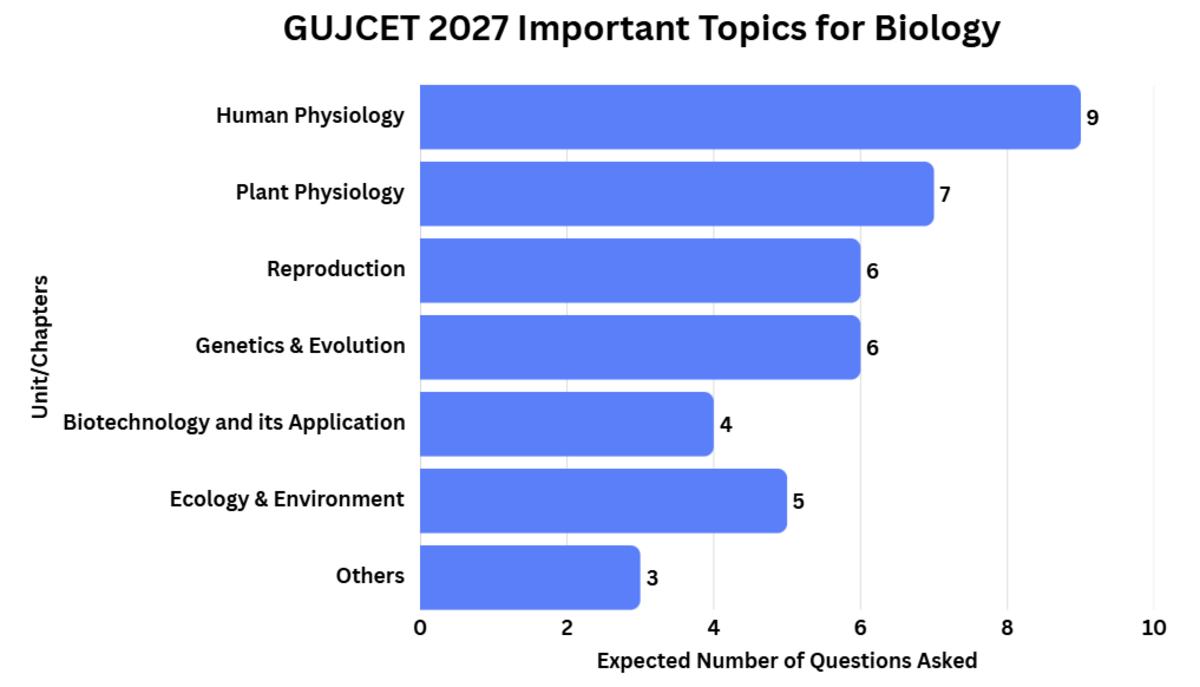
Human Physiology, Plant Physiology and Genetics and Evolution are the most important and account for more than 50% weightage of the paper.
Tip: Master your GSEB and NCERT Biology textbook. Questions are direct from the book. Memorise definitions, practice labelling and diagrams to score well in GUJCET Biology.
| Unit/Chapters | Key Topics | Expected Number of Questions Asked |
|---|---|---|
| Human Physiology | Digestion, Respiration, Circulation, Excretion, Locomotion, Nervous, and Endocrine | 8- 9 |
| Plant Physiology | Photosynthesis, Respiration, Transport, Growth & Hormones | 6- 7 |
| Reproduction | Sexual Reproduction in Flowering Plants, Human Reproduction and Reproductive Health | 5- 6 |
| Genetics & Evolution | Inheritance, Molecular Basis, Evolution | 5- 6 |
| Biotechnology and its Application | - | 3- 4 |
| Ecology & Environment | - | 4- 5 |
| Others | Biology & Human Welfare / Human Health & Diseases: Cell Biology, Diversity, Structural Organisation, Biomolecules | 2- 3 |
Also Check: GUJCET Mock Test: Attempt Online Mock Test, PYQ, Download PDF for Free
Ques. Which topics are important for GUJCET 2027?
Ans. Prioritise Electrostatics, Current Electricity, Electromagnetic Induction, Optics and Modern Physics for GUJCET Physics. For Chemistry, focus on Solutions, Electrochemistry, Chemical Kinetics, Coordination Compounds and Organic Chemistry. Integration, Differentiation, Matrices, Differential Equations, Vectors and 3D Geometry all together contribute more than 50% of the Maths paper.
How to Prepare Based on GUJCET 2027 Exam Pattern
- Know the paper structure: Prepare for Physics, Chemistry and Mathematics/Biology, with 40 questions from each subject.
- Prioritise important topics: Focus on frequently asked chapters while covering the complete syllabus.
- Practise MCQs daily: Solve subject-wise and mixed GUJCET PYQs and mocks to improve speed and accuracy. After solving, analyse them to identify errors that require revision.
- Take timed mocks: Practise completing Paper 1 (Physics + Chemistry) in 120 minutes and Paper 2 in 60 minutes to maintain speed and accuracy.
- Avoid blind guessing: With 0.25-mark negative marking, prioritise accuracy over unnecessary attempts.
- Revise regularly: Maintain short notes for formulas, reactions, concepts and frequently made mistakes.
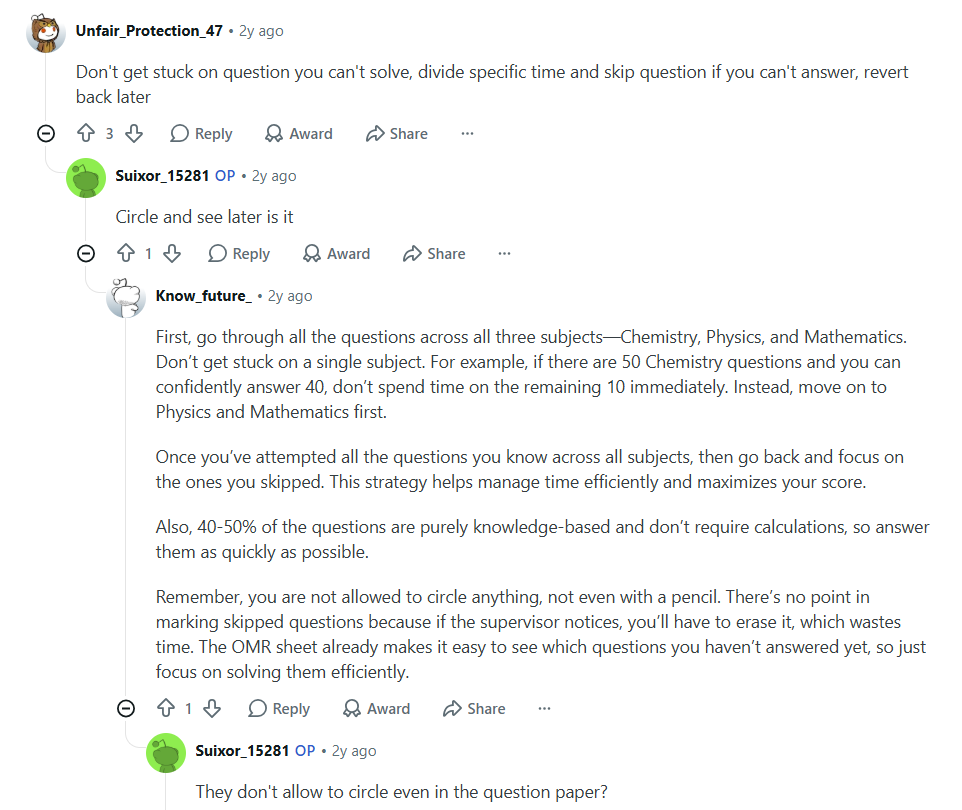
In discussion forums, such as Reddit, a user shared tips while appearing for GUJCET, which you should not avoid. First, go through all the questions. Don't get stuck on a question you can't solve. Skip the question if you can't answer and manage your time strategically. After answering, look for the questions that you cannot solve. This strategy helps manage time efficiently and maximises your score.
Source: Reddit
GUJCET Exam Pattern 2027 FAQs
Ques. What is the structure of GUJCET Paper 1 and Paper 2?
Ans. Paper 1 covers Physics (40 questions) and Chemistry (40 questions) and runs for 120 minutes. Paper 2 covers Mathematics (engineering) or Biology (pharmacy), with 40 questions in 60 minutes.
Ques. What is the marking scheme for GUJCET 2027?
Ans. According to GUJCET marking scheme, it awards +1 mark for every correct answer and deducts 0.25 marks (1/4 mark) for every wrong answer. Unattempted questions carry no penalty.
Ques. Is GUJCET 2027 conducted online or offline?
Ans. GUJCET 2027 is an offline, pen-and-paper exam. You mark answers on an OMR sheet using a black or blue ballpoint pen at your designated exam centre. There is no computer-based option for GUJCET.
Ques. How long is the GUJCET 2027 exam?
Ans. GUJCET 2027 runs for a total of 3 hours (180 minutes). Paper 1 (Physics + Chemistry) is 120 minutes; Paper 2 (Mathematics or Biology) is 60 minutes. Both papers are held on the same day.
Ques. What is the syllabus for GUJCET 2027?
Ans. The GUJCET syllabus 2027 is based entirely on the GSEB Class 11 and Class 12 curriculum. Physics and Chemistry cover chapters from both classes; Mathematics or Biology in Paper 2 follows the same GSEB scope. NCERT-level knowledge is sufficient, as GUJCET does not go beyond the GSEB board syllabus.
Ques. Are there any numerical or integer-type questions in GUJCET 2027?
Ans. No, GUJCET 2027 does not include numerical or integer-type questions. All 120 questions are single-correct MCQs with four options.
Ques. In which language is GUJCET 2027 conducted?
Ans. GUJCET 2027 is available in three languages: Gujarati, English, and Hindi. You select your preferred medium during the application process and receive the corresponding question booklet on exam day.



Comments