



Content Curator
Microorganisms or microbes are other living organisms in our environment that we are unable to see with our naked eyes. These are unicellular or multicellular organisms that maybe harmful or beneficial to us. The majority of illnesses are caused by microbes. The bacteria that cause diseases are called pathogens. They have evolved specifically to infect and reproduce within a host.
| Table of Content |
Key Takeaways: Microorganisms, Pathogens, Bacteria, Virus, Unicellular and Multicellular Organisms, Communicable Diseases
Where are Microorganisms Found?
[Click Here for Sample Questions]
Bacteria, certain algae, and protozoa are single-celled microorganisms, whereas many algae and protozoa are multicellular. They may be found in a variety of environments, including icy cold climates, hot springs, deserts, and marshy plains. They can also be found inside the bodies of humans and other animals. Some bacteria are parasitic on other creatures, whereas others are free-living.
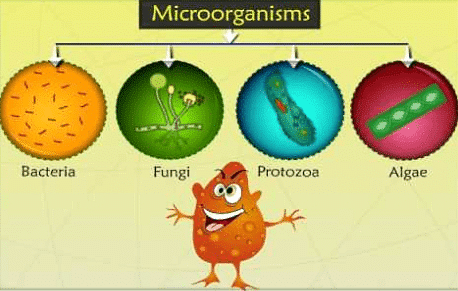
Types of Microorganisms
Microorganisms are dangerous in many ways. Humans, plants, and animals are all affected by some of the microbes. Pathogens are the bacteria that cause illnesses. Food, textiles, and leather are all spoiled by microorganisms.
Read Also:
Disease Causing Microorganisms in Humans
[Click Here for Sample Questions]
Pathogens enter our bodies via the air we breathe, the water we drink, and the food we consume. They can also be spread by animals or by direct contact with an affected person. Communicable illnesses are microbial infections that can transmit from an infected person to a healthy person by the air, water, food, or personal contact. Cholera, common cold, chicken pox, and TB are examples of such illnesses.
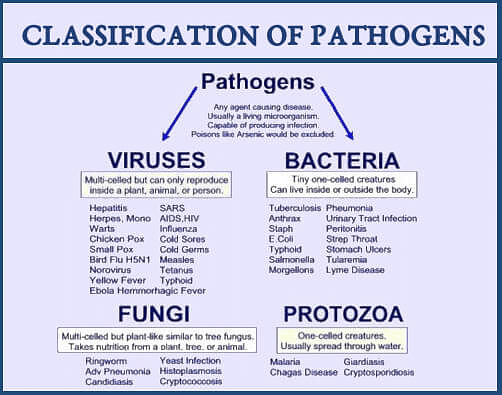
Disease Causing Pathogens in Humans
Fine droplets of moisture carrying millions of viruses are distributed in the air when a person with a typical cold sneezes. While breathing, the virus might enter a healthy person's body and cause illness. Some insects and animals serve as carriers for disease-causing microorganisms.
One such carrier is the housefly. The flies congregate around rubbish and animal waste. Pathogens cling to their hosts' skin. These flies may spread infections if they land on uncooked food. Anyone who consumes the tainted food is likely to become ill. As a result, it's best to keep food covered at all times. Avoid eating food that has been exposed to the elements. The female Anopheles mosquito, which carries the malaria parasite (Plasmodium), is another example of a carrier. Dengue is spread by female Aedes mosquitos.
Here is a table that shows a list of microorganisms and infectious diseases caused by them:
| Diseases | Type of Microorganism | Microorganism Name |
|---|---|---|
| Cold | Virus | Rhinovirus |
| German measles | Virus | Rubella |
| Chicken pox | Virus | Varicella zoster |
| Whooping cough | Bacteria | Bordetella pertussis |
| Bubonic Plague | Bacteria | Yersinia pestis |
| Ringworm | Fungi | Trichophyton rubrum |
| Tuberculosis | Bacteria | Mycobacterium tuberculosis |
| Malaria | Protozoa | Plasmodium falciparum |
| Athlete’s Foot | Fungi | Trichophyton mentagrophytes |
Also Read:
Disease Causing Microorganisms in Animals
[Click Here for Sample Questions]
Diseases are caused by a variety of microorganisms that affect not just people and plants, but also other creatures. Anthrax, for example, is a bacterium that causes a deadly illness in humans and livestock. Another virus causes foot and mouth disease in cattle. Crown gall disease is caused by bacteria and viruses that attack plants. Animal and plant infections can reduce product quality and production, potentially resulting in a loss of investment. As a result, microbial growth must be controlled.

Disease causing pathogens in Animals
Read Also: Human Health and Diseases
Disease Causing Microorganisms in Plants
[Click Here for Sample Questions]
Diseases are caused by a variety of microorganisms in plants such as wheat, rice, potato, sugarcane, orange, apple, and others. Crop yields are reduced as a result of the illnesses. The use of some drugs that kill bacteria can be used to regulate them. Food poisoning might also be caused by eating food that has been spoiled by bacteria. Toxic chemicals are occasionally produced by microorganisms that live on our food. Pasteurization, salting, boiling, and other methods of food preservation are used to prevent food poisoning. Some common plant diseases caused by microorganisms are:
| Plant Diseases | Microorganisms | Mode of Transmission |
|---|---|---|
| Rust of Wheat | Fungi | Air, Seeds |
| Yellow vein mosaic of okra | Virus | Insects |
| Citrus Canker | Bacteria | Air |

Plants Pathogens
Also Read:
Things to Remember
- Bacteria are single-celled creatures that require the use of a microscope to be observed.
- Only a few types of bacteria are really hazardous.
- Most of the infections are added approximately via unique microorganisms. These organisms are called pathogens.
- Some germs do not infect their host directly, instead, they carry a carrier, which is a live creature that contains the disease-causing virus without displaying any symptoms.
Also Read:
Sample Questions
Ques. Write a short paragraph on the harmful effects of microorganisms. (2 Marks)
Ans. Fungi, bacteria, protozoa, viruses etc. are some examples of harmful microbes. They cause a variety of illnesses in humans, animals, and plants, some of which are fatal. Microorganisms can affect not just the human body but also the food we eat. Pathogens are the bacteria that cause illness.
Ques: What are antibiotics? What precautions must be taken while taking antibiotics? (2 Marks)
Ans. Antibiotics are the medicines that kill disease-causing bacteria in our body. Antibiotics should be taken only when advised by a qualified doctor. A person must complete the full course as prescribed by the doctor. They should not be taken unnecessarily as it may kill the useful bacteria in the body.
Ques. Explain how malaria is transmitted to humans. (2 Marks)
Ans. Malaria is caused by a protozoan called Plasmodium. It dwells in the individual who has been infected with this disease in liver and blood. When a female Anopheles mosquito takes blood from an infected individual, Plasmodium is ingested into its stomach along with the blood. On biting, it transmits the disease into the human body.
Ques. Unscramble the jumbled words underlined in the following statements: (5 Marks)
- Curbossulite is an air-borne disease caused by a bacterium.
- Xanrhat is a dangerous bacterial disease.
- Yeasts are used in the wine industry because of their property of meronettinaf.
- Cells of our body produce santiidobe to fight pathogens.
- Aeeessrrwtip are added to food to prevent growth of microorganisms.
Ans.
- Tuberculosis
- Anthrax
- Fermentation
- Antibodies
- Preservatives
Ques. What are the major groups of microorganisms? (5 Marks)
Ans. Bacteria, archaea, fungus (yeasts and moulds), algae, protozoa, and viruses are the primary categories of microorganisms:
- Algae - They are eukaryotic microorganisms that have nuclei that are comparable to plant and animal cells in that their DNA is encased by a nuclear membrane.
- Bacteria - They are single-celled creatures that are very small in size. Bacteria can be found practically everywhere on the globe and are essential to its ecosystems. Some organisms are able to survive at extremes of temperature and pressure.
- Fungi - They are usually multicellular microorganisms that cause diseases. Fungi are commonly seen in bread molds.
- Protozoa - They mostly consist of organisms such as Amoeba, Plasmodium, and others. They can be single-celled or multi-celled.
- Virus - Viruses are disease causing microorganisms that replicate solely inside their hosts.
Ques. What are the different types of diseases? (5 Marks)
Ans. The different types of diseases are:
- Infectious Diseases: It includes those diseases that can spread from one person to other through various means.
- Deficiency Diseases: Diseases that arise due to deficiency of certain nutrients like vitamins in the body are called deficiency diseases.
- Hereditary Diseases: Those diseases that can pass into successive generations are called hereditary diseases.
- Physiological Diseases: Those diseases that affect physiological functions in the body are called physiological diseases.
Ques. What is the difference between communicable and non-communicable diseases? (3 Marks)
Ans. Communicable diseases are those diseases that can transmit through one person to another. They are mainly caused by bacteria, viruses etc. like AIDS and Common Cold.
Whereas, non-communicable diseases are those diseases that cannot be transmitted from one person to another. They mainly include diseases caused due to some nutrient deficiency, allergy etc.
Ques. What is the difference between innate and adaptive immunity? (2 Marks)
Ans. Innate immunity refers to the immunity that is present in an organism since birth. It is non-specific. Whereas, adaptive immunity is the immunity that an organism acquires throughout its life. It is developed in response to exposure to certain pathogens and thus, it is more specific.
Read Also:



Comments