



Education Journalist | Study Abroad Lead
Hexadecimal Number System is one type of the various number systems along with the binary number system, the octal number system, and the decimal number system. In the hexadecimal number system, the base number of hexadecimal numbers is ‘16’ where it consists of both the digits from zero to 9 and also numbers from A to F. Also, the hexadecimal number system is considered as one of the most adapted ways to showcase a binary number in computers and is done with the help of a conversion table.
Key Terms: Hexadecimal Number System, Number System, Octal Number System, Hexadecimal Numbers, Binary Numbers, Positional Number System, Decimals
Hexadecimal Number System
[Click Here for Sample Questions]
The word hexadecimal can be bifurcated as Hexa and Deci, where Hexa means ‘6’ and Deci means ‘10’. The hexadecimal number system is described as a 16-digit number presentation of digits from 0-9 and numbers from A-F. In simple words, the first 9 numbers represent numbers whereas the next 6-digit are represented as symbols from A-F.
The hexadecimal number is quite similar to the decimal number system that has a base number of ‘9’. Hence, after 9-digits, the 10th digit is expressed as a notation- 10 as A, 11 as B, 12 as C, 13 as D, 14 as E, 15 as F. As we know, hexadecimal is a positional number system as each digit has a weight power of 16. Each digit is 16 times more than the previous one.,

Number Systems
Therefore, when hexadecimal is converted to any other number system, we multiply the digits individually keeping the power as 16 in mind as per the placement of their position.
Read More: Binary & Decimal Number System, Methods, Examples
Hexadecimal Number System Conversion to Others
[Click Here for Sample Questions]
A hexadecimal digit or number can be converted to Binary, Octal, and Decimal numbers by using the base as 16. As, each digit has a weight of power 16, to convert from hexadecimal we use the sum of the product of each digit with its positional value by taking the product of each digit from the left with 160, 161, 162, and from right 16-1, 16-2, 16-3.
Read Also:
Convert Hexadecimal to Binary
To convert a hexadecimal number into a binary number with a conversion table, we first have to convert hexadecimal to decimal by obtaining the equivalent of the decimal number of each digit by looking at the table given below. We convert the given decimal number to binary by taking reference of the same table. Finally, to obtain the binary number we combine the numbers together.
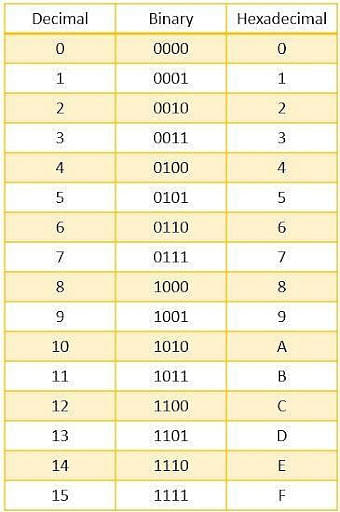
Hexadecimal Number System Conversion Table
| Example: Convert hexadecimal (77F)16 to binary. Solution: As per the table of conversion, 7 = (7)10 7 = (7)10 F = (15)10 Once the decimal of the digit is obtained, with the use of conversion table we get, (7)10 = (0111)2 (7)10 = (0111)2 (F)10 = (1111)2 Combining all the binary digits we get the resultant as, (77F)16 = (0111101111111)2. |
Read More: Decimal to Hex Conversion
Convert Hexadecimal to Octal
Conversion of Hexadecimal to Octal is done in two stages which are, first convert the hexadecimal to decimal number and then later convert to octal number.
| Example: Convert (BE5)16 to Octal. Solution: (BE5)16 = B x 162 + E x 161 + 5 x 160 = 11 x 256 + 14 x 16 + 5 x 1 = 3045. (BE5)16 = (3045)10 Convert the decimal number to octal by dividing it by 8 until the quotient is zero. 3045/8 = 380, remainder = 5 380/8 = 47, remainder = 4 47/8 = 5, remainder = 7 5/8 = 0, remainder = 5 The final resultant of (BE5)16 to Octal = (5745)8 |
Convert Hexadecimal to Decimal
Converting hexadecimal number to decimal is done in equivalent manner as the other two discussed before that is to multiply each number with the power of 16.
| Example: Convert (AC24)16 to Decimal. Solution: (AC24)16 = A x 163 + C x 162 +2 x 161 + 4 x 160 = 10 x 4096 + 12 x 256 + 32 + 4 = 44068. Hence, the decimal corresponding of (AC24)16 = (44068)10. |
Read More: Natural Numbers and Whole Numbers
Conversion From Others to Hexadecimal Number System
[Click Here for Sample Questions]
Conversion from other Number systems such as Binary, Octal, and Decimal to Hexadecimal is all done in a similar way. The conversion table used earlier is taken into use here as well.
Convert Binary to Hexadecimal
To convert binary digits to hexadecimal we take the help of the conversion table.
| Example: Convert (11001111011)2 to Hexadecimal. Solution: In this system, the binary numbers are expressed in ‘4’. Hence, every 4-digit binary becomes 1 digit in hexadecimal. Hence, using the table we get, 0110=6, 0111= 7, 1011= B When we arrange all these numbers together, we get a final number as (11001111011)2 = (67B)16. |
Convert Octal to Hexadecimal
To convert octal number to hexadecimal, we first convert the octal to binary and then to hexadecimal. Octal to Binary has a distinct conversion Table as the 3 binary digits tend to make 1 octal digit. The conversion table is given as

| Example: Convert (150)8 to hexadecimal. Solution: With the help of conversion table, 1 = 001, 5= 101, 0 = 000 Therefore, (150)8 = (001101000)2 Now, by taking a look at binary to hexadecimal table we have, 0110 = 6, 1000 = 8 Thus, (150)8 = (68)16. |
Read More: Binary Operations
Convert Decimal to Hexadecimal
The Decimal to Hexadecimal conversion is calculated by using the base number of hexadecimal which is 16 so the number needs to be bifurcated by 16 until the quotient is zero.
| Example: Convert (150)10 to Hexadecimal. Solution: Fractionate 150 by 16 until the quotient is zero. 150/16 = 9, the remainder is ‘6’. 9/16 = 0, remainder is ‘9’. Write the remainder from bottom to top. Hence, (150)10 = (96)16. |
Hexadecimal Number System With Decimal Point
[Click Here for Sample Questions]
With a decimal point, a hexadecimal digit has two parts:
- Integer
- Fraction.
The integer part is on the left side of the decimal point and the fraction part is on the right-hand side of the decimal point. As the digit use the power of 16, the numbers on the right will have a power of 16 in the non-increasing order.
Read More: Decimal Expansion of Rational Numbers with Solved Examples
Things to Remember
- The hexadecimal number system is a type of number system in Mathematics apart from the binary, octal, and decimal number system.
- In a hexadecimal number system, the base number is 16 where it includes numbers from 0 -9 and digits from A - F.
- The first 9 digits are represented as numbers while the next 6 digits are represented as symbols from A - F. Thus, after the 9th digit, the 10th digit is represented as a symbol. It is like that 10 is represented as A, 11 as B, 12 as C, 13 as D, 14 as E, and 15 as F. Hence, the 16 digits are 1, 2, 3, 4, 5, 6, 7, 8, 9, A, B, C, D, E, F.
- A hexadecimal number system is also referred to as the positional number system as each digit has a weight of power 16.
- The numbers system of Hexadecimal is one of the most convenient ways to depict a binary number in computers and this is done by using a conversion table.
Sample Questions
Ques. Convert 30010 into the Binary System base 2. (3 Marks)
Ans. 30010 is in the form of a Decimal system. Simply, divide 300/2 and write the quotient and the remainder. Repeat this step for every quotient until we get a quotient that is less than two.
| 2 | 300 |
| 2 | 150-0 |
| 2 | 75-0 |
| 2 | 37-1 |
| 2 | 18-1 |
| 2 | 9-0 |
| 2 | 4-1 |
| 2 | 2-0 |
| 1-0 |
The corresponding number in the binary system is obtained by reading all the remainders and last quotient from down to up.
Hence, 30010 = (100101100)2.
Ques. Convert 5BC16 into the Decimal System. (3 Marks)
Ans. 5BC16 is in the hexadecimal form. As per the table, B = 11, C=12, in the hexadecimal system. Thus, we get the equal number in the decimal system,
| 5 | B | C |
| 5 | 11 | 12 |
For 5 5 x 162 = 5 x 256 = 1280
B 11 x 161 = 11 x 16 = 176
C 12 x 160 = 12 x 1 = 12
Sum = 1468
So, 5BC16 = (1468)10.
Ques. Convert 1648 into the Hexadecimal System. (3 Marks)
Ans. We can see that the base of 1648 is 8. First, convert the given number to the decimal system.
For 1 6 4 4 x 80 = 4 x 1 = 4
6x 81 = 6 x 8 = 48
1 x 82 = 1 x 64 = 64
Sum = 116
| 16 | 116 |
|---|---|
| 7-4 |
So, 1648 = (116)10 →1. Now, convert this into hexadecimal system,
So, 11610 = 7416 → 2. From the above steps, we can understand that 1648 = 7416.
Ques. State four facts of the Hexadecimal System. (3 Marks)
Ans. The four simple facts of the Hexadecimal number system are
- Out of many types of number expressing methods, the Hexadecimal is one with the value of base as 16.
- Hence, the Hexadecimal system possesses 16 notations or digital numbers, as, 0, 1, 2, 3, 4, 5, 6, 7, 8, 9, A, B, C, D, E, F.
- A, B, C, D, E, F are expressed as single or one-bit representations of 10, 11, 12, 13, 14, and 15.
- The addition of ‘o’ (prefix) or ‘h’(prefix) signifies HEXADECIMAL.
Ques. How are numbers in a hexadecimal number system converted to others? (3 Marks)
Ans. A number in the hexadecimal number system can be converted to binary, octal, and decimal by utilizing the base number of 16. As each digit has a weight of power 16 in the hexadecimal number system, to convert from hexadecimal, the sum of the product of each digit is used with its positional value by multiplying each digit from the left with 160, 161, 162, 163 and from the right 16-1, 16-2, 16-3.
Ques. How are the numbers represented in the hexadecimal number system? (3 Marks)
Ans. In the hexadecimal number system, there is a 16 digit number representation of numbers from 0 - 9 and digits from A - F. in simpler terms, the first 9 numbers or digits are represented as numbers while the next 6 digits are represented as alphabets from A - F. Hexadecimal number system is quite similar to the decimal number system that has a base number of 9. Thus, after the 9th digit, the 10th digit is represented as a symbol. It is like that 10 is represented as A, 11 as B, 12 as C, 13 as D, 14 as E, and 15 as F. Hence, the 16 digits are 1, 2, 3, 4, 5, 6, 7, 8, 9, A, B, C, D, E, F.
Ques. What do you understand by Hexadecimal Number System with decimal points? (3 Marks)
Ans. A hexadecimal number has two parts when it is with a decimal point - integer and fraction. The fraction part is on the right of the decimal point while the integer part is on the left of the decimal point. As the digits use the power of 16, the digits that are there on the right will have a power of 16 in the decreasing order.
For Latest Updates on Upcoming Board Exams, Click Here: https://t.me/class_10_12_board_updates
Check More:



Comments