



Content Writer
Parathyroid Hormone is a hormone secreted by the parathyroid glands. It controls the blood calcium levels through its actions on the bone, kidney, and intestine. The excess of parathyroid hormone can cause Hypercalcaemia whereas the lack of this hormone can cause a medical condition called Hypoparathyroidism.
Parathyroid Hormone
[Click Here for Sample Questions]
Parathyroid Hormone (PTH) also known as parathormone or parathyrin is a hormone produced by the parathyroid glands that control blood calcium levels through its actions on the bone, kidney, and gut.

Parathyroid Glands
Parathyroid Hormone has an effect on bone remodelling. Bone remodelling is a continuous process in which bone tissue is resorbed and regenerated. PTH is produced in response to low calcium (Ca2+) levels in the blood serum. It promotes osteoclast activity in the bone matrix (osteon) to release more ionic calcium (Ca2+) into the blood to raise a low serum calcium level.
Functions of Parathyroid Hormone
[Click Here for Sample Questions]
Parathyroid Hormone performs its functions by affecting the kidneys, bones, and intestine.
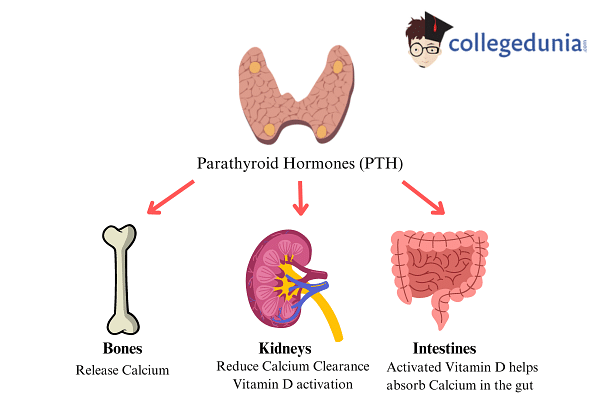
Bone- The release of calcium from substantial calcium deposits in the bones into the circulation is stimulated by the parathyroid hormone. This causes more bone to be destroyed and less new bone to be formed.
Kidney- The parathyroid hormone decreases calcium loss in urine in the kidneys. The synthesis of active vitamin D in the kidneys is also stimulated by the parathyroid hormone.
Intestine - Parathyroid hormone indirectly enhances calcium absorption from meals in the intestine through its effects on vitamin D metabolism
- The major function of the parathyroid hormone is to manage the density of bones by controlling calcium levels in the blood. The range of the bone density is very narrow from 9.0 to 10.1.
- It also aids in the synthesis of activated vitamin D, which increases calcium absorption in the intestine.
- The hormone aids in the reabsorption of calcium from the proximal tubule, distal tubule, and renal collecting ducts during the breakdown of calcium from the bones.
- The control of phosphate is another essential function of the parathyroid hormone.
Excess of Parathyroid Hormone or hyperparathyroidism
[Click Here for Sample Questions]
Primary hyperparathyroidism is a condition in which the parathyroid glands produce too much parathyroid hormone, which increases the calcium levels in the blood. This disease is also known as hypercalcaemia. Hypercalcaemia is caused by increased parathyroid hormone production as a result of all four glands being hyperactive in tertiary hyperparathyroidism, a similar but more uncommon disease.
Secondary hyperparathyroidism is a kind of hyperparathyroidism that develops in reaction to low blood calcium levels and is caused by a variety of factors, including renal illness and vitamin D insufficiency.
Mild primary hyperparathyroidism usually has few symptoms and is identified by a high calcium concentration on a normal blood test. Surgical removal of the afflicted glands may be used as a treatment option known as parathyroidectomy.
Lack of Parathyroid Hormone or Hypoparathyroidism
[Click Here for Sample Questions]
Hypoparathyroidism, or a lack of the parathyroid hormone, is an uncommon medical disease. It can cause low calcium levels in the blood. This condition is also known as hypocalcaemia. Oral calcium and vitamin D analogues are generally used to treat it, however, the availability of parathyroid hormone replacement therapy may modify how certain individuals are treated.
Hypoparathyroidism is most often caused by injury to the parathyroid glands during neck surgery. The parathyroid glands are killed by autoimmune assault or radiation in extremely rare situations. It is generally caused due to tumour therapy or uncommon illnesses that affect the parathyroid glands.
Some persons are born with hypoparathyroidism also known as congenital hypoparathyroidism. The people who do not have surgery-induced hypoparathyroidism, a genetic foundation for the condition is increasingly being recognised among them.
Treatment for Hyperparathyroidism and Hypoparathyroidism
[Click Here for Sample Questions]
Antithyroid medications and radioactive iodine therapy are two treatments for hyperparathyroidism. The condition can be cured by surgically removing non-cancerous parathyroid adenomas as well as the malignant tumour.
Intravenous calcium gluconate can help people with hypoparathyroidism to restore the proper quantity of calcium in their bodies. For someone with an irreversible disease, injections of recombinant human parathyroid hormone combined with calcium supplementation can be a lifelong therapy.
Sample Questions
Ques: Which hormone is secreted by Parathyroid Gland? (1 Mark)
Ans: Parathyroid gland secretes only one hormone called parathyroid hormone or parathormone (PTH)
Ques: List two hormones causing fluctuation of Ca2+ level. (1 Mark)
Ans: Parathyroid hormone and Calcitonin are the two hormones that cause Ca2+ fluctuation.
Ques: Is it possible to inherit hyperparathyroidism and hypoparathyroidism? (2 Marks)
Ans: Medical problems affecting the parathyroid glands are generally caused by internal or external sources. Injuries, post-surgery difficulties, and tumorous development (both malignant and non-cancerous) are some of the most common causes of both of these illnesses. They can also be inherited from a parent. Many examples of family hereditary hyperparathyroidism have been reported. As a result, it's impossible to rule out the possibility of acquiring these diseases from parents. It is usually caused by tumorous development in one of the four parathyroid glands, although in certain situations, more than one gland may be involved.
Ques: What if someone has a dangerously low PTH level? (2 Marks)
Ans: The three types of PTH and their widely recognised levels are as follows:
C-terminal- 50 to 330 pg/mL
N-terminal- 8 to 24 pg/mL
Intact molecule- 10 to 65 pg/mL
Someone with a severe case of hypoparathyroidism may be given calcium gluconate intravenously. This will help the patient in balancing out the dangerously low PTH levels. Alternatively, a dietary calcium supplement combined with Vitamin D analogues can aid in the restoration of calcium levels in the afflicted person.
Ques: Where is the parathyroid gland located? (2 Marks)
Ans: The parathyroid gland is located behind, next to, or within the thyroid gland in the neck. It is located adjacent to each side of Adam’s apple. The number of glands varies, although most people have four when they are born. They are roughly the size of a grain of rice and are located on either side of the neck, one above the other. The parathyroid gland is made up of epithelial cells that produce parathyroid hormone and will be well-supplied by capillary beds.
Ques: What are the functions of Parathyroid Hormone (PTH)? (2 Marks)
Ans: The parathyroid gland secretes the parathyroid hormone. Its primary purpose is to raise calcium levels in the blood. It encourages calcium reabsorption from the nephrons as well as calcium absorption from digested meals. As a result, it is critical for maintaining calcium equilibrium in the body.
Ques: Difference between Primary and secondary Hyperparathyroidism (3 Marks)
Ans: (1) Primary Hyperparathyroidism- This type of hyperparathyroidism occurs when there is an anomaly inside or around the parathyroid glands, such as a malignant or non-cancerous tumorous growth on the gland, or hyperplasia, or enlargement of at least two of the glands. Primary hyperparathyroidism can also be passed down through the generations.
(2) Secondary Hyperparathyroidism- This is a condition that causes the overproduction of parathyroid hormones, but it is not caused by any physical abnormalities of the parathyroid glands. PTH overproduction might have serious consequences for the individual who is afflicted. Kidney stones can occur as a result of significant and persistent calcification, which is a major risk factor. This can cause severe kidney discomfort, especially during urination.
Ques: Write short notes on the functions of the following hormones:
(a) Parathyroid hormones (PTH)
(b) Thyroid hormones
(c) Thymosin
(d) Androgens
(e) Estrogens
(f) Insulin and Glucagon. (5 Marks)
Ans: (a) Parathyroid hormone decreases the level of phosphate in the blood and increases the level of calcium in the bones.
(b) Thyroid gland secretes three hormones: thyroxine, triiodothyronine and calcitonin. Calcitonin regulates the concentration of calcium in the blood.
Thyroxine and triiodothyronine control the metabolism of the body, promote the growth of body tissues and stimulate differentiation in tissues.
(c) Thymus secretes thymosin hormone. It increases the division of cells and regulates the development and differentiation of T-lymphocytes.
(d) Androgens hormones are secreted by the testis. These hormones stimulate the development of the male reproductive system, regulates the formation of sperms and also determines the sexual behaviour and the sex urge in males.
(e) Ovaries secrets the Estrogen. They stimulate the female reproductive tract to become functional. They also regulate the differentiation of ova and the development of accessory sex characters.
(f) Insulin is secreted by the pancreas. This hormone lowers the glucose level in the blood and promotes the synthesis of proteins and fats. Glucagon is also secreted by the pancreas. This hormone increases the blood glucose level.



Comments