




The ICSE Class 10 Syllabus 2027 is divided into three groups, namely Group I (compulsory), Group II, and Group III, for the academic year 2026–27 totaling 100 marks per subject.
The ICSE Class 10 Syllabus 2027 covers all subjects including English, Mathematics, Science, History-Civics, and Geography. The syllabus is the same as the previous year since no major topics have been added or removed. You can download the ICSE 10th Syllabus 2027 official subject-wise PDFs directly from the CISCE Official Website
| ICSE Class 10 Syllabus 2027 PDF Download (Official CISCE) |
- The ICSE Class X 2027 syllabus covers subjects across three groups: Group I (compulsory languages and social sciences), Group II (optional sciences and mathematics), and Group III (skill and vocational subjects).
- Group I and Group II papers follow an 80 marks theory + 20 marks internal assessment pattern (total 100 marks per subject).
- Group III subjects follow a 50 marks theory + 50 marks practical pattern in ICSE 10th Syllabus 2027.
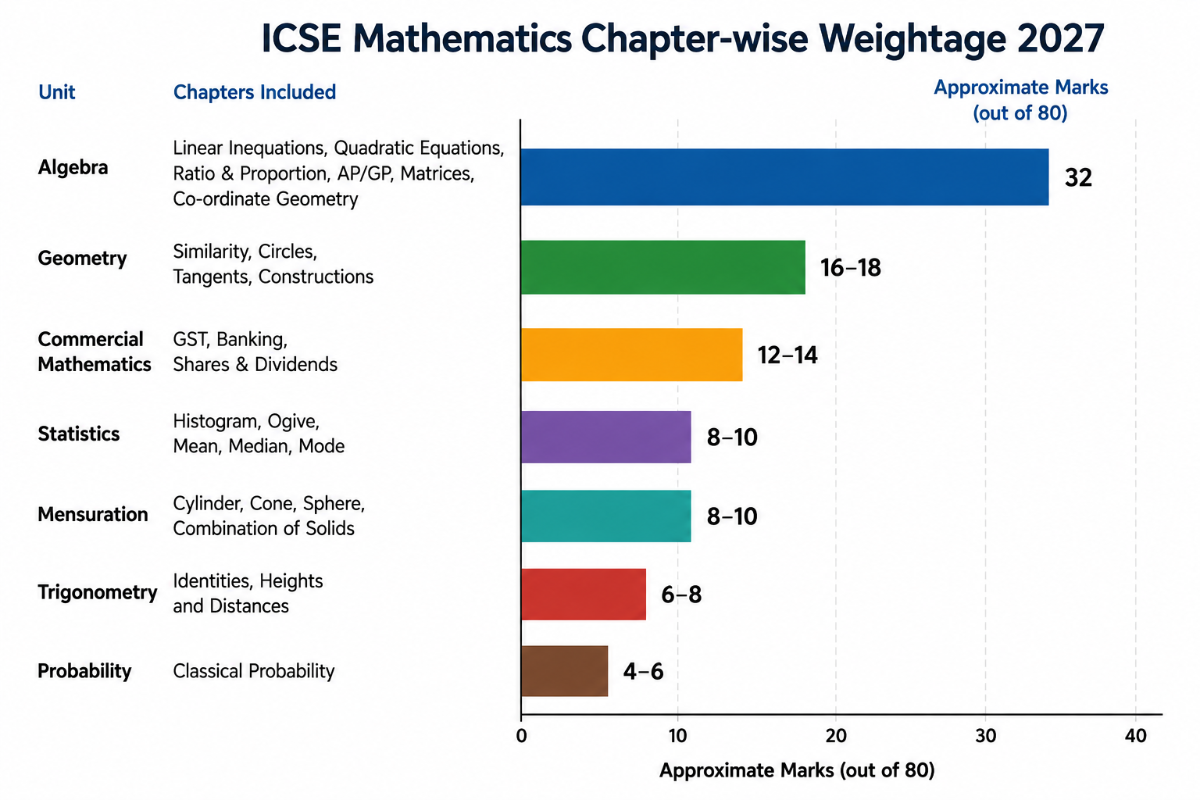
- Mathematics carries the highest individual chapter weightage, with Algebra alone contributing approximately 32 marks out of 80.
- In English, Composition, Letter Writing, Notice & Email, and Comprehension cover most of the syllabus.
- Some of the important sections of Physics include Force, Work, Power and Energy, Light (Reflection and Refraction), Sound, and Current Electricity.
- In Chemistry, Chemical Bonding, Acids, Bases and Salts, Mole Concept, Electrolysis, and the Periodic Table are the most important chapters.
ICSE theory examinations for 2027 are expected to be held between February and March 2027. You should cover the complete unit-wise ICSE 10th Syllabus 2027 for each subject and practise with previous year question papers to maximise your score in the ICSE 2027 board exam.
Check:
- ICSE Class 10 Board Exam Pattern 2027: Marking Scheme, Paper Format, Duration and Total Marks
- ICSE Preparation Tips 2027: Check Subject-Wise Tips and Important Topics
- ICSE Class 10 Question Papers: Download Previous Years' Question Paper PDF
ICSE Class X Syllabus 2027: Download Subject-wise PDFs
CISCE has published the official ICSE Class 10 syllabus 2027 PDF download for the 2026–27 academic year on its website.
| Subject | ICSE Class X Syllabus 2027 PDF |
|---|---|
| English Language | ICSE English Language Syllabus PDF |
| Literature in English | ICSE Literature in English Syllabus PDF |
| History and Civics | ICSE History and Civics Syllabus PDF |
| Geography | ICSE Geography Syllabus PDF |
| Economics | ICSE Economics Syllabus PDF |
| Mathematics | ICSE Mathematics Syllabus PDF |
| Physics | ICSE Physics Syllabus PDF |
| Chemistry | ICSE Chemistry Syllabus PDF |
| Biology | ICSE Biology Syllabus PDF |
| Computer Applications | ICSE Computer Applications Syllabus PDF |
| Commercial Studies | ICSE Commercial Studies Syllabus PDF |
| Environmental Science | ICSE Environmental Science Syllabus PDF |
| Economic Applications | ICSE Economic Applications Syllabus PDF |
| Commercial Applications | ICSE Commercial Applications Syllabus PDF |
| Home Science | ICSE Home Science Syllabus PDF |
| Physical Education | ICSE Physical Education Syllabus PDF |
| Hindi | ICSE Hindi Syllabus PDF |
ICSE Class 10 Syllabus 2027: Subject-wise Structure 2026–27
Students must study subjects across three compulsory groups in ICSE Syllabus 2027 Class 10:
| Group | Subjects | Compulsory / Optional |
|---|---|---|
| Group I | English Language (Paper 1), English Literature (Paper 2), Second Language (Hindi / Regional) | Compulsory |
| Group II | History & Civics, Geography, Mathematics, Science (Physics, Chemistry, Biology) | Any 2 from this group are compulsory; Math & Science almost universally chosen |
| Group III | Computer Applications, Economic Applications, Commercial Studies, Environmental Science, Physical Education, Technical Drawing, etc. | Any 1 optional subject |
ICSE Class X English Language Syllabus 2027
The ICSE English Language paper (Paper 1, Group I) carries 80 marks and tests writing skills, grammar, and reading comprehension. This ICSE Syllabus 2027 Class 10 paper is compulsory for all ICSE Class X students and must be passed to receive the certificate. The duration is 2 hours.
| Section | Topic | Marks (out of 80) |
|---|---|---|
| Composition | Directed Writing (Notice, Letter, Report, Article, Speech); Essay Writing (Descriptive, Narrative, Argumentative, Discursive); Short Composition (dialogue, summary, email). | 30 |
| Comprehension and Summary | Unseen prose passage; questions on content, inference, vocabulary in context; summary writing (identifying and presenting main points from the passage in your own words). | 30 |
| Grammar | Sentence transformation; sentence combination; gap-filling (prepositions, conjunctions, articles); error correction; rearranging jumbled sentences; active and passive voice; direct and indirect speech; degrees of comparison. | 20 |
ICSE Class X Literature in English Syllabus 2027
Literature in English (Paper 2, Group I) covers prescribed prose, poetry, and drama texts. CISCE prescribes specific texts for each academic year; verify the exact prescribed books for 2026–27 from the official ICSE specimen paper on cisce.org. The ICSE Syllabus 2027 Class 10 paper carries 80 marks and lasts 2 hours.
| Section | Component | Details |
|---|---|---|
| Section A — Drama or Prose Text | Prescribed Text | Character analysis, theme, setting, and extract-based contextual questions from the prescribed play or prose text (Shakespeare or other prescribed author as per CISCE list). |
| Section B — Poetry | Prescribed Poems | Questions on meaning, poetic devices, tone, theme, and extract-based contextual questions from the prescribed poetry anthology. |
| Section C — Short Stories or Novel | Prescribed Short Stories or Novel | Character analysis, plot summary, extract-based comprehension, and theme-based essay questions on the prescribed short story collection or novel. |
ICSE Class X History and Civics Syllabus 2027
History and Civics is Paper 1 of the Humanities, Civics and Geography (H.C.G.) Group I combination in the ICSE Board Class 10 Syllabus 2027. The paper carries 80 marks and is split into two parts — Civics (the Indian Union government) and History (Indian national movement and world history).
| Part | Unit | Key Topics |
|---|---|---|
| Part I — Civics | The Union Legislature |
|
| Part I — Civics | The Union Executive |
|
| Part I — Civics | The Judiciary |
|
| Part II — History | The Indian National Movement (1857–1947) | First War of Independence (1857); Growth of Nationalism — formation of Congress, Moderates and Extremists; Partition of Bengal and Swadeshi Movement; Home Rule Movement; Non-Cooperation Movement (1920–22); Civil Disobedience Movement (1930–34); Quit India Movement (1942); Role of Subhash Chandra Bose and the INA; The Last Phase (1945–47) and Transfer of Power. |
| Part II — History | Contemporary World History | The First World War (1914–1918) — causes, major events, results; Rise of Fascism and Nazism in Europe; The Second World War (1939–45) — causes, events, consequences; The United Nations Organisation — formation, structure, objectives, principal organs, role; Non-Aligned Movement — origin and significance. |
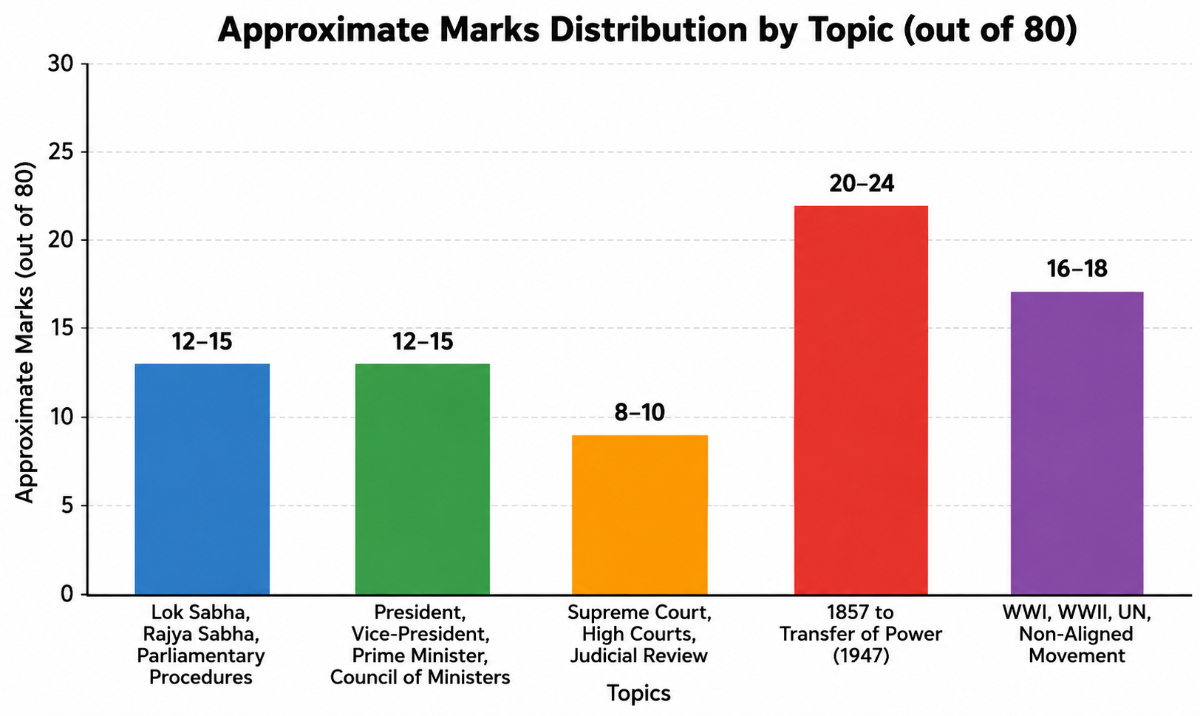
ICSE History and Civics Chapter-wise Weightage 2027
| Unit | Topics | Approximate Marks (out of 80) |
|---|---|---|
| Civics — Union Legislature | Lok Sabha, Rajya Sabha, Parliamentary Procedures | 12–15 |
| Civics — Union Executive | President, Vice-President, Prime Minister, Council of Ministers | 12–15 |
| Civics — Judiciary | Supreme Court, High Courts, Judicial Review | 8–10 |
| History — Indian National Movement | 1857 to Transfer of Power (1947) | 20–24 |
| History — World History | WWI, WWII, UN, Non-Aligned Movement | 16–18 |
ICSE Class X Geography Syllabus 2027
Geography is Paper 2 of the H.C.G. combination under Group I and carries 80 marks in the ICSE Board Class 10 Syllabus 2027. The paper includes a compulsory map-based component. Map work carries up to 10 marks and requires regular practice using a blank outline map of India.
| Unit | Chapter | Key Topics |
|---|---|---|
| 1 | Soils | Types of soils — alluvial, black, red, laterite, mountain, desert soils; Factors affecting soil formation; Types of soil erosion and conservation methods; Importance of soil conservation for agriculture. |
| 2 | Natural Vegetation | Types of natural vegetation — tropical evergreen forests, tropical deciduous forests, tropical thorn and scrub, mountain vegetation, mangrove forests; Distribution across India; Importance and conservation of forests. |
| 3 | Water Resources | Sources of water — rivers, lakes, groundwater; Multipurpose river valley projects (Bhakra Nangal, Damodar Valley, Hirakud); Rainwater harvesting; Water scarcity and conservation strategies. |
| 4 | Mineral and Energy Resources | Metallic minerals — iron ore, copper, bauxite, manganese; Non-metallic minerals — mica, limestone; Conventional energy — coal, petroleum, natural gas; Non-conventional energy — solar, wind, hydroelectric, biogas, tidal energy. |
| 5 | Agriculture | Types of farming — subsistence, commercial, mixed, plantation; Major food crops — rice, wheat, pulses, millets; Major cash crops — cotton, jute, sugarcane, tea, coffee; Green Revolution and its impact on Indian agriculture. |
| 6 | Industries | Classification of industries; Major industries — Cotton Textile (Mumbai–Ahmedabad belt), Iron and Steel (Jamshedpur, Bhilai, Rourkela), Petrochemicals, Software (Bengaluru, Hyderabad, Pune); Factors of industrial location; Industrial pollution and control measures. |
| 7 | Transport | Types of transport — road, rail, water, air, pipeline; Golden Quadrilateral and National Highways; Indian Railways — zones, importance; Major airports and seaports in India; Importance of transport in economic development. |
| 8 | Map Work | Identification and marking of major rivers, mountain ranges, peaks, cities, industries, crop-producing regions, and mineral belts on a blank political map of India. |
Check:
ICSE Class X Mathematics Syllabus 2027
Mathematics is the most popular Group II subject for the ICSE Class X syllabus 2027. The Mathematics theory paper carries 80 marks and lasts 2.5 hours; internal assessment contributes the remaining 20 marks. Algebra has the highest chapter-level weightage at approximately 32 marks out of 80.
| Unit | Chapter | Sub-topics |
|---|---|---|
| 1 | Commercial Mathematics | GST (Goods and Services Tax) — concept, types (CGST, SGST, IGST), calculation with input tax credit; Banking — savings accounts, recurring deposits, fixed deposits, interest calculations; Shares and Dividends — face value, market value, rate of return, annual income from shares. |
| 2 | Algebra | Linear Inequations in one variable; Quadratic Equations in one variable (factorisation and quadratic formula); Ratio and Proportion (proportion, componendo-dividendo rule); Factorisation of polynomials; Matrices — order, types, addition, subtraction, multiplication of 2×2 matrices; Arithmetic Progressions — nth term, sum of n terms; Geometric Progressions — nth term and sum; Co-ordinate Geometry — distance formula, section formula, mid-point formula, equation of a straight line, slope. |
| 3 | Geometry | Similarity — similar triangles (AA, SAS, SSS), applications to maps and models, areas of similar triangles; Loci — concept of locus, standard loci results; Circles — arc and chord properties, angle subtended by a chord, cyclic quadrilateral properties; Tangent and Secant — tangent to a circle at a point, properties; Constructions — circumscribed and inscribed circles of triangles, tangents from an external point. |
| 4 | Mensuration | Surface area and volume of 3D solids — Cylinder (curved surface area, total surface area, volume); Cone (slant height, curved surface area, total surface area, volume); Sphere (surface area, volume); Hemisphere (curved and total surface area, volume); Combination of solids (e.g., cone mounted on a cylinder, hemisphere on a cylinder). |
| 5 | Trigonometry | Trigonometric identities — proving and using standard identities; Heights and Distances — angle of elevation, angle of depression; Problems involving right-angled triangles using sin, cos, tan, cosec, sec, cot. |
| 6 | Statistics | Graphical representation — Histogram, Frequency Polygon, Ogive (cumulative frequency curve); Measures of central tendency — Mean (direct, short-cut, step-deviation methods for grouped data), Median (from ogive), Mode (from histogram); Quartiles and inter-quartile range from ogive. |
| 7 | Probability | Classical definition of probability; Random experiments; Sample space; Events — simple, compound, complementary; Probability of an event; Problems on playing cards, dice, and coins; Probability scale (0 to 1). |
Check:
- ICSE Board Class 10 Mathematics 2026 Question Paper with Solution PDF
- ICSE Class 10 Mathematics Question Paper 2023 with Answer Key
- ICSE Class 10 Mathematics Question Paper 2020 with Answer Key (March 3)
ICSE Mathematics Chapter-wise Weightage 2027
| Unit | Chapters Included | Approximate Marks (out of 80) |
|---|---|---|
| Algebra | Linear Inequations, Quadratic Equations, Ratio & Proportion, AP/GP, Matrices, Co-ordinate Geometry | 32 |
| Geometry | Similarity, Circles, Tangents, Constructions | 16–18 |
| Commercial Mathematics | GST, Banking, Shares & Dividends | 12–14 |
| Statistics | Histogram, Ogive, Mean, Median, Mode | 8–10 |
| Mensuration | Cylinder, Cone, Sphere, Combination of Solids | 8–10 |
| Trigonometry | Identities, Heights and Distances | 6–8 |
| Probability | Classical Probability | 4–6 |
ICSE Class X Physics Syllabus 2027
Physics is Paper 1 of Science under Group II for ICSE Class X. The theory paper carries 80 marks (2 hours) and the practical carries 20 marks, assessed by the school and moderated by CISCE. Section A (40 marks) has compulsory short-answer questions; Section B (40 marks) offers internal choice.
| Unit | Chapter | Sub-topics |
|---|---|---|
| 1 | Force | Turning effect of forces — moment of a force, torque, principle of moments; Centre of gravity — location in regular bodies, stability (stable, unstable, neutral equilibrium); Uniform circular motion — centripetal force, examples (Earth’s orbit, car on a curved road). |
| 2 | Work, Energy and Power | Work done by a force; Kinetic energy and Potential energy — formulae and examples; Law of conservation of energy; Power — formulae and units; Simple machines — levers (classes I, II, III), pulley systems (single fixed, single movable, block and tackle); Mechanical Advantage (MA), Velocity Ratio (VR), Efficiency — relationships and calculations. |
| 3 | Light — Refraction and Lenses | Refraction at a plane surface — laws of refraction, refractive index, Snell’s Law, apparent depth; Total internal reflection — critical angle, conditions, applications (optical fibre, prism periscope, sparkling of diamonds); Refraction through a lens — convex and concave lenses, lens formula, magnification, power of a lens; Human eye — structure, accommodation, defects (myopia, hypermetropia, presbyopia) and correction; Simple microscope and astronomical telescope (ray diagrams). |
| 4 | Spectrum | Electromagnetic spectrum — members, wavelength range, and uses; Dispersion of white light through a prism; Scattering of light — Rayleigh scattering; Why the sky is blue and sunsets are red; Colours of objects. |
| 5 | Sound | Properties of sound waves (longitudinal, transverse); Characteristics of sound — pitch, loudness, quality (timbre); Speed of sound in different media; Reflection of sound — echo, reverberation; Resonance; Free and forced vibrations; Applications of sound reflection (SONAR, acoustics of buildings). |
| 6 | Electricity and Magnetism | Ohm’s Law; Resistance — factors affecting it, specific resistance (resistivity); Series and parallel circuits — equivalent resistance, current and voltage; EMF and internal resistance; Electrical power and energy — formulae and units; Domestic electric circuits — earthing, fuses, MCBs, safety precautions; Magnetic effect of current — Oersted’s experiment, field due to a straight conductor and a coil; Electromagnets; Force on a current-carrying conductor (Fleming’s Left-Hand Rule); DC Motor; Electromagnetic induction — Faraday’s Laws, Fleming’s Right-Hand Rule, AC Generator; Transformer (principle, step-up, step-down). |
| 7 | Heat | Calorimetry — heat capacity, specific heat capacity, principle of calorimetry (method of mixtures); Latent heat — specific latent heat of fusion and vaporisation; Numerical problems on heat gained and heat lost. |
| 8 | Modern Physics | Radioactivity — alpha, beta, gamma radiations; Properties of nuclear radiations; Background radiation; Detectors of radiation (Geiger-Müller tube); Safe handling and uses of radioisotopes; Nuclear energy — fission chain reaction, fusion; Basic principle of a nuclear reactor. |
Check:
- ICSE Board Class 10 Physics – Science Paper 1 2026 Question Paper with Solution PDF
- ICSE Class 10 Physics Question Paper 2023 with Answer Key
- ICSE Class 10th Physics Exam Paper Analysis 2022: Check Expert Reviews Here
- ICSE Class 10 Science Paper 1 (Physics) Question Paper 2020 with Answer Key
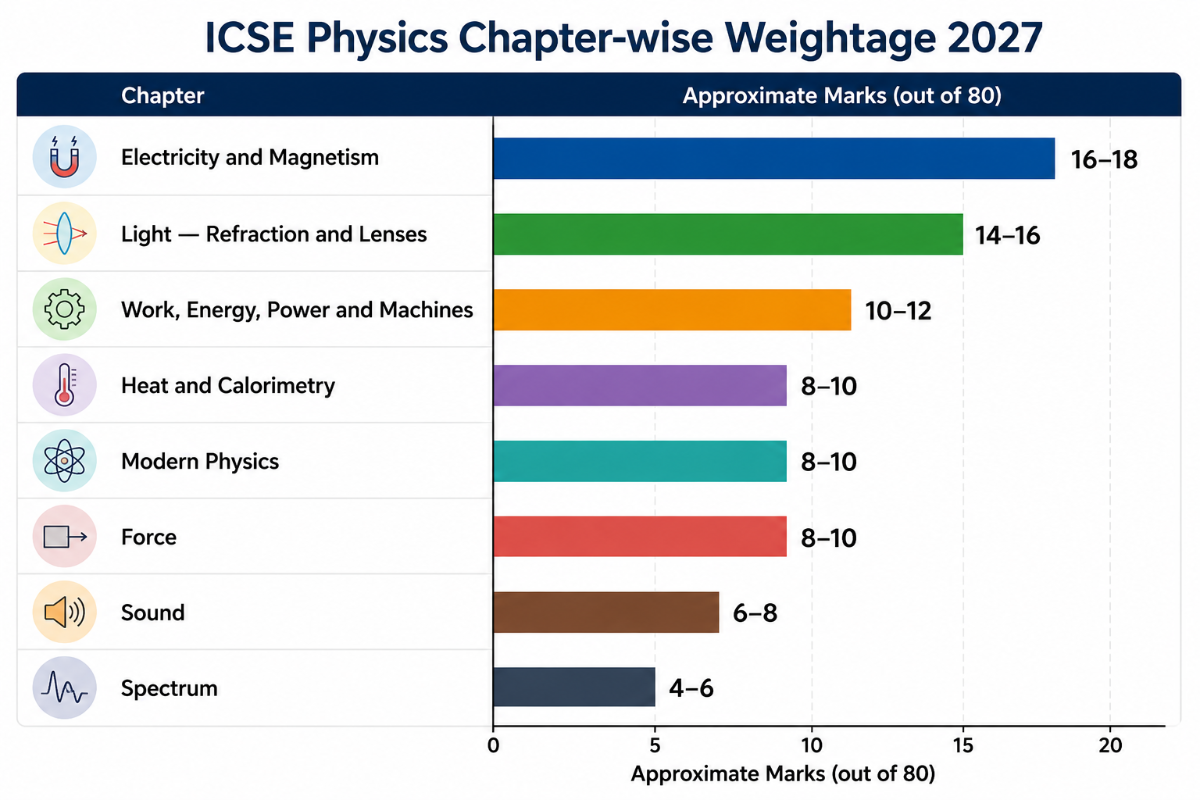
ICSE Physics Chapter-wise Weightage 2027
| Chapter | Approximate Marks (out of 80) |
|---|---|
| Electricity and Magnetism | 16–18 |
| Light — Refraction and Lenses | 14–16 |
| Work, Energy, Power and Machines | 10–12 |
| Heat and Calorimetry | 8–10 |
| Modern Physics | 8–10 |
| Force | 8–10 |
| Sound | 6–8 |
| Spectrum | 4–6 |
ICSE Class X Chemistry Syllabus 2027
Chemistry is Paper 2 of Science under Group I of the ICSE Class 10 Syllabus 2027. The theory paper carries 80 marks and the practical carries 20 marks. Numerical problems appear frequently in the Mole Concept and Electrolysis units. Students must also practise balanced chemical equations for every reaction-based chapter.
| Unit | Chapter | Sub-topics |
|---|---|---|
| 1 | Periodic Table | Periodic properties — atomic size, metallic character, electron affinity, electronegativity, ionisation energy; Variation across periods and down groups; Significance of the Modern Periodic Table. |
| 2 | Chemical Bonding | Electrovalent (ionic) bonds — electron transfer, formation of ions, properties of ionic compounds; Covalent bonds — electron sharing, single, double and triple bonds, properties; Co-ordinate (dative) bonds; Comparison of ionic and covalent compounds. |
| 3 | Acids, Bases and Salts | Properties of acids and bases (Arrhenius concept); pH scale; Neutralisation reactions; Types of salts — normal, acid, basic, double, complex; Methods of preparation of salts; Properties of salts. |
| 4 | Analytical Chemistry | Identification of cations: Na+, K+, Ca2+, Fe2+, Fe3+, Cu2+, Zn2+, Al3+, NH4+, Pb2+; Identification of anions: Cl−, SO42−, CO32−, NO3−; Tests using specific reagents; Flame test colours; Colour of compounds. |
| 5 | Mole Concept and Stoichiometry | Atomicity; Relative Atomic Mass and Molecular Mass; Mole — Avogadro’s number; Molar mass; Gay-Lussac’s Law of combining volumes; Molar volume at STP; Percentage composition; Empirical and molecular formulae; Stoichiometric calculations from balanced equations. |
| 6 | Electrolysis | Electrolytes and non-electrolytes; Electrolytic dissociation; Electrolysis of dilute sulphuric acid; Electrolysis of acidified water; Electrolysis of brine (sodium chloride solution); Discharge of ions at electrodes; Applications — electroplating, electrorefining, extraction of aluminium. |
| 7 | Metallurgy | Occurrence of metals; Activity series and extraction methods; Extraction of zinc (reduction) and iron (blast furnace); Alloys — composition and uses (brass, bronze, stainless steel); Corrosion — rusting of iron, prevention methods (galvanising, electroplating, painting). |
| 8 | Study of Compounds — Ammonia and Nitric Acid | Ammonia — laboratory preparation (ammonium chloride + calcium hydroxide), industrial preparation (Haber Process), physical and chemical properties, uses (fertilisers, refrigerants); Nitric Acid — laboratory preparation (copper + conc. HNO3), industrial preparation (Ostwald Process), dilute and concentrated acid properties, uses. |
| 9 | Study of Compounds — Sulphuric Acid | Industrial preparation (Contact Process — steps and conditions); Properties of dilute H2SO4 as an acid; Properties of concentrated H2SO4 as a dehydrating agent and as an oxidising agent; Reactions with metals and non-metals; Uses. |
| 10 | Organic Chemistry | Introduction to organic compounds; Hydrocarbons — alkanes, alkenes, alkynes (IUPAC nomenclature, preparation, properties, substitution and addition reactions); Homologous series; Isomerism (structural); Functional groups; Ethanol — preparation (fermentation, hydration of ethylene), properties, uses; Ethanoic acid — preparation, properties, uses. |
Check:
- ICSE Board Class 10 2026 Chemistry – Science Paper 2 Question Paper with Solutions : Download PDF
- ICSE Class 10 Chemistry Question Paper 2023 with Answer Key
- ICSE Class 10 Science Paper 2 (Chemistry) Question Paper 2020 with Answer Key
ICSE Chemistry Chapter-wise Weightage 2027
| Chapter | Approximate Marks (out of 80) |
|---|---|
| Study of Compounds (Ammonia, Nitric Acid, Sulphuric Acid) | 12–14 |
| Acids, Bases and Salts | 10–12 |
| Analytical Chemistry | 8–10 |
| Mole Concept and Stoichiometry | 8–10 |
| Electrolysis | 8–10 |
| Organic Chemistry | 8–10 |
| Metallurgy | 6–8 |
| Periodic Table and Chemical Bonding | 8–10 |
ICSE Class X Biology Syllabus 2027
Biology is Paper 3 of Science under Group II for ICSE Class 10 Syllabus 2027. The theory paper carries 80 marks and the practical carries 20 marks. Human anatomy and physiology is the most heavily tested section, covering multiple organ systems. Diagrams with accurate labels are compulsory in Biology and carry dedicated marks every year in ICSE Class 10 Syllabus.
| Unit | Chapter | Sub-topics |
|---|---|---|
| 1 | Cell Biology | Cell as the basic unit of life; Cell organelles — nucleus, mitochondria, chloroplast, endoplasmic reticulum, Golgi body, ribosomes, vacuoles, lysosomes, centrosome; Cell division — Mitosis (phases and significance), Meiosis (overview and significance in reproduction and variation); Comparison of plant and animal cells. |
| 2 | Plant Physiology | Absorption and Ascent of Sap — osmosis, plasmolysis, root pressure, cohesion-tension theory; Transpiration — types (stomatal, lenticular, cuticular), significance, factors affecting, wilting; Photosynthesis — light and dark reactions, chloroplasts, factors affecting, significance; Respiration in plants — aerobic and anaerobic, Krebs cycle (overview); Growth regulators — auxins and gibberellins (role). |
| 3 | Human Anatomy and Physiology — Circulatory and Excretory Systems | Circulatory System — structure of the human heart, cardiac cycle, blood vessels (arteries, veins, capillaries), blood composition (plasma, RBCs, WBCs, platelets), ABO blood groups, Rh factor, disorders (hypertension, coronary artery disease); Excretory System — structure of the kidney, nephron (diagram), process of urine formation (glomerular filtration, tubular reabsorption, tubular secretion), kidney disorders (kidney stones, dialysis). |
| 4 | Human Anatomy and Physiology — Nervous and Endocrine Systems | Nervous System — neuron structure, central nervous system (brain and spinal cord), peripheral nervous system, autonomic nervous system, reflex arc, sense organs (structure of the eye and ear); Endocrine System — major glands (pituitary, thyroid, parathyroid, adrenal, pancreas, gonads), hormones and their functions, feedback mechanism, diabetes mellitus. |
| 5 | Human Anatomy and Physiology — Reproductive System | Male and female reproductive organs (labelled diagrams); Menstrual cycle; Fertilisation; Foetal development; Birth and parturition; Sexually transmitted infections (STIs) and their prevention. |
| 6 | Genetics | Mendel’s Laws — Law of Segregation, Law of Independent Assortment; Monohybrid and dihybrid crosses; Punnett square method; Phenotype, genotype, dominant, recessive alleles; Sex determination in humans (XX/XY); Hereditary diseases — haemophilia, colour blindness, sickle-cell anaemia, Down’s syndrome. |
| 7 | Evolution | Theories of evolution — Lamarck’s theory (use and disuse), Darwin’s theory (natural selection, survival of the fittest, variations); Evidence for evolution — fossil record, comparative anatomy (homologous and analogous organs), embryology; Human evolution (brief overview). |
| 8 | Health and Hygiene | Bacterial diseases — tuberculosis, cholera (causes, symptoms, prevention); Viral diseases — dengue, influenza, AIDS/HIV; Protozoan diseases — malaria, amoebic dysentery; Vaccination and immunisation; Tobacco, alcohol, and drug abuse — effects on health and society; Cancer — types, causes, treatment basics; AIDS — transmission and prevention. |
| 9 | Population and Environment | Population growth — causes, demographic transition, consequences, control measures; Environmental issues — deforestation (causes and effects), pollution (air, water, soil, noise — sources and control); Ozone layer depletion — causes and effects; Global warming and greenhouse effect; Conservation of biodiversity; Sustainable development. |
Check:
- ICSE Board Class 10 Biology Question Paper 2026 Available- Download PDF with Solutions
- ICSE Class 10 Biology Question Paper 2023 with Answer Key
- ICSE Class 10 Science Paper 3 (Biology) Question Paper 2020 with Answer Key
ICSE Biology Chapter-wise Weightage 2027
| Chapter | Approximate Marks (out of 80) |
|---|---|
| Human Anatomy and Physiology (all systems combined) | 28–32 |
| Plant Physiology | 12–14 |
| Genetics | 10–12 |
| Cell Biology | 8–10 |
| Health and Hygiene | 8–10 |
| Evolution | 6–8 |
| Population and Environment | 6–8 |
ICSE Class 10 Subject Group Structure
The ICSE Class 10 examination is structured in three groups. You must study all subjects in Group 1, choose a defined number of subjects from Group 2, and may optionally select subjects from Group 3.
Group 1: Compulsory Subjects
All candidates must study and appear for examination in every subject listed under Group 1. Group 1 covers the core language, social science, and second language requirements of the ICSE curriculum.
| Subject | Code | Theory Marks | Practical / Internal | Duration |
|---|---|---|---|---|
| English Language | 101 | 80 | 20 (Internal) | 2 hrs |
| Literature in English | 102 | 80 | None | 2 hrs |
| History & Civics | 111 | 80 | None | 2 hrs |
| Geography | 112 | 80 | 20 (Practical) | 2 hrs |
| Second Language (e.g. Hindi / French / German / etc.) | Varies | 80 | None / Varies | 3 hrs |
Group 2: Science, Mathematics and Other Electives
Candidates must take at least two subjects from Group 2. The sciences (Physics, Chemistry, Biology) and Mathematics are the most commonly chosen subjects.
| Subject | Code | Theory Marks | Practical / Internal | Duration |
|---|---|---|---|---|
| Mathematics | 211 | 80 | None | 2.5 hrs |
| Physics | 212 | 80 | 20 (Practical) | 2 hrs |
| Chemistry | 213 | 80 | 20 (Practical) | 2 hrs |
| Biology | 214 | 80 | 20 (Practical) | 2 hrs |
| Computer Applications | 221 | 80 | 20 (Practical) | 2 hrs |
| Commercial Studies | 230 | 80 | 20 (Project) | 2 hrs |
| Economics | 231 | 80 | 20 (Project) | 2 hrs |
| Environmental Science | 240 | 80 | 20 (Project) | 2 hrs |
| Technical Drawing Appls. | 251 | 80 | 20 (Practical) | 2 hrs |
Group 3: Optional Subjects
Group 3 subjects are fully optional. Students who wish to study an additional creative, vocational, or physical education subject may choose one subject from Group 3.
| Subject | Code | Theory Marks | Practical / Internal | Duration |
|---|---|---|---|---|
| Art | 305 | 30 | 70 (Studio Work) | 3 hrs |
| Cookery | 306 | 30 | 70 (Practical) | 2.5 hrs |
| Fashion Designing | 261 | 50 | 50 (Practical) | 2 hrs |
| Home Science | 307 | 50 | 50 (Practical) | 2 hrs |
| Performing Arts | 310 | 30 | 70 (Performance) | 2 hrs |
| Physical Education | 270 | 50 | 50 (Practical) | 2 hrs |
| Yoga | 312 | 50 | 50 (Practical) | 2 hrs |
ICSE Class X 2027 Subject-wise Preparation Tips
Use these subject-wise strategies to cover the ICSE Class X 2027 syllabus efficiently and score well in the board exam.
English Language
- Practise letter writing, essay writing, and notice writing regularly. Each format follows fixed conventions.
- Read quality newspapers daily to build vocabulary and improve comprehension speed.
- Solve at least 10 previous year Grammar sections to cover all sentence transformation types.
- Grammar questions carry 20 marks — do not skip sentence transformation practice.
- Practise summary writing by identifying 5–6 key ideas from unseen passages under timed conditions.
Mathematics
- Start with Algebra — it carries approximately 32 marks, the highest of any single unit.
- Practise Co-ordinate Geometry problems daily. Formula recall alone is not enough; application matters.
- Solve Section A-type short-answer questions from all chapters. This section is compulsory.
- Complete all exercises in the Selina Concise Mathematics book before moving to specimen papers.
- Revise mensuration formulae for cylinders, cones, and spheres at least a week before the exam.
Physics
- Focus heavily on Light (refraction and lenses) and Electricity — together they account for about 30 marks.
- Practise numericals on Ohm’s Law, series-parallel circuits, and the lens formula daily.
- Draw neat, labelled ray diagrams for optics and circuit diagrams for electricity questions.
- Understand the working principle of machines (levers, pulley systems) rather than memorising numbers.
- Revise Modern Physics (radioactivity and nuclear energy) — it is frequently asked in Section A.
Chemistry
- Memorise all balanced chemical equations. Equations carry marks in every section of the Chemistry paper.
- Analytical Chemistry (identification of cations and anions) is directly linked to practicals. Learn all colour changes and reagent tests.
- Practise Mole Concept numericals every alternate day. Calculation accuracy is essential here.
- Study the preparation and properties of ammonia, nitric acid, and sulphuric acid in full — these are high-yield chapters every year.
- Make a one-page reference sheet of all industrial processes (Haber, Ostwald, Contact) with conditions.
Biology
- Practise drawing labelled diagrams of the heart, kidney, nephron, brain, eye, and ear regularly. These are asked every year.
- Genetics problems (Punnett squares, ratios) are predictable. Practise all standard 10 question types.
- Make a two-page summary of all hormones and their functions. The endocrine system is asked annually.
- Do not skip Plant Physiology — photosynthesis and transpiration regularly carry 10–12 marks combined.
- For Health and Hygiene, learn the pathogen, mode of transmission, and prevention for each disease.
History and Civics
- Write structured answers with dates and names for History questions. Organised factual recall scores well.
- Create flow-chart notes for the Union Legislature, Union Executive, and Judiciary. These are asked every year.
- Practise Part II long-answer questions on the Indian National Movement using the 8–10 marks format.
- For World History, focus on causes and consequences of both World Wars and the formation of the UN.
Geography
- Map work is compulsory. Mark all major rivers, mountain ranges, cities, and industries on a blank India map weekly.
- Learn the characteristics of each soil type and vegetation zone alongside the key states they occur in.
- Agriculture and Industries are high-scoring chapters — study them using a location-factor-example framework.
- For Transport, memorise the Golden Quadrilateral route and major ports with their locations.
ICSE Class 10 Syllabus 2027 FAQs
Ques: How many subjects are compulsory in the ICSE Class 10 syllabus 2027?
Ans: ICSE Class 10 students have three compulsory Group I components: English, a Second Language, and History, Civics & Geography (HCG). Each of these carries 80% marks for the external examination and 20% for Internal Assessment. Students then select subjects from Group II and/or Group III as per CISCE rules.
Ques: Is the entire ICSE Class 10 syllabus included in the board examination?
Ans: Yes. For ICSE Class 10, the examination is based on the entire syllabus prescribed for the subject. Students should therefore avoid preparing only selected chapters and should cover all topics specified in the official ICSE 2027 syllabus.
Ques: How many marks are there for Internal Assessment in ICSE Class 10?
Ans: For major ICSE Class 10 subjects such as English, Second Language and History, Civics & Geography, the assessment is divided into 80 marks for the external examination and 20 marks for Internal Assessment, making 100 marks in total for each subject.
Ques: How many hours is the ICSE Class 10 Second Language exam in 2027?
Ans: The ICSE 2027 Second Language paper is of 3 hours and carries 80 marks, with another 20 marks allotted to Internal Assessment. The written paper is divided into Section A: Language (40 marks) and Section B: Prescribed Texts (40 marks).
Ques: Has CISCE released the ICSE Class 10 syllabus for 2027?
Ans: Yes. CISCE released the Regulations and Syllabuses for the ICSE Examination Year 2027 in February 2025. Two ICSE syllabus booklets were released: “Regulations and Syllabuses – ICSE 2027” and a separate “Vocational Subjects – ICSE 2027” syllabus.
Ques. Is the ICSE Class X syllabus 2027 the same as last year?
Ans. Yes, the ICSE Class X syllabus for 2027 (academic year 2026–27) is largely the same as the 2025–26 syllabus. CISCE has not announced any major topic deletions or additions for any subject as of July 2026. You should check cisce.org periodically for any official updates during the academic year.
Ques. How many subjects are compulsory in ICSE Class X 2027?
Ans. All Group I subjects are compulsory. These include English Language, Literature in English, History and Civics, Geography, and a Second Language. From Group II, most schools require students to offer at least two subjects. English Language must be passed to receive the ICSE certificate.
Ques. What is the marking scheme for ICSE Class X 2027?
Ans. For Group I and Group II subjects, the theory paper carries 80 marks and internal assessment carries 20 marks, totalling 100 marks per subject. For Group III subjects (art, home science, physical education, etc.), the theory carries 50 marks and the practical carries 50 marks.
Ques. Which subject has the highest chapter-wise weightage in ICSE Mathematics 2027?
Ans. Algebra is the highest-weighted unit in ICSE Class X Mathematics 2027. It carries approximately 32 marks out of 80 in the theory paper. This unit covers Quadratic Equations, Linear Inequations, Matrices, Arithmetic and Geometric Progressions, Ratio and Proportion, and Co-ordinate Geometry.
Ques. Where can I download the official ICSE 2027 syllabus PDF?
Ans. You can download the official ICSE Class X 2027 syllabus PDF from the CISCE website at cisce.org. Go to the Publications section, select "Regulations and Syllabuses," and choose ICSE. Individual subject-wise PDFs are available for download. The full regulation document also contains the complete syllabus for all subjects.
Ques. Has the ICSE syllabus been revised or reduced for 2027?
Ans. As of July 2026, CISCE has not announced any syllabus reduction or revision for ICSE Class X 2027. The 2026–27 syllabus is stable compared to 2025–26. You should check cisce.org for any official circular if a revision is announced later in the academic year.
Ques. Which are the most important chapters in ICSE Physics 2027?
Ans. Light (Refraction and Lenses) and Electricity and Magnetism are the highest-weightage chapters in ICSE Physics 2027. Together they account for approximately 30–34 marks out of 80. Work, Energy, Power and Machines and Modern Physics are also important and appear in both Section A and Section B every year.
Ques. Is ICSE Class X Biology divided into Botany and Zoology?
Ans. The ICSE Class X Biology syllabus is not formally split into separate Botany and Zoology papers. Both plant physiology (photosynthesis, transpiration, respiration) and human anatomy (circulatory, nervous, excretory, endocrine, reproductive systems) are covered in the single Science Paper 3 (Biology) under Group II.
Ques. What books should I follow for ICSE Class X Chemistry 2027?
Ans. The most recommended books for ICSE Class X Chemistry 2027 are "Concise Chemistry for Class X" by R.D. Madan (Selina Publications) and "ICSE Chemistry Book 2" by K.L. Chugh (Kalyani Publishers). Both are aligned with the CISCE syllabus and include solved examples and balanced equations for all chapters.
Ques. Does ICSE Class X have internal assessment for all subjects?
Ans. Group I and Group II subjects carry 20 marks of internal assessment. Schools conduct and assess this through projects, assignments, and oral tests. CISCE moderates these marks. Group III subjects have a 50-mark practical component instead of the 20-mark internal assessment format.
Ques. When are ICSE Class X 2027 board exams expected to be held?
Ans. Based on previous year patterns, ICSE Class X 2027 theory examinations are expected to begin around February 16, 2027, and conclude by late March 2027. Practical examinations typically occur in January and February 2027. CISCE will release the official timetable on cisce.org. Results are typically declared in May.
Ques. How should I cover the full ICSE Class X syllabus in the remaining months?
Ans. Divide your time based on subject weightage. In Mathematics, prioritise Algebra and Geometry first. In Science, cover high-weightage chapters (Light, Electricity in Physics; Ammonia/Acids in Chemistry; Human Anatomy in Biology) before moving to lighter units. Complete primary textbook exercises for each subject first. Then solve previous 5 years’ ICSE board question papers. Reserve the final 30 days for full-syllabus revision and specimen paper practice.



Comments