



Content Curator
Laceration wounds are cuts that happen as a result of contact between the skin and anything sharp or even as a result of an accident. It can take many different forms; for example, it could be as superficial as a cut or as deep as to actually harm the subcutaneous tissue.
- Depending on the kind of instrument that produced the laceration damage, the laceration wound may be lengthy or short.
- It may also be both broad and narrow. Hemostasis, or the cessation of bleeding, is the initial stage in the treatment of lacerations.
- Hemostasis can be attained by applying direct, continuous manual pressure to the location of the lesion while using sterile gauze.
Read Also: Hemophilia
Key Terms: Laceration, Blood, Tendon, Wound, Skin, Sharp, Suture, Tissue, Epidermis, Dermis
What is Laceration?
[Click Here for Sample Questions]
Lacerations can be defined as:
| “Wounds caused by the ripping of delicate bodily tissue. This type of wound is often uneven and jagged.” |
Laceration wounds are commonly infected with germs and debris from the instrument that created the cut.
- It is more prevalent where underlying bone is visible, typically along the orbital edge.
- After treatment, such as suture or glue, it is sometimes hard to tell the difference between a laceration and an incised wound.
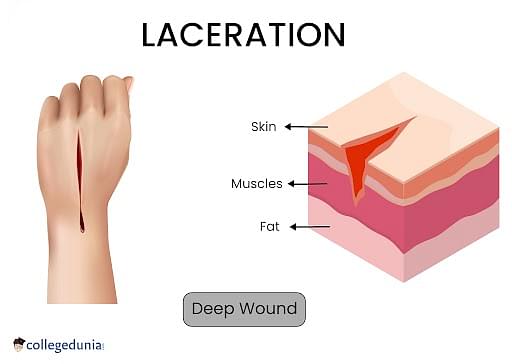
Laceration Diagram
- It typically exhibits uneven or macerated edges, residual skin bridging (especially at the ends), and other characteristics of hard impact damage, such as swelling, reddening and bruising.
- They could appear anywhere on the body. In most situations, there is little tissue damage and few infections.
Also Read:
Laceration Injuries
[Click Here for Previous Year Questions]
The wound is examined for damage to underlying tissues such as bones, joints, tendons, nerves, and blood vessels as well as for the presence of foreign materials or penetration of the bodily cavity (eg, peritoneum, thorax).
One of the biggest mistakes in wound management is failing to notice these complications.
- Sensory or motor abnormalities can happen if a person suffered a laceration wound on the head. Motor skills and senses should be checked to ensure that no damage is done to the eyes.
- Any laceration near a tendon can cause tendon injury leading to a deformity. The damaged area should be checked properly and in case of doubt, it's best to take an ultrasound.
- If the cause or location of the injury is concerning, plain x-rays are taken to rule out a fracture.
- In a laceration wound, it is important to check for any kind of foreign body. Depending on the wound, foreign material can be found inside a wound. Foreign materials are more likely to be present in glass-related wounds. They should be removed properly and carefully to not cause any discomfort or infection.
- If the complete depth of the wound cannot be seen, wound exploration and examination should be done to ensure that there is no underlying issue.
- If a wound is near a joint then it should be examined properly to rule out any harm to the concerned joint with the help of a joint-specialised CT scan.
- Local hair should be trimmed instead of shaved to prevent wound contamination. Eyebrow clipping should be avoided due to uncertain regrowth.
- Blind probing shouldn't be used on wounds because it's unreliable and could lead to further damage.
- A chest x-ray or other imaging study is required for patients with suspected throat lacerations after 4 to 6 hours of observation; any slowly developing pneumothorax should be detectable by then.
Read More: Types of Joints: Functional & Structural Classification
Causes of Laceration Wounds
[Click Here for Sample Questions]
A laceration is an open cut that is generally caused by the skin contacting an object or by an object striking the skin firmly.
- Road rash is an example of an abrasion, which occurs when skin rubs or scrapes against a rough or hard surface.
- When a pointed, lengthy item like a needle or nail punctures the skin, causing the skin to tear. Even a wound from a gunshot might be described as a puncture or laceration wound from the bullet.
- A laceration wound can be caused by a penetration wound in which a sharp instrument cuts the wound both at the point of entrance and exit of a bullet as it enters through the skin. Both puncture and penetrating laceration wounds may not appear to be bleeding, but they are likely to cause internal organ damage, and internal bleeding is more harmful to the human body since it takes longer to heal.
- Another reason for laceration injuries is when there is a partial or total tearing of the skin and the tissue beneath as a result of violent accidents that result in body crushing or when someone is injured in an explosion. An avulsion is a type of laceration wound when both the skin and the tissue underneath are harmed.
Laceration Types
[Click Here for Previous Year Questions]
A tear or break in the skin, mucous membrane, muscle, or internal organs is known as a laceration. Lacerations are caused by the application of blunt force over a large area of the body, crushing or stretching the tissues above their elastic limit.
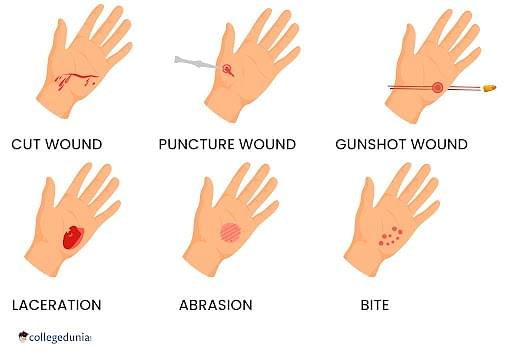
Types of Laceration
The many laceration types are given below:
Contused Laceration
Any bony part of the body that receives a blunt blow is likely to sustain a contusion if the surrounding tissues are quickly and forcefully pushed against the bone. An abraded laceration is another name for a wound when the edges have been worn away.
Split Laceration
This is also known as slit laceration because the skin splits as a result of a slit when it is squeezed between two hard things. Bone, the object itself, or even the surface might be considered hard objects.
Incised Laceration
The edges of this kind of laceration are extremely clean and sharp, and there is no tissue bridging or skin crushing.
People frequently confuse a slit/split laceration as an incised laceration wound, hence a detailed examination is essential. The scalp, brows, forehead, and other areas of the face might be injured.
Cut Lacerations
This is created by a hefty, sharp-edged object crushing and stretching a large region of skin before splitting open in the centre. The tissues bleed as a result of the damage generated by the cut and tear.
Internal damage is also conceivable in addition to tearing of the skin and surrounding tissues, and this possibility increases when the visceral organs are harmed. It results in deadly haemorrhage; damaged temporal arteries may bleed freely; and if blood leaks into voids, it may irritate the area, produce pain, and impair function. A pulmonary or systemic fat embolism could also happen.
Also check:
Treatment for Laceration
[Click Here for Sample Questions]
Laceration treatment aims to achieve hemostasis, prevent infection, restore function to the affected tissues, and produce optimal cosmetic results with minimal scarring.
The treatment for a laceration is determined by what caused it and the depth of the wound. Taking proper care of a wound can help to avoid infection, scarring, and hospitalisation.
Stopping the bleeding
Appropriate laceration treatment is critical to reducing the risk of excessive scar development.
- Hemostasis, or the stopping of bleeding, is the initial stage in the treatment of lacerations. It can be achieved by applying constant manual pressure to the region of damage with sterile gauze.
- Once the bleeding has stopped, the incision can be examined to assess the degree and extent of bone, muscle, tendons, nerves, or blood vessel involvement.
Cleaning up wounds
- The skin around the area and the wound itself is both cleaned.
- Since the subepidermal tissue around the wound is relatively fragile, harsh cleaners (such as full-strength povidone iodine, chlorhexidine, and hydrogen peroxide) and thorough scrubbing should be avoided.
- Although it is not necessary for wound hygiene to remove hair from laceration edges, it can make it simpler to work on places that are noticeably hairy, such as the scalp. Instead of shaving, use electric clippers or scissors to remove unwanted hair if necessary. Shaving causes microtrauma, which invites skin pathogens in and raises the risk of infection.
- Prior to irrigation of the area, hair is trimmed to ensure that any clipped hair that enters the wound is removed. Because the hair-to-skin border is necessary for the proper alignment of wound margins, eyebrow trimming is not done.
Local anaesthetic for the treatment of lacerations
Local anaesthetics that can be injected is frequently employed. In some circumstances, topical anaesthetics are advantageous, particularly when using topical skin adhesives to close wounds on the face and scalp.
- The amide group of local anaesthetics comprises procaine, tetracaine, and benzocaine; the ester group contains the injectable anaesthetics lidocaine and bupivacaine.
- Most frequently, lidocaine is utilised. Bupivacaine has a much longer duration and a little delayed start.
- Epinephrine is typically utilised for wounds in highly vascular areas because vasoconstriction could reduce wound vascularity (and subsequently defences).
Closure of the wound
If the incision is particularly deep or across a joint, it is critical that the wound be properly cleaned and closed. To prevent infection and further spread, tetanus vaccination is recommended. Immediate care is critical; if the wound is deep, it should be closed or sutured within the first 12 hours. And if the wound has been open for a day or more, it is highly likely that it is contaminated.
Stages of Healing
[Click Here for Previous Year Questions]
Even with proper care, a severe wound takes a long time to heal. Let's examine the stages of the healing process, starting with the first injury and ending with complete recovery.
Fresh wounds bleed, and once stopped, the fresh clot seems large and the edges are red, as is the wounded section of the skin.
- The edges are still swollen and red after 12 to 24 hours, but the clot is now covered with lymph and no longer sensitive; instead, it is getting drier.
- After 3-5 days, the edges are still tightly attached to one another and are coated in a dry crust that appears to be drier.
- A new layer of healed skin forms after 6-7 days and the dry crust or scab naturally slips off. It may be easily removed leaving a sensitive, soft, reddish scar.
- After a few weeks, the wound area is more solid but no longer painful. The scar is still white and is trying to blend in with the surrounding skin.
Read Also: Infectious Diseases: Definition, Types, Symptoms and Preventions
Laceration Side Effects
[Click Here for Sample Questions]
When the wound is left unattended, untreated, and even if it is treated at all, the skin may experience some adverse effects that may last a short time or even a long time.
- Infection is possible depending on the bacterial infections.
- Additionally, this results in increased bleeding and subsequent blood loss, which can impair immunity, weaken a person, and delay the healing process.
- Scars that can be shown if neglected over a long period of time.
- Inadequate wound closure may result if someone tries to do it himself as opposed to seeking professional help.
Also check: Human Health and Diseases
Things to Remember
- Laceration is essentially the tearing of the skin due to a deep cut caused by a mishap using a knife or any other sharp instrument.
- In pathology, a fracture is a crack in a bone brought on by stress.
- Due to stress from daily activities and sports, the knee, a rather weak joint, frequently suffers from problems.
- Lacerations may have clean and obvious edges under macroscopy, but not under magnification.
- Lacerations typically have uneven margins because of remaining skin bridging.
Previous Year Questions
- Antibodies in our body are complex..[NEET 2006]
- Antigens are present...[NEET 1995]
- Which of the following is a pair of viral diseases?...[NEET 2009]
- In which disease does mosquito transmitted...[NEET 2018]
- A person likely to develop tetanus is immunized by….[NEET 2009]
- A person suffering from a disease caused by Plasmodium...[NEET 2010]
- The infectious stage of Plasmodium that enters the human body… [NEET 2020]
- In higher vertebrates, the immune system can distinguish….[NEET 2016]
Sample Questions
Ques. What things can lacerate someone? (1 mark)
Ans. Usually, hard things like a pipe, rocks, or the ground produce lacerations. The devitalized tissue from the crushing process may increase the risk of infection as well as affect scarring and wound healing. A sharp edge causes a cut or incised wound, which is typically longer than it is deep.
Ques. What are some of the side effects related to laceration treatment? (2 marks)
Ans. One can suffer from the following side effect if they undergo a laceration wound treatment after wound closure due to poor aftercare.
- Infection
- Bleeding
- Visible scarring
- Inadequate wound closure
- Anesthesia-related allergy
Ques. How Can You Tell If Laceration has Caused an Infection? (3 marks)
Ans. Laceration damage, if left untreated, can result in infection.
- The surrounding area turns red, and this area grows in size with time.
- The region around the wound swells, gets tender to touch or becomes painful.
- The wound leaks an odorous or discoloured fluid; this pus may be yellow, greenish, or hazy.
- Red streaks extending from the wound site.
- The patient gets a fever (particularly if it is higher than 100.4° F).
- The lymph nodes swell.
Ques. Which skin layers are affected by a laceration? (3 marks)
Ans. The tissue layers to be concerned with during skin laceration repair are the epidermis, dermis, and subcutaneous layer:
- The epidermis and dermis are clinically indistinguishable and form the skin when joined together. The strength and alignment of skin closure are provided by dermal approximation.
- The subcutaneous layer is primarily made up of adipose tissue. Here are nerve fibres, blood arteries, and hair follicles. Although this layer adds minimal strength to the repair, sutures inserted in the subcutaneous layer may reduce wound tension and improve visual results.
Ques. What depth is ideal for laceration stitches? (2 marks)
Ans. A laceration is a ripped or jagged wound of varying lengths. /It is advisable to get a cut looked out if it is longer than 1/2 inch or deeper than 1/4 inch since larger or deeper lacerations may need stitches, sutures, or staples to completely shut and securely heal. Stitches will be required to stop the bleeding from a cut this large since it is likely to haemorrhage extensively. That doesn't imply a small wound won't require medical attention, though.
Ques. Explain the type of 2 types of wound healing. (3 marks)
Ans. The two types of wound healing are as follows:
- Primary healing of a laceration happens when the wound is fixed with skin adhesives, tissue tapes, or sutures.
- Secondary healing occurs when a wound is left open to heal through the creation of granulation tissue (a coating of connective tissue and capillaries), and contraction (bringing wound edges closer together).
- Infected wounds usually recover via secondary healing. Delayed primary closure is frequently utilised for lacerations that are not clean enough for primary closure.
Ques. When should you avoid suturing a wound? (5 marks)
Ans. In the following cases, suturing of a wound should be avoided.
- Superficial wounds, such as lacerations or abrasions that only contact the epidermis, are expected to heal without severe scarring. Suturing in these wounds may result in increased scar development and infection risk.
- Lacerations that have been heavily contaminated with foreign material and cannot be totally removed by bedside irrigation and debridement
- Lacerations with considerable tissue loss in which suturing will produce excessive tension across the suture line. In this case, surgical consultation to explore grafting vs secondary intention healing with later scar correction may be a superior strategy.
- Wounds other than cosmetic wounds that are older than 24 hours in individuals with risk factors for infection or poor wound healing (eg, immunocompromise, peripheral vascular disease, or diabetes mellitus), especially when presented from the time of injury, are delayed or the wound site is more prone to infection.
Ques. What effect does a laceration have on your emotions? (3 marks)
Ans. Effect of laceration on a person's emotional well-being.
- Stress, sleep difficulties, poor mood, and social isolation can all be psychological effects of a wound.
- These outcomes could be the result of the wound's physical impacts, such as pain or high amounts of exudate.
- Problems with wound treatment, mobility, and malodor will all have an impact on the patient's psychological well-being.
- Social isolation can also arise when a person lacks energy as a result of sleep loss.
Ques. Explain the process of skin healing after a laceration wound treatment. (5 marks)
Ans. Skin healing occurs in numerous stages, which are listed here and addressed in depth separately.
- Hemostasis - In healthy people, hemostasis and clot formation occur within minutes of superficial skin damage. The fibrin matrix stabilises the wound and acts as the first scaffold for wound healing.
- Inflammation - Inflammation enhances vascular permeability, local vasodilation, and cellular migration and is complete in three days in the absence of infection or other causes of poor wound healing. Polymorphonucleocytes absorb and consume bacteria, foreign particles, and necrotic tissue enzymatically.
- Proliferation: Two days after suturing, endothelial cells from the epithelium's basal cells bridge clean wounds, forming a waterproof barrier. This superficial layer, however, is weak and quickly damaged.
- Remodelling - Around 24 hours after damage, fibroblasts produced from mesenchymal cells proliferate near the wound site. They provide key materials for wound contraction and scar formation, including collagen, by building on the fibrin matrix.
- Collagen creation is required to restore the wound's tensile strength. The process starts 48 hours after the injury and peaks in the first week. Collagen production and remodelling last between Six and Twelve months.
Ques. Describe the types of sutures. (4 marks)
Ans. The suture material is classified into two types:
- Absorbable sutures do not need to be removed since they dissolve in the body and are constructed of either synthetic polymers or natural mammalian collagen. Absorbable sutures dissolve at different rates. Three ties of absorbable suture result in a tight knot (throws).
- Nonabsorbable - Nonabsorbable sutures must be removed after insertion and are constructed of synthetic materials like nylon, polyester, polypropylene, or natural silk. Because synthetic nonabsorbable sutures retain their shape (memory) and do not stick to themselves as tightly during knot tying as absorbable sutures or natural silk, they require up to five ties (throws) to make a secure knot. Synthetic nonabsorbable sutures have superior handling and will stretch to accommodate wound swelling as compared to absorbable sutures. They also come in a range of colours to make suturing and suture removal easier.
Also Check-Out:



Comments