



Content Curator
The layers of the sun can be categorized into two parts: the inner layers and the outer layers. The inner layers of the sun comprise the Core, Radiative Zone, and Convection Zone. The outer layers of the sun comprise the Photosphere, the Chromosphere, the Transition Region, and the Corona.
- The Sun is a star made up of hydrogen and helium gases and is considered the heart of our solar system.
- All the planets that circle this enormous gas ball receive light and heat from it.
- It is composed of several layers, each of which has distinct properties and purposes.
- The outer layers of the sun are those that are situated above the visible surface of the sun, while the internal layers are those that are situated below it.
| Table of Content |
Key Terms: Core of the sun, Radiative zone, Helium, Convection Zone, Nuclear fusion, Chromosphere, Atmosphere, Corona
What is the Sun?
[Click Here for Sample Questions]
The sun is a star at the core of the solar system. All of the planets and other celestial bodies revolve around it. It is a gigantic ball of hot, incandescent gas, and 109 times the size of the Earth.
- The sun makes up more than 99.8% of the Solar System's mass.
- The Sun is a main-sequence star, which means that it is undergoing stable nuclear fusion, which results in the release of enormous amounts of energy in the form of heat and light.
- The temperature of the core of the sun is roughly 15 million degrees Celsius, and it produces a massive quantity of energy, which is the source of all life on Earth.
- The energy of the sun powers the Earth's temperature and weather patterns, as well as providing the light and heat required for photosynthesis in plants.
- The Sun is also a very dynamic entity, with a continually changing magnetic field that causes sunspots, solar flares, and coronal mass ejections.
- These catastrophes can have a tremendous influence on the Earth's ecology, disrupting communication and electricity infrastructure and potentially changing the temperature.
Facts About Sun
[Click Here for Sample Questions]
Some important facts about the sun are:
- The sun is considered to be the biggest object in the solar system.
- The diameter of the sun is 1.39 million kilometers and an estimated age of 4.5 billion years.
- The temperature of the Sun's core is predicted to be more than 15 million K due to constant thermal nuclear processes, whereas the temperature of its surface is around 6000 K.
- The Sun accounts for 99.8% of the total mass of our Solar System.
- The Sun revolves anticlockwise around the Earth.
- It is a massive blazing ball of gases with a rotation period of 25 days and 9 hours.
- It contains around 73.4% hydrogen and 25% helium.
- Since the Sun's magnetic field is so powerful, it encircles the whole Solar System.
- The hydrogen fuel of the sun can last for more than 5 billion years.
Internal Structure of the Sun
[Click Here for Sample Questions]
The interior structure of the sun has three major layers.
- The core
- Radiative zone
- Convection zone

Internal structure of the sun
Each layer is unique and plays a vital part in the Sun's energy production and dynamics.
Core
The core is the deepest layer of the sun, where nuclear fusion events take place.
- It is the hottest region of the sun having a temperature of more than 15 million degrees Celsius.
- The pressure at the core is roughly 250 billion times that of the Earth's atmosphere.
- Because of the extreme pressure and temperature, hydrogen atoms fuse together, producing helium atoms and unleashing a massive quantity of energy in the form of light and heat.
- The energy created in the core is distributed across the other layers of the sun.
Radiative Zone
The radiative zone surrounds the core. This layer stretches from the core to around 70% of the radius of the Sun.
- Radiation transfers energy across the Sun in the radiative zone.
- Light photons are created in the core by fusion processes and travel outward through the thick gas of the radiative zone.
- When they exit the Sun, photons are absorbed and re-emitted multiple times by the gas particles in the zone.
Convection Zone
The convection zone is the outermost layer of the interior of the sun. This layer stretches from approximately 70% of the radius of the Sun to the visible surface, or photosphere.
- Convection transports energy across the Sun in the convection zone.
- Hot gas rises to the top, while colder gas sinks back to the core, resulting in a continually churning action.
- The core structure of the Sun influences its magnetic activity as well. The migration of electrically charged particles in the convection zone produces the Sun's magnetic field.
- The rising and falling of the gas in the convection zone produce large-scale movements that generate the Sun's magnetic field.
- Many of the Sun's dynamic phenomena, including sunspots, solar flares, and coronal mass ejections, are influenced by its magnetic field.
Overall, the interior structure of the sun is a complex and dynamic system that is vital to the star's energy creation and magnetic activity. Knowing the fundamental structure of the Sun is critical for researching its behavior and anticipating its influence on Earth and other planets in the Solar System.
Layers of the Atmosphere of the Sun
[Click Here for Sample Questions]
The Sun’s atmosphere is divided into different layers, each with its unique set of traits and qualities. These are
- The photosphere
- The chromosphere
- Transition area
- Corona
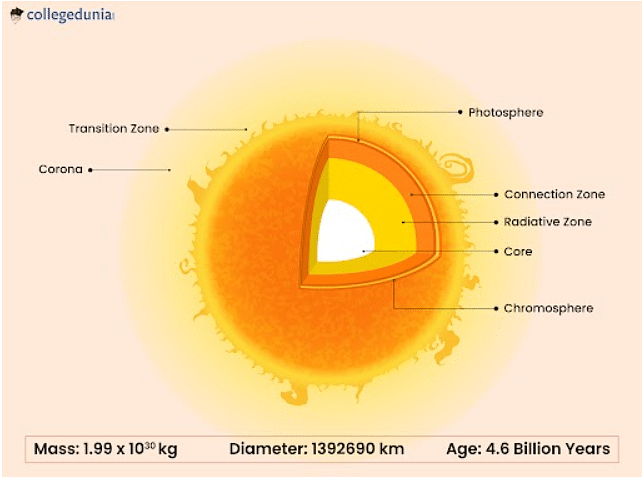
Layers of the sun’s atmosphere
Photosphere
The photosphere is the Sun's visible surface and the layer from which the majority of the Sun's light and heat is released.
- It has a thickness of 500 kilometres and a temperature of about 5,500 degrees Celsius.
- A thick layer of gas, primarily hydrogen and helium, makes up the photosphere.
- As observed from Earth, it appears as a brilliant yellow-orange disc with black patches called sunspots created by magnetic activity on the Sun's surface.
Chromosphere
The chromosphere is a small layer of gas above the photosphere with a temperature of roughly 10,000 degrees Celsius.
- The chromosphere is named after its red hue, which is created by excited hydrogen atoms emitting light.
- The chromosphere also contains gas jets known as spicules, which may reach heights of several thousand kilometres and may contribute to the heating of the Sun's corona.
Transition Region
A small layer of the Sun's atmosphere between the chromosphere and the corona is known as the transition area.
- The temperature rapidly rises from roughly 10,000 degrees Celsius in the chromosphere to several hundred thousand degrees Celsius in the corona.
- The precise mechanisms causing this temperature increase are unknown, although they are considered to be connected to the Sun's magnetic field.
Corona
The corona is the Sun's outermost layer, spanning millions of kilometres into space. It has a temperature of 1-3 million degrees Celsius, which is substantially higher than the photosphere and chromosphere, and it mostly emits X-rays and ultraviolet light.
The corona is also the source of the solar wind, a stream of charged particles emitted by the Sun that affects the Earth's magnetic field and upper atmosphere.
- The magnetic field of the Sun influences the structure and behaviour of the Sun's atmosphere.
- The activity of electrically charged particles in the Sun's centre generates magnetic fields, which can twist and distort as they climb through the atmosphere.
- This can result in the production of sunspots, prominences, and other dynamic phenomena visible on the surface of the Sun.
Apart from the four primary layers of the Sun's atmosphere, there are numerous other factors that influence its structure and behaviour.
- Filaments are black, thread-like structures held above the Sun's surface by magnetic fields, while coronal holes are places of the corona where the solar wind flows faster, resulting in a lower particle density.
- Understanding the Sun's behaviour and forecasting its influence on Earth and other planets in the Solar System requires studying the layers of the Sun's atmosphere.
- Understanding the Sun's behaviour is vital for maintaining our planet and society since its activity may impact Earth's temperature, communications systems, and power grids.
Also Read:
Things to Remember
- The convective zone is the outermost layer of the Sun's interior, characterised by heated gas movement.
- The Sun's atmosphere is divided into various layers, including the photosphere, chromosphere, transition area, and corona.
- The photosphere is the Sun's visible surface, where the majority of its light and heat are emitted.
- The chromosphere is a small layer of gas above the photosphere that has a red hue due to light emission from excited hydrogen atoms.
- The transition area is a thin layer that exists between the chromosphere and the corona and is distinguished by a fast temperature increase.
- The magnetic field of the Sun influences the structure and behaviour of the Sun's atmosphere.
Sample Questions
Ques. What is the Sun's primary source of energy production? (1 Mark)
a) Nuclear fission
b) Nuclear fusion
c) Chemical reactions
d) Gravitational collapse
Ans. The Correct option is (b) Nuclear fusion
Explanation: Nuclear fusion is the principal source of energy generation in the Sun, where hydrogen atoms fuse to make helium, releasing energy in the process.
Ques. What exactly is a sunspot? (1 Mark)
a) A portion of the Sun's surface that is colder and darker than the rest of the planet.
b) A portion of the Sun's surface that really is hotter and brighter than the rest of the planet.
c) An area on the surface of the Sun where nuclear fusion occurs.
d) The location on the Sun's surface from where solar flares originate.
Ans. The Correct option is (a) A portion of the Sun's surface that is colder and darker than the rest of the planet.
Explanation: A section of the Sun's surface that is colder and darker than the rest of the planet. Sunspots are black patches on the Sun's surface that seem dark because they are colder than their surroundings because the Sun's magnetic field prevents hot gas from flowing to those regions. Sunspots are related to the Sun's 11-year magnetic activity cycle and are frequently the location of solar flares and other explosive occurrences.
Ques. What effect do the Sun's activities have on Earth? (2 Marks)
Ans. The Sun's activity, including sunspots, solar flares, and coronal mass ejections, may have a considerable influence on Earth's environment, including variations in the Earth's magnetic field, the ionosphere, and the upper atmosphere. These changes may have an impact on satellite communications, electricity grids, and other Earth-based technology systems.
Ques. What is the difference between solar flares and coronal mass ejections? (2 Marks)
Ans. Solar flares and coronal mass ejections are explosive phenomena on the Sun's surface that cause massive amounts of energy and particles to be sent into space. These can have serious consequences for the Earth's ecology, such as auroras and interruptions to technological systems.
Ques. What distinguishes the radiative zone from the convective zone? (2 Marks)
Ans. The radiative zone is the Sun's layer immediately around the core, where energy is transmitted by photon absorption and re-emission. The convective zone, on the other hand, is the Sun's outermost layer, where hot gas rises and cold gas sinks, generating a revolving flow of material.
Ques. What exactly is the chromosphere, and what can be seen there? (2 Marks)
Ans. The chromosphere is the Sun's layer just above the photosphere. It is significantly hotter than the photosphere and has a reddish hue. The chromosphere contains prominences, which are enormous arches of gas, in addition to spicules, which are close to the end jets of gas that shoot up from the surface.
Ques. What are the layers of the sun called? (3 Marks)
Ans. The core, radiation zone, convection zone, photosphere, chromosphere, and corona are the Sun's six major layers. The core is where nuclear fusion processes transmit energy to the surface. The radiation zone surrounds the core and aids in energy transmission. The convection zone, which is located above the radiation zone, is where hot plasma rises and cooled plasma descends. The photosphere is the visible layer of the sun. The chromosphere is located above the photosphere and is composed of gases that release light when activated by photosphere energy. The corona is the sun's outermost layer, made composed of plasma that has been heated to extreme temperatures.
Ques. How do the Sun's layers interact to generate the Sun's energy output? (3 Marks)
Ans. The Sun's layers collaborate to create the Sun's energy output. Nuclear fusion produces massive amounts of energy in the core, which radiates outward through the convection zone. The heated plasma rises to the surface, bringing the energy with it, into the convective zone. Eventually, the photosphere emits energy in the form of light and heat. By ejecting high-energy particles and magnetic fields into space, the chromosphere and corona contribute to the Sun's energy production. Altogether, the Sun's layers comprise a complicated system that supports life on Earth while also shaping our view of the cosmos.
Ques. How does the Sun generate energy, and what role does nuclear fusion play in this process? (5 Marks)
Ans. The Sun generates energy through a process known as nuclear fusion. This process takes place at the center of the Sun, where the temperature and the pressure are so high that the hydrogen atoms will fuse together to form helium.
The process begins with the conversion of hydrogen into plasma, which is a hot, ionized gas. The temperature and pressure at the Sun's core are thought to be roughly 15 million degrees Celsius. Hydrogen atoms lose their electrons in this environment and become positively charged ions. These ions can then collide with one another and fuse together to generate helium under the correct conditions.
During the fusion process, some of the hydrogen's mass is turned into energy, which is released as light and heat. This energy emanates from the Sun's core and is eventually expelled into space. The Sun is powered by nuclear fusion, which allows it to generate light and heat. The Sun would not be able to sustain itself without this mechanism and would ultimately run out of fuel.
Ques. What causes solar flares and coronal mass ejections, and what impact do they have on the Earth's magnetosphere? (5 Marks)
Ans. Solar flares and coronal mass ejections (CMEs) are both associated with surface activity on the Sun. Solar flares are brief bursts of radiation from the Sun's surface, whereas CMEs are massive ejections of the plasma and the magnetic fields from the Sun's corona.
When magnetic energy that has accumulated in the Sun's atmosphere is abruptly released, solar flares erupt. This energy is released as strong bursts of radiation, such as X-rays and gamma rays. Solar flares may be extremely strong, releasing as much energy as a billion atomic bombs. Coronal mass ejections, on the other hand, are massive plasma and magnetic field eruptions from the Sun's corona. These ejections can span millions of kilometers and carry billions of tonnes of debris. A CME can send a shock wave through the solar system, causing geomagnetic storms on Earth.
Solar flares and CMEs can have a considerable impact on Earth's magnetosphere. As charged particles from all these events reach the Earth, they interact with the planet's magnetic field, generating magnetosphere disruptions.
For Latest Updates on Upcoming Board Exams, Click Here: https://t.me/class_10_12_board_updates
Check-Out:



Comments