



Content Writer
This article provides notes for CBSE Class 10 Metals and Nonmetals which is an important part of the Chemistry syllabus for the Class 10 Board Examination. A thorough revision of the same is necessary to score well in the examination. All these notes are based on the new revised science syllabus of CBSE Class 10 relevant for the board examination.
Physical Properties of Metals
[Click Here for Sample Questions]
- All metals are solid (exception: Mercury, which is liquid at room temperature);
- Metals are lustrous, they have a shiny surface;
- They are good conductors of heat and electricity. [Exceptions- Mercury, and Lead]
- Metals are ductile and hence can be drawn into wires;
- Metals are malleable and hence can be beaten into sheets [Exception- Mercury]
- They have a high density and high melting point barring alkali metals like sodium, lithium, potassium is so soft that it can be cut using a knife;
- Metals are sonorous;
- Silver grey in color. [Exception-gold and copper]
Physical Properties of Non-Metals
[Click Here for Sample Questions]
Nonmetals can be described as those elements which do not display the properties of metals.
- May occur as a solid, liquid, or gas at room temperature;
- Non-sonorous;
- Non-ductile;
- Non-malleable;
- Bad conductors of heat and electricity;
- Brittle
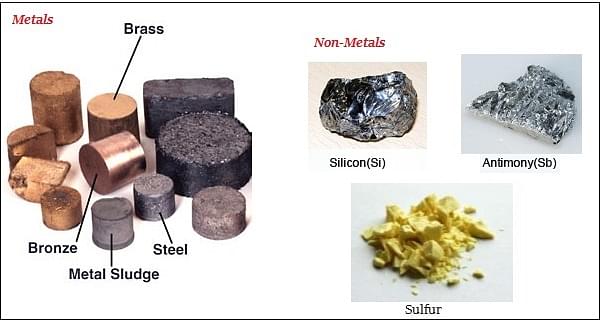
Chemical Properties of Metals
[Click Here for Sample Questions]
- Magnesium reacts with hot water;
- Alkali metals (Na, Li, K, etc.) react vigorously with oxygen/water/air;
- Copper, Silver, Platinum, and Gold do not react with dilute acids and water;
- Aluminum, Zinc, and Iron react with steam.
Reaction of Metals with Oxygen (when burnt in the air)
[Click Here for Sample Questions]
Metal + Oxygen= Metal Oxide (Basic)
- Zn, Pb, Al, Mg react with air slowly to form a protective layer that prevents corrosion.
4Al(s)+3O2(g)→2Al2O3(s)
2Mg(s)+O2(g)→2MgO(s) (Mg burns while emitting a white dazzling light)
- Gold, Silver, or Platinum do not react or burn with air.
- Na and K (Sodium and Potassium) respectively are preserved by immersing them in kerosene oil or else they react aggressively with air and catch fire.
4K(s)+O2(g)→2K2O(s) (vigorous reaction)
Basic Oxides of Metals: There are some metallic oxides which when dissolved in water form alkalis. Their aqueous solution turns red litmus paper blue.
K2O(s)+H2O(l)→2KOH(aq)
Na2O(s)+H2O(l)→2NaOH(aq)
Amphoteric Oxides of Metals: Amphoteric oxides are metal oxides that react with both bases and acids to form salt and water: PbO, Al2O3, SnO,ZnO
- Al2O3(s)+2NaOH(aq)→2NaAlO2(aq)+H2O(l)
- Al2O3(s)+6HCl(aq)→2AlCl3(aq)+3H2O(l)
- ZnO(s)+2NaOH(aq)→Na2ZnO2(aq)+H2O(l)
- ZnO(s)+2HCl(aq)→ZnCl2(aq)+H2O(l)
Differentiate between Metals and Nonmetals
[Click Here for Sample Questions]
A reactivity series is an essential tool, studying it carefully will help students differentiate between metals and nonmetals.
| Metals | Non-metals |
| They are very hard. [Exception- Sodium] | They are very soft. [Exception- Diamond] |
| They are solids are room temperature. [Exception- Mercury] | They exist in all 3 states. |
| They are malleable and ductile. | They are brittle and can break into tiny pieces. |
| They are shiny. | They are non-lustrous. [Exception-Iodine] |
Sample Questions
Ques: Give an example of a metal that is
(a) liquid at room temperature;
(b) Is the best conductor of heat;
(c) Can be easily cut with a knife;
(d) Is a poor conductor of heat; (1 mark)
Ans:
- Mercury is liquid when kept at room temperature.
- Silver is the best conductor of heat.
- Potassium and Sodium can be easily cut with a knife;
- Lead and Mercury are poor conductors of heat.
Ques: What type of ores are typically formed when nonmetals combine with oxygen?(1 mark)
Ans: When non-metals combine with oxygen the same results in the formation of neutral or acidic oxides.
Examples- N2O3 – acidic oxide, CO-neutral oxide
Ques: Which of the following methods is suitable to prevent an iron frying pan from rusting?
(a) Applying paint;
(b) Applying a coat of zinc;
(c) Applying grease;
(d) All the above(1 mark)
Ans: b); Applying a coat of zinc.
Ques: Name two metals that do not corrode easily.(1 mark)
Ans: Platinum and Gold are two metals that do not corrode easily.
Ques: Select which of the following pairs will give displacement reactions?
(a) FeSO4 solution and silver metal
(b) NaCl solution and copper metal
(c) AgNO3 solution and copper metal
(d) MgCl2 solution and aluminium metal(1 mark)
Ans: c) will give a displacement reaction. [Cu(s) + 2AgNO3 (aq) → Cu(NO3)2 (aq) + 2Ag (s)]
Ques: Give reasons for the following- (CBSE 2008)
(a) Carbonate and sulphide ores are usually converted into oxides before reduction during the process of extraction.
(b) Gold and Silver are used to make jewelry.
Ans:
(a) Sulphide ores are converted by heating in the presence of excess air. This process is called roasting. Carbonate and sulphide ores are usually converted into oxides during the process of extraction because extraction of metals is easier from their oxides when compared to their carbonates or sulphides.
(b) Gold and Silver are used for jewelry making because metals that are used in the making of jewelry are always chosen depending on their reactivity. These being highly lustrous metals are resistant to corrosion. Also, they are highly ductile and malleable and can be molded into any shape or form.
Ques: State 3 reasons for the following facts with a chemical equation:
(a) Magnesium is a metal;
(b) Sulphur is a nonmetal;(2 marks)
Ans:
| Magnesium is a metal: | Sulphur is a nonmetal- |
| Malleable and ductile; | Neither malleable nor ductile |
| Good conductor of heat and electricity; | Poor conductor of heat and electricity |
| 2Mg + O2 → 2MgO MgO + H2O→Mg(OH)2 (MagnesiumHydroxide) Magnesium Oxide is basic | S+O2→SO2 SO2 +H2O→H2SO3 (Sulphurous acid) Sulphur dioxide is acidic oxide |
Ques:
(a) An ore on treatment with dilute hydrochloric acid produces brisk effervescence. Write down what type of ore this is and what steps would be required to obtain metals from this enriched ore?
(b) The coin is immersed in silver nitrate solution for some time. Describe the change that will take place in the color of the solution and the coin. Also, write a balanced chemical equation of the appropriate reaction. (CBSE 2014)
Ans: a) The name of the ore is carbonate ore.
The steps required are-
Calcination: Carbonate ore is heated in a limited supply of air and then oxide is obtained, the equation for the same is given below:
ZnCO3 →ZnO + CO2
This is followed by reduction with carbon: wherein oxide ore is heated with carbon
ZnO + C→Zn +CO
b)Copper, being more reactive than Silver, will displace the silver from the silver nitrate solution and there shall be a deposit of silver on the coin. The color of the solution will turn blue.
Ques: Suggest a method for reduction for the following metals during the metallurgical process-
(a) Metal B which tends to give a vigorous reaction even with water and air;
(b) Metal D which is kept in the middle of the activity series;
(c) Metal C is one of the last, second, or third positions in the reactivity.(2 marks)
Ans: (a) Metal B can be obtained by electrolytic induction;
(b) Metal D can be obtained with the help of a reducing agent like Aluminum;
(c) Metal C can be obtained by way of chemical reduction using carbon monoxide or as a reducing agent.
Read more : Important metals and non metals
Ques: Name the following-
(a) A lustrous colored non-metal;
(b) A metal that is a poor conductor of heat;
(c) A metal which is preserved in kerosene;
(d) A metal that will melt at room temperature when kept on a palm;(2 marks)
Ans:
(a) Iodine
(b) Lead
(c) Sodium
(d) Gallium
Previous Year Questions
Ques 1. (a) List in tabular form three chemical properties on the basis of which we can differentiate between a metal and a non-metal.
(b) Give reasons for the following:
(i) Most metals conduct electricity well.
(ii) The reaction of iron (III) oxide [Fe2O3] with heated aluminum is used to join cracked machine parts. (2019)
Ans. a. Three chemical properties on the basis of which we can differentiate between a metal and a non-metal are:
| Metal | Non-Metal |
| They react with oxygen to form the primary oxides. | On reacting with the oxygen they give rise to acidic or neutral oxides. |
| On reacting with water they give rise to hydroxides and hydrogen gas. | Non-metals don’t react with water. |
| Except for sodium, calcium and potassium metals do not combine with hydrogen. | As a reaction between non-metals and hydrogen, they form covalent hydrides. |
- (i) Most metals are good conductors of electricity because of the electrons present within the metal. These electrons move freely as a result of which when minimum electricity passes through the metals those free electrons take the electricity and transfer it throughout the metal.
(ii) Fe2O3 (s) + 2AI (s) → AI2O3 (s) + 2Fe (I) + Heat
It is called as the thermite reaction
This reaction is said to be an exothermic reaction and generates a huge amount of heat because of which iron metal is produced in molten form and used for joining the cracked parts.
Ques 2. Given reasons:
(a) Platinum, gold, and silver are used to make jewelry.
(b) Metals like sodium and potassium are stored under oil. (Outside Delhi 2019)
Ans. a. Platinum, Gold, and Silver are used to make jewelry because of their metallic luster.
- Metals like sodium and potassium are stored under oil due to its high reactivity nature when it comes in contact with oxygen. Thus to avoid this they are kept under oil.
Ques 3. Silver articles become black when kept open for some time, whereas copper vessels lose their shiny brown surfaces and gain a green coat when kept in open. Name the substances present in the air with which these metals react and write the name of the products formed. (Outside Delhi 2019)
Ans. Silver articles become black when kept open for some time, whereas copper vessels lose their shiny brown surfaces and gain a green coat when kept open because silver articles when comes in contact with hydrogen compounds present in air such as hydrogen sulfide it forms Silver sulfide (Ag2S). Whereas copper reacts with carbon dioxide slowly and H2O present in the air makes a green coating of a mixture of copper hydroxide and copper carbonate.
Ques 4. (a) Write the steps involved in the extraction of pure metals in the middle of the activity series from carbonate ores.
(b) How is copper extracted from its sulfide ore? Explain the various steps supported by chemical equations. Draw labeled diagram for electrolytic refining of copper. (2018)
Ans. a. In the absence of air, first of all, the carbonate ore of the metal is heated and this process is known as calcination.

- Through the process of roasting, copper is separated from the sulfide ore and it is done in the presence of air.



Comments