



Content Writer
Chemical properties of metals are important to understand the nature of the metal. The elements that are present around us are metals and nonmetals. Therefore, understanding whether a specific element is a metal or nonmetal is crucial. Metals and nonmetals are additional categories for materials. High electrical and thermal conductivity is a defining attribute of metals like aluminum and copper, whereas insulators like sulphur and phosphorus metal are found in nonmetals. Based on their qualities, elements are classified as metals or nonmetals.
Read more: Phosphorus cycle
| Table of Content |
KeyTerms: Metal, Non - metals, Acid, Water, Oxygen, Salts, Elements, Alkaline
Metals and Non-metals
[Click Here for Sample Questions]
The simplest type of matter that cannot be divided into or constructed from simpler substances using regular chemical or physical processes is called an element. Both metals and nonmetals are vital components of our daily life. The majority of the elements in the periodic table are metals. These include alkali metals, actinides, transition metals, lanthanides, and metals from the alkaline earth.
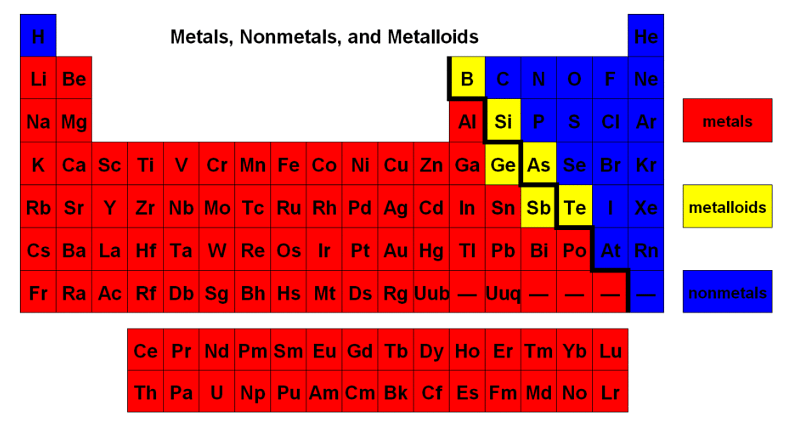
Periodic table
These types of elements and the elements in the modern periodic table to their right are both nonmetals. Semimetals or metalloids are the elements that are just to the left of the line. These will combine the characteristics of metals and nonmetals.
The periodic table only contains a relatively small number of nonmetals. These can be found on the periodic table's right side. Sulphur, carbon, phosphorus, all halogens, hydrogen, oxygen, nitrogen, selenium, and noble gasses are elements connected to nonmetals. Nonmetals are positioned in the periodic table to the right of metalloids and left of halogens. Halogens and noble gasses are both nonmetals, hence non-metals frequently refer to them as non-metals.
What are Metals?
[Click Here for Sample Questions]
The electropositive element that has a propensity for donating electrons, forming positive ions, and being stable is metal. For instance:
Na → Na+ + e–
In general, metals have specific distinct physical characteristics that make them simple to recognise and categorize.
Among metals' primary physical characteristics are;
- They appear metallic and have luster.
- At room temperature, they are often in the form of a solid.
- They are excellent heat and electricity conductors.
- Metals are ductile and malleable.
- Most of them have an extremely high melting point.
Reaction Of Metal
[Click Here for Sample Questions]
With Oxygen
Metal oxides are created when metals and oxygen react. Metal oxides are created when metals provide oxygen with electrons. For instance,
4K + O2 → 2 K2O
Metal oxides can be amphoteric or basic in nature, albeit the former is more common. Amphoteric oxides denote both acidic and basic properties. Oxygen and some metals, such as sodium and potassium, react violently. Anytime sodium or potassium is in contact with air, it ignites. As a result, they are stored in kerosene.
With Water
While certain metals do not react with water, some do to generate metal hydroxide. Each metal has a unique water reactivity.
Metals with high reactivity include salt and potassium. They combine with water to create alkalis like sodium and potassium hydroxides.
2Na + 2H2O → 2NaOH + H2
Water and calcium can also combine to create calcium hydroxide and hydrogen.
Ca + 2H2O → Ca (OH)2 + H2
Zinc and magnesium do not react with cold water, however. When they interact with hot water, they each produce their own oxides.
Mg + H2O → MgO + H2
Compared to sodium, potassium, calcium, zinc, and magnesium, iron is less reactive. It does not react with hot or cold water, but instead forms magnetic oxides when combined with steam.
3Fe + 4H2O → Fe3O4 + 4H2
With Dilute Acids
Strong reactions occur between diluted HCl and H2SO4 and metals like sodium, potassium, lithium, and calcium to produce their metal salts and hydrogen.
While lead, zinc, iron, tin, magnesium, and zinc do not react strongly with acids.
Mg + HCl → MgCl2 + H2
Fe + H2SO4 → FeSO4 + H2
In the reactivity series, metals that follow hydrogen do not react with dilute acids. They are unable to bind with a non-metal anion via displacing hydrogen.
With Other Metal Salts
More reactive metals can be combined easily with less reactive metals. The less reactive metal is forced out of its oxides, chlorides, or sulphurised by the more reactive metal.
Zn + CuSO4 → ZnSO4 + Cu
The arrangement of metals is determined by their electrode potential. The series for electrochemistry is displayed below.
Read more:
| Relevant Concepts | ||
|---|---|---|
| Mercuric Chloride | Magnesium Phosphate | Hydrogen Bonding |
| Classification of Oxides | Change of State | Alkanes |
Chemical Properties
[Click Here for Sample Questions]
Metals
The following is a list of a few nonmetals' chemical properties.
- In general, metals have a high density.
- Metals are ductile and malleable.
- Alloys are produced when metals are combined with nonmetals or other metals.
- Some metals rust when exposed to air, for example iron.
- Metals are efficient heat and electrical conductors. The one exception is lead.
- At normal temperature, metals often exist in a solid state. excluding mercury. Mercury is liquid at this time.
- Oxygen in the air causes the combustion of many metals, forming metal oxide. Highly reactive metals react violently when burned in oxygen.
- Metals that react fast with oxygen, such as salt and potassium, are held in oil. They are metals with strong reactivity.
- Metals with lower reactivity, such as platinum, gold, and silver, don't tarnish as quickly.They continue to shine and glisten.
- Metal oxide and hydrogen gas are created when metals and water interact. Metal hydroxide is created when water and soluble metal oxides are combined.
- Some metals do not react with water. However, when highly reactive metals like sodium and potassium combine with water, a strong reaction occurs and an exothermic reaction occurs, igniting the hydrogen.
- In the event that a metal and an acid combine, salt and hydrogen are created. A metal frequently takes the place of a less reactive metal in a metal salt solution.
Non – Metal
The following is a list of a few nonmetals' chemical properties.
- Nonmetals are poor heat and electrical conductors. The exceptions are graphite and gaseous carbon.
- Nonmetals lack the malleability and ductility of metals. Metals and nonmetals respond differently from one another.
- High temperatures are frequently used in the reactions between nonmetals.
- The majority of nonmetals do not react with air at ambient temperature.
- White phosphorus is the only nonmetal that burns when it reacts with air to form its oxide.
- Nonmetals typically don't react with water. The only element other than chlorine that does not dissolve in water to form an acidic solution is chlorine.
- Nonmetals are not very dense. None of them produce alloys. However, nonmetals like silicon, phosphorus, and carbon.
- At room temperature, nonmetals can be found in all known states of matter.
- Different nonmetals respond in various ways.
- In the halogen family, which consists of chlorine (Cl), bromine (Br), iodine (I), and fluorine (F), chlorine is the most reactive metal (F). The halogen family's reactivity hierarchy is Cl > Br > I.
- Therefore, in solutions of bromides (NaBr) and iodides, chlorine (Cl) can replace bromine (Br) and iodine (I) (NaI).
- Ionic solids are produced when high electronegativity nonmetals interact with alkali and alkaline earth metals.
Reaction Of Non - Metal
[Click Here for Sample Questions]
With Oxygen
When non-metals and oxygen interact, non-metal oxides are produced. Non-metal oxides can have corrosive or acidic properties.
Sulphur dioxide is produced when sulphur and oxygen interact.
S + O → SO2
Sulphuric acid is created when sulphur dioxide and water combine.
SO2 + H2O → H2SO3
With Water
While non-metals do not react with water, they do so vigorously with air. Many of the non-metals are therefore submerged in water for storage. For instance, phosphorus, one of the highly reactive nonmetals, reacts vehemently with air but is prevented from coming into contact with the atmosphere while submerged in water.
Difference Between Chemical Properties of Non-metals and Metals
[Click Here for Sample Questions]
The major difference between chemical properties of nonmetals and metal are:
| Metals | Non - Metals |
|---|---|
| Metals are prone to corrosion. | Nonmetals are resistant to corrosion. |
| They have a valence shell with 1, 2, or 3 electrons. They can therefore quickly lose electrons. | Nonmetals have valence shells with more than four electrons. They can get electrons with ease. |
| The primary oxides are made of metals. | Oxides of acid are created. |
| They have electropositive makeup. | These are inherently electronegative. |
| These work well as reducing agents. | They are excellent oxidizers. |
Things to Remember
- Lead is the only metal that does not transfer heat and electricity well.
- All other metals, with the exception of Mercury, are typically solid at room temperature. Mercury, however, is a liquid substance.
- More metals burn in the air's oxygen to generate metal oxide. Metals that are highly reactive react violently when burned in oxygen.
- Compared to metals, nonmetals have a lower density. Alloys do not form with nonmetals. Some elements, including silicon, phosphorus, and carbon, can form.
- Nonmetals are present in all states of matter at normal temperature.
Sample Questions
Ques. What ingredients make up solder alloy? What about solder makes it appropriate for joining electrical wires? (1 mark)
Ans. Lead and aluminum combine to form the solder alloy. It is ideal for welding electrical cables due to its low melting point.
Ques. Why should the metal carbonates and sulphides be changed into metal oxides during the metal extraction process? (1 mark)
Ans. Metals are extracted from metal sulphides and metal carbonates by converting them to metal oxides since obtaining metals in their oxide form is simpler than sulphide or carbonate form.
Ques. Which of the following metals exhibits poor heat and electrical conductivity? (1 mark)
(a) Lead
(b) Gold
(c) Iron
(d) Zinc
Ans. The correct answer is option (a) Lead. As lead conducts heat and electricity poorly.
Ques. Which of the following statements about magnesium metal is false? (1 mark)
(a) It emits a brilliant white flame when burning in oxygen.
(b) It produces hydrogen gas when it combines with cold water to create magnesium oxide.
(c) It produces hydrogen gas when it combines with hot water to create magnesium hydroxide.
(d) It produces hydrogen gas when it combines with steam to create magnesium hydroxide.
Ans. It produces hydrogen gas when it combines with cold water to create magnesium oxide.
Ques. Oxygen and an element combine to form a compound with a high melting point. Additionally soluble in water is this substance. The component is probably (1 mark)
(a) Calcium
(b) Carbon
(c) Silicon
(d) Iron
Ans. Correct answer is Calcium.
Oxygen and calcium react to form calcium oxide. Calcium Hydroxide is produced when calcium oxide is dissolved in water. Option B is incorrect because carbon reacts with oxygen to generate carbon-oxide, which is a gas. Oxygen and silicon react to generate silicon dioxide. This cannot dissolve in water. Option C is therefore incorrect. Iron dioxide is created when iron and oxygen react. This cannot dissolve in water. Option D is therefore incorrect.
Ques. For the reactions of, create equations for (3 marks)
(i) a steam irons
(ii) water mixed with calcium and potassium
Ans. (i) Steam and iron react, releasing H2 and creating a magnetic oxide of iron.
3Fe(s) + 4H2O(g) → Fe3O4(s) + 4H2(g)
(ii) Calcium hydroxide and hydrogen are produced when calcium combines with water.
Ca(s) + 2H2O(I) → Ca (OH)2(aq) + H2(g)
Potassium strongly reacts with cold water right away, generating H2 that ignites.
2K(s) + 2H2O(I) → 2KOH (aq) + 2H2(g)
Ques. Electrolytic refining is used to achieve pure metals during the extraction of metals. (3 marks)
(a) Which substance will be used as the anode and cathode for this procedure of purifying silver metal?
(b) Also, suggest an appropriate electrolyte.
(c) Where do we get pure silver after running an electric current through this electrolytic cell?
Ans.
- Impure metal will be utilized as an anode during the extraction process, and pure metal will be employed as a cathode to refine silver metal electrolytically.
- either silver nitrate or silver sulphate
- On the cathode, pure silver is produced.
Ques. Describe what ductile and malleable mean as well. Give an illustration of a metal that (5 marks)
(i) Is a liquid warm enough to drink?
(ii) Knife-cuttable with ease?
(iii) Is the best heat conductor?
(iv) Is it a bad heat conductor?
Ans. Malleable metals are those that can be pounded into sheets. Ductile metals are those that can be pulled into thin wires.
(i) The metal that is liquid at normal temperature is mercury.
(ii) The only metals that can be sliced with a knife are sodium and potassium.
(iii) The best heat conductor is silver.
(iv) Lead and mercury are poor heat conductors.
Ques. Give reasons (7 marks)
(a) Jewelry is made from platinum, gold, and silver.
(b) Oil is used to store lithium, potassium, and sodium.
(c) Despite being a highly reactive metal, aluminum is utilized to create cooking utensils.
(d) During the extraction process, oxides are typically formed from carbonate and sulfuric ores.
Ans.
- Jewelry is made from platinum, gold, and silver since these metals have a very low level of reactivity. They are therefore unaffected by air, water, or the majority of chemicals. These metals are highly corrosion resistant, malleable, and lustrous in addition to being malleable and ductile in nature.
- (b) Lithium, sodium, and potassium easily combine with water to generate a lot of heat. As a result of the reaction's hydrogen evolution, a fire results. They react with atmospheric moisture (water droplets) when exposed to water in order to avoid coming into touch with it. As a result, these metals are kept underneath oil.
- Aluminum develops an oxide-coated surface that is nonreactive. This coating stops other substances from interacting with aluminum. So, cooking utensils are made using aluminum.
- It is simple to convert metal oxide into free metal. Additionally, the carbonate and sulphide ores are first converted to oxides in order to access the metals because it is simpler to obtain the metals directly from their oxides also than from their carbonates or sulphides.
Ques. Justify the following (7 marks)
a) Al becomes less reactive when dipped in HNO3.
b) Na or Mg oxides cannot be reduced by carbon.
c) NaCl does not conduct electricity when it is in the solid state, but it does so when it is molten and in aqueous solution.
d) Iron objects receive galvanization.
e) In nature, metals such as Na, K, Ca, and Mg are never discovered in their free state.
Ans.
- Aluminum becomes less reactive when dipped in HNO3, as HNO3 is a potent oxidizing agent. Here, an oxide coating of aluminum is formed, which lessens the aluminum’s reactivity.
- (b) Because Na and Mg are very reactive metals, carbon cannot reduce their oxides. Compared to carbon, oxygen has a stronger affinity for Na and Mg. As a result, carbon is unable to decrease the Na and Mg oxides.
- Because NaCl is an ionic molecule, electricity can flow through it in both the liquid and molten states even though it is not an electrical conductor in the solid form. Ionic compounds cannot conduct electricity when they are solid, but they can do so when they are dissolved in water or molten.
- Rust is created when iron and oxygen in the air react. Iron is galvanized to prevent rusting.
- Highly reactive metals include Na, K, Ca, and Mg. They can combine with practically any element to generate compounds. They are not present in nature in their original form as a result.
Check out:



Comments