



Content Writer
A number chart refers to a list of numbers written in a sequential order. It helps students identify patterns within the numbers.
- Numbers are necessary to understand any concept as they play a significant part in mathematics.
- The pattern in number charts could be in the form of even numbers, odd numbers, or counting by fives, tens, etc.
- Students are introduced to numbers starting at the elementary school level in order to help them comprehend patterns.
- For children at this stage, we provide various number charts so they may quickly learn how to count to ten.
- It is used for developing basic skills in addition and subtraction.
| Table of Content |
Key Terms: Number Chart, Prime Number, Natural Number, Odd Number, Composite Number, Pattern, Even Number Chart, Types of Numbers, Number Chart in Words
What is a Number Chart?
[Click Here for Sample Questions]
A number chart refers to a table that lists the numbers in numerical order. In the first line, the order will be 1–10; in the second, 11–20; in the third, and so forth.
- Different types of specific number charts are possible; for example, hundred charts, which display the numbers 1 through 100.
- Students can discover patterns in the numbers and learn to recognise numerals and their numerical sequence with the aid of these charts.
- For instance, counting in fives, tens, even and odd numbers, etc.
- Certain number charts might merely have written digits, or they might have integers together with an image showing how many things correspond to each digit.
- A list of whole numbers or natural numbers is not a requirement for a number chart.
- It could be a list of odd, even, or mixed numbers.
Example of Number ChartExample 1: Examine the following numerical chart to determine its pattern.
Ans: As indicated in the number chart, the required numbers are 9,18,27,36,45,54,63,72,81,90 and 99.
Example 2: Label the provided number chart and write the missing numbers.
Ans: Zero is the ones digit for every number. Moreover, there is a ten-point gap between any two successive integers.
|

Also Read:
| Related Articles | ||
|---|---|---|
| Irrational Number | Difference Between Area and Perimeter | Number System |
| Natural Numbers | Decimal to Hex Numbers | Addition and Subtraction of Integers |
Types of Number Chart
[Click Here for Sample Questions]
Children can detect number patterns with the use of several kinds of number charts. Here are the several kinds of number charts:
Even Number Chart
Even number charts include numbers that can be divided by 2. For instance, it may include 2, 4, 6, and 8 and so on.
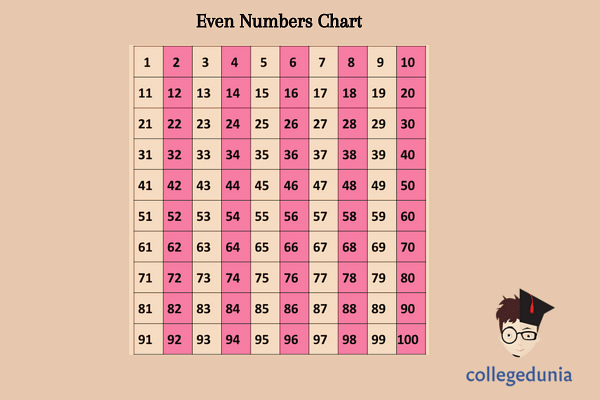
Even Number Chart
Odd Number Chart
Odd Number Chart includes numbers that cannot be divided by 2. For instance, it may include 1, 3, 5, 7, and so on.
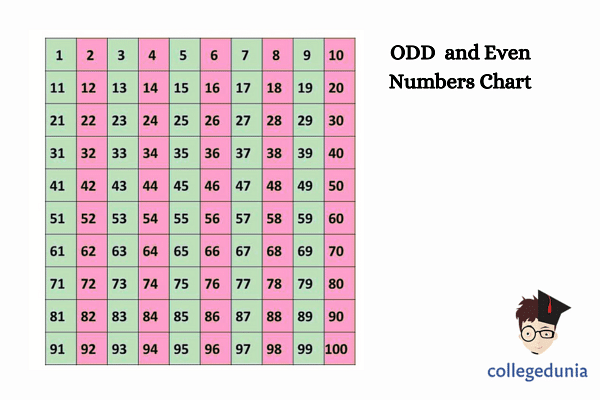
Odd Number Chart
Prime Number Chart
Prime Number Chart includes a number that has two factors, which are 1 and the number itself. It may include 2, 3, 5, 7, and so on.
- It can be noted that the numbers 0 and 1 are not included in the prime number.

Prime Number Chart
Composite Number Chart
The composite number chart includes numbers that are not prime. It consists of more than two components.
- Composite numbers may include 4, 6, 8, 9, and so on.
- It must be noted that 0 and 1 should not be included in these numbers list.

Composite Number Chart
Natural Number Chart
Natural numbers are employed in ordering and counting. These numbers begin at 1. They don't contain 0.
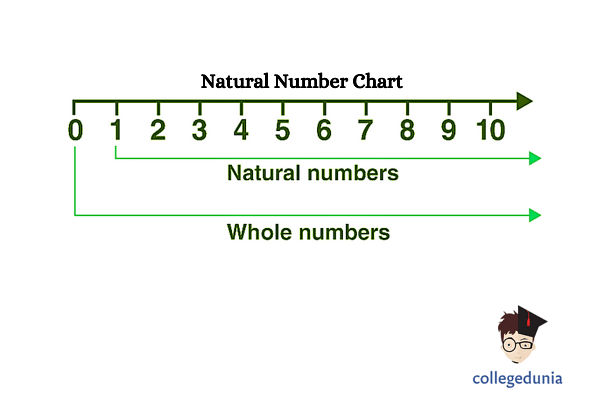
Natural Number Chart
How to make a Number Chart?
[Click Here for Sample Questions]
A number chart can be formulated by following several steps, which may include:
Selecting the pattern and range
Choose the range of values that you wish to display in your chart. You could decide to make a chart with the numbers 1 through 100 or a chart with multiples of 6 between 1 and 100.
Making grid
Using a computer tool or pen and paper, draw a grid. Using the range that you have selected, divide the grid into rows and columns. Put the proper headings on the rows and columns.
Filling the numbers
Start filling in the numbers in the first row and work your way across the columns in numerical sequence. For instance, the numbers 1 through 10 might be in the first row, 11 to 20 in the second, and so forth.
Labelling chart
Give your number chart a title that describes the range of numbers. This aids visitors in comprehending the chart's goal.
Number Chart in Words
[Click Here for Sample Questions]
It is feasible to write the numbers in words so that reading the numbers would be simple to comprehend.
- The following chart displays the numerical values in words, ranging from 1 to 20, along with the corresponding words.
- It can be written for all the natural numbers based on the place value of digits, such as ones, tens, hundreds, thousands, and so on.
- Similarly, students can write the numbers from 101 to 1000 in words.

Number Chart in Words
List of Numbers in Words (1 to 100)
The list of numbers in words from 1 to 100 are as follows:
| 1 | One | 21 | Twenty-one | 41 | Forty-one | 61 | Sixty-one | 81 | Eighty-one |
| 2 | Two | 22 | Twenty-two | 42 | Forty-two | 62 | Sixty-two | 82 | Eighty-two |
| 3 | Three | 23 | Twenty-three | 43 | Forty-three | 63 | Sixty-three | 83 | Eighty-three |
| 4 | Four | 24 | Twenty-four | 44 | Forty-four | 64 | Sixty-four | 84 | Eighty-four |
| 5 | Five | 25 | Twenty-five | 45 | Forty-five | 65 | Sixty-five | 85 | Eighty-five |
| 6 | Six | 26 | Twenty-six | 46 | Forty-six | 66 | Sixty-six | 86 | Eighty-six |
| 7 | Seven | 27 | Twenty-seven | 47 | Forty-seven | 67 | Sixty-seven | 87 | Eighty-seven |
| 8 | Eight | 28 | Twenty-eight | 48 | Forty-eight | 68 | Sixty-eight | 88 | Eighty-eight |
| 9 | Nine | 29 | Twenty-nine | 49 | Forty-nine | 69 | Sixty-nine | 89 | Eighty-nine |
| 10 | Ten | 30 | Thirty | 50 | Fifty | 70 | Seventy | 90 | Ninety |
| 11 | Eleven | 31 | Thirty-one | 51 | Fifty-one | 71 | Seventy-one | 91 | Ninety-One |
| 12 | Twelve | 32 | Thirty-two | 52 | Fifty-two | 72 | Seventy-two | 92 | Ninety-two |
| 13 | Thirteen | 33 | Thirty-three | 53 | Fifty-three | 73 | Seventy-three | 93 | Ninety-three |
| 14 | Fourteen | 34 | Thirty-four | 54 | Fifty-four | 74 | Seventy-four | 94 | Ninety-four |
| 15 | Fifteen | 35 | Thirty-five | 55 | Fifty-five | 75 | Seventy-five | 95 | Ninety-five |
| 16 | Sixteen | 36 | Thirty-six | 56 | Fifty-six | 76 | Seventy-six | 96 | Ninety-six |
| 17 | Seventeen | 37 | Thirty-seven | 57 | Fifty-seven | 77 | Seventy-seven | 97 | Ninety-seven |
| 18 | Eighteen | 38 | Thirty-eight | 58 | Fifty-eight | 78 | Seventy-eight | 98 | Ninety-eight |
| 19 | Nineteen | 39 | Thirty-nine | 59 | Fifty-nine | 79 | Seventy-nine | 99 | Ninety-nine |
| 20 | Twenty | 40 | Forty | 60 | Sixty | 80 | Eighty | 100 | Hundred |
Number Chart in Pattern
[Click Here for Sample Questions]
Numerous patterns, including even, odd, prime, and so on, can be seen in number charts. The even numbers in the picture below range from 1 to 100; odd numbers should be placed in the blank spots.
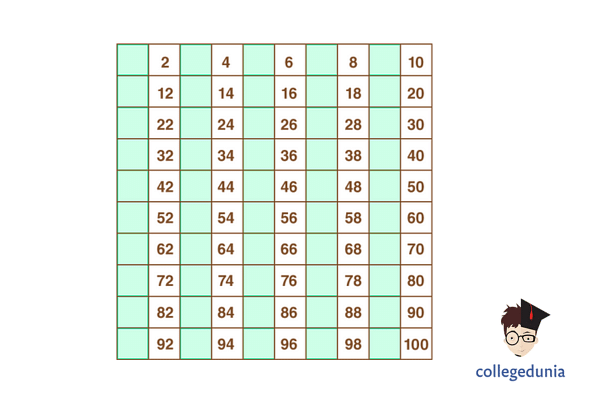
Number Chart in Pattern
Things to Remember
- Number charts offer a graphical depiction of numerical relationships and patterns.
- Numerous formats, including tables, grids, and interactive digital versions, are available for the representation of these charts.
- Addition, subtraction, and skip counting can all be taught using a number chart.
- It is used to identify the order of numbers along with the patterns that are followed between the numbers.
- Even numbers, odd numbers, composite numbers, prime numbers, and natural numbers are different types of number charts.
Sample Questions
Ques. What distinguishes a place value chart from a number chart? (3 marks)
Ans. A chart that presents a list of numbers in an orderly fashion is called a number chart. Whole numerals, for instance, are written as 0, 1, 2, 3, 4, and so forth. In contrast, the value of each digit in the number is determined using the place value table.
Ques. Describe a number chart? (2 marks)
Ans. A list of numbers displayed in a methodical order is called a number chart. In a grid, counting numerals, for instance, could be written as 1, 2, 3, 4, 5, and so forth.
Ques. How can a place value chart be created? (5 marks)
Ans. Using the following procedures, we may create a place value chart:
Step 1: Create columns that represent various time intervals, such as ones, thousands, and so on, based on the type of number system. To create an Indian place value chart for nine places, for instance, we would draw four columns representing the four periods: ones, thousands, lakhs, and crores.
Step 2: To illustrate the various place values, such as ones, tens, hundreds, thousands, ten thousands, and so forth, we draw sub-columns beneath each period.
Step 3: We include ones, tens, and hundreds under the period of Ones. Next, we include the thousand and ten thousand under the thousands period.
Step 4: Next, we list lakh and ten lakh under the lakhs period. Lastly, we list crore and ten crores under the crores period.
Ques. How can a Number Chart be used? (2 marks)
Ans. We utilize a number chart to help us understand numbers better. We decipher its numerical sequence and pattern. For instance, all even numbers are arranged starting at 2 in the even number chart. As a result, we can quickly find the missing numbers using that information and apply the generalisation of the rule to get the following number in the chart.
Ques. What is a chart of hundreds? (2 marks)
Ans. One hundred is represented by a hundreds chart. It's a numerical grid with numbers ranging from 1 to 100 placed in numerical order.
Ques. How can a number chart be made? (4 marks)
Ans. The steps are as follows:
Step 1: Create a 10 × 10 grid.
Step 2: Begin writing the numbers in the first block, beginning with 1. Continue writing the numbers that follow in a horizontal fashion. ...
Step 3: Enter the numbers as precisely and cleanly as you can.
Step 4: Write the numbers down and read aloud.
Ques. Create a number chart that illustrates the pattern of skip counting by four? (3 marks)
Ans. The following numerals are highlighted to show skip counting by fours:
16, 20, 24, 28, 32, 36, 40, and so forth.

Illustrates the pattern of skip counting by four
Ques. What is a chart of prime numbers? (2 marks)
Ans. A chart that displays solely prime numbers is known as a prime number chart. Prime numbers are ones that have just one divisor, the number itself, and 1. Prime numbers include, for instance, 2, 3, 5, 7, 11, and so on.
Ques. How to Write 156 in Words? (3 marks)
Ans. To write 156 in words, we shall use the place value chart. In the place value chart, write 1 in the hundreds, 5 in the tens, and 6 in the ones, respectively. Now let us make a place value chart to write the number 156 in words.
| Hundreds | Tens | Ones |
|---|---|---|
| 1 | 5 | 6 |
- Thus, we can write the expanded form as
- 1 × Hundred + 5 × Ten + 6 × One
- 1 × 100 + 5 × 10 + 6 × 1
- 100 + 50 + 6
- 156
- One hundred fifty-six.
Ques. What are numbers in the Indian System? (2 marks)
Ans. In the Indian Numbering System, numbers will be named from the place value, which goes as Ones, Tens, Hundreds, Thousands, Ten Thousand, Lakhs, Ten Lakhs, Crore, Ten Crore and so on. It can be summarized as follows:
| Numbers | Names |
|---|---|
| 1 | Ones |
| 10 | Tens |
| 100 | Hundred |
| 1,000 | Thousand |
| 10,000 | Ten Thousand |
| 1,00,000 | Lakh |
| 10,00,000 | Ten Lakh |
Ques. Write 174 , 96465 and 88990 in words? (3 marks)
Ans. 174: One hundred and Seventy Four
- 96465: Ninety Six Thousand Four hundred and Sixty Five
- 88999: Eighty Eight Thousand Nine Hundred and Ninety
For Latest Updates on Upcoming Board Exams, Click Here: https://t.me/class_10_12_board_updates
Check-Out:



Comments